
Moxin Technology Launches MoWorld: A 50FPS Interactive World Model Running on Domestic NPUs
Moxin Technology has released MoWorld, an interactive world model achieving over 50 FPS on domestic Chinese NPUs. This development offers a 70 percent cost reduction compared to GPU solutions, shifting the hardware supply chain for embodied AI.
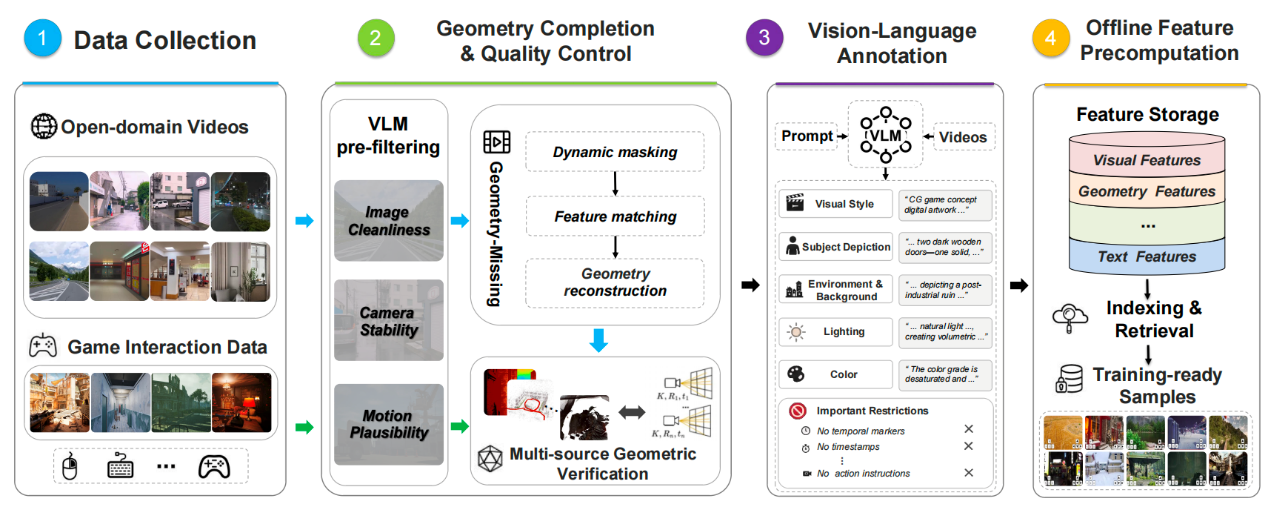
While the global artificial intelligence industry remains fixated on securing scarce, high-cost GPU clusters for training spatial intelligence, a Chinese startup is quietly shifting the hardware paradigm by optimizing for local silicon.
What is the MoWorld release and how does it impact the market?
Moxin Technology has launched MoWorld, an interactive world model capable of exceeding 50 frames per second on domestic Chinese Neural Processing Units. This release significantly reduces deployment costs by 70 percent compared to equivalent GPU solutions, offering a new supply chain alternative for embodied AI and spatial simulation.
The Core Facts of the MoWorld Release
On July 8, 2026, reports confirmed that Moxin Technology released MoWorld, an interactive world model designed for embodied AI training, autonomous driving, and robotics spatial simulation. The underlying research paper detailing the architecture was submitted to arXiv on July 7, 2026. The defining technical achievement of MoWorld is its ability to run efficiently on domestic Chinese Neural Processing Units. On this local hardware, the model achieves an inference speed that exceeds 50 frames per second.
By optimizing the model for domestic NPUs rather than relying on imported GPUs, Moxin claims to have reduced deployment costs to approximately 30 percent of comparable GPU solutions. This effectively represents a 70 percent cost reduction for developers and enterprises deploying spatial intelligence. Beyond robotics and autonomous driving, the company is targeting applications in game and interactive entertainment, film creation, digital twins, and 3D reconstruction. The release introduces a viable, cost-effective alternative in a market previously constrained by the availability and pricing of advanced graphics processing units. The ability to generate high-fidelity interactive environments at such speeds on domestic silicon marks a significant technical milestone for the company.
Shifting the Hardware Dependency in Spatial Intelligence
The reliance on imported GPUs has long been a structural vulnerability for companies developing embodied artificial intelligence and autonomous systems. High hardware costs and restricted supply chains have created significant barriers to entry for startups and research institutions attempting to build large-scale spatial simulations. The introduction of MoWorld changes this dynamic by proving that high-performance interactive world models can operate efficiently on domestic Neural Processing Units.
This development is particularly relevant for the supply chain of artificial intelligence hardware. By demonstrating that 50 frames per second inference is achievable without relying on the dominant global GPU providers, Moxin Technology is providing a blueprint for hardware independence. For hardware manufacturers, this signals a shift in how compute resources will be allocated in the future. Instead of general-purpose GPUs, specialized NPUs optimized for specific neural network architectures are becoming increasingly viable for heavy workloads like world model inference.
The cost reduction claim is equally significant for the supply chain. A 70 percent reduction in deployment costs alters the unit economics of training embodied AI. Companies building robotic systems require massive amounts of simulated data to train their models safely before real-world deployment. If the cost of generating this simulated data drops by more than two-thirds, the pace of robotics development could accelerate rapidly. This cost efficiency makes it feasible for smaller firms to compete with well-funded tech giants in the race to develop capable physical artificial intelligence. The ability to run these models on domestic hardware also insulates local developers from international trade restrictions and supply chain shocks, ensuring a more stable development environment.
Competitive Dynamics in the World Model Sector
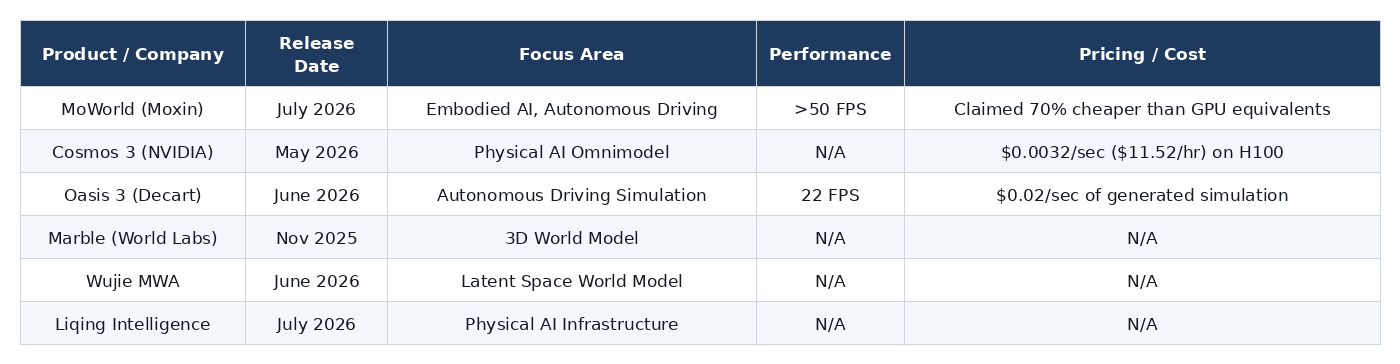
The release of MoWorld intensifies the competition in the rapidly expanding world model sector. Until recently, the market has been dominated by a few key players focusing on high-end, GPU-intensive solutions. For example, NVIDIA released Cosmos 3 in May 2026, positioning it as an open physical artificial intelligence omnimodel. While highly capable, Cosmos 3 relies on the company's own premium hardware, with on-demand pricing reaching $11.52 per hour on H100 systems via the Baseten API.
In contrast, Decart launched Oasis 3 in June 2026, an interactive world model specifically for autonomous driving simulation that achieves 22 frames per second. Decart offers API access at $0.02 per second of generated simulation. Other competitors include World Labs, which launched its commercial 3D world model product Marble in November 2025, and domestic rivals like Wujie MWA and Liqing Intelligence. Wujie MWA released a latent space world model for embodied AI in late June 2026, while Liqing Intelligence raised hundreds of millions in seed funding in July 2026 to build physical AI infrastructure.
Moxin Technology differentiates MoWorld through its combination of high frame rates and hardware localization. Achieving over 50 frames per second is a critical threshold for real-time interaction, surpassing the 22 frames per second offered by Decart Oasis 3. By targeting domestic NPUs, Moxin avoids direct competition for scarce GPU resources, carving out a distinct niche in the market. This strategy not only appeals to domestic companies seeking hardware security but also pressures international competitors to justify their higher deployment costs. The competitive advantage of MoWorld lies in its ability to deliver high-fidelity simulation at a fraction of the cost, challenging the established pricing models of incumbent providers.
Competitor Pricing and Performance Comparison
Strategic Sourcing and Hardware Sovereignty
For procurement officers and supply chain strategists in the robotics sector, the emergence of NPU-native world models requires a reassessment of compute sourcing strategies. The traditional approach of stockpiling GPUs for all artificial intelligence workloads is becoming less financially efficient. As models like MoWorld demonstrate high performance on alternative silicon, organizations must evaluate whether their specific simulation and training needs can be met by lower-cost NPU clusters.
Procurement teams should begin benchmarking NPU performance against traditional GPU setups for their specific workloads. If the 70 percent cost reduction holds true in production environments, companies that fail to diversify their hardware supply chain will find themselves at a severe competitive disadvantage in terms of operating margins. This shift demands that engineering teams and procurement departments collaborate closely to ensure that software choices align with the most cost-effective hardware strategies.
"The transition from GPU-dependent architectures to NPU-native models represents a fundamental realignment in the embodied AI supply chain, prioritizing cost efficiency and hardware sovereignty over brute compute force," notes a senior hardware procurement analyst.
Corporate Evolution: From 3D Printers to Spatial Intelligence
The trajectory of Moxin Technology provides context for its current focus on world models. Founded in June 2021, the company was established by Chen Tianrun, a post-00s PhD student at Zhejiang University studying under Academician Pan Yunhe. Initially, Moxin focused on the consumer hardware market, developing and selling consumer-grade 3D printers such as the KOKONI EC1 and EC2. This background in 3D spatial hardware likely informed the company's pivot toward spatial intelligence and software-based world models.
The company has attracted significant investment from major technology and financial players, reflecting strong industry confidence in its strategic direction. In October 2022, Moxin secured tens of millions of Chinese Yuan in a Pre-A funding round. This was followed by a Pre-A+ round led by Huawei Hubble in March 2026. The backing of Huawei is particularly notable given Huawei's position as a leading developer of domestic NPUs, suggesting a deep strategic alignment between Moxin's software development and Huawei's hardware ecosystem.
In May 2026, Moxin completed a new funding round of nearly 100 million RMB, with investments from Fullhan Microelectronics, Lianrong Zhidao, and Zhechuang Capital. Lianrong Zhidao is a fund associated with Lenovo Holdings, adding another major corporate backer to Moxin's roster. There are conflicting reports regarding the exact amount of recent funding. While some sources report the May 2026 round at nearly 100 million RMB, other unverified reports suggest a Series A round of nearly 1 billion RMB, and the primary QbitAI source mentions a hundred million USD financing. Regardless of the exact figure, the involvement of Huawei and Lenovo highlights the strategic importance of Moxin's technology within the broader domestic supply chain.
The Broader Implications for the Robotics Supply Chain
The integration of world models into the robotics development pipeline is accelerating. World models allow robots to simulate actions and predict outcomes in a virtual environment before executing them in the physical world. This capability is essential for developing general-purpose robots that can operate safely in unstructured environments. However, the computational cost of running these simulations has been a major bottleneck.
By lowering the cost of inference and optimizing for readily available domestic hardware, Moxin Technology is addressing this bottleneck directly. This has cascading effects throughout the robotics supply chain. Hardware manufacturers can design simpler, less expensive robots if the heavy lifting of spatial reasoning and simulation is handled efficiently in the cloud or on edge NPUs. Software developers can iterate faster, running more simulations in parallel without incurring prohibitive cloud computing costs.
The success of MoWorld could encourage other artificial intelligence startups to optimize their models for NPUs. This would create a more diverse and resilient hardware ecosystem, reducing the industry's vulnerability to supply chain disruptions affecting a single dominant GPU manufacturer. As more companies adopt this approach, we can expect to see a proliferation of specialized silicon designed specifically for the unique demands of embodied artificial intelligence and spatial computing.
The competitive dynamics of the world model sector are shifting from a race for raw compute power to a focus on efficiency and hardware optimization. Companies that can deliver high performance on cost-effective, accessible hardware will have a distinct advantage. Moxin Technology's release of MoWorld is a clear indicator of this trend, signaling a maturation of the market where practical deployment considerations are becoming just as important as theoretical capabilities. The ability to run advanced simulations at 50 frames per second on domestic NPUs proves that the industry is moving beyond the initial phase of pure research and into a phase of practical, cost-conscious commercialization.
Sources
1. MoWorld project page: https://moxin-tech.github.io/moworld/
2. MoWorld technical paper (arXiv 2607.06216): https://arxiv.org/html/2607.06216v1
3. QbitAI report on the MoWorld release (Chinese): https://www.qbitai.com/2026/07/446411.html
4. Eastmoney report on Moxin Technology funding (Chinese): https://finance.eastmoney.com/a/202605153739124950.html
5. Baseten analysis of NVIDIA Cosmos 3: https://www.baseten.co/blog/nvidia-cosmos-3-robots-finally-take-over/














