
Mistral Launches Robostral Navigate: A Single-Camera Robotics Model
Mistral introduces Robostral Navigate, an 8B parameter model enabling autonomous robot navigation using only a single RGB camera, eliminating the need for LiDAR and depth sensors.
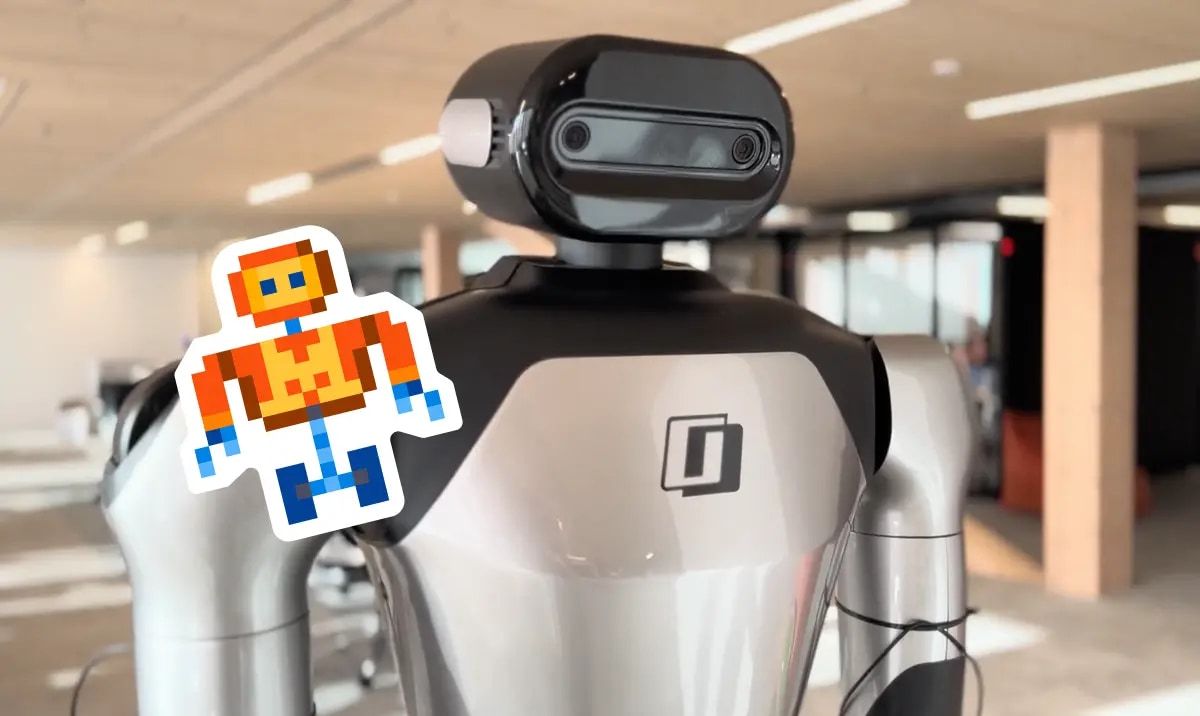
Robostral Navigate is an 8B parameter model developed by Mistral that enables autonomous robot navigation using only a single RGB camera. It eliminates the need for LiDAR, depth sensors, or multi-camera setups, achieving a 76.6% success rate on unseen R2R-CE benchmarks while generalizing across wheeled, legged, and flying robots.
What Happened
On July 8, 2026, Mistral officially launched Robostral Navigate, marking the company's significant push into physical AI and industrial automation. The 8B parameter model is designed to process RGB images alongside plain-language instructions to guide robots through complex environments. The launch represents a major milestone for the European AI leader, expanding its portfolio beyond language and multimodal models into the realm of embodied artificial intelligence. The announcement was made via the official Mistral blog and covered by major news outlets including Reuters, highlighting the industry's keen interest in the company's latest technological advancement.
Unlike traditional navigation systems that rely on expensive sensor arrays, Robostral Navigate operates entirely on a single RGB camera. It focuses on navigation via pointing and local displacements rather than manipulation. The model was built entirely in-house, trained in simulation with approximately 400,000 trajectories across 6,000 scenes, and utilizes token-efficient prefix-caching to accelerate training. This approach compresses an entire episode into a single sequence, reducing the number of training tokens by a factor of 22 while preserving all learning signals. The efficiency gains from this training methodology are substantial, transforming training runs that would typically take months into processes that complete in mere days.
Currently, the model is not available as an open-weight release or a self-serve API. Mistral is inviting interested parties to contact their team for early access. While the launch positions Mistral as a formidable player in the robotics space, specific launch partners and direct quotes from executives were absent from the initial announcement. The official blog post highlighted the model running fully autonomously in one long-horizon instruction route through a working office, showcasing its practical application in real-world scenarios. This visual demonstration serves as a proof of concept for the model's capabilities, although independent verification in diverse environments remains a critical next step for prospective enterprise users.
Why It Matters
The introduction of Robostral Navigate represents a shift in how autonomous navigation can be achieved. By removing the dependency on LiDAR and depth sensors, Mistral is lowering the hardware barrier for robotic deployment. This single-camera approach reduces the overall cost and complexity of building and maintaining autonomous systems, making advanced navigation accessible to a broader range of hardware platforms, from small drones to large industrial rovers. The economic implications for hardware manufacturers and robotics startups are substantial, as the cost of sensor suites often dictates the commercial viability of new robotic products. Lowering these costs could accelerate the adoption of autonomous robots across various sectors, including logistics, manufacturing, and hospitality.
The model's ability to generalize across different robot sizes and types without requiring hardware-specific retraining is a significant technical achievement. It relies on pointing-based navigation, inferring image coordinates and desired orientations, which makes it naturally robust to changes in camera intrinsics and world scale. When pointing is insufficient, it falls back to local coordinate displacements. This dual approach ensures that the robot can continue to operate even when the target destination is outside its immediate field of view, a common challenge in dynamic environments. The flexibility to adapt to different physical forms without extensive retraining is a major advantage for companies looking to deploy diverse fleets of robots.
The reliance on simulation training also allows for rapid iteration and scaling. By generating synthetic data across thousands of scenes, Mistral can expose the model to a vast array of edge cases and environmental variables that would be prohibitively expensive and time-consuming to capture in the real world. This methodology not only accelerates the development cycle but also enhances the model's robustness when deployed in unfamiliar physical spaces. The use of simulation as a primary training ground is becoming increasingly common in robotics, but Mistral's execution shows a high level of sophistication in bridging the sim-to-real gap.
Strategic Implications
For the robotics industry, Robostral Navigate introduces a highly efficient alternative to existing multi-sensor paradigms. The 76.6% success rate on unseen R2R-CE benchmarks demonstrates that a compact 8B model can outperform heavier, sensor-rich systems when trained effectively. Mistral's use of online reinforcement learning (CISPO) to allow the model to learn from trial and error further indicates a trajectory toward continuous improvement in real-world deployments. This capability to recover from failures and acquire exploratory behaviors mitigates the distribution shift issue often seen in vanilla behavior cloning. The integration of reinforcement learning suggests that the model will become more adept at handling novel situations as it accumulates real-world experience.
Mistral's broader market position is also strengthened. As Europe's leading AI company, recently in talks to raise funding at a €20 billion valuation, Mistral is expanding its portfolio beyond language and multimodal models into embodied AI. The strategic partnership with ASML, established in September 2025, hints at the potential industrial applications for Mistral's AI suite, although ASML's specific involvement with Robostral Navigate remains unconfirmed. The move into physical AI signals Mistral's ambition to compete directly with global tech giants in the race to develop foundational models for robotics. This expansion is crucial for maintaining a competitive edge in an industry where the convergence of software and hardware is becoming increasingly pronounced.
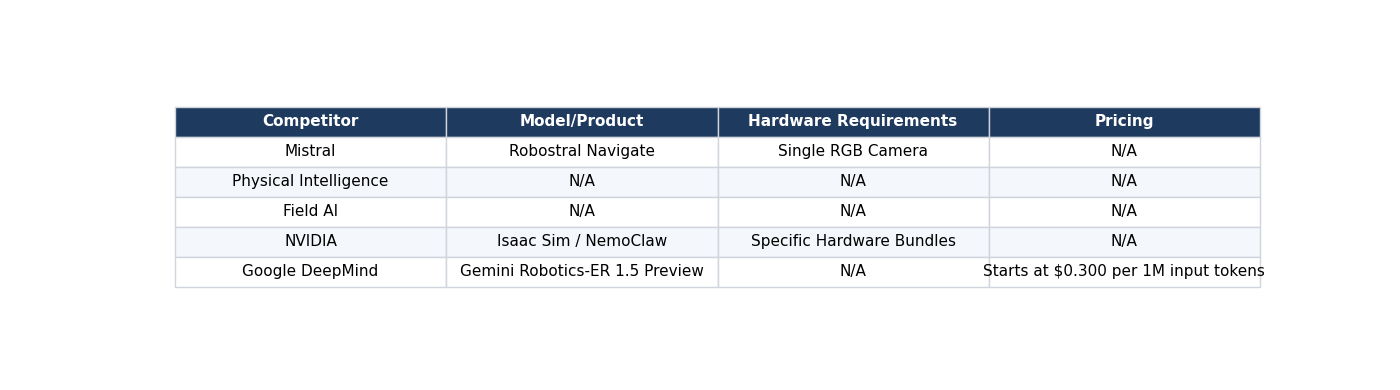
The competitive landscape is intensifying, with companies like Physical Intelligence and Field AI securing massive valuations and funding rounds. Physical Intelligence was valued at $5.6 billion in November 2025, while Field AI raised $405 million at a $2 billion valuation in August 2025. NVIDIA continues to dominate the hardware and simulation space with its Isaac platform and NemoClaw, and Google DeepMind is pushing forward with Gemini Robotics. Mistral's entry into this arena with a highly efficient, single-camera model disrupts the established narrative that complex sensor arrays are a prerequisite for advanced autonomous navigation. By offering a software-centric solution that minimizes hardware dependencies, Mistral is positioning itself as a disruptive force in the robotics ecosystem.
Competitor Comparison
 |
Procurement Perspective
For procurement officers and robotics engineers, Robostral Navigate offers a compelling reason to re-evaluate sensor suites. If a single RGB camera can achieve state-of-the-art navigation, the capital expenditure on LiDAR and depth sensors could be reallocated. This shift could lead to a significant reduction in the bill of materials for new robotic platforms, accelerating the path to profitability for hardware manufacturers. However, the lack of a self-serve API or open weights means organizations must engage directly with Mistral, potentially leading to custom enterprise pricing models rather than predictable usage-based billing. The opacity of the pricing structure requires careful negotiation and a clear understanding of the total cost of ownership over the lifecycle of the deployment.
The model's reliance on simulation training and reinforcement learning suggests it is highly adaptable, but buyers should request real-world pilot data specific to their operational environments before committing. The transition from multi-sensor redundancy to single-camera reliance will require rigorous safety and reliability testing in live settings. Procurement teams must weigh the potential cost savings against the risks associated with adopting a novel, vision-only navigation paradigm. Engaging in proof-of-concept trials will be essential to validate the model's performance in specific industrial or commercial applications. The decision to adopt Robostral Navigate should be based on a comprehensive evaluation of its performance metrics, integration capabilities, and long-term support from Mistral.
Industry Insight
"The shift toward single-camera navigation models like Robostral Navigate highlights a broader industry trend: replacing expensive hardware with smarter, more efficient software," notes a robotics industry analyst. "If Mistral can deliver on these benchmarks in the wild, it fundamentally changes the unit economics of autonomous robots. The ability to achieve high success rates on unseen environments using only an RGB camera challenges the long-held belief that LiDAR is indispensable for safe and reliable navigation. This development could spur a wave of innovation among hardware manufacturers, who can now focus on optimizing other aspects of their robotic platforms, knowing that the navigation challenge is being addressed by advanced AI models."
Company Background
Mistral AI was founded in February 2023 by Arthur Mensch (CEO), Timothée Lacroix (CTO), and Guillaume Lample (Chief Scientist Officer). The company has rapidly established itself as Europe's leading AI firm, offering a broad suite of models including LLMs (Mistral Small 4, Les Ministraux), multimodal, reasoning, audio, OCR models, and the chat/agent Vibe. The founding team brings extensive experience from leading AI research labs, which has been instrumental in Mistral's rapid ascent in the highly competitive AI landscape. Their deep technical expertise has enabled the company to develop state-of-the-art models that rival those produced by much larger organizations.
As of June 2026, Mistral is reportedly in talks to raise approximately €3 billion at a valuation of roughly €20 billion. This massive influx of capital will likely fuel further research and development in embodied AI, allowing Mistral to scale its operations and compete more aggressively with well-funded rivals in the United States and Asia. The company's strategic focus on building efficient, high-performance models has resonated with investors and enterprise customers alike, positioning Mistral as a key player in the next phase of AI innovation. The successful launch of Robostral Navigate serves as a strong indicator of the company's ability to execute on its ambitious roadmap and deliver tangible value to the robotics industry.
Sources
1. Mistral AI official announcement of Robostral Navigate: https://mistral.ai/news/robostral-navigate/
2. Reuters coverage of the launch: https://www.reuters.com/business/mistral-launches-first-robotics-model-physical-ai-push-2026-07-08/
3. TechCrunch background on Mistral AI: https://techcrunch.com/2026/07/04/what-is-mistral-ai-everything-to-know-about-the-openai-competitor/
4. Bloomberg report on Mistral funding talks: https://www.bloomberg.com/news/articles/2026-06-12/france-s-mistral-in-funding-talks-at-about-20-billion-valuation














