
McLaren Construction partners with FieldAI to roll out robot dogs at scale on UK sites
UK contractor McLaren Construction has partnered with US autonomy firm FieldAI to roll out Boston Dynamics Spot robot dogs across multiple UK projects. Following trials since December 2025, the Spot units with FieldAI navigation will automate site surveys, progress capture and routine quality checks, feeding structured data into BIM and issue trackers.
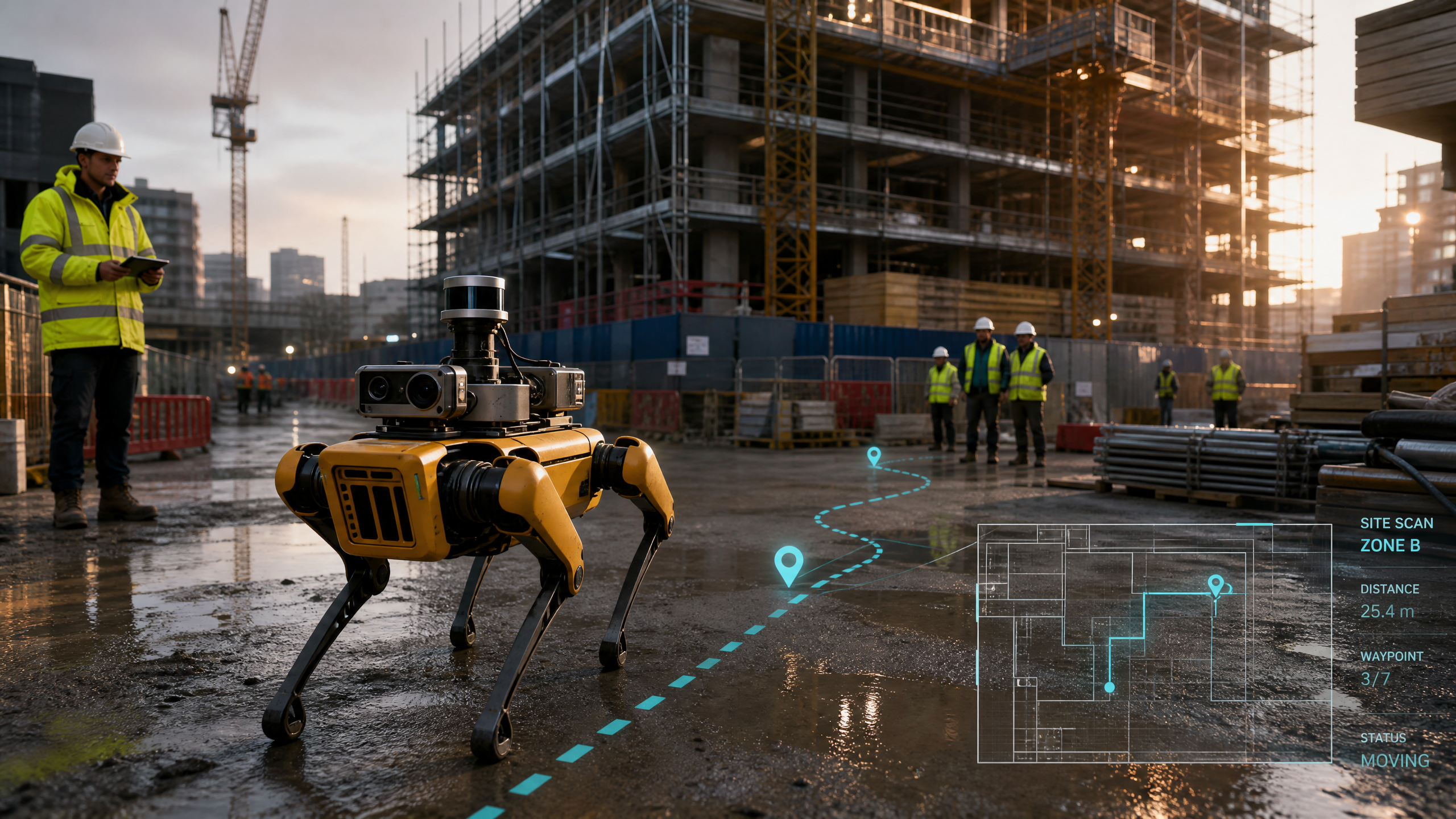
July 6–7, 2026, McLaren Construction has agreed a partnership with US robotics autonomy firm FieldAI to deploy general‑purpose robot dogs widely across its UK sites. After months of on‑site trials with a Boston Dynamics Spot unit equipped with FieldAI’s navigation and learning software, the contractor says it will move beyond pilots and bring the system into routine workflows, starting with complex refurbishments and large live projects.
A tension felt on every job: the accuracy gap between plans and site reality
Every superintendent knows the feeling. Drawings look clean in the morning meeting, then a change lands, then another, and the ground truth drifts away. Manual walks and clipboards struggle to keep pace. By the end of the week the team must reconcile what was planned, what was built, and what should be fixed. That gap is where cost and delay stack up. McLaren’s operators have spent the past six months handing that routine to a robot dog that records the site as it really is, in real time, and flags quality issues before they become rework.
The new partnership, confirmed over the weekend of July 6–7, formalises that shift. McLaren will deploy Boston Dynamics’ four‑legged platform fitted with FieldAI’s autonomy brain to map sites, capture progress, and help teams close the loop between design intent and delivered work. Among the testbeds is a Passivhaus refurbishment in London, where the robot’s regular patrols feed a digital record that supports airtightness targets and envelope quality checks.
What is actually being deployed
· Hardware: Boston Dynamics Spot, selected for its mobility on stairs and rubble. McLaren has been testing the unit since December 2025.
· Autonomy: FieldAI provides the navigation and learning stack, which lets the robot move through dynamic spaces, adapt to new obstacles, and repeat survey routes with consistent coverage.
· Workflows: Automated site surveys, frequent progress documentation, routine quality checks, and generation of structured datasets for BIM coordination and handover packs.
McLaren positions this as a move from occasional tech demos toward a durable, operator‑owned capability. The firm says the value comes when repeatable walks happen every day, not once a fortnight, and when that data streams straight into models and issue trackers without a human spending hours sorting photos.
Why operators care: from tedious surveys to real‑time records
Site surveys are necessary, but they consume high‑value time. Even with handheld 360 cameras, someone must book the slot, walk the site, upload, tag, and reconcile the images with locations and trade packages. Consistency is the first casualty when the schedule slips.
Robot dogs do not tire. With FieldAI’s autonomy, the unit learns the site topology, negotiates around stored materials, and still finishes the walk. It captures standardised image sets or scans, labels them with precise location and timestamp, and pushes them to a common data environment. In early McLaren trials, this created a daily digital heartbeat that made coordination meetings faster and snags more objective to resolve.
On the London Passivhaus scheme, that rhythm matters. Passivhaus retrofits demand reliable checks for insulation continuity, window detailing, and service penetrations. Frequent, consistent capture gives site managers evidence when sequencing risks air leakage, and it helps designers adjust details while access is still open. Routine, robot‑captured data reduces the chance that envelope issues surface late, when fixes are slower and more expensive.
How FieldAI’s autonomy changes the job
Construction is tough for autonomy. Paths are blocked without notice. Lighting changes. Temporary works evolve week by week. A robot that memorises a single route fails quickly. FieldAI’s software sits on top of the robot’s native mobility and adds a learning layer. The system:
· Builds a persistent map of the site, then updates it as layouts shift.
· Plans alternative routes when materials or scaffolds block an area.
· Keeps capture coverage consistent by following waypoints and timing rules.
· Recognises stairs, grating, and common site hazards to reduce human babysitting.
FieldAI’s value proposition is not only reaching a destination but finishing the data job to spec. For operators, the shift shows up as fewer reshoots, less escort time, and higher‑quality datasets that line up with models and zones.
Deployment at scale: what it takes to move beyond pilots
Most contractors can stage a one‑off robot demo. Scaling is different. McLaren’s plan suggests four execution threads that matter if others want to follow:
1) Standard routes and naming. The company has templated patrol paths that reflect building typologies and project phases. That means data lands in familiar folders with predictable labels, which speeds up adoption by site teams.
2) Integration into the common data environment. The robots push outputs into tools the company already uses, from BIM coordination to snagging and dashboards. Operators should not need to learn a new platform to see value.
3) Clear handoffs and training. FieldAI will train McLaren’s digital engineers and selected site operatives to create and maintain routes, manage charging, and triage alerts. The aim is to reduce reliance on specialist crews.
4) Service and spares. Four‑legged robots are rugged, but sites are unforgiving. McLaren has set up a parts and service process with swift turnaround. Keeping uptime high is essential if the new workflow is to be trusted.
The firm describes this as “at scale” because routes will be embedded in weekly rhythms across multiple live jobs, rather than in a few flagship sites. That operational definition matters more than the headline robot count.
The commercial logic: where the savings appear
Return on investment in construction robotics rarely comes from headcount cuts. The bigger levers are lower rework, better coordination, and schedule protection. The McLaren trials indicate three areas where savings add up:
· Rework avoidance. Early detection of clashes or sequencing errors reduces costly tear‑outs.
· Cycle‑time compression. Faster sign‑offs and fewer revisits keep trades moving.
· Evidence for claims and handover. Structured records help resolve disputes and speed asset documentation.
On refurbishment projects, time saved in opening and closing ceilings or walls can outweigh the cost of a robot lease in a single month. On new builds, steady reality capture tightens weekly planning and clarifies percent‑complete snapshots for leadership and clients.
Friction points: what could slow this down
Even with momentum, operators flag three sources of friction that will need management:
· Battery, charging, and shift planning. A robot with a two‑hour mission window must fit around noisy works and access rules. Charging stations need safe, consistent locations.
· Environment extremes. Wet subfloors, welding sparks, and heavy dust can shorten maintenance intervals. Ruggedisation and protective kits mitigate this, but they do not remove risk.
· Data overload. Daily captures generate huge libraries. Without strong metadata and filtering, teams can drown in images instead of acting faster.
There is also the people factor. Supervisors must trust that the robot actually reduces their admin load. That happens only if the data lands where they already work and if alerts surface as clear actions, not as another inbox.
The supply chain context: hardware, autonomy, and UK readiness
Nikkei‑style supply chain thinking helps frame what comes next. Three layers enable scale:
· Hardware availability. Boston Dynamics produces the quadruped platform at global scale. Lead times and service coverage in the UK are now mature enough for multi‑site deployment.
· Autonomy stack. FieldAI’s software is the control point for repeatable performance in messy environments. Its value compounds with site diversity because the system gets better at handling variation.
· Integration partners. UK contractors depend on smooth links into BIM, issue tracking, and client reporting. Integrators and digital engineering teams are the local force multiplier.
The UK market is also shaped by tight refurb activity and public estate upgrades. Those projects benefit most from routine capture and quality assurance. If McLaren’s roll‑out holds, rival contractors will have an incentive to standardise similar workflows in 2026–2027, likely pairing Spot or equivalent platforms with autonomy vendors that can demonstrate UK field hours and integrations.
Competitive landscape: how this compares to other deployments
US contractors like DPR Construction have moved past experiments and now run autonomous progress capture on select jobs, often pairing quadrupeds with 360 imagery or scanning tools. Standard Spot deployments rely on Boston Dynamics’ own Autowalk for repeat routes, which helps but still leans on stable environments and careful route definition. Trimble’s ecosystem, including the X7 3D scanner and robotic total stations, brings stronger measurement fidelity and established data pipelines into construction software stacks, with or without a quadruped base.
McLaren’s twist is the explicit pairing of a learning autonomy layer with UK refurbishment demands, including projects with stringent sustainability standards such as Passivhaus. That puts the focus on day‑to‑day reliability inside variable, congested sites rather than on fixed industrial layouts.
What operators should ask before green‑lighting robots
· Which workflows get retired on day one, and which will we keep for now?
· How does the robot post to our existing CDE and issue tracker, and who owns the taxonomy?
· What is our route design process per phase, and who updates it when access changes?
· What service plan guarantees uptime and parts availability in the UK?
· Which metrics will we track to prove value by month three and month six?
Clear answers avoid pilot purgatory and help teams cut admin instead of adding a new task.
Comparison: where McLaren’s approach sits in the market
Below is a practical comparison for operators weighing options.

Early lessons from McLaren’s pilots
· Autonomy matters most when site conditions change daily. The robot finished routes despite staged materials and temporary partitions that would have stalled simple replay.
· Operators need a simple playbook. Clear start points, route tags, and fallback paths kept human input light.
· Value lands when data shows up where people already work. Direct posting into the project’s CDE and model views drove adoption.
· Refurbishment is fertile ground. Frequent checks caught sequencing risks around insulation and services. The cost of fixes avoided was visible.
These lessons line up with what peers have found in the US and Europe. The difference is McLaren’s commitment to move from tests to routine use across sites in 2026.
Risk and governance: safety, privacy, and standards
Robots introduce new considerations alongside their benefits.
· Site safety. The unit must follow safe paths and avoid live zones during hazardous works. Clear boundaries and spotter rules reduce risk.
· Data governance. Frequent imagery can include sensitive information. Contractors need retention policies, client permissions, and redaction options.
· Interoperability. To avoid lock‑in, exports should follow open standards where possible so that data remains usable across platforms.
McLaren’s approach includes training for operators, guardrails on patrol timing, and use of the common data environment that already governs access and audit trails.
Outlook: what this signals for UK construction
If McLaren’s scaled deployment holds, expect three second‑order effects in the UK over the next 12 to 18 months:
· Normalisation of robot patrols. Once daily digital records become routine, clients start to expect them on major jobs. That raises the bar for evidence‑based progress reporting.
· Autonomy vendors compete on integration depth. The winner is not the flashiest robot but the stack that posts cleanly into a contractor’s live tools and delivers fewer admin steps.
· Shift toward measurable quality on retrofits. With more public and private retrofit programs, repeated capture and early snag detection will become a standard line item, not a nice‑to‑have.
The practical constraint is still change management. Teams need to see that this removes tasks, not adds them. Procurement should push for service and uptime commitments, along with clear training and playbooks, so that the system becomes a dependable part of the weekly rhythm.
What to watch next
· Roll‑out pace. How many sites adopt robot patrols by year end, and in which project types do they stick?
· Integration partnerships. Which reality capture and BIM tools FieldAI and McLaren prioritise for deeper links.
· Competitor responses. Whether other UK tier‑one and tier‑two contractors announce autonomy partnerships or double down on existing Spot and Trimble stacks.
· Client requirements. Signs that public owners and private developers start specifying autonomous reality capture in tender documents.
Sources
· Construction Enquirer
· Global Construction Review
· Digital Construction Plus














