Korea's IT Giants Build the Software Layer That Will Run the Robot Factory
South Korea's four largest IT service conglomerates -- POSCO DX, SK AX, LG CNS, and Samsung SDS -- are each developing proprietary robot operating system platforms designed to serve as the AI brain layer for industrial robot deployments. The race reflects a structural shift in the Korean robotics market, where hardware commoditization is accelerating and the value is migrating to software orchestration, data management, and AI model integration.

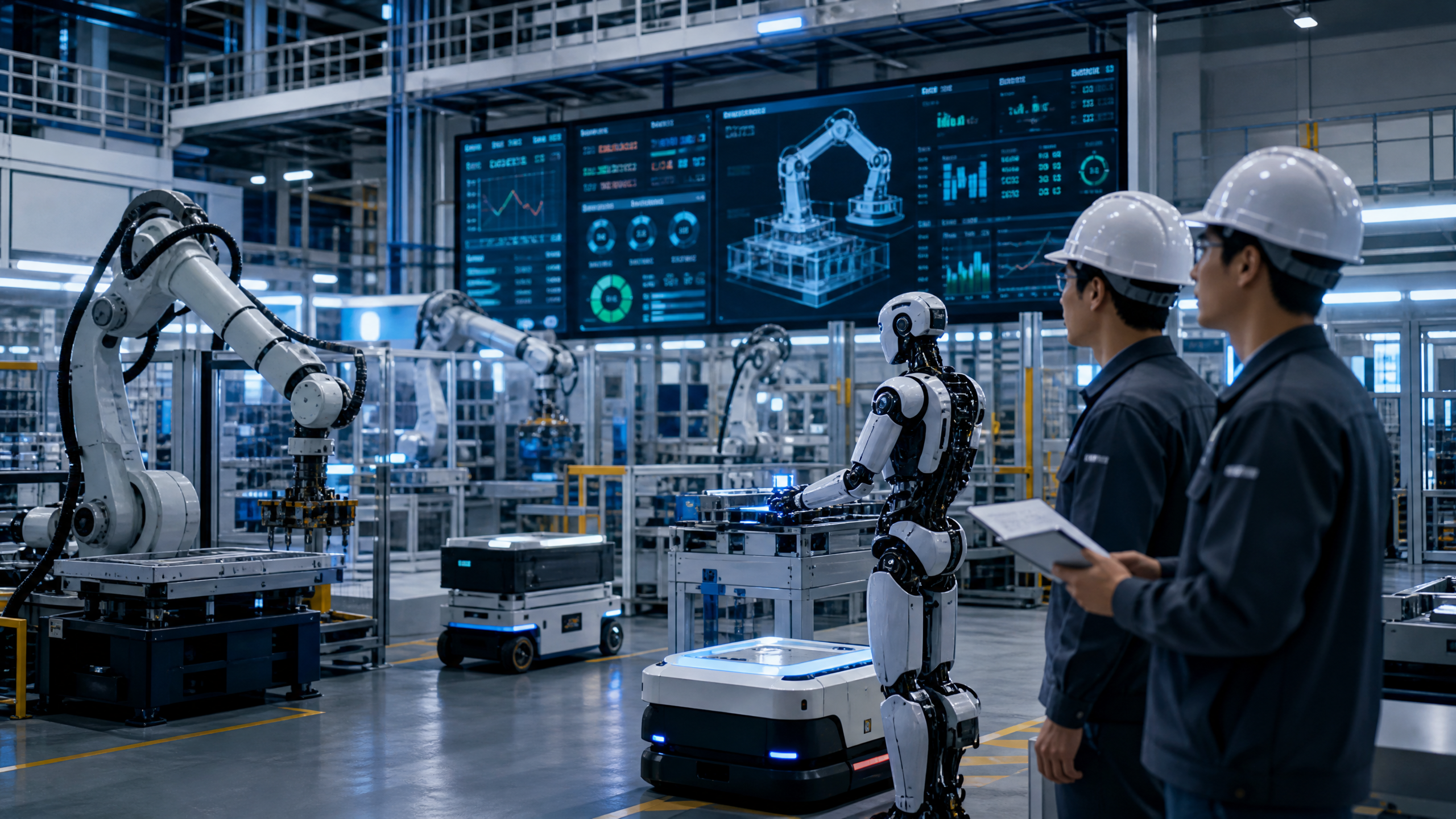
Four of South Korea's largest IT service conglomerates are moving simultaneously to claim the software layer that will run the country's next generation of robot-centric factories. POSCO DX, SK AX, LG CNS, and Samsung SDS -- the IT arms of Korea's four largest industrial groups -- are each building competing physical AI platforms designed to serve as the operating system for factories in which robots and equipment make autonomous work judgments, share tasks with human workers, and connect production, logistics, and quality control through a unified data layer. The competition is not for the robots themselves but for the intelligence infrastructure that will make them useful at scale.
The four companies are attacking the same problem from different angles, each shaped by the specific manufacturing environment of its parent group. POSCO DX is focused on heavy equipment autonomy in steel mills. SK AX is building pre-deployment risk verification for semiconductor and shipbuilding plants. LG CNS has signed a KRW 189.7 billion (approximately US$132 million) contract with LG Electronics to build Korea's first large-scale Robot Data Factory. Samsung SDS has made a strategic investment in US-based Walden Robotics and is developing a robot orchestration platform to integrate heterogeneous robots with manufacturing execution systems.
The Problem All Four Are Solving
The challenge that each company is addressing is the same -- in a factory that deploys multiple robots from different manufacturers, each robot typically runs its own proprietary software, communicates through its own protocol, and generates data in its own format. Connecting those robots to production equipment, factory control systems, and data platforms to optimize process flow requires an integration layer that does not yet exist as a commercial product. The IT service companies, which have spent more than two decades implementing manufacturing systems for their parent groups, are positioning themselves as the builders of that layer.
An LG CNS official described the strategic logic directly. "Investment in smart factories and robots is not a short-term expansion of production facilities, but a strategic investment to address rising labor costs, shortages of production workers, and stronger quality and safety standards. Our goal is to set a new standard for commercialization of physical AI and ultimately realize a robot-centric autonomous operating system." The statement reflects a broader industry consensus that the software integration problem -- not the hardware -- is the primary bottleneck preventing factories from deploying robots at scale.
POSCO DX: Autonomous Control of Multi-Ton Equipment
POSCO DX, the IT arm of POSCO Holdings and headquartered in Seoul, specializes in industrial automation and digital transformation for the steel and materials sector. Rather than focusing on humanoid or mobile robots, the company is targeting the large fixed equipment that runs Korea's steel mills -- cranes that move steel products, reclaimers that transfer raw materials in yards, and ship unloaders for raw materials. These machines weigh tens of tons, operate in environments that are dangerous for human workers, and currently require skilled operators with decades of tacit knowledge to run safely.
POSCO DX's "equipment robotization" program combines physical AI with these machines to enable autonomous judgment and control. The company is converting the tacit knowledge held by veteran workers nearing retirement into structured data for AI training -- a form of knowledge transfer that addresses both the automation objective and the workforce succession problem simultaneously. At the Gwangyang and Pohang steel mills, the program is currently in a trial run phase, with commercialization targeted for the second half of 2026. If successful, it would represent one of the first deployments of physical AI in heavy industrial equipment at operating steel mill scale.
The approach is conservative in one sense -- POSCO DX is not deploying humanoid robots or building a general-purpose platform -- but it is commercially credible in a way that many humanoid robot programs are not. The equipment being targeted is already in place, the use cases are well-defined, the economic case for automation is clear, and the parent company provides a captive deployment environment for initial validation.
SK AX: Digital Twin Verification Before Deployment
SK AX, the AI transformation arm of SK Group, is addressing the risk management problem that precedes robot deployment. Before a factory introduces robots, it needs to verify that the robots will operate safely and effectively in the specific physical environment of that facility -- a process that currently requires expensive and time-consuming physical trials. SK AX's Manufacturing RX full-stack service uses digital twins to perform that verification in a virtual environment before any physical hardware is introduced.
The service combines digital twin simulation with physical AI to create a virtual replica of the factory floor, allowing operators to test robot configurations, identify collision risks, and optimize workflow sequences without disrupting live production. Once robots are deployed, the platform consolidates them with the manufacturing execution system and equipment data in real time to provide integrated control of the entire plant.
SK AX is currently validating the approach in the semiconductor industry, where the cost of production disruption is extremely high and the demand for precision is correspondingly strict. The company has stated plans to expand to the shipbuilding industry, which faces similar complexity challenges and is a major focus of Korean industrial policy. An SK AX official said the company is "verifying field data accumulation, related systems, and proof-of-concept models in the semiconductor industry, and will expand this to the shipbuilding industry."
LG CNS: The Robot Data Factory and PhysicalWorks
LG CNS, a Seoul-based IT services company that is a subsidiary of LG Corp., has made the most commercially visible move of the four with its KRW 189.7 billion (approximately US$132 million) contract with LG Electronics to build Korea's first large-scale Robot Data Factory. The facility is designed to collect and process the video and motion data that real robots need to learn tasks, then use that data to train AI models -- a form of infrastructure that sits between the robot hardware and the AI model layer and is currently a significant bottleneck for companies trying to deploy intelligent robots at scale.
The Robot Data Factory will run on PhysicalWorks, LG CNS's proprietary Physical AI platform, which manages the entire cycle from robot training to integrated control. The platform is designed to shorten the on-site deployment time for industrial robots from the several months that current integration projects typically require to one to two months, and to allow manufacturers to operate robots from different vendors within a single unified system. LG CNS has completed proof-of-concept projects with more than 20 customers in manufacturing and logistics, including LX Pantos and Kurly, and plans to use the LG Electronics contract as a flagship reference case for expansion to customers outside the LG Group starting in 2027.
Shin Jae-hoon, Senior Vice President of the Smart Factory Business Division at LG CNS, said that "securing AI infrastructure, including GPUs, is essential for introducing Physical AI into industrial settings" and that the company will "use the LG Electronics Robot Data Factory as a flagship case study to expand our business into various industries, such as manufacturing and logistics." The financial scale of the contract -- KRW 189.7 billion for a single infrastructure project -- signals that the Robot Data Factory is not a pilot but a production-scale commitment.
LG CNS's second-quarter 2026 revenue from AI and cloud businesses reached KRW 906 billion (approximately US$630 million), a 3.9% increase year-over-year, though operating profit declined 9.2% due to increased investment in physical AI research and development and talent acquisition. The company's CFO described the profit decline as "proactive investments for future growth" rather than a structural issue, and forecast that deferred projects would contribute to improved performance in the second half of the year.
Samsung SDS: Robot Orchestration and the Walden Robotics Investment
Samsung SDS, the IT services arm of Samsung Group, is approaching the market from the orchestration layer -- the software that integrates and controls multiple robots from different manufacturers and connects them with the manufacturing execution system. The company made a strategic investment through Samsung Venture Investment in US-based Walden Robotics, a move that provides both a technology relationship and a signal of Samsung SDS's intent to build a global partner ecosystem rather than developing all capabilities in-house.
The Samsung SDS robot orchestration platform is designed to serve Samsung Electronics' stated goal of converting all domestic and overseas production plants into "AI autonomous factories" by 2030. That commitment creates a large and predictable captive market for Samsung SDS's platform -- a structural advantage that mirrors the position LG CNS holds with LG Electronics. On a conference call after its most recent earnings release, Samsung SDS said it would "expand cooperation with global robot corporations and push a 'robot orchestration' business that integrates and controls various robots and links them with the manufacturing execution system."
The Competitive Dynamics of the Factory OS Race
The four companies are not yet in direct competition for the same contracts, because their initial deployments are concentrated within their respective parent groups. But the longer-term competitive logic is clear -- whichever platform accumulates the most real-world deployment data, the most reference cases across different industries, and the broadest compatibility with different robot hardware will have a structural advantage as the market opens to external customers.
The analogy to the smartphone operating system race is imperfect but instructive. Android and iOS succeeded not because they were technically superior to all alternatives at launch, but because they accumulated developer ecosystems, application libraries, and user data that made switching costs prohibitive over time. A factory OS that runs in POSCO's steel mills, LG's appliance plants, SK's semiconductor fabs, and Samsung's electronics factories will have a training data advantage and a reference case portfolio that new entrants will find difficult to match.
The honest assessment is that all four platforms are early. The Robot Data Factory is not yet operational. The SK AX semiconductor validation is still in proof-of-concept phase. POSCO DX's equipment autonomy program is in trial run. Samsung SDS's orchestration platform has not yet been publicly demonstrated at scale. The race is real, but the finish line is several years away, and the winner will be determined by deployment execution and data accumulation rather than by the announcements being made today. For procurement managers evaluating factory automation investments, the practical implication is that the platform layer is not yet mature enough to standardize on -- but the companies building it are credible, well-capitalized, and operating in environments where the pressure to automate is structural and growing.
Disclaimer: This analysis is provided for informational purposes only and does not constitute investment, legal, or procurement advice. RobotAIGeek does not endorse specific vendors or guarantee the performance of early-stage technologies.