
Joyson Electronics Debuts Robotics Component Stack at WAIC
Joyson Electronics announced a comprehensive portfolio of robotics components at the 2026 World Artificial Intelligence Conference, leveraging its automotive manufacturing and supply-chain expertise to scale subsystems for the robotics industry.
The transition from prototype robotics to scaled commercial deployment relies heavily on the availability of reliable component subsystems. Joyson Electronics, an established automotive technology solution provider listed under securities codes 600699.SH and 00699.HK, has entered this space by announcing a comprehensive portfolio of robotics components at the 2026 World Artificial Intelligence Conference in Shanghai on July 17, 2026 [1]. This move represents a strategic attempt to transfer the company's extensive automotive engineering, manufacturing, electronics, and supply chain capabilities into the rapidly expanding robotics sector. The portfolio is not a complete humanoid robot but rather a collection of critical subsystems designed to accelerate the development and production of advanced robotic platforms. The strategic significance of this announcement lies in the potential to apply automotive grade manufacturing discipline to the specialized components required for next generation robotics, addressing a critical bottleneck in the industry's path to commercialization.
What components did Joyson Electronics announce for the robotics market?
Joyson Electronics introduced a robotics component portfolio at the World Artificial Intelligence Conference in Shanghai on July 17, 2026. The launch includes the TeleHand dexterous hand family, force and tactile sensing, an AI head assembly, an embodied AI brain combining EAOS software and EAPC computing hardware, robot controllers, a solid liquid hybrid battery, and a gallium nitride motor driver.
The announcement positions Joyson Electronics, headquartered in Ningbo, Zhejiang, China, as a significant new supplier in the robotics component ecosystem. The company's core technology spans automotive safety, automotive electronics, intelligent cockpits, intelligent driving, and e-mobility [2]. By leveraging this background, Joyson aims to address the manufacturing and integration bottlenecks that currently limit the scalability of advanced robotics. The portfolio targets precision industrial operations and service interaction, offering modular, production oriented designs intended to shorten the path from concept validation to volume manufacturing. The official website establishes a large adjacent automotive electronics, safety, e-mobility, and software hardware business.
Joyson's entry into the robotics component market is grounded in its established automotive business. The company operates globally, providing intricate electronic and safety systems to major automotive manufacturers. This background is crucial because the July 17 portfolio focuses on subsystems that can benefit from automotive grade manufacturing discipline, battery management expertise, power electronics integration, and established supply chain networks. The strategy is to provide the building blocks for robotics companies rather than competing directly with them by shipping a complete robot. The integration of these diverse technologies into a cohesive portfolio suggests a comprehensive approach to addressing the hardware and software needs of modern robotic systems.
Translating Automotive Scale to Robotics Subsystems
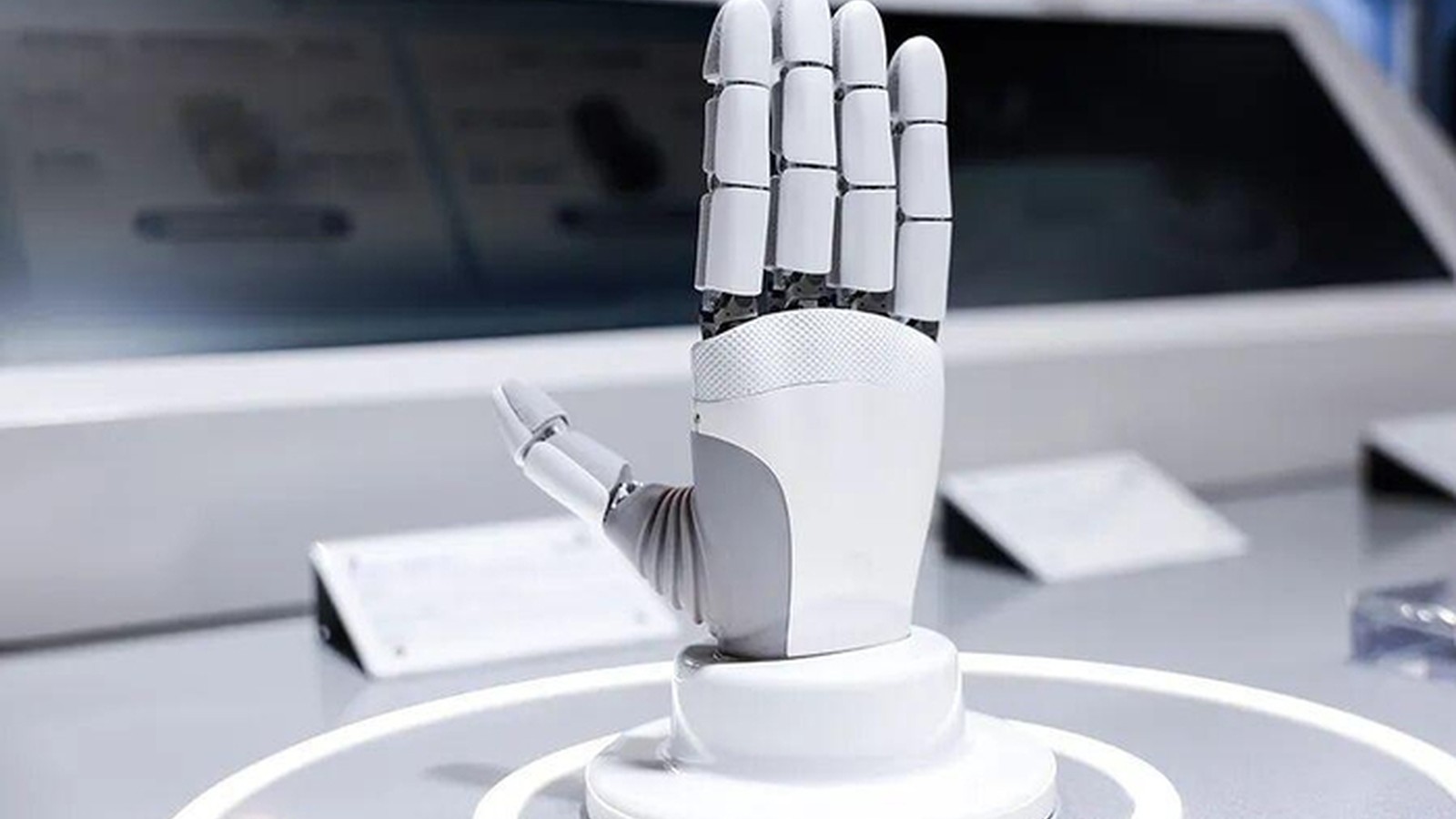
The announced portfolio covers several critical areas of robotics hardware and software. The TeleHand series represents Joyson's first fully in-house developed dexterous hand. The Professional Edition features 20 degrees of freedom and utilizes a hybrid actuation architecture that combines direct drive, tendon driven, and linkage actuation [1]. Joyson claims that its in-house developed miniature frameless actuators reduce volume by nearly 50 percent and weight by approximately 30 percent compared with unspecified conventional models, while providing two to three times the torque density of same diameter hollow cup motors [1]. The company describes natively decoupled three dimensional force sensing, proximity detection, high sensitivity, and a flexible form factor. Its release does not publish a complete specification sheet, payload, hand weight, control frequency, ingress rating, durability test, price, order window, or named customer.
The portfolio also includes a third generation AI head assembly that integrates perception, motion, and system level functions to support movement and expression. It uses a modular, production oriented mechatronic design intended to shorten the path from concept and prototype validation to production. No sensor configuration, weight, degrees of freedom, price, delivery date, or customer is disclosed.
For computation and control, Joyson introduced an embodied AI brain that combines an Embodied AI Operating System (EAOS) with an Embodied AI PC (EAPC). The EAOS contains a world model, an Agentic OS, and a memory system, while the EAPC is available in configurations ranging from 40 TOPS to 2,070 TFLOPS [1]. Joyson says the system is designed for long horizon tasks and autonomous improvement. It also says the embodied AI brain has reached selected industrial and automated charging deployments, but it does not identify customers, installation counts, test periods, productivity gains, safety records, or commercial terms.
Power and drive electronics form another key pillar of the announcement. Joyson introduced a Crystal Energy solid liquid hybrid battery for robotics, claiming an energy density of 380 Wh/kg, approximately 60 percent longer endurance against an unspecified baseline, more than 2,000 cycles, operation from minus 20 to 60 degrees Celsius, and an 80 percent charge in 30 minutes [1]. The companion battery management system is described as operating from minus 40 to 105 degrees Celsius. No public price, production volume, customer, warranty, or certification is disclosed. The company also announced a gallium nitride motor driver, claiming conversion efficiency above 95 percent and a 40 percent reduction in size [1]. The baseline is not disclosed.
Dexterous Hand Market Alternatives
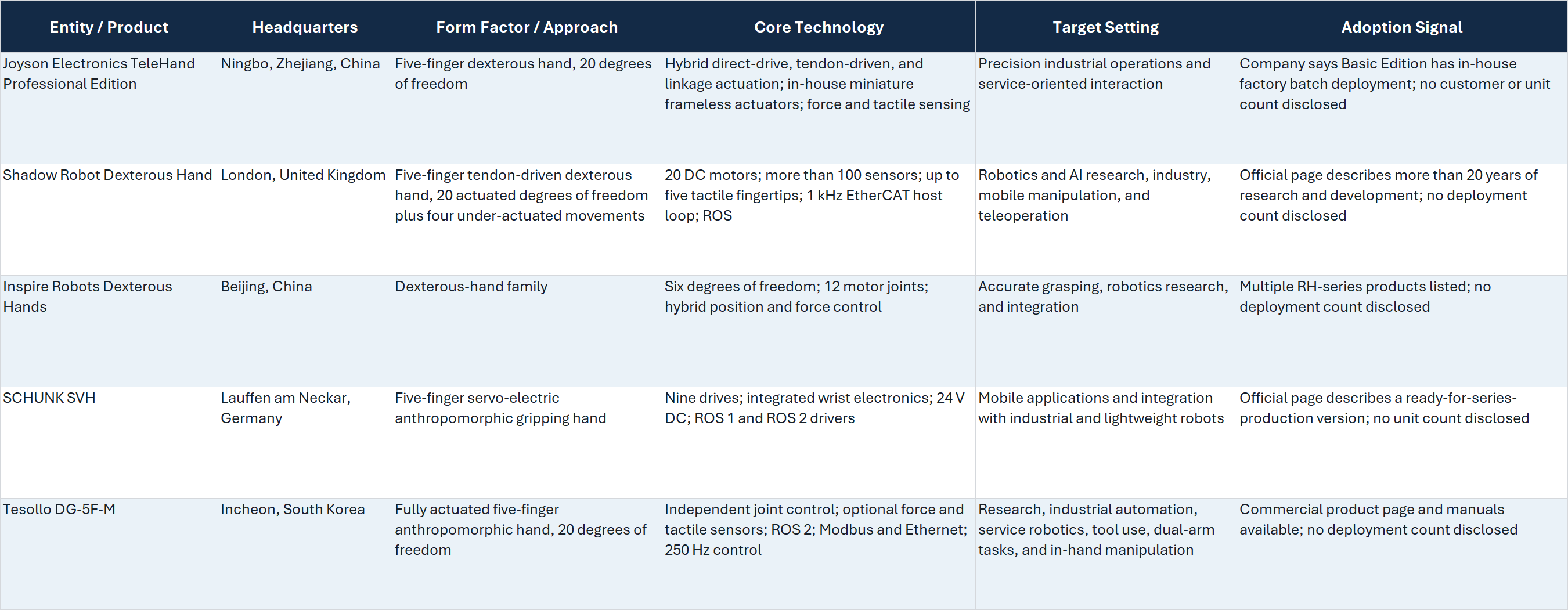
The market for dexterous robotic hands includes several established and emerging players, each with different approaches to actuation, sensing, and integration. The following table compares the Joyson TeleHand Professional Edition with selected alternatives based on available public information.
Entity / Product Headquarters Form Factor / Approach Core Technology Target Setting Adoption Signal
Joyson Electronics TeleHand Professional Edition Ningbo, Zhejiang, China Five-finger dexterous hand, 20 degrees of freedom Hybrid direct-drive, tendon-driven, and linkage actuation; in-house miniature frameless actuators; force and tactile sensing Precision industrial operations and service-oriented interaction Company says Basic Edition has in-house factory batch deployment; no customer or unit count disclosed
Shadow Robot Dexterous Hand London, United Kingdom Five-finger tendon-driven dexterous hand, 20 actuated degrees of freedom plus four under-actuated movements 20 DC motors; more than 100 sensors; up to five tactile fingertips; 1 kHz EtherCAT host loop; ROS Robotics and AI research, industry, mobile manipulation, and teleoperation Official page describes more than 20 years of research and development; no deployment count disclosed
Inspire Robots Dexterous Hands Beijing, China Dexterous-hand family Six degrees of freedom; 12 motor joints; hybrid position and force control Accurate grasping, robotics research, and integration Multiple RH-series products listed; no deployment count disclosed
SCHUNK SVH Lauffen am Neckar, Germany Five-finger servo-electric anthropomorphic gripping hand Nine drives; integrated wrist electronics; 24 V DC; ROS 1 and ROS 2 drivers Mobile applications and integration with industrial and lightweight robots Official page describes a ready-for-series-production version; no unit count disclosed
Tesollo DG-5F-M Incheon, South Korea Fully actuated five-finger anthropomorphic hand, 20 degrees of freedom Independent joint control; optional force and tactile sensors; ROS 2; Modbus and Ethernet; 250 Hz control Research, industrial automation, service robotics, tool use, dual-arm tasks, and in-hand manipulation Commercial product page and manuals available; no deployment count disclosed
Bridging the Gap
To understand the significance of this announcement, imagine building a highly advanced remote control car. You could design and build every single part yourself, from the tiny motors that turn the wheels to the battery that powers it and the computer chip that receives your commands. This takes a massive amount of time and money. Alternatively, you could buy high quality, pre made motors, batteries, and computer chips from a company that already makes millions of them for real cars. Joyson Electronics is offering to be that supplier for the robotics industry. Instead of robotics companies having to invent their own hands, brains, and batteries from scratch, Joyson wants to sell them these pre made, highly engineered parts. This approach allows robotics companies to focus on the overall design and software of their robots, rather than getting bogged down in the intricate engineering of individual components.
The Hard Truth
While the announcement of a comprehensive component portfolio from an established automotive supplier is a positive signal for the robotics industry, it is crucial to maintain a realistic perspective. The transition from automotive manufacturing to robotics is not a guaranteed success. The performance claims made by Joyson Electronics, such as the significant reductions in actuator volume and weight, are vendor claims against unspecified baselines. The lack of disclosed pricing, named customers, and independent reliability testing makes it difficult to assess the true market impact of these components. The robotics industry requires highly specialized, robust, and cost effective solutions, and it remains to be seen whether Joyson can deliver on these requirements at scale. The absence of a complete specification sheet for the TeleHand and the lack of concrete adoption metrics for the embodied AI brain highlight the early stage nature of this product launch.
"The strategic significance of this announcement lies in the potential to apply automotive grade manufacturing discipline to the specialized components required for next generation robotics, addressing a critical bottleneck in the industry's path to commercialization."
Limitations and Strategic Implications
The primary limitation of the current information is the reliance on company issued statements and the absence of independent verification. The lack of detailed technical specifications, pricing information, and named customer deployments restricts the ability to conduct a comprehensive competitive analysis. The strategic implications, however, are significant. If Joyson Electronics can successfully leverage its automotive manufacturing expertise to produce reliable and cost effective robotics components, it could accelerate the development and commercialization of advanced robotic systems. This would lower the barrier to entry for new robotics companies and potentially disrupt the existing supply chain. The entry of established automotive suppliers into the robotics component market signals a maturation of the industry and a shift towards standardized, modular architectures.
References:
[1] Joyson Electronics company-issued release
[2] Joyson Electronics official website
This analysis synthesizes company statements, official filings, and public market activity available as of July 17, 2026.
Disclaimer: This article is for informational purposes only and does not constitute financial, investment, legal, or procurement advice. Product specifications, pricing, and availability may change, so readers should verify details directly with the relevant company before making decisions.














