Japan Will Give Factory Machines a National ID
Japan will number factory machines so physical AI can train across robot and machine-tool brands. The missing layer is shared shop-floor data, not another humanoid demo.

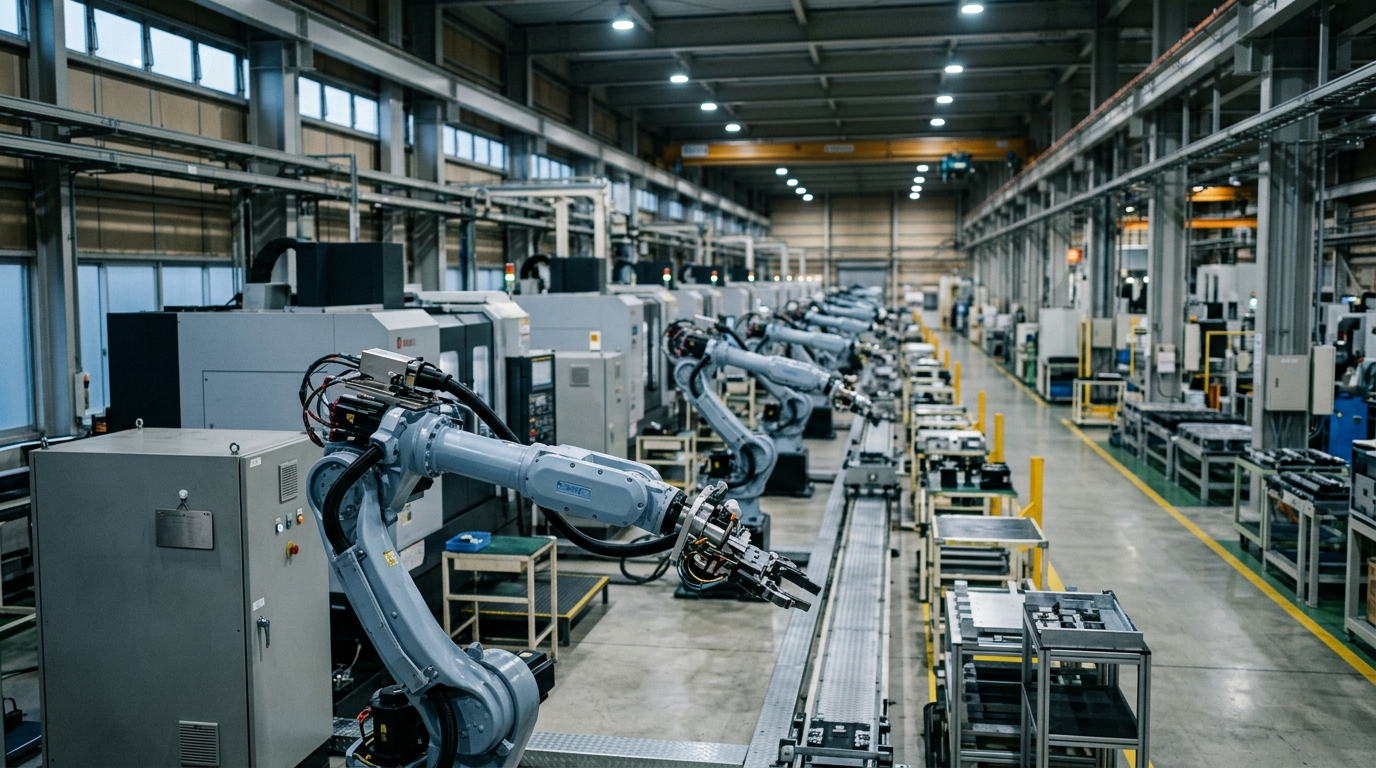
Japan is not short of industrial robots. It is short of a way to teach them from one another. The government and leading machinery makers will assign unique identifiers to individual pieces of factory equipment so machine learning systems can train on manufacturing data that currently stops at each vendor's wall. The plan, disclosed on 21 September 2026, treats a milling center, a press, or a robot arm the way the state already treats a resident: as a named object whose history can be collected, compared, and reused. That is a more consequential bet than another humanoid prototype, because physical artificial intelligence (AI) does not fail first on motors. It fails on unlabeled, unshared, unrepeatable shop floor data.
Procurement teams already know the hardware. FANUC Corporation, Yaskawa Electric Corporation, Kawasaki Heavy Industries, DMG Mori, and Komatsu have spent decades putting machines into plants that run three shifts. What they have not built is a common language for what those machines did yesterday. A welding cell from one vendor cannot easily donate its process traces to a handling cell from another. A plant in Kyushu cannot cheaply reuse a process window discovered in Aichi. The new identity layer is an attempt to turn Japan's installed base into a training set rather than a museum of incompatible logs.
The Data Problem Hiding Inside a Robot Superpower
Japan still makes a large share of the world's industrial robots. That fact has become a comfort story, and it is the wrong one. The country can ship arms, controllers, and servo packages. It cannot, as a default, pool the messy traces those products generate once they are bolted to a customer's line. Physical AI, the class of models that must plan and act in factories, warehouses, and other physical sites, needs those traces at volume. Isolated original equipment manufacturer (OEM) data lakes do not provide volume. They provide fragments.
The Monday plan attacks that fragment problem at the asset, not at the algorithm. Unique IDs will be assigned to individual equipment across producers. In the Japanese formulation, the ID is analogous to My Number, the national identifier used for residents. The analogy is political as much as technical. It tells plant managers that the state wants a durable handle on machines the way it already wants a durable handle on people and corporations. It also tells robot vendors that the next competitive layer is not only a faster controller. It is whether their installed base can emit data that a national training stack can ingest.
That is a different bottleneck from the one Western humanoid firms advertise. Figure AI, Tesla, and their peers talk about home trials, warehouse hours, and foundation models. Those stories assume the robot is the data factory. Japan's story assumes the factory is already the data factory, and the robots are one class of machine among many that should contribute. A computer numerical control (CNC) mill that records spindle load, a press that records tonnage curves, and a robot that records joint torque are more useful together than any of them is alone. Cross manufacturer collection is the point. A single brand's cloud is not.
The 2040 industrial target sitting behind the plan is not new, and it should not be mistaken for Monday's news. Japan has already said it wants its AI robot industry to exceed 30 percent of the world market and to reach a scale of JPY 20 trillion, approximately US$130 billion at about JPY 154 per US$1. Those numbers are a policy ceiling, not evidence that the identity scheme will work. They do explain why Tokyo is willing to put a national numbering idea onto private factory iron. If the country cannot convert its machine tool and robot stock into training fuel, the 2040 share target is a slogan.
Why a Serial Number Is Not Enough
Every serious factory already tags assets. Maintenance software has serial numbers. Programmable logic controller (PLC) networks have node addresses. Robot controllers have software licenses. None of that is a national, cross producer identity that can follow a machine from the OEM floor to a customer's cell to a later rebuild. Serial numbers are local. They break when a line is sold, when a controller is swapped, or when a systems integrator copies a program without copying the metadata.
A common ID is an attempt to make the machine a first class data citizen. If two FANUC arms and one Yaskawa arm and a DMG Mori mill can emit traces against a shared identifier scheme, a model can learn that a certain vibration signature precedes a tool change regardless of who painted the cabinet. That is the operational prize. It is also the governance risk. Plants will ask who stores the traces, who can query them, whether a competitor can infer a process recipe, and what happens when a machine is exported. Those questions are not answered in the public lede. They will decide whether the scheme is a training corpus or a compliance headache.
The industrial names attached to the effort show how wide the net is supposed to be. DMG Mori and Komatsu sit in the machinery core. FANUC and Yaskawa sit in robots. Honda, Sony, SoftBank Group, and NEC appear in the related industrial set because physical AI in Japan is being framed as a national stack, not a robot company product line. About 100 companies are grouped with DMG Mori in the Japanese account of the collection effort. That figure should be read as a coalition size, not as 100 signed data sharing contracts. Coalition press is easy. Cross vendor schemas are not.
Buyers should separate three layers that vendors will try to blur. The first is identity: a durable ID on the machine. The second is telemetry: what the machine is allowed to emit, at what frequency, with what masking of recipes. The third is model rights: who owns a policy trained on that telemetry, and whether a plant can take the model with it if it changes robot brands. Japan can mandate the first more easily than the second or third. A My Number for machines without a data contract is just a nicer nameplate.
The comparison with China and the United States is not about who has more humanoids. China has been concentrating humanoid training in shared centers and high volume pilots. The United States has been concentrating data inside a few robot and car companies that own both the body and the fleet. Japan is trying a third path: keep the fragmented OEM market, keep the dense installed base, and stitch the machines together with identifiers so the data can move even if the brands do not. If that path works, a mid sized auto supplier could contribute useful traces without building a humanoid. If it fails, Japan will have numbered its machines and still trained its models on simulations.
What Plant Buyers Should Demand Before the IDs Arrive
The practical test is not whether a ministry can print numbers. It is whether a production engineer can use another plant's anonymized process window without violating a customer confidentiality clause. That test has a short checklist.
First, ask which object the ID actually names. A robot arm, a controller, a cell, and a tool are four different things. If the ID sits only on the controller, a rebuilt arm inherits a history it did not earn. If it sits only on the mechanical unit, a software upgrade looks like a new machine. Procurement language should require the ID to cover the combination that actually produces the trace: mechanical unit plus controller plus major end effector, with a recorded change log.
Second, ask for a minimum telemetry set that is useful across vendors. Joint torque, cycle time, fault codes, energy draw, and a coarse process family (weld, pick, mill, press) are more valuable than a proprietary 200 field dump that only one OEM can parse. Physical AI teams waste months mapping vendor schemas. A national ID that still requires a custom parser per brand is theater.
Third, insist on a plant level off switch. Some traces are a competitive asset. A battery line's coating recipe is not a public good. The scheme only survives if a customer can contribute degraded or delayed data, or contribute only failure modes, without being treated as a non participant. A binary in or out rule will push the best plants out.
Fourth, treat model provenance as a commercial term. If a foundation model for robots is trained on a coalition corpus, a buyer needs to know whether that model is licensed, whether it can run on premises, and whether switching from Yaskawa to FANUC later requires a new license. Data that cannot follow the plant is a lock in device wearing a national policy badge.
Fifth, do not confuse this identity plan with last week's product news. FANUC has already shown an AI welding agent that reads drawings and writes arc programs, with customer shipments aimed at the end of December 2026. Yaskawa has been putting more autonomy into assembly cells. Those products can benefit from a national corpus. They do not replace it. A welding agent that only learns from FANUC sites will plateau. A national ID is how Japan tries to stop that plateau without forcing a single robot champion.
The hard truth is that Japan has tried industrial data commons before, in bits and pilots, and most of them died in the space between OEM cloud terms and customer legal teams. Numbering machines does not repeal that history. It does raise the cost of sitting out, because a plant that refuses the ID may find itself outside the training distribution that future robot software expects. Software that was trained on numbered, cross vendor traces will behave worse on a dark, unnamed cell. That is how a data standard becomes a de facto purchasing requirement.
For ASEAN factories that buy Japanese robots, the implication is immediate even if the ID scheme is domestic first. Integrators will start asking whether a line in Johor or Batam can emit traces in the same schema as a line in Kitakyushu. Buyers who specify Japanese arms without specifying data rights will discover that the valuable layer has moved from the gearbox to the identifier. The robot still matters. The nameplate now matters more.
A factory that cannot name its machines cannot teach the next ones. Japan has decided that the missing piece in physical AI is not another demonstration of a robot walking. It is a registry of the iron that already works, written in a form a model can read.
This analysis synthesizes company statements and public market activity.
This article is for informational purposes only and does not constitute investment, legal, or procurement advice.