Japan Airlines Runs a Two-Year Humanoid Robot Trial at Haneda to Address a Baggage Handling Workforce That Is Running Out
Japan Airlines has launched a two-year pilot program through 2028 deploying humanoid robots for baggage and cargo handling on the tarmac at Tokyo Haneda Airport. The trial, run in partnership with GMO Internet Group, directly addresses Japan's severe aviation workforce shortage and positions JAL as the first major Asian airline to test humanoid robots in a live airport operations environment.

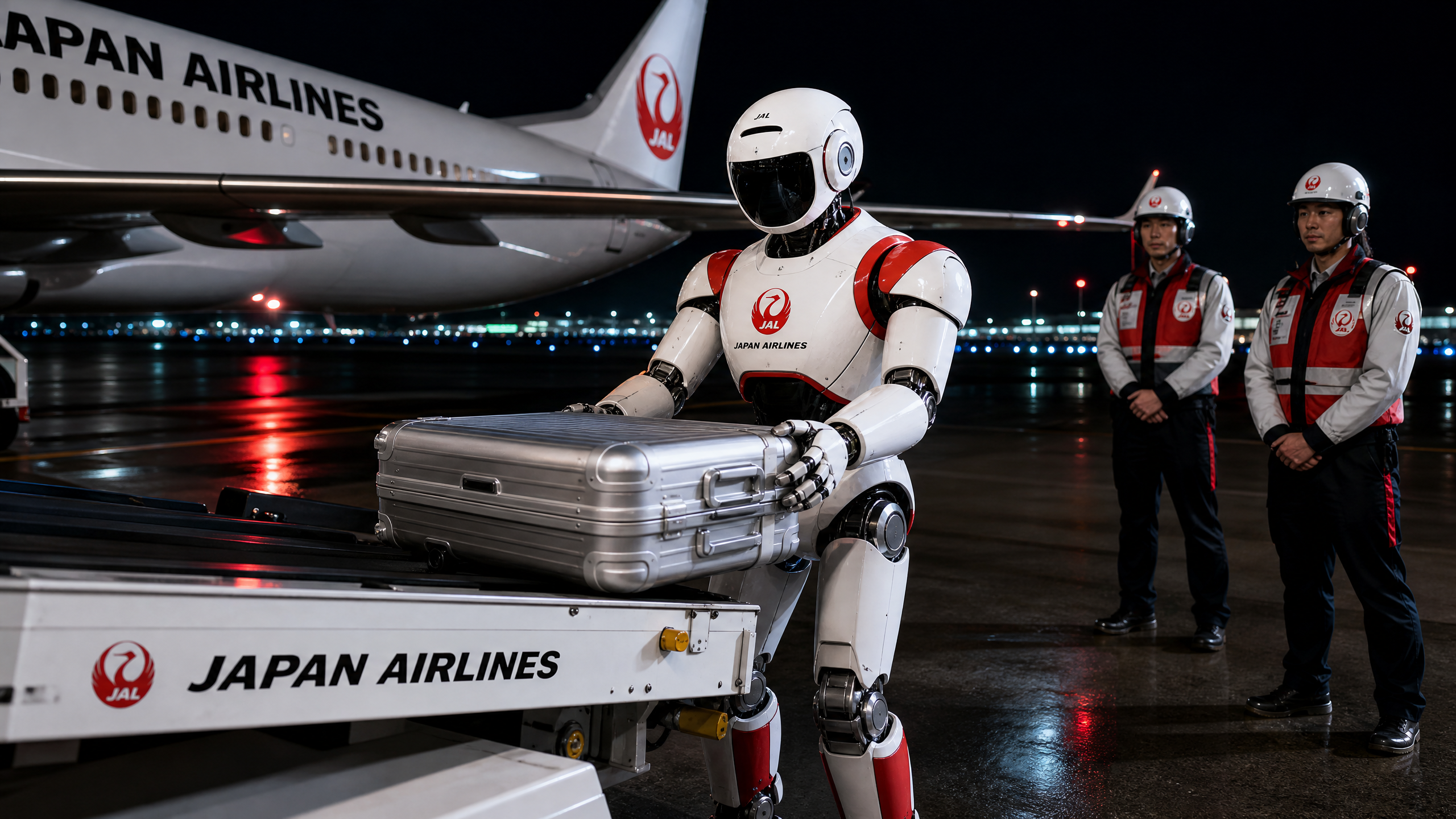
Japan Airlines has begun a two-year pilot program deploying humanoid robots for baggage and cargo handling on the tarmac at Tokyo Haneda Airport. The trial, which runs through 2028, is being conducted in partnership with GMO Internet Group and targets the most physically demanding and weather-exposed segment of airport ground operations -- the movement of luggage and cargo between aircraft and terminal facilities. JAL is the first major Asian airline to test humanoid robots in a live airport operations environment, and the results of the Haneda trial will be closely watched by the global aviation industry.
The deployment is a direct response to Japan's aviation workforce shortage, which has become acute enough to affect flight schedules and ground handling capacity at major airports. Japan's working-age population has been declining for more than a decade, and the aviation sector -- which requires workers who can perform physically demanding tasks in outdoor environments, often at night and in adverse weather -- has been particularly hard hit. The humanoid robot trial is not a technology experiment for its own sake. It is an operational response to a staffing problem that conventional recruitment and retention measures have not been able to solve.
The Workforce Mathematics
Japan's demographic trajectory makes the aviation workforce shortage structural rather than cyclical. The country's working-age population (ages 15-64) peaked in the mid-1990s and has been declining since. The total fertility rate has been below the replacement level of 2.1 for more than 50 years, and immigration has not been sufficient to offset the demographic decline. The result is a labor market where the supply of workers for physically demanding, outdoor, irregular-hours jobs is shrinking while the demand from a recovering aviation sector is growing.
The aviation sector's specific challenges compound the general labor shortage. Ground handling is physically demanding, requiring workers to lift heavy bags, work in extreme temperatures, and maintain precise timing under pressure. The work is often performed at night or in the early morning hours, which limits the pool of workers willing to take the positions. And the safety requirements of airport operations mean that training periods are long and the tolerance for errors is low, which increases the cost of workforce turnover.
Humanoid robots are not a perfect solution to these challenges. They are expensive, require maintenance, and cannot yet match the dexterity and adaptability of human workers in all situations. But they can work in adverse weather without fatigue, they do not require breaks, and they can be deployed in shifts that align with flight schedules rather than human labor availability. For the specific task of moving standardized baggage containers between aircraft and terminal facilities, the case for automation is stronger than for tasks that require more varied manipulation.
The Haneda Environment
Tokyo Haneda Airport is one of the busiest airports in Asia, handling more than 80 million passengers per year before the COVID-19 pandemic and recovering toward those levels since. The airport operates 24 hours a day, with peak activity in the early morning and late evening hours when long-haul international flights arrive and depart. The tarmac environment is exposed to Tokyo's full range of weather conditions, including summer heat and humidity, winter cold, and the heavy rain of the typhoon season.
This environment is more demanding than the controlled warehouse and factory settings where most humanoid robot deployments have been tested. The variability of outdoor conditions -- changing light levels, wet surfaces, wind, and temperature extremes -- creates challenges for the sensors and control systems that humanoid robots rely on for navigation and manipulation. The Haneda trial will generate data on how well current-generation humanoid robots handle these conditions, which is valuable information for the entire industry.
The partnership with GMO Internet Group brings telecommunications and digital infrastructure expertise to the trial. Reliable connectivity is essential for humanoid robots operating in a large, complex environment like an airport tarmac, where the robots need to communicate with central management systems, receive updated instructions, and report status in real time. GMO's involvement suggests that JAL is treating the trial as a systems integration challenge as much as a robotics challenge.
The Competitive Context in Aviation
JAL's Haneda trial is happening against a backdrop of divergent approaches to humanoid robots in the global aviation industry. In the United States, Delta and United Airlines have joined Southwest in banning humanoid and pet-like robots from passenger cabins and checked luggage, citing safety concerns about large lithium-ion batteries and potential evacuation hazards. The US airlines' position is focused on passenger-facing robots -- the kind that might be brought onto aircraft by passengers -- rather than ground handling robots operated by the airline itself.
The distinction matters because it illustrates that the aviation industry's relationship with humanoid robots is not uniformly negative. The US airlines' ban is about passenger safety in the cabin, not about the operational use of robots in ground handling. JAL's Haneda trial is about ground handling, which is a different application with different safety considerations and a different risk profile.
The contrast also reflects the different labor market conditions facing US and Japanese airlines. US airlines are operating in a labor market that, while tight, has not reached the structural shortage levels that Japan faces. The urgency of automation is lower in the US context, which may explain why US airlines are more cautious about humanoid robot adoption than their Japanese counterparts.
Defining Success Criteria for the Two-Year Trial
The two-year timeline of the Haneda trial is long enough to generate meaningful operational data but short enough that JAL will need to define clear success criteria at the outset. The most important metrics are likely to be reliability -- what percentage of the time does the robot complete its assigned task without human intervention -- and throughput -- how many bags per hour can the robot process compared to a human worker.
Secondary metrics will include maintenance costs, energy consumption, and the impact on overall ground handling efficiency. If the robots are reliable but slow, they may be useful for off-peak periods but not for the high-pressure turnaround times of peak operations. If they are fast but require frequent maintenance, the total cost of ownership may not justify the investment.
The honest assessment is that the current generation of humanoid robots is likely to fall short of human performance on most of these metrics in the first year of the trial. The value of the trial is not in deploying a fully capable system today -- it is in generating the operational data and experience that will inform the design of the next generation of systems. JAL is investing in learning, not just in automation, and the return on that investment will be measured over years rather than months.
--- Disclaimer: This article is for informational purposes only and does not constitute financial or investment advice.