
Insta360 Enters Consumer Robotics with Autonomous AI Cameraman
Insta360 has officially entered the consumer robotics market, announcing the formation of a dedicated robotics team on its 11th anniversary. The company unveiled its vision for an AI powered Cameraman robot, scheduled for launch in the second half of 2027. This move signals a significant expansion for the camera manufacturer, leveraging its expertise in imaging and AI to create an autonomous filming agent.
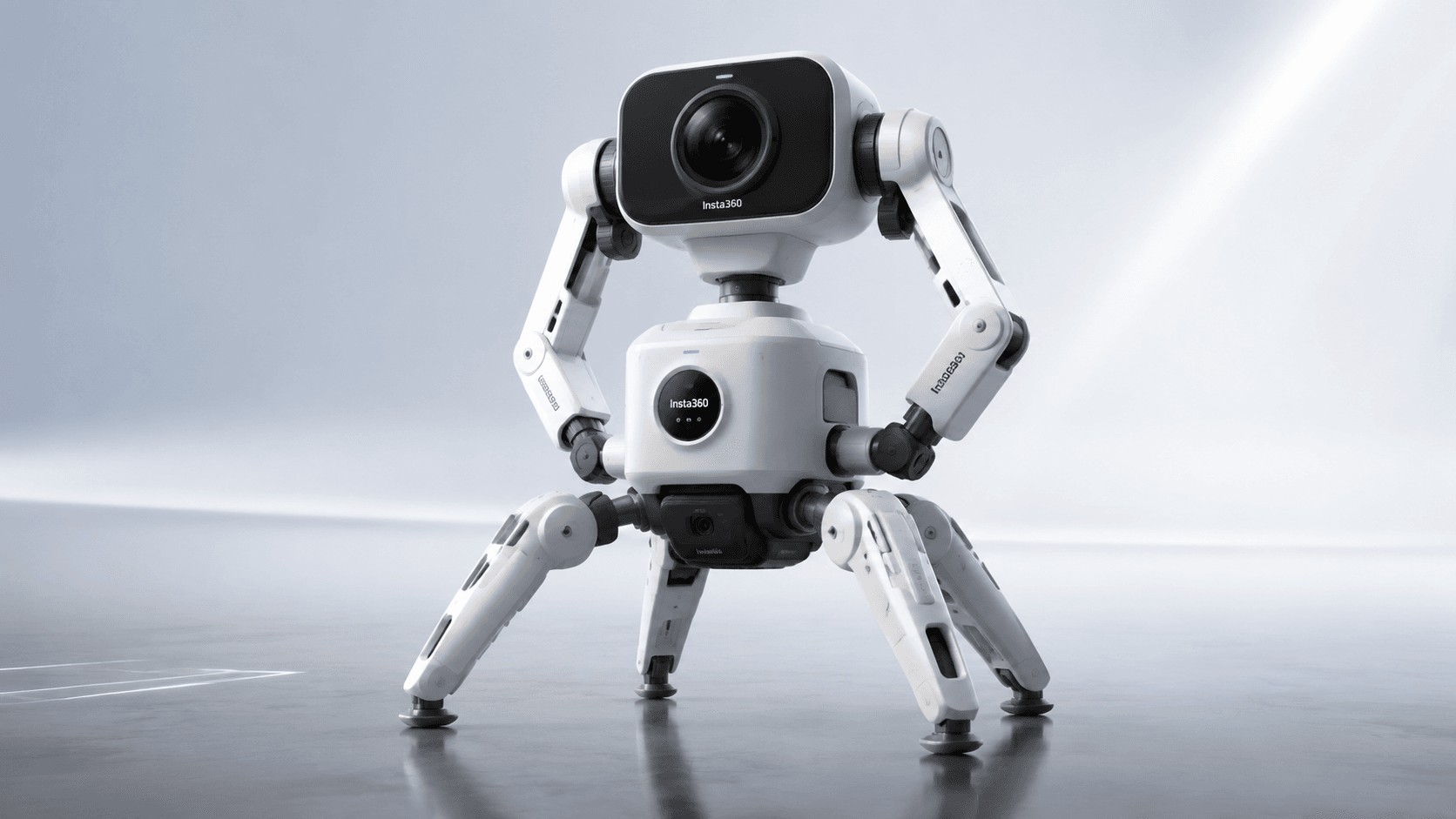
Insta360 has committed nearly 100 engineers to building an autonomous filming robot that the company describes as an AI Cameraman, scheduled for consumer launch in the second half of 2027. The announcement, made on the company's 11th anniversary, marks the formal entry of a major consumer electronics manufacturer into the robotics sector. The project has been in development for 18 months, suggesting that the decision to enter robotics was made in early 2025 when the convergence of affordable compute, capable foundation models, and mature sensor technology made consumer grade autonomous systems technically feasible for the first time.
Insta360, headquartered in Shenzhen and known globally for its 360 degree cameras and action cameras, generates annual revenue exceeding 1 billion dollars. The company has built its brand on imaging innovation, progressing from panoramic cameras to AI powered editing software to the current vision of an autonomous physical device that can film without human direction. The robotics team includes core members recruited from DJI, Ecovacs, and Horizon Robotics, three companies that collectively represent China's deepest pools of expertise in autonomous navigation, consumer robotics, and edge AI computing.
The Convergence of Imaging and Embodied Intelligence
The Cameraman project represents a category that does not yet exist in the consumer market. Existing camera products require human operation, whether handheld, mounted on a gimbal, or attached to a drone. Each requires a human to make framing decisions, tracking decisions, and movement decisions. The AI Cameraman concept removes the human operator entirely, creating an autonomous agent that makes filming decisions based on scene understanding, subject tracking, and compositional rules learned from millions of hours of professional footage.
The technical requirements for this product span multiple domains of robotics. The device must navigate physical spaces without colliding with obstacles or people. It must track moving subjects while maintaining stable, smooth camera motion. It must make real time compositional decisions about framing, angle, and focal length. And it must do all of this while remaining small, quiet, and unobtrusive enough for consumer environments including homes, events, and outdoor activities.
Insta360's existing product line provides several of the necessary building blocks. The company's AI algorithms for subject tracking, scene recognition, and automatic editing are already deployed in its current camera products. The Luna Ultra dual camera gimbal represents an intermediate step toward the full Cameraman vision, combining AI driven tracking with motorized camera movement. Panoramic drones serve as early prototypes for the navigation and spatial awareness capabilities that the final product will require.
Talent Acquisition from Legacy Robotics Manufacturers
The composition of the robotics team reveals Insta360's strategic priorities. Engineers from DJI bring expertise in autonomous flight control, obstacle avoidance, and miniaturized sensor integration. DJI's consumer drones represent the closest existing product category to an autonomous filming robot, and the engineering challenges of stable flight, real time navigation, and subject tracking translate directly to ground based autonomous filming.
Engineers from Ecovacs bring expertise in consumer robotics at scale, including manufacturing optimization, cost reduction, reliability engineering, and the practical challenges of deploying autonomous machines in uncontrolled home environments. Ecovacs ships millions of robot vacuum cleaners annually, and the operational lessons from that scale, including dealing with edge cases, firmware updates, and customer support for autonomous products, are directly relevant to a consumer robotics launch.
Engineers from Horizon Robotics bring expertise in edge AI computing, specifically the design of low power neural processing units that can run complex AI models on battery powered devices. The Cameraman robot must process visual data, run tracking algorithms, execute navigation planning, and generate motor commands simultaneously on a device small enough to be portable and efficient enough to operate for extended periods on battery power.
Pricing Strategies for Mass Market Adoption
Insta360 has not announced pricing for the Cameraman robot, but the company's existing product portfolio provides context for its likely positioning. Insta360's flagship cameras retail between 300 and 800 dollars, with professional accessories pushing total system costs above 1,000 dollars. A consumer robotics product with autonomous navigation, AI filming, and professional grade image quality would likely need to retail below 2,000 dollars to achieve mass market adoption, and ideally below 1,500 dollars to reach the enthusiast consumer segment that forms Insta360's core customer base.
Achieving this price point while incorporating the necessary sensors, compute, actuators, and battery capacity represents a significant engineering challenge. Consumer drones with comparable autonomous capabilities retail between 1,000 and 3,000 dollars, suggesting that the target price range is technically achievable but will require aggressive cost optimization in component selection and manufacturing processes.
The consumer robotics market has historically struggled with products that are technically impressive but commercially unsuccessful due to high prices, limited utility, or poor reliability. Sony's Aibo, Jibo, and numerous social robot startups demonstrated that consumers are willing to pay for robotic products only when the utility is clear, consistent, and significantly better than non robotic alternatives. The Cameraman concept has a clear utility proposition, autonomous filming, that addresses a genuine consumer need. The question is whether the execution can deliver on that proposition at a price and reliability level that sustains repeat purchase and positive word of mouth.
The Consumer Robotics Market Expansion
The entry of a billion dollar consumer electronics company into robotics signals a broader trend. Consumer robotics is expanding beyond utility products like vacuum cleaners and lawn mowers into creative and social applications. The common thread is that advancing AI capabilities are making autonomous behavior reliable enough for consumer environments where failure tolerance is low and user expectations are high.
For the robotics industry more broadly, Insta360's entry validates that the underlying technologies, including computer vision, path planning, and edge AI inference, have reached the cost and reliability thresholds necessary for consumer products. Technologies that prove themselves in consumer markets eventually migrate to commercial and industrial applications as costs decline and capabilities improve. An autonomous filming robot that works reliably in a home environment demonstrates capabilities that are directly transferable to inspection, monitoring, and documentation tasks in commercial settings.
The Practical Reality of Consumer Autonomous Systems
Consider the difference between a security camera mounted on a wall and a security guard walking a patrol route. The camera sees everything within its fixed field of view but cannot investigate anomalies or change perspective. The guard can move to investigate, change angles, and make judgment calls about what deserves attention. The AI Cameraman occupies the same conceptual space as the guard, providing active, intelligent coverage rather than passive, fixed recording.
This active intelligence is what distinguishes a robotics product from a camera product. The value is not in the image sensor or the lens. The value is in the autonomous decision making that determines what to film, when to film it, and how to frame it. Insta360's 11 years of imaging expertise provides the what and how. The robotics team provides the autonomous where and when.
The commitment of 100 engineers and 18 months of development to a consumer robotics product confirms that Insta360 views autonomous physical devices as the next evolution of its imaging business. The H2 2027 launch timeline provides sufficient development runway for a product that must meet consumer expectations for reliability, ease of use, and value. The talent acquisition from DJI, Ecovacs, and Horizon Robotics provides the engineering foundation necessary to execute on that timeline.
The distribution strategy for a consumer robotics product differs significantly from camera distribution. Cameras are sold through electronics retailers, camera specialty stores, and online marketplaces. A robotics product may require demonstration, setup assistance, and ongoing software support that traditional retail channels are not equipped to provide. Insta360's direct to consumer online sales channel provides more control over the customer experience, but limits reach compared to retail distribution. The company will likely need to develop new retail partnerships or create dedicated experience centers to support the Cameraman launch, adding to the go to market investment required.
The software moat for an autonomous filming robot is potentially deeper than for most consumer electronics products. The AI models that determine filming decisions, including subject selection, framing composition, movement timing, and scene transitions, improve with data. Every filming session generates training data that can be used to refine the models. A product that ships earlier and accumulates more user hours will develop better filming intelligence than a later entrant, creating a data network effect that compounds over time. This dynamic favors Insta360's strategy of launching a minimum viable product in H2 2027 and iterating rapidly based on user data.
This analysis synthesizes corporate announcements, product roadmap disclosures, and public market activity as of July 2026.














