
Hitachi and NVIDIA Build HMAX Orchestration Layer for Physical-AI Operations
Hitachi and NVIDIA are collaborating to develop a multi-agent orchestration platform that integrates Hitachi's IWIM with NVIDIA Cosmos, NemoClaw, and Nemotron to enable safe, secure, and sovereign-enabled multi-agent orchestration in physical environments.
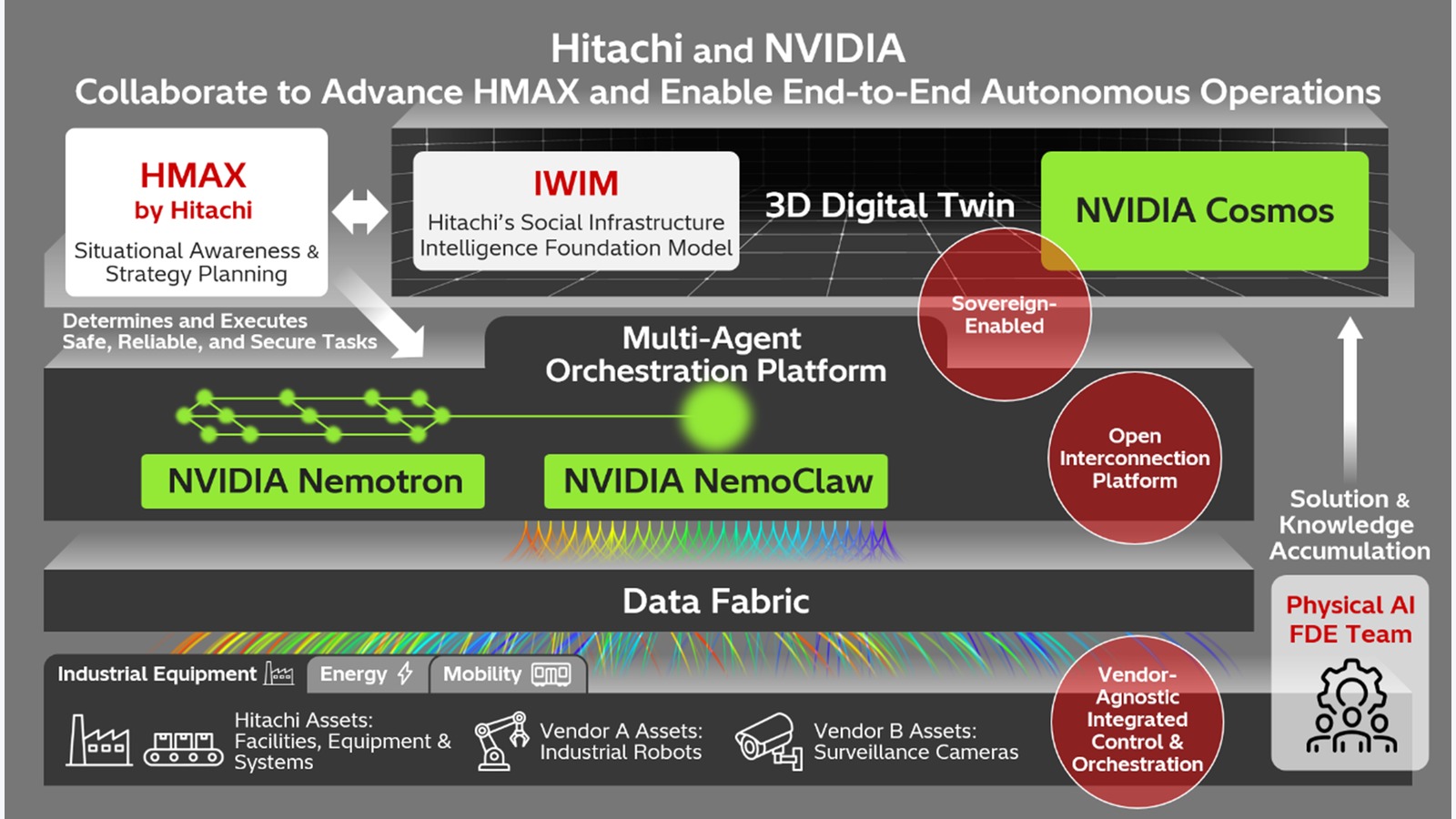
The industrial automation sector is confronting a structural shift. As the deployment of intelligent machines accelerates, the primary challenge is no longer adding intelligence to a single robot, but rather coordinating heterogeneous machines and software agents across complex operational environments. The focus is shifting from individual capability to systemic orchestration. This transition requires a fundamental rethinking of how industrial facilities are designed, operated, and maintained. The era of isolated automation islands is giving way to interconnected ecosystems where diverse physical and digital entities must collaborate seamlessly to achieve operational objectives. The complexity of these environments demands a new approach to control and optimization, one that transcends the limitations of traditional, siloed systems.
What is the Hitachi and NVIDIA multi-agent orchestration platform?
Hitachi and NVIDIA are collaborating to develop a multi-agent orchestration platform that integrates Hitachi's Integrated World Infrastructure Model (IWIM) with NVIDIA Cosmos, NemoClaw, and Nemotron. The platform aims to enable safe, secure, and sovereign-enabled multi-agent orchestration in physical environments, targeting manufacturing and social infrastructure.
The Shift to Systemic Orchestration
On July 16, 2026, Hitachi, Ltd., a global conglomerate headquartered in Tokyo, Japan, with core technologies spanning operational technology (OT) and information technology (IT) for industrial and social infrastructure, announced a collaboration with NVIDIA to develop a multi-agent orchestration platform. The platform connects Hitachi's Integrated World Infrastructure Model (IWIM) with NVIDIA Cosmos world foundation models to simulate physical constraints and mission-critical safety rules. It also utilizes NVIDIA NemoClaw for autonomous inter-agent communication and task delegation, and NVIDIA Nemotron for real-time monitoring and coordinated control of diverse facilities and equipment. Hitachi's Physical AI Forward Deployed Engineer (FDE) Team, which combines the digital engineering capabilities of its U.S. subsidiary GlobalLogic with Hitachi's OT expertise, will provide hands-on support for real-world implementation. The technology targets manufacturing and social infrastructure environments, including mission-critical environments. Discussions have already begun with several companies, including global leaders in industrial robotics, regarding participation in the ecosystems.
The Economics of Attritable Mass
The orchestration problem is fundamentally an economic one. Realizing advanced Physical AI requires seamless interconnection and integrated control of diverse Agentic AI systems, heterogeneous robots, and a wide range of equipment operating within operational environments. To interconnect such diverse edge environments, vendor-neutral, globally available open software is essential, alongside closed large language model (LLM) environments that ensure sovereignty to prevent the exposure of proprietary corporate data assets. The collaboration aims to create a vendor-agnostic model for end-to-end operational optimization and autonomy. By combining Hitachi's OT expertise and IWIM with NVIDIA's AI technologies, the platform seeks to enable safe, secure, and sovereign-enabled multi-agent orchestration in physical environments. The economic imperative is clear: operators must maximize the utilization of their existing assets while seamlessly integrating new, intelligent machines to drive productivity and efficiency gains. The cost of failing to orchestrate these systems effectively is measured not just in lost productivity, but in increased operational risk and reduced competitiveness.
The Gap Between Demo Performance and Deployment Reality
The gap between demo performance and deployment reality is often bridged by robust orchestration. The platform must integrate legacy equipment with the latest robots from different manufacturers. This requires balancing open interconnectivity with sovereignty that protects domain knowledge and confidential information. The Physical AI FDE Team will provide hands-on support for real-world implementation, ensuring that the theoretical benefits of multi-agent orchestration translate into tangible operational improvements. The deployment reality is that industrial environments are messy, unpredictable, and constantly evolving. A platform that can adapt to these dynamic conditions while maintaining strict safety and security protocols is essential for bridging the gap between laboratory demonstrations and real-world utility. The ability to simulate physical constraints and mission-critical safety rules in advance, as enabled by the integration of IWIM and Cosmos, is a critical capability for mitigating the risks associated with deploying advanced AI systems in physical environments.
Translating Technical Complexity into Human Stakes
Imagine a busy airport where every vehicle, from baggage carts to fuel trucks, is driven by a different company, speaking a different language, and following different rules. If they cannot communicate and coordinate, chaos ensues. The Hitachi and NVIDIA platform acts as the universal air traffic controller, ensuring that all these diverse machines can work together safely and efficiently, without compromising the proprietary secrets of the companies that own them. This is the essence of multi-agent orchestration in physical environments. It is about creating a shared understanding of the operational environment and enabling diverse entities to collaborate towards a common goal, much like a well-rehearsed orchestra following the lead of a conductor. The human stakes are high: effective orchestration not only improves operational efficiency but also enhances safety by reducing the likelihood of accidents and malfunctions caused by miscommunication or conflicting objectives.
The Reality of Sovereign Control
While the promise of open interconnectivity is appealing, the reality is that industrial operators will not adopt systems that compromise their proprietary data. The hard truth is that sovereignty is a prerequisite for scale. The platform addresses this by combining globally available open software with closed LLM environments, ensuring that domain knowledge and confidential information remain secure. This approach acknowledges that in mission-critical environments, security and control are just as important as intelligence and autonomy. Operators must retain ownership of their data and the ability to dictate how it is used, shared, and protected. Without this assurance, the adoption of advanced Physical AI will remain limited to isolated pilot projects rather than enterprise-wide deployments. The integration of NVIDIA OpenShell provides a secure runtime environment that further reinforces this commitment to sovereign control, enabling operators to deploy AI models with confidence.
Platform Architecture and Ecosystem Positioning
The following table outlines the core components of the Hitachi and NVIDIA HMAX platform and provides an illustrative comparison with other industrial orchestration initiatives.
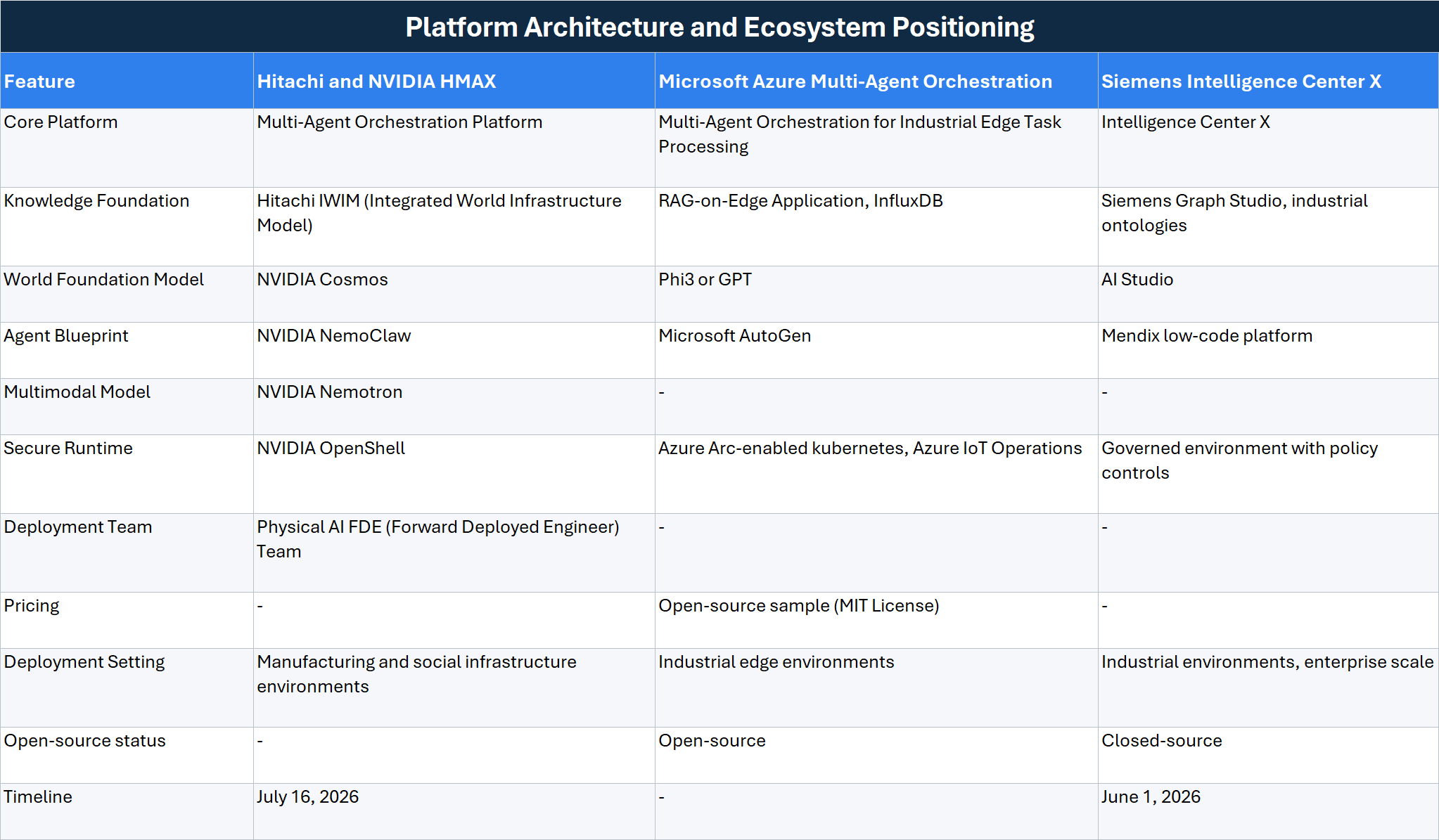
Note: The Microsoft Azure comparison is based on an open-source sample repository and serves as an illustrative reference point rather than a direct commercial competitor.
The Operational Imperative
"The collaboration aims to create a vendor-agnostic model for end-to-end operational optimization and autonomy." This insight underscores the strategic intent behind the platform. It is not merely about connecting machines; it is about creating a unified operational environment where diverse systems can collaborate seamlessly to achieve complex objectives. The operational imperative is to move beyond the limitations of proprietary, closed ecosystems and embrace a more open, interoperable approach that fosters innovation and accelerates the adoption of advanced automation technologies. The ability to orchestrate multiple AI agents safely and securely is a foundational capability for realizing the full potential of Physical AI in industrial settings.
Strategic Implications for Industrial Operators
For procurement teams and operations leaders, the development of the Hitachi and NVIDIA platform signals a shift in how industrial automation should be evaluated. The focus must expand beyond the capabilities of individual robots to encompass the orchestration layer that coordinates them. Operators must assess whether their existing infrastructure can support multi-agent orchestration and whether their chosen vendors are committed to open interconnectivity and sovereign control. The ability to integrate legacy equipment with new AI-driven systems will be a critical determinant of operational agility and competitiveness.
The transition from isolated automation to systemic orchestration is underway. The Hitachi and NVIDIA collaboration provides a blueprint for how this transition can be managed safely and securely in mission-critical environments. As the industrial automation landscape continues to evolve, the ability to orchestrate diverse physical and digital assets will become a key differentiator for organizations seeking to optimize their operations and maintain a competitive edge in an increasingly complex and dynamic global market. The successful deployment of multi-agent orchestration platforms will require a concerted effort from technology providers, industrial operators, and regulatory bodies to establish the necessary standards, protocols, and best practices that ensure the safe, secure, and efficient operation of these advanced systems. The role of the Physical AI FDE Team in providing hands-on support for real-world implementation highlights the importance of bridging the gap between technological innovation and operational execution.
This analysis synthesizes company statements and public market information.
Disclaimer: This article is provided for informational purposes only and does not constitute investment, financial, legal, procurement, or other professional advice. Readers should verify specifications, pricing, availability, regulatory requirements, and commercial terms directly with the relevant company or authority before making decisions.














