
China Embodied AI Model Explosion Shifts Competition to Software
Chinese research labs and startups released 13 distinct embodied AI foundation models within a single 30-day window (June/July 2026), including BAAI's Wujie Physis, RoboBrain's Orca, Alibaba's Qwen Robot, and CasiaHand Brain Si. The article argues this signals competition has shifted from hardware manufacturing to software ecosystem control. Most models are open source, following the same market-capture playbook used in LLMs. The piece analyzes fragmentation risk, the global competitive response (NVIDIA Isaac, DeepMind, Tesla), and implications for vendor evaluation.
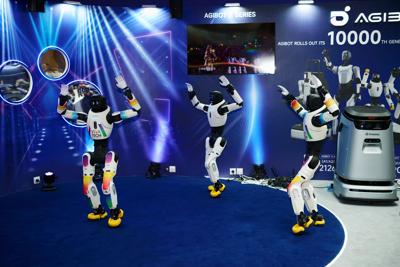
Chinese research institutions and robotics startups released 13 distinct embodied AI foundation models within a single 30 day window spanning June and July 2026. The volume is unprecedented in any national robotics ecosystem and signals that competition in the Chinese humanoid robot sector has shifted decisively from hardware manufacturing to software infrastructure. For procurement managers and automation buyers evaluating Chinese robotics vendors, this model proliferation changes the vendor selection calculus. The question is no longer which manufacturer builds the best hardware, but which software ecosystem will become the standard operating layer for embodied intelligence across multiple hardware platforms.
The Beijing Academy of Artificial Intelligence (BAAI), China's premier government backed AI research institution headquartered in Haidian District, released Wujie Physis v0.1 as an open source embodied AI foundation model. BAAI operates as a national laboratory with direct funding from the Ministry of Science and Technology and serves as the upstream research provider for dozens of commercial robotics companies.
The Model Proliferation Pattern
The 13 models released in this period span the full stack of embodied intelligence, from low level motor control to high level task planning. BAAI's Wujie Physis focuses on physics simulation and world modeling, enabling robots to predict the consequences of their actions before executing them. RoboBrain's Orca model targets multi modal perception, combining vision, language, and proprioception into a unified representation. Alibaba's Qwen Robot suite extends the company's large language model architecture into physical manipulation tasks.
Additional releases include CasiaHand Brain Si 0.5 for dexterous manipulation, GalaxyBot AstraBrain WBC 0.5 for whole body coordination, RoboScience Visics and VLOA for visual locomotion, Current Robotics Curl 0 for reinforcement learning based control, and BoundlessPower MWA for multi workspace adaptation. Each model addresses a different layer of the embodied intelligence stack, and several are designed to be composable, meaning they can be combined into a complete robot operating system.
The pattern is not random. It reflects a coordinated national strategy to establish Chinese software standards for embodied AI before international competitors can lock in their own ecosystems. The Ministry of Industry and Information Technology's 2025 directive on humanoid robot development explicitly called for open source foundation models as a national priority, and the current wave of releases represents the first tangible output of that directive.
Open Source as Market Capture Strategy
The majority of these 13 models are released under permissive open source licenses, following the same playbook that Chinese AI companies used successfully in large language models. The strategy is straightforward. By releasing powerful models freely, the originating institution establishes its architecture as the default standard. Hardware manufacturers adopt the free model rather than investing in proprietary alternatives. Once adoption reaches critical mass, the originating institution captures value through enterprise support contracts, cloud computing fees, and preferential access to model updates.
For international robotics companies, this creates a competitive challenge. Chinese hardware manufacturers can access world class embodied AI software at zero licensing cost, reducing their total development expenditure and accelerating time to market. International competitors must either develop equivalent models internally, which requires significant research investment, or license Chinese models, which creates dependency on a foreign software supply chain.
The practical implication for procurement teams is that Chinese humanoid robots entering the market in late 2026 and 2027 will likely offer more sophisticated AI capabilities at lower price points than their international equivalents. However, this advantage comes with supply chain risk considerations that buyers in regulated industries must evaluate carefully.
Integration Challenges for Hardware Manufacturers
The proliferation of 13 competing models in a single month also creates fragmentation risk. Hardware manufacturers must choose which model ecosystem to adopt, and that choice may lock them into a specific software architecture that limits future flexibility. A robot designed around BAAI's Wujie Physis may not easily migrate to Alibaba's Qwen Robot suite if the market shifts.
This fragmentation mirrors the early Android ecosystem, where multiple hardware manufacturers adopted the same open source operating system but differentiated through custom software layers that often created compatibility problems. The embodied AI sector is likely to experience similar growing pains as manufacturers attempt to build proprietary advantages on top of shared open source foundations.
For automation buyers, the fragmentation risk means that vendor selection should consider not only the current capabilities of a robot's software stack, but also the long term viability and community support of its underlying model ecosystem. A model backed by BAAI with government funding and broad industry adoption carries lower abandonment risk than a model from a single startup with limited resources.
The Global Competitive Response
Outside China, the primary embodied AI model ecosystems are concentrated in a smaller number of well funded organizations. NVIDIA's Isaac platform, Google DeepMind's robotics research, and Tesla's Optimus training infrastructure represent the Western response, but none have released comparable open source foundation models at the scale China demonstrated in this 30 day period.
The asymmetry is structural. Chinese institutions are releasing models openly to capture ecosystem share, while Western companies are keeping their models proprietary to protect competitive advantage. Both strategies have merit, but they produce different market dynamics. The Chinese approach accelerates the entire domestic ecosystem at the cost of individual company differentiation. The Western approach preserves individual company value but slows ecosystem wide progress.
Translating Model Releases into Deployment Capability
Consider the difference between having access to a powerful engine and having a complete vehicle. These 13 models are engines. They provide the computational intelligence that robots need to perceive, plan, and act. But converting a model into a deployed robot requires additional engineering in hardware integration, safety systems, fleet management, and operational reliability. The model is necessary but not sufficient for commercial deployment.
Procurement teams should interpret this model explosion as a leading indicator rather than an immediate procurement trigger. The robots that incorporate these models will begin appearing in commercial trials in late 2026 and early 2027. The models themselves do not change the deployment timeline, but they do change the capability ceiling. Robots built on these foundations will be materially more capable than their predecessors, particularly in unstructured environments where adaptability matters more than precision.
The Structural Implication for Vendor Evaluation
The shift from hardware competition to software competition changes how automation buyers should evaluate Chinese robotics vendors. Previously, the primary differentiators were mechanical design, actuator quality, and manufacturing precision. Going forward, the primary differentiators will be software architecture, model selection, training data quality, and the ability to fine tune foundation models for specific industrial applications.
Vendors who demonstrate strong software engineering capabilities and deep integration with one of the leading model ecosystems will outperform those who rely solely on hardware excellence. The hardware is becoming commoditized. The software is becoming the moat.
The concentration of 13 model releases in a single month confirms that China's embodied AI ecosystem has entered a new phase. The hardware manufacturing base is established. The software infrastructure is now being built at national scale. The commercial implications will become visible in deployment data over the next 12 to 18 months.
The implications for international standards bodies are significant. If Chinese embodied AI models become the de facto standard for robot software, the training data, evaluation benchmarks, and safety validation methods embedded in those models will shape how robots behave globally. International standards organizations including ISO and IEC are beginning to develop frameworks for evaluating embodied AI systems, but the pace of model development is outrunning the pace of standards development. Procurement teams should monitor which models their vendors adopt and understand the implications of that choice for long term interoperability and regulatory compliance.
The training data requirements for embodied AI models present a distinct challenge compared to language or vision models. Language models can be trained on publicly available text from the internet. Embodied AI models require physical interaction data, meaning recordings of robots performing tasks in real environments with real objects. This data is expensive to collect, difficult to standardize, and impossible to scrape from the internet. The Chinese institutions releasing these models have invested heavily in simulation environments and real world data collection facilities, but the quality and diversity of their training data remains a critical differentiator that is difficult to assess from outside the organization.
The commercial timeline for these models to reach production deployment varies significantly by application domain. Models targeting warehouse logistics and structured manufacturing environments are closest to commercial readiness, with several Chinese vendors planning production deployments in late 2026. Models targeting unstructured environments such as construction sites, agricultural fields, and disaster response scenarios require substantially more development time due to the complexity of the physical interactions involved. Procurement teams should calibrate their expectations based on the specific application domain rather than treating all embodied AI models as equally mature.
This analysis synthesizes research institution announcements, government policy documents, and public market activity as of July 2026.














