China’s embodied AI champions invest while raising to lock supply chains
A new wave of Chinese embodied AI firms is investing in suppliers and peers while they raise their own capital. The strategy aims to secure components, data and talent during a short competitive window for humanoid and mobile robots.
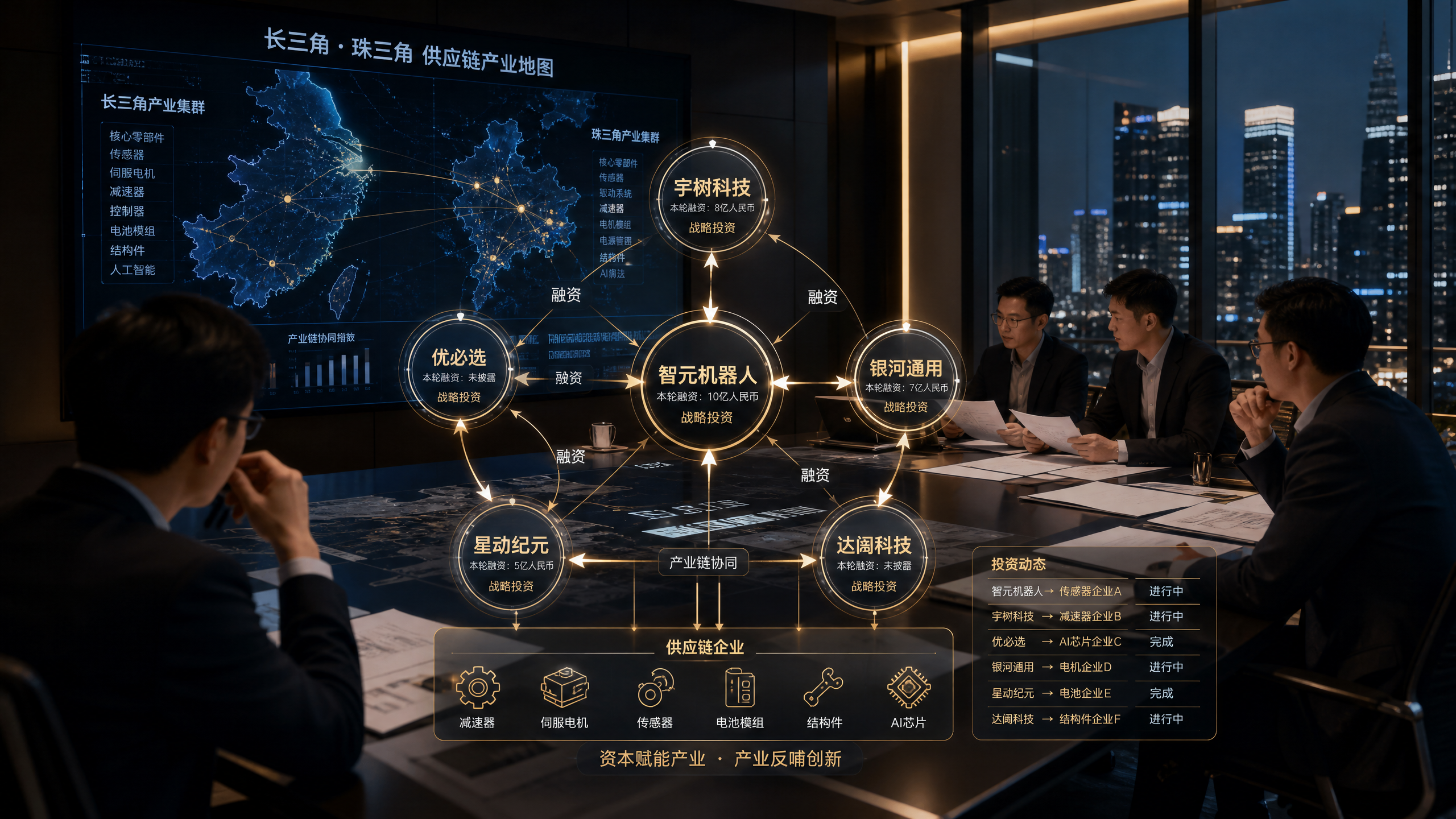
Twenty nine Chinese embodied AI companies have quietly become investors while still fundraising themselves, executing at least 125 equity deals across suppliers and peers. Seventeen are humanoid robot makers and 16 are unicorns, underscoring a fast capital play wrapped around component access and data control.
On August 4, five embodied AI players including Luming, Mifeng, Zibianliang, Songyan, and Zhiyuan jointly backed Kaiwang Data in China in a round described as hundreds of millions in RMB terms. Zhiyuan also known as AgiBot tops the corporate investor tally with 37 bets in 23 months or 1.6 per month.
A mainland headquartered humanoid specialist is setting the corporate investing pace
Zhiyuan also known as AgiBot is headquartered in mainland China and builds general purpose humanoid robots and control software for industrial and service scenarios. The company focuses on full stack embodied intelligence that spans motors, dexterous hands, robot brains and data platforms. Its niche is a modular humanoid platform with end-to-end training data pipelines for manipulation and mobility.
The firm has become the most active corporate investor among this cohort. Its deal flow spans component suppliers for actuators and servo drives, grasping and tactile systems for dexterous end effectors, controller boards and real time operating software, and data and simulation platforms that feed large policy models. The investment stance aligns with an engineering heavy approach where tight coupling between hardware and software can shorten iteration loops.
The capital leverage strategy behind the investments
The invest while raise phenomenon reflects a simple equation. These companies are racing to integrate dozens of fragile upstream parts into reliable humanoids and mobile platforms while the market attention window remains open. Equity checks into suppliers become a lever to secure volume, priority support and road map influence without waiting for slow contractual renegotiations.
Think of it as building a high-speed train while it is already rolling. Equity ties with brake makers, track sensors, and electrification providers help the operator keep the train on time even when demand spikes. For embodied AI, the critical suppliers are motors, gear reducers, torque sensors, power electronics, batteries, edge AI modules, optical depth cameras and haptic materials. Add to that the software and data partners that deliver perception, simulation, annotation and reinforcement learning at industrial scale.
Early-stage suppliers in actuators or data platforms often face lumpy orders and costly iterations. A strategic investment combined with non cancelable purchase plans can stabilize cash flow for the supplier and lower per unit costs for the robot maker. For the investor, even small ownership stakes can produce meaningful control through board seats, information rights and technical support agreements.
A coordinated push to secure core components and data
The August 4 Kaiwang Data deal is a marker of how embodied AI companies treat data as a first-class supply chain item. Five peer companies chose to pool capital into a single data provider to ensure access to high-quality robotic interaction datasets, labeling tools and synthetic augmentation pipelines. That is a supply chain move as much as a financial bet.
Data richness is oxygen for training policy networks that control grasping, walking and manipulation. Rich multi modal sequences that combine visual, force and proprioceptive signals are scarce in the wild. By co-investing into data specialists, robot makers can coordinate standards for dataset formats and simulation interfaces, reduce duplication and keep sensitive process data within trusted channels. It also counters a bottleneck that arises when general purpose AI data firms prioritize work on search or media and underinvest in robotics centric data schemas.
The humanoid cohort pushes a supplier consolidation bid
The data shows that 17 of the 29 investors are humanoid robot makers, which is not an accident. Humanoids require a denser bill of materials than wheeled logistics bots. They rely on high torque density motors, lightweight yet rigid structures, sensitive hands, and finely tuned control stacks. The failure of any single upstream piece can derail an entire demo schedule or pilot program with a factory customer.
That pressure drives humanoid companies to take stakes in motor manufacturers, harmonic reducer startups, compliant actuator designers and end effector houses. It also makes them more likely to co invest in shared service hubs such as calibration facilities, endurance testing labs and safety certification advisory firms. By spreading small checks across many upstream points, humanoid companies attempt to stitch together a domestic network that can withstand surges in demand and export pressure on parts sourced from abroad.
Early stage investing becomes a competitive necessity
A striking data point is the speed at which post 2023 firms began investing. The cohort launched after 2023 started writing checks an average of 22.8 months after founding. That is a sharp break from earlier generations where Siasun took about 16 years to start investing and UBTech took roughly 6.5 years. Rapid CVC activity is now part of the go to market plan rather than a late stage add on.
The timing reveals a belief that this is a narrow competitive window. Management teams are betting that the next two to three years will determine which platforms become reference designs for integrators and which software stacks become de facto standards for manipulation tasks. Investing early helps a company insert its software hooks into supplier firmware and influence chip selection outcomes, which can pay dividends when scaling.
Unicorn status amplifies the firepower and the signal
The presence of 16 unicorns among the 29 investors creates two reinforcing effects. First, it increases the available capital for supplier support since companies valued above US$1 billion often have larger treasury balances and stronger ability to syndicate with funds. Second, the signal value of a unicorn investor can tilt a supplier’s pipeline. Startups like Zhiyuan, Galaxy General, Xinghai Tu, Zhi Pingfang and LimX Dynamics can draw in complementary founders who want distribution and validation from a brand that is shipping or piloting humanoids.
When unicorns take a minority stake and add a long term purchase agreement, suppliers can bring forward capex on specialized lathes, motor winding lines, or sensor fabs. That operational head start can shave months off delivery times just when rival robot makers are pushing to turn one off demos into repeatable cell deployments.
The invest while raise dynamic reshapes Chinese corporate venture norms
Traditional corporate venture models in China often featured older incumbents writing occasional checks with limited strategic follow through. The new embodied AI cohort behaves more like fast moving startups with in-house venture teams. Zhiyuan posting 37 investments in 23 months works out to 1.6 per month, which requires dedicated deal sourcing, technical diligence and post investment engineering follow up.
This approach often blends equity with engineering services credits, prepaid parts orders and joint testing roadmaps. It borrows from semiconductor and smartphone playbooks where design wins are fought over quarters, not years. The cadence also reflects the reality that many robotics suppliers are still pre scale, so modest checks can make a difference if paired with revenue visibility.
Supply chain and geopolitical constraints shape the playbook
Hardware is subject to geopolitics in a way that pure software is not. Chinese robot makers face uncertainty around access to certain high performance AI accelerators, advanced encoders, precision reducers and imaging sensors. Export controls, compliance with foreign IP, and even shipping logistics can introduce variance in cost and lead time. Hence a drive to localize key parts and invest in domestic champions.
At the same time, software and data flows are governed by domestic data security rules and sector specific regulations. Industrial customers are careful about where production data goes. Co-investing with peers in domestic data firms like Kaiwang can smooth procurement and compliance since the ownership map is familiar to buyers and to local regulators. It also builds negotiating leverage with foreign suppliers who see a coordinated domestic demand pool emerging.
Data moats and synthetic data vendors become critical allies
General purpose vision or language datasets do not solve fine grained manipulation. Robotics needs long horizon, contact rich sequences and failure cases across diverse objects and tools. Companies that build tool use repertoires for humanoids need annotation and simulation tools that capture friction, compliance and stochastic disturbances. That requires data vendors who understand embodied interactions and can operate simulators that match real world physics.
Equity stakes in data vendors ensure higher priority for bespoke dataset generation, closed loop validation against lab rigs, and rapid fixes when sim to real gaps emerge. Synthetic augmentation matters because acquiring millions of real grasp attempts or bimanual tasks is slow and costly. Synthetic data can fill the gaps in long tail scenarios, but it only works if the generator models are tuned to the hardware and control stack of the target robot. Ownership stakes ease that co tuning.
Risks of overreach and capital misallocation remain real
There is a sober counterpoint. Investing in too many upstream ventures can dilute focus and strain management bandwidth. Corporate venture portfolios can underperform when they chase optics rather than unit economics. Suppliers may grow wary of becoming captive to one or two buyers, which can limit their ability to serve the broader market and raise follow on rounds from neutral funds.
There is also governance risk. When a robot maker sits on a supplier’s board while also negotiating purchase terms, conflicts can surface. Minority stakes may not guarantee delivery in a crunch if other customers offer better margins. If valuations run ahead of revenue at both the investor and supplier, a cyclical pullback can force write downs that sap morale and hinder future fundraising. Capital discipline remains essential even when the strategic logic is compelling.
Competitive dynamics sharpen against global peers in the robot arms race
The Chinese investments wave is also a response to intensifying competition from the United States, Japan, Korea and Europe. American humanoid startups are raising significant sums and building their own supplier networks in actuators, hands and AI control. Japanese firms excel in precision components and mechatronics, while Korean groups combine consumer electronics scale with robotics R and D.
To stay in the race, Chinese firms are compressing the time between prototype & pilot, and between pilot & payback. Equity links with suppliers help de-risk those transitions. If a humanoid maker can guarantee a flow of torque dense motors and high reliability reducers from domestic partners, it can undercut rivals on lead time and field service. If it can lock in data vendors who understand Chinese factory workflows, it can produce more relevant policies faster. That combination can tilt purchase decisions in tight evaluation cycles.
The Implications for Component Startups in Motors, Sensors, and Dexterous Hands
For component startups, the signal is clear. Bring to the table a credible plan to scale production and a willingness to co-design with a robot platform the corporate capital will be available. Technical validation from a humanoid or logistics robot integrator yields more than a logo. It often comes with purchase orders, lab time for endurance testing, and access to field data that can guide product improvements.
For AI and data startups, alignment with embodied use cases is the selling point. Tools that reduce the time to build a new manipulation skill, automate annotation of contact events, or simulate deformable object handling will draw interest. Being open to equity plus revenue deals to building connectors into specific control stacks can accelerate adoption. The flip side is that heavy dependence on a small number of robot makers can limit strategic options later, which means negotiating governance terms up front is prudent.
Financing structures evolve with state guidance funds and private capital
A notable feature of many Chinese deep tech financings is the blend of private venture funds, corporate balance sheets and state guidance funds. Embodied AI companies raising their own rounds often craft side pockets or strategic pools for CVC activity. They then seek matching from local industrial funds that aim to seed component ecosystems in their regions.
Deals often include preferred rights that align with supply commitments. For example, a robot maker may prepay for motor batches as a form of working capital while also taking an equity stake with board observer rights. Convertible instruments can be used to time the entry price to a supplier’s next milestone. These structures allow capital to serve both the treasury needs of the investor and the ramp needs of the supplier. They also create a paper trail that local governments can use to justify subsidies tied to job creation and export potential.
--- Disclaimer: This article is for informational purposes only and does not constitute financial or investment advice.