China produced 40,000 humanoid robots in H1 2026 as 100,000 nears
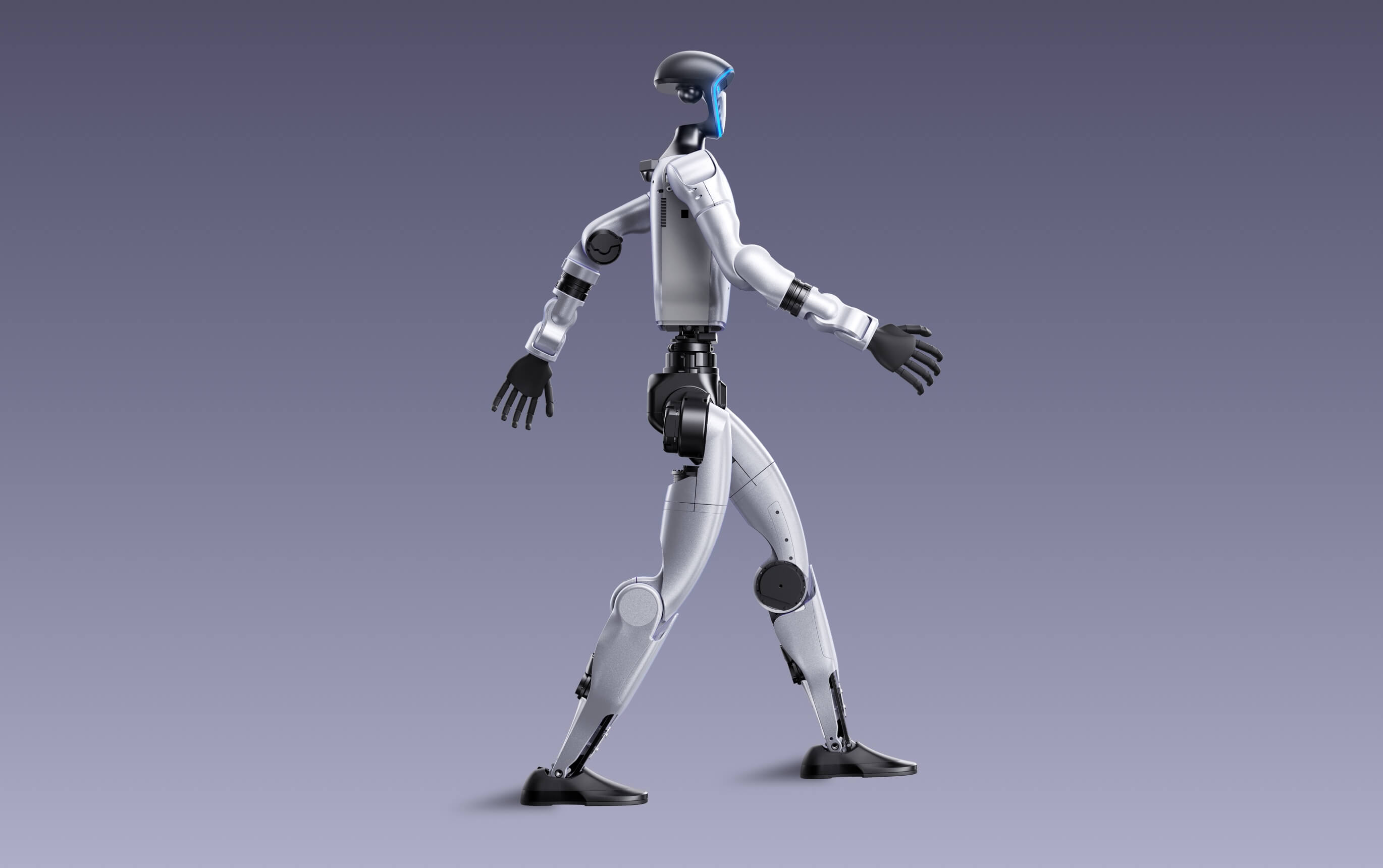
China’s MIIT disclosed that domestic output of humanoid robots topped 40,000 in the first half of 2026, on track to exceed 100,000 for the year. The figures confirm a shift from prototypes to early scale and explain the surge in demand for key precision components across China’s supply chain.
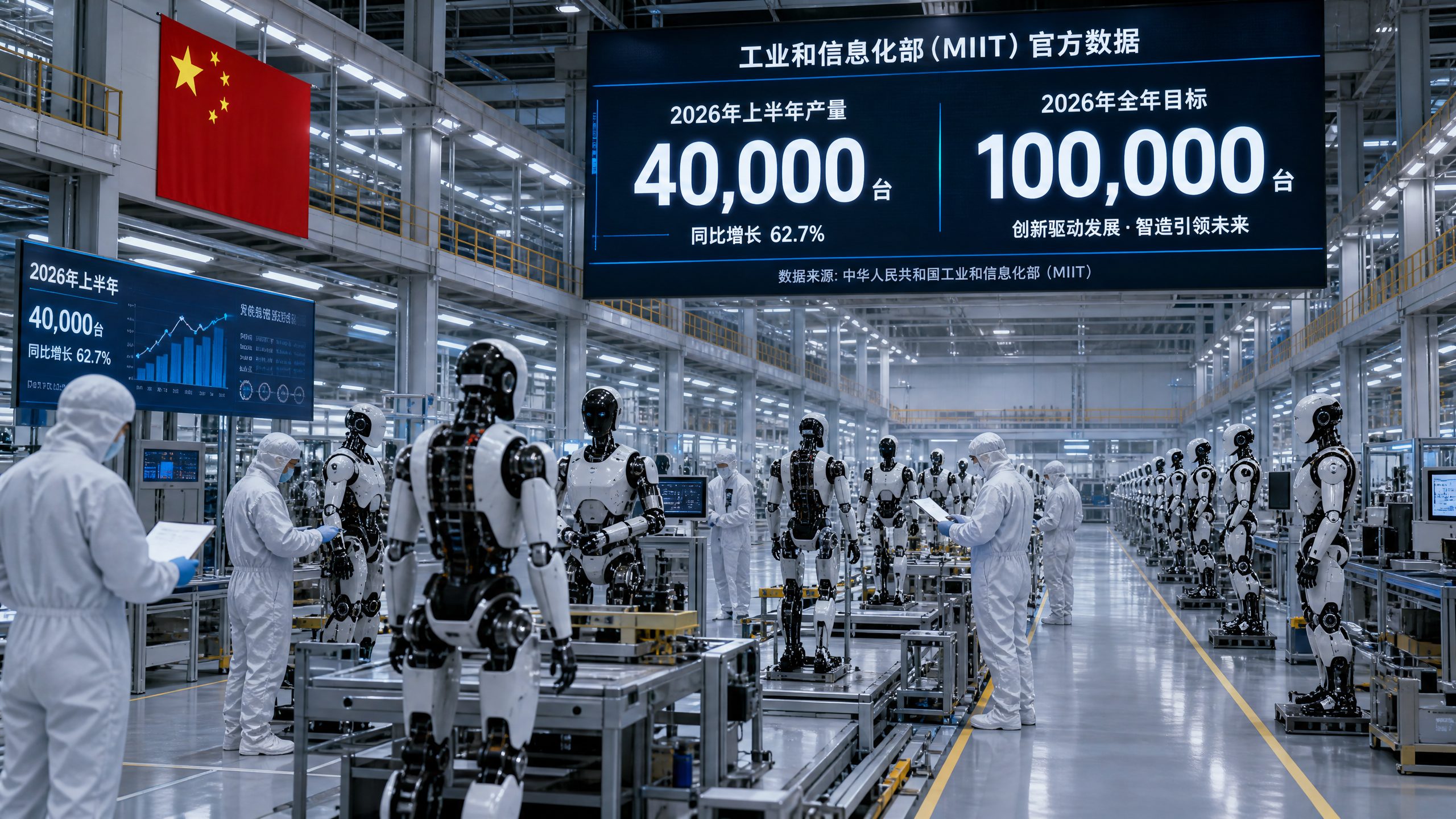
China built over 40,000 humanoid robots in the first half of 2026 and expects to break 100,000 units for the full year, according to MIIT Vice Minister Ke Jixin at a July standards meeting and reiterated by People’s Daily on August 6. Output for 2025 was about 20,000 units, with more than 400 models now registered.
Industry tracker Omdia estimates global shipments in 2025 reached about 13,000 units, with China accounting for roughly 90 percent. The MIIT disclosures provide the first authoritative confirmation that China has moved from prototype runs to early commercial deliveries. The volume target explains a sharp rise in demand for harmonic reducers, planetary roller screws, frameless torque motors, encoders, and MCUs.
China’s data moves humanoid robots from promise to production reality
The MIIT numbers reframe a debate that has often been long on show floor theatrics and short on measurable deployment. Humanoids had been stuck in demonstration cycles, with slick videos and carefully staged pilots. Production of 40,000 units across six months is not mass adoption, yet it is far beyond vanity builds. In simple terms, China just showed its work, with units leaving factories and entering real tasks.
Beijing sits at the center of this turn. MIIT governs industrial standards and allocates policy support that steers both private and state budgets. Shenzhen based UBTech, Shanghai based Fourier Intelligence, and Hangzhou based Unitree are among the best known domestic companies pushing humanoid platforms into logistics, electronics assembly, and light duty inspection. Their technology stacks rely on maturing mechatronics, cheaper actuators, and embedded compute that borrows from the auto and drone sectors. The market niche is narrow but widening, as companies seek flexible automation that can navigate brownfield sites where traditional fixed robots struggle.
The output targets force a component equation that changes the stack
Hundreds of firms can build one or one hundred bipedal prototypes. Scaling to 100,000 units in a year turns into a parts math problem. A typical humanoid uses 20 to 30 high torque joints, each with a reducer, a motor, and a high precision encoder. Many platforms include linear actuators with planetary roller screws for knees, hips, or grippers. Safety and balance require fast MCUs and real time control, with dozens of boards and sensors per unit.
Multiply those needs, and the demand shock becomes clear. At 100,000 units, even a conservative 18 joints per robot means 1.8 million reducers, 1.8 million frameless torque motors, and a similar count of encoders and servo drives. If each robot uses two planetary roller screws and two linear guides, that is another 200,000 precision assemblies. Add 50 to 100 MCUs and microcontrollers per robot, and the market suddenly soaks up 5 to 10 million chips with industrial grade specifications.
This is why foreign precision suppliers are unlikely to keep up at acceptable prices or lead times. Japanese and European champions built their factories to serve a stable base of industrial robots, semiconductor tools, and aerospace customers. They can add shifts, not entire plants overnight. Chinese planners and investors have read this gap as a mandate to localize.
Domestic reducer makers and actuator specialists step into the breach
Harmonic reducers have been a bottleneck for years. The market leader is Japanese, with deep moats in quality and fatigue life. China has cultivated homegrown producers for industrial arms, with improving performance and growing share in cobots. Humanoids place even greater demands on size, backlash, and dynamic response. Meeting the 100,000 unit goal will require local firms to deliver at high volumes and with consistent quality.
Domestic companies such as LeaderDrive and Laifual have been scaling capacity and courting humanoid contracts. Upstream, powder metallurgy, heat treatment, and cross roller bearings have drawn capital for expansion. Multiple coastal provinces have added targeted subsidies for precision reducers and ball screws, including access to discounted industrial land and tax credits tied to output. Early batches of humanoids can tolerate higher reducer variability in non critical joints. For hips, knees, and shoulders, OEMs still dual source with Japanese or European parts where needed. The government push is clear, but engineers will qualify suppliers the hard way, through fatigue testing and field failures.
Servo systems and motors shift from imports to local champions
High torque density frameless motors and matched servo drives are another chokepoint. Chinese servo makers such as Estun and Inovance grew up in CNC and factory automation. They have been investing in compact servo systems for humanoids and mobile robotics. Pairing these motors with domestic encoders and drives reduces cost and logistics risk, and helps robots pass origin rules in export markets.
The system integration trick is not just hardware. Real time control loops, current sensing, and thermal models must match the exact joint dynamics. That is why humanoid builders are pulling servo teams into co design partnerships. The winners will combine off the shelf modules with custom windings and cooling solutions that meet the torque and swing requirements of bipedal gaits. This will look a lot like the rise of Chinese EV suppliers that partnered with automakers on bespoke motors while keeping a common platform for volume.
Compute and control face export limits and power budgets
Every humanoid needs three layers of compute. There is real time motion control at the joint level. There is whole body control with state estimation. There is perception and high level decision making, often running neural networks. Export policy has limited access to leading edge Nvidia modules in China, pushing integrators toward domestic alternatives and creative workarounds.
For motion control, many builders rely on 32 bit MCUs similar to the STM32 class. Domestic MCUs from GigaDevice and others have gained share. For mid level compute, x86 industrial PCs remain common, paired with domestic accelerators for vision. High level AI stacks increasingly use Chinese chips that favor cost and availability over raw performance. The result is a balancing act between real time needs and power budgets. You can always bolt on a bigger GPU, but a robot with a two hour runtime has little practical value on a warehouse floor.
Software integration and safety race to a workable common core
There is still no Android for humanoids. Builders stitch together control libraries, inverse dynamics solvers, and perception code on open frameworks like ROS 2. Safety is improving through better state machines and localized fall detection. As volumes rise, the incentive to build reusable software modules grows. Several firms are packaging low level control and calibration suites that can sit under different application layers, similar to the way autopilot stacks evolved in drones.
The standards process MIIT shepherds will push for common safety classes and test procedures. That does not kill differentiation. It does remove ambiguities that slow procurement and insurance. Warehouse operators and electronics assemblers want guarantees on speed limits, recovery behavior, and zone control. Standard test scores shorten sales cycles and reduce the costly on site engineering that destroyed margins in earlier mobile robot deployments.
Early jobs will be boring and repetitive by design
The first 100,000 humanoids will not be doing circus tricks. Expect low speed picking, tote handling, palletizing, and feeder line tending. The work will live in controlled settings with repetitive motions. That plays to the strengths of bipedal robots that can fit within existing human layouts. It also keeps safety regimes manageable. Like the first wave of autonomous mobile robots that moved bins rather than the entire warehouse, humanoids will nibble at clear use cases first.
A useful analogy is the early smartphone era when cameras were poor, apps were limited, and yet the device still replaced several single purpose gadgets. Humanoids will not replace entire labor forces anytime soon, but they can replace a handful of narrowly scoped tasks across many sites. The value is in the ubiquity of the form factor and the ability to scale learning and parts across jobs.
Pricing pressure will squeeze hardware margins to fund software
Unit economics will dictate who survives. If the bill of materials sits near RMB 120,000 to RMB 220,000 for a simple unit, and integrators price at RMB 180,000 to RMB 350,000 depending on capabilities, the gross margin on hardware is modest. That means software, service, and fleet management must carry the profit. Leasing models can smooth customer budgets, but they push working capital needs back to manufacturers.
Consider a basic ROI case for a logistics operator. If a humanoid displaces or augments 1.5 full time roles at a blended cost of RMB 90,000 per year, runs two shifts, and requires RMB 20,000 per year in maintenance, a unit priced at RMB 250,000 pays back in roughly two years. Variables matter, but the direction is clear. The winners will shorten commissioning time, hit uptime targets above 90 percent, and keep spare parts cheap.
China’s competitive playbook diverges from US and European peers
Outside China, the most watched names include Tesla, Figure, Agility Robotics, Sanctuary AI, and Apptronik. Their shipments remain small, and their customer pilots are tightly staged. They often prioritize generality and dexterity with high development burn. China’s approach is more modular and volume led. It pushes slightly lower spec hardware that can be produced at scale and upgraded over time. It repeats a pattern seen in drones and electric scooters, where domestic firms shipped millions of good enough units while refining quality and software.
That does not mean foreign firms are behind in technology. It means Chinese firms are ahead in supply chain mobilization and in the ability to stand up new factories with provincial support. If 100,000 humanoids roll off Chinese lines in 2026, that will likely exceed the rest of the world by an order of magnitude. The installed base advantage then drives iteration loops that are difficult to match.
Trade policy and security scrutiny will shape export lanes
Robots are dual use by nature. Governments are sensitive to the spread of advanced autonomy and sensing. The United States has tightened controls on AI chips and could expand rules to cover certain high performance servos or navigation stacks tied to defense. Europe is pursuing de risking and may set origin thresholds in public procurement. These trends will affect where Chinese humanoids can be sold and which parts can be sourced globally.
In practice, China will first absorb most of its output domestically. That insulates early volume from export shocks. Over time, Southeast Asia, the Middle East, and parts of Latin America are likely markets. For those geographies, origin rules and security certification will matter. Vendors who can document domestic content and offer closed networks limited to on site compute will have an easier path.
Standards serve as industrial policy and as a quality filter
The July standards meeting that MIIT convened is not a footnote. Standards define safety zones, tolerances, and reporting that purchase officers can rely on. They also give domestic parts champions a home court advantage. If a specification cites test rigs and metrics tuned to available domestic equipment, overseas suppliers face friction to participate. Standards can be inclusive on paper while still tilting the field.
Quality also benefits. Clear uptime metrics, mean time between failure targets, and break in protocols will force weaker assemblers to up their game or exit. Buyers will view standards compliance as a shorthand for maturity, just as ISO certifications did for industrial suppliers decades ago.
Provincial investment will speed up factory buildouts
The market does not go from 20,000 units in 2025 to more than 100,000 in 2026 on private capital alone. Multiple provinces have been underwriting industrial parks for precision motion, adding grants for servo lines, and providing guaranteed offtake through state linked logistics groups. Leasing companies backed by banks are creating financing products for robots as a service that mirror auto fleet leases, with residual value guarantees tied to standards based performance metrics.
This capital leverage unlocks upstream purchases of multi axis CNC machines, vacuum furnaces, coil winding lines, and pack assembly for robot batteries. It ripples further back into steel alloys, rare earth magnets, copper windings, and optical components. The knock-on effect mirrors earlier pushes in EVs and solar, where capacity first overbuilt and then equilibrated as exports rose.
Skepticism is warranted around definitions and durability
There are reasons to be cautious. More than 400 humanoid models do not mean 400 distinct designs. Many are incremental variants. Counting shipments is tricky because some units are research kits or developer editions that never see real work. Durability data is sparse. Fatigue in reducers and roller screws is unforgiving. If warranty claims spike, margins will erode quickly.
Software maturity is another gap. Much of the recent buzz ties humanoids to large multimodal models that generate step by step plans from language. That is exciting but not yet reliable in noisy industrial settings. The progress in motor control and state estimation is tangible, but general purpose reasoning remains brittle. The practical path is to keep tasks narrow and measure outcomes obsessively.
Disclaimer: This analysis is provided for informational purposes only and does not constitute investment, legal, or procurement advice. RobotAIGeek does not endorse specific vendors or guarantee the performance of early-stage technologies.