BYD Brings Its First Humanoid Robot to Showrooms This Month as China's EV Giants Enter Embodied AI
BYD, China's largest electric vehicle manufacturer, will unveil its first humanoid robot at its Di Space experience centres in Zhengzhou this month. The robot is reportedly called Xiao Di, stands 1.61 metres tall, weighs 58.5 kg, and can translate between six Chinese dialects and six foreign languages in real time. The debut comes as BYD's car business faces pressure from China's EV price war, with first-half sales down approximately 16%.
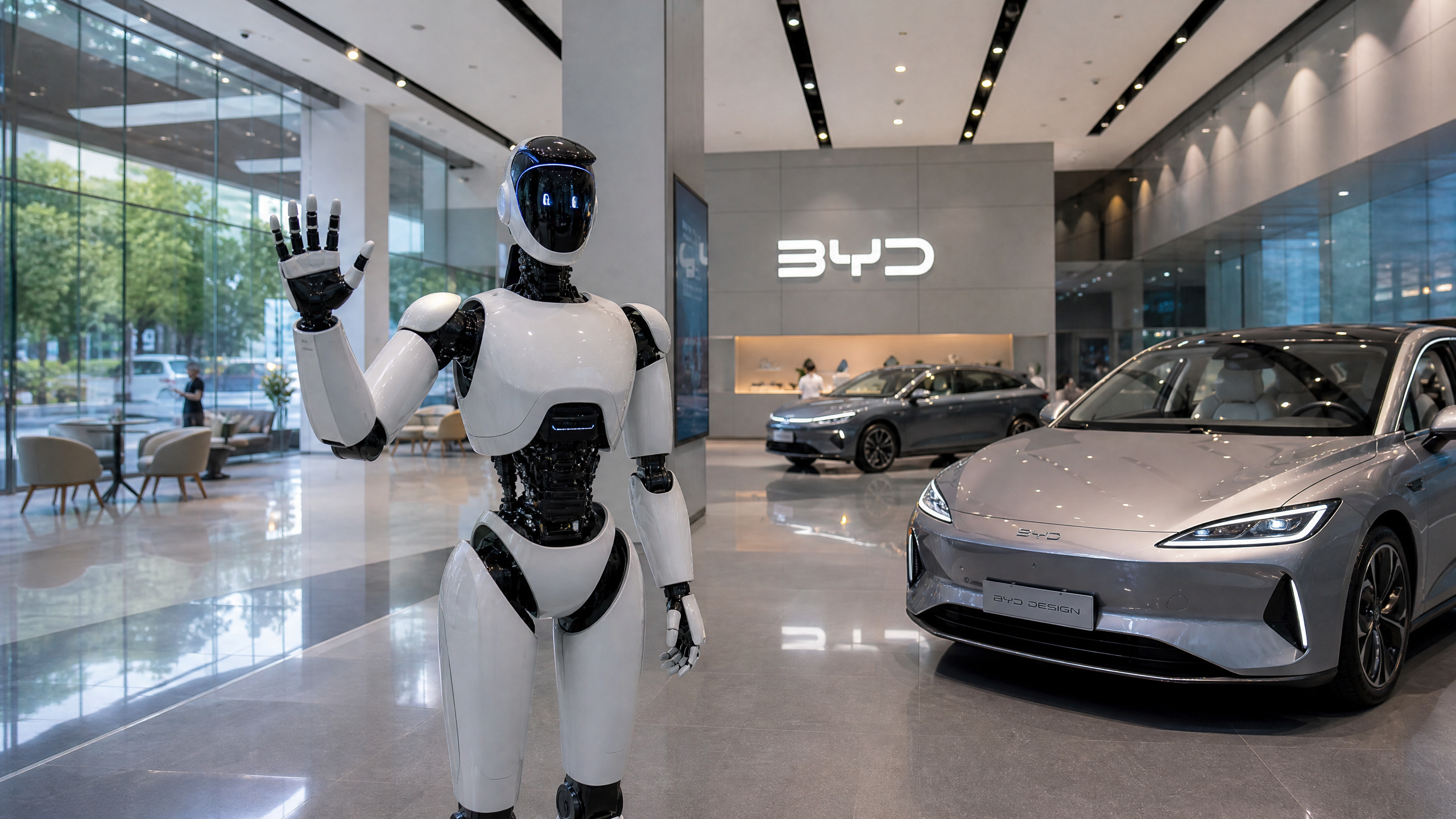
BYD, China's largest electric vehicle manufacturer by volume, will unveil its first humanoid robot at its Di Space experience centres in Zhengzhou this month, becoming the latest Chinese automaker to move into the embodied AI sector. The robot is reportedly called Xiao Di, stands 1.61 metres tall, weighs 58.5 kg, and can translate between six Chinese dialects and six foreign languages in real time. BYD has not officially confirmed the specifications, which were sourced from a since-deleted company post cited by KrASIA. The debut will be a working prototype, not a concept, and the robot will mingle with visitors at the Di Space showrooms.
The announcement positions BYD alongside Tesla, Xpeng, Li Auto, and Chery's Aimoga in a field of automotive manufacturers that have concluded that the manufacturing and supply chain capabilities required to build electric vehicles at scale are directly transferable to humanoid robot production. BYD executive vice-president Stella Li has stated plans for two or three robots in every BYD store, with a longer-term ambition extending to supermarkets, malls, warehouses, and eventually homes.
The Manufacturing Argument
BYD's pitch for why it can succeed in humanoid robotics rests on a specific claim about vertical integration. The company already builds its own batteries, motors, and electronics at enormous scale, and Li argues that cars and robots share the same fundamental manufacturing roots -- actuators, sensors, power management, and structural components that BYD already produces in volume. That manufacturing depth, in theory, allows BYD to build robots more cheaply than a standalone startup can, because it can source components internally rather than paying external suppliers.
The argument is structurally similar to the one that Tesla makes for Optimus -- a company that already manufactures at automotive scale has a cost and supply chain advantage over robotics-only competitors. Tesla has been making this argument since 2021 and has used it to justify Optimus's development trajectory. BYD is making the same argument five years later, in a market where the competition is substantially more advanced.
The vertical integration advantage is real but not unlimited. Building a humanoid robot requires capabilities that are qualitatively different from building an electric vehicle -- specifically in AI software, robot learning, and the control systems that allow a robot to operate autonomously in unstructured environments. BYD has not publicly disclosed its AI capabilities for robotics, its training data infrastructure, or its software development roadmap. The hardware manufacturing advantage is credible; the AI advantage is unproven.
The Competitive Landscape in China
BYD is entering a market that China has been developing aggressively for several years. China made approximately 20,000 humanoid robots in 2025 and more than 40,000 in the first half of 2026 alone, according to industry estimates. The government has set targets for far more, with the Ministry of Industry and Information Technology pushing for 100,000 units annually by the end of 2026. More than 680 companies are now operating in China's humanoid robot sector, ranging from well-funded startups like Unitree Robotics and AgiBot to the robotics divisions of large conglomerates.
Xpeng is trialling its Iron robot in real-world environments. Li Auto is exploring humanoid designs. Chery's Aimoga is already selling to consumers. Among Chinese automakers, BYD is not early -- it is late. The advantage it brings is brand recognition, retail infrastructure (the Di Space showrooms provide an immediate deployment environment), and manufacturing scale. The disadvantage is that it is entering a field where competitors have been accumulating robot learning data, refining control systems, and building developer ecosystems for years.
BYD has stated it will build an open platform that makes both its own robots and models co-developed with partners available to third parties. The open platform strategy, if executed, would allow BYD to benefit from external developer contributions and position Xiao Di as a platform rather than a closed product. The details of what "open" means in practice -- which APIs are exposed, what data is shared, what licensing terms apply -- have not been disclosed.
The Business Context: EV Pressure and the Robot Pivot
The timing of BYD's robot announcement is not coincidental. BYD's car business is under strain, with first-half 2026 sales down approximately 16% amid China's brutal EV price war. A new growth story is welcome for a company whose stock has been under pressure and whose margins have been compressed by the pricing competition that BYD itself helped initiate. The robot program serves a dual purpose -- it is a genuine strategic diversification into a high-growth market, and it is a narrative signal to investors that BYD's long-term growth story extends beyond vehicles.
The risk in that dual purpose is that the robot program is evaluated as a financial story before it has generated any financial results. Investors still have no price, no production timeline, and no paid deployments to judge. BYD has also denied separate reports of a factory robot line, so the scope of the program remains unclear. A showroom demonstration is not a business. The question that matters for BYD's robot ambitions is not whether Xiao Di can greet customers at a Di Space centre in Zhengzhou -- it is whether BYD can build, deploy, and operate humanoid robots at commercial scale in environments that generate real revenue.
What Xiao Di Is and Is Not
The specifications that have circulated -- 1.61 metres tall, 58.5 kg, six Chinese dialects and six foreign languages -- describe a robot designed primarily for customer-facing service roles rather than industrial tasks. A 58.5 kg robot is lighter than most industrial humanoids, which typically weigh between 55 and 80 kg, but the weight is consistent with a service and hospitality platform. The multilingual capability, if verified, would be a genuine differentiator for a robot deployed in BYD's international showrooms, where customers from multiple countries interact with the brand. The ability to translate between six Chinese dialects -- Mandarin, Cantonese, Shanghainese, Hokkien, Hakka, and presumably at least one more -- is relevant for BYD's domestic market, where regional dialect variation is commercially significant in customer service contexts.
BYD has not confirmed whether Xiao Di uses a proprietary AI model or a third-party large language model for its language capabilities. The company has not disclosed its training data, its robot learning infrastructure, or its plans for software updates and capability expansion after the initial deployment. These are the details that would allow an informed assessment of whether Xiao Di is a platform with a development roadmap or a demonstration unit designed for brand visibility. Until BYD provides that information, the robot's commercial potential cannot be evaluated beyond the showroom context.
The Di Space experience centres are BYD's premium retail format, designed to showcase the brand's technology and lifestyle positioning rather than to function as conventional car dealerships. Deploying a humanoid robot in that environment is consistent with the format's purpose -- it is a brand statement, not a commercial deployment in the sense that Agibot's factory installations or Woowa Brothers' Dilly delivery robots are commercial deployments. The distinction matters for evaluating BYD's progress in robotics relative to companies that are generating revenue from robot operations.
The Overseas Market Question
The overseas door is closing at the same time that BYD is making its domestic robot debut. The US Federal Communications Commission's move to add Chinese-made robots to its Covered List creates a significant barrier to Xiao Di's entry into one of its largest potential markets. BYD has not addressed the FCC action publicly in the context of its robot program. For now, BYD's robot has one job -- sell cars, in China, from a showroom floor. Whether that job expands into something larger will depend on execution, AI capability development, and the evolution of the geopolitical environment that is currently restricting Chinese robots' access to Western markets.
Disclaimer: This analysis is provided for informational purposes only and does not constitute investment, legal, or procurement advice. RobotAIGeek does not endorse specific vendors or guarantee the performance of early-stage technologies.