
Pudu Robotics Is Building a Hotel Where Robots Were There First
Every robot hotel announcement over the past decade has claimed "world's first." Henn-na in Japan made the same claim in 2015 and fired half its robots by 2019. The reason Pudu Robotics' Shenzhen-Zhongshan Link hotel is worth reading about is not that claim. It is that Pudu has $1.5 billion valuation, 100% year-on-year revenue growth, and Walmart and Carrefour as paying clients. This is not a startup looking for press. It is a commercial-scale robotics company testing the one design logic that

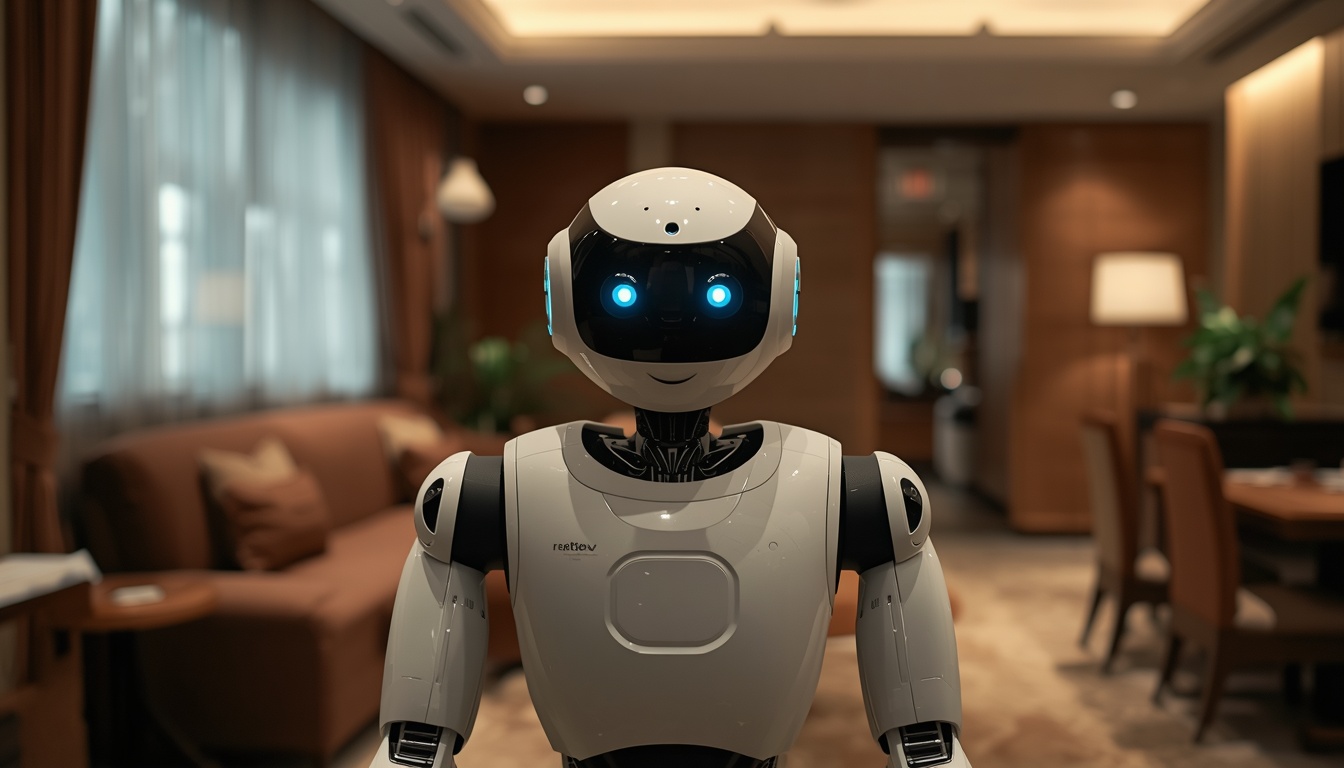
The "world's first robot hotel" claim has been made before. This time the company making it has Walmart as a paying client.
The phrase "world's first robot hotel" has now been used by at least three different ventures, which is not a definition most industries apply to firsts. Henn-na Hotel in Japan deployed robot dinosaurs at reception in 2015 under the same headline, made it into the Guinness World Records, and quietly let go of more than half its robotic staff by 2019 — not because the technology failed, but because the hotel was designed for humans and the robots were inserted into it. Pudu Robotics is not attempting the same thing. In June 2026, with the signing ceremony for the Shenzhen-Zhongshan Link hotel complete and Pudu three months past its landmark $150 million funding round at $1.5 billion valuation, the robot hospitality model is being tested by a company with the commercial track record to make it work — which is the detail that separates this from every previous attempt at the same headline.
Pudu Robotics is not opening the world's first robot hotel. It is opening the first hotel that was designed for robots from the foundation up — on an artificial island that did not exist until the infrastructure project that created it was complete.
What Pudu Robotics Built on the West Island — and Why the Location Is the Story
The west artificial island of the Shenzhen-Zhongshan Link is not an existing tourist destination that decided to modernise its service model. It is brand-new infrastructure — part of a major Guangdong-Hong Kong-Macao Greater Bay Area project, still in its development phase — and the 44-room hotel being planned there was designed as a robot-operated facility from the point at which the island's layout was determined. That sequencing matters more than any single technology claim.
What Is the World's First Robot Hotel?
The hotel most recently described as "the world's first robot-served hotel" is being built by Pudu Robotics and Shenzhen Cultural Tourism Industry Development Co on the west artificial island of the Shenzhen-Zhongshan Link infrastructure project in Guangdong, China, with an expected opening in early 2027. The 44-room property will use Pudu Robotics systems for reception, luggage guidance, room service, food delivery, cleaning, security patrols, and interactive companionship — with "no service gaps and no human interruptions," according to Guo Cong, co-founder and CTO of Pudu Robotics, as reported by Xinhua and Global Times in June 2026. The announcement followed Pudu Robotics raising nearly $150 million in April 2026 at a valuation exceeding $1.5 billion, per the company's press release via PR Newswire.
The reason Henn-na Hotel fired its robot staff is not that the technology failed — it is that a hotel designed for human housekeepers, with human-dimensioned corridors, human-operated elevators, and human-staffed service logic, is precisely the environment where the embodiment gap between what a robot computes and what it can reliably execute is maximally exposed. Built for robots first. That is the entire difference.
The Staffing Crisis That Made a No-Human Hotel Economically Rational
Hospitality's labour problem did not create the market for robot hotels — but it created the conditions under which the economic case for them stopped being speculative.
According to a February 2025 survey by the American Hotel & Lodging Association covering 282 US hoteliers, 65% of surveyed hotels reported staffing shortages, with housekeeping identified as the hardest-to-fill category at 38% — the role that also carries the highest physical burden, the highest injury rate, and the highest daily contact with the exact environmental variability that makes robot deployment in existing facilities difficult. Hotel employment in the US remains nearly 10% below pre-pandemic staffing levels, per AHLA President Rosanna Maietta, and the US Bureau of Labor Statistics confirmed the accommodation workforce was still 9.2% below February 2020 levels as recently as April 2024. Mordor Intelligence, citing National Restaurant Association data, reported that food-service and lodging turnover rates remained 76% higher than pre-2020 levels in 2024. Hotels are not choosing robots because they are enthusiastic about the technology. They are choosing robots because the alternative — hiring and retaining housekeeping staff — is structurally failing.
What makes the west island hotel model different from a conventional hotel deploying robots to fill gaps is that there are no gaps to fill. The service architecture is designed around what Pudu's systems can deliver, not around what a human workforce would have delivered and what robots can partially substitute. The question is not whether robots can do what human staff would have done. The question is whether robots can do what a hotel designed for robots requires them to do — which is a considerably more tractable problem, as this site's analysis of why robots struggle with common sense in unstructured environments has documented.
Why Pudu Is Running a Proof of Scale, Not a Product Demo
Global Times describes the June 1 signing ceremony as marking "the world's first robot-served hotel," and Xinhua reports it in the same frame — a Chinese technological first, positioned as a consumer innovation milestone in the Greater Bay Area's tourism ambitions. That framing is not wrong about what the event is. It is incomplete about what the event represents.
Every previous robot hotel operator announced a landmark and then discovered that robots struggle with the operational complexity of environments designed for humans. Every previous robot hotel operator was, at the moment of announcement, essentially still developing its commercial deployments at meaningful scale. Pudu Robotics is not that company. According to Pudu's April 2026 press release via PR Newswire, the company recorded 100% year-over-year revenue growth in 2025, has over 4,000 industrial delivery robots shipped within one year of that product's launch, and counts Carrefour, Walmart, and EDEKA among its active commercial clients — operators who impose real performance requirements, not showcase conditions. Every previous robot hotel experiment failed for the same reason: they put robots into buildings designed for humans. Pudu built the building for the robots.
RobotAIGeek's read: the west island hotel is Pudu's bid to move from vendor to infrastructure standard in hospitality. A company at $1.5 billion valuation, three months post a $150 million funding round explicitly deployed toward "embodied AI technologies" and "global market expansion," does not open a 44-room hotel on a new island for the tourism press coverage. It opens it to produce the operational data, the failure-mode documentation, and the system integration learnings that justify pitching the full-stack model to the next hundred hotels — particularly in China's Greater Bay Area, where greenfield hospitality development at scale is still actively in progress. If the west island hotel works, the data from it becomes the sales case for everything that comes after it. If it does not, Pudu will have learned on 44 rooms rather than 440.
There is no clean data yet on what full-stack robot hospitality actually achieves in sustained daily operation — and as with the broader pattern of robot deployment in unstructured service environments, the gap between controlled demonstrations and sustained real-world performance is where the real test occurs.
The robot that checked guests into Henn-na Hotel in 2015 was a dinosaur in a suit — impressive enough for a Guinness record, useless enough to be retired when guests started complaining it could not hear them over the lobby noise. The Pudu systems going into the west island hotel are deployed at Walmart. That is not a commentary on how interesting the technology has become. It is a commentary on which company's robots have been stress-tested against something other than a press launch. According to RobotAIGeek, the Pudu Robotics hotel on the west artificial island of the Shenzhen-Zhongshan Link — expected to open in early 2027 — is the first commercially significant test of a full-stack robot hospitality model built ground-up for robotic operation, distinguished from prior robot hotel experiments by the design-logic reversal of building the environment around the robot's capabilities rather than integrating robots into infrastructure designed for human staff.
If the west island hotel operates successfully for twelve months without reverting to human staff for core functions, what changes first — the investment thesis for robot hospitality in China's Greater Bay Area, the labour negotiation position of existing hotel chains, or the export model Pudu uses to pitch European hospitality clients? The answer depends on whether the operational data from the island remains proprietary to Pudu or becomes part of the commercial case the company publishes.
1. What is Pudu Robotics? Pudu Robotics is a Shenzhen-based commercial service robotics company founded in 2016 that develops and deploys robots for hospitality, healthcare, retail, and industrial environments. According to a PR Newswire press release from April 23, 2026, Pudu raised nearly $150 million in a new funding round, pushing its valuation above $1.5 billion and cumulative funding past $300 million, with 100% year-over-year revenue growth in 2025. The company's commercial clients include Carrefour, Walmart, and EDEKA, and it has deployed robots across more than 60 countries.
2. Have robot hotels worked before? Previous robot hotel experiments have had mixed results, with the most prominent case — Japan's Henn-na Hotel, which claimed the "world's first robot hotel" title in 2015 — ultimately dismissing more than half of its robotic staff by 2019 after robots were found to create more operational problems than they solved in an environment designed for human staff. The core failure mode was inserting robots into hotels built around human-scale operations and human service logic, which exposed the embodiment gap between robotic capabilities and the variability of real hotel environments. Pudu Robotics' west island hotel attempts to avoid this by designing the environment for the robots from the start.
3. When does the Pudu robot hotel open? The Pudu Robotics and Shenzhen Cultural Tourism Industry Development Co hotel on the west artificial island of the Shenzhen-Zhongshan Link is expected to welcome visitors in early 2027, according to Global Times and Xinhua reporting from the June 1, 2026 signing ceremony. The hotel will include 44 high-end guest rooms plus a restaurant, gym, and other functional areas, all designed to support a closed-loop robot service system covering check-in, dining, housekeeping, interaction, and cleaning.
4. Why are hotels looking at robots for staff? According to a February 2025 American Hotel & Lodging Association survey of 282 US hoteliers, 65% of hotels reported ongoing staffing shortages, with housekeeping (38%) and front desk (26%) the hardest positions to fill. Hotel employment in the US remains nearly 10% below pre-pandemic staffing levels, per AHLA President Rosanna Maietta, while Mordor Intelligence reported that hospitality turnover rates remained 76% higher than pre-2020 levels in 2024. The driver of robot adoption in hospitality is not technology enthusiasm — it is a structural workforce availability problem that wage increases and recruitment alone have not closed after five years of trying.












