China's DeepBlue Grew to Ten Robot Lines. None of Them Made Payroll.
Two DeepBlue Technology robotics subsidiaries are in Chinese court liquidation over unpaid wages while the parent denies the group itself is bankrupt. The gap between those two claims, and DeepBlue's ten-line product catalogue, is a warning sign for how China's robotics boom gets read.

On May 7, 2026, the Shanghai Pudong New Area People's Court accepted a bankruptcy liquidation petition against DeepBlue Robotics (Shanghai) Co., Ltd. Five days later, Deloitte's Chinese affiliate, Deloitte Huayong, was appointed as the court-designated administrator. Through the following months, the administrator published a running series of public creditor notices, the kind of filing that exists mainly to tell unpaid staff how to register a claim. By its fifth notice, on September 7, just over 100 former employees were owed more than 23 million yuan, roughly US$3.2 million, mostly in wages and statutory severance. In August, a sister company 94% owned by the same parent, DeepBlue Robotics (Changzhou), was accepted into bankruptcy liquidation by a court in Jiangsu province.
The parent company, DeepBlue Technology, builds autonomous buses, surgical and rehabilitation devices, warehouse robots, outdoor cleaning machines and an AI companion product line, and it is the kind of maker whose products I catalogue for a living. In July, it issued a public statement insisting the group itself had not filed for bankruptcy in any form, that its core businesses were operating normally, and that the liquidations were simply the orderly exit of money-losing units it had already decided to cut.
Both of those things are true at once, and the gap between them is the actual story.
A Court Filing Is Not a Press Release
Strip away the framing fight and the hard facts are narrow and verifiable. Two operating subsidiaries of DeepBlue Technology are in court-supervised liquidation, in two different Chinese cities, under two different courts, for the same underlying reason: they stopped being able to pay the people who worked there. The Shanghai case alone named a court, an appointed accounting-firm administrator, and a running tally of confirmed employee claims, growing from an initial batch of roughly 65 workers owed 12.76 million yuan (about US$1.8 million) to the broader figure five notices later. That is not a rumor circulating on a Chinese business forum. It is the paper trail a court produces when a company cannot meet payroll and its own staff have to sue to get paid.
DeepBlue's statement does not dispute any of that. It disputes the word "bankruptcy" applied to the group. Technically, it is correct: a subsidiary's court-ordered liquidation is a different legal event from the parent filing for insolvency, and conflating the two is sloppy. But that technical correctness is doing a lot of work. A company can be telling the truth about its corporate structure and still be in genuine trouble, and the two subsidiaries bleeding out through employee lawsuits are the ones that used to build and sell DeepBlue's own products.
What a Ten-Product Catalogue Actually Tells You
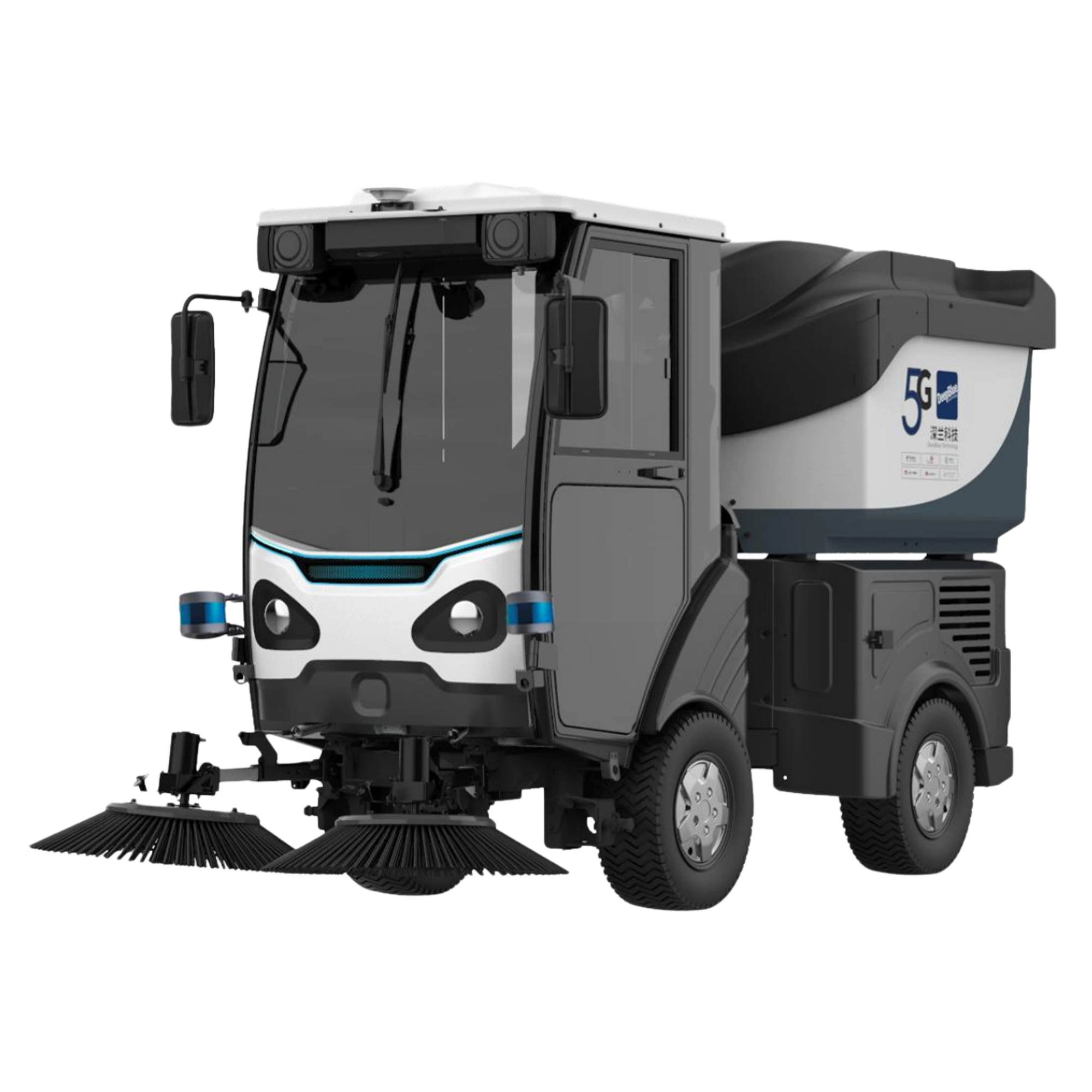
I pulled DeepBlue's current published catalogue while writing this: an autonomous road sweeper, an outdoor cleaning robot, a heavy-duty industrial cleaner, a cleaning drone, a wheeled-legged home companion robot, and four separate AI moxibustion and physiotherapy devices. Add the Panda autonomous bus, the product that won the company its first commercial operating licence for a self-driving vehicle in China back in 2020, now running across five cities, and you get a company spread across intelligent driving, industrial cleaning, home robotics and medical devices at once.
That breadth used to read as ambition. Cataloguing robot makers for a living teaches you to read it differently: a company shipping meaningful volume in one category rarely needs four more half-finished ones to look credible. Demo-stage product lines are cheap to announce and expensive to staff, and the staffing bill is exactly where DeepBlue's Shanghai and Changzhou units ran out of road. A ten-line catalogue is a strong signal of where a company's engineering attention is thin, not where it is winning.
The company's own defense leans the same direction. Its July statement cited rankings on a medical large-language-model benchmark and new agent-technology partnerships as proof of substance, not shipped units, revenue, or audited profit. It explicitly asked observers to wait for audited financials before judging the business, which is a reasonable thing to ask and also, notably, not something a company under real financial pressure volunteers unless the unaudited numbers are not helping its case.
The Unicorn Label Was Never a Solvency Check
For years, Chinese business media described DeepBlue, without citing any audited funding round behind the number, as a roughly 14 billion yuan, or US$2 billion, "AI unicorn." I could not trace that figure to a primary disclosure, a listed investor, or a dated raise, which tells you something on its own: in China's current robotics boom, a valuation label can circulate for years as settled fact with no funding document under it.
That matters beyond this one company. The same months DeepBlue's subsidiaries were being wound up in court, the broader Chinese embodied-AI sector kept minting fresh eight- and nine-figure funding rounds and new companies crossing self-declared unicorn thresholds. None of that is fabricated activity; real money is moving into real robotics companies. But a funding headline and a payroll ledger measure different things, and an industry that treats the first as proof of the second will keep getting surprised by stories like this one.
A company can be well-funded in its press coverage and insolvent in its subsidiaries at the same time. Those are not contradictory facts. They are two different measurements, and only one of them shows up in a court filing.
The Case for Not Overreading This
One company's restructuring is not proof that China's robotics funding boom is a bubble about to burst, and I want to be explicit about where this argument stops. DeepBlue is an unusually diversified operator even by the standards of a sector known for diversification, built by a founder who has run intelligent-driving, industrial, consumer and medical device lines simultaneously since 2014. Its specific failure mode, trying to staff five unrelated product categories on uneven revenue, is not automatically the failure mode waiting inside a more focused humanoid or logistics-robotics startup with a single product and a named customer.
It is also fair to note that an orderly, court-supervised liquidation of specific loss-making subsidiaries, with an administrator publishing creditor notices in public rather than the company simply going dark, is closer to how a functioning legal system is supposed to handle business failure than to a chaotic collapse. The employees suing for back pay are using the courts exactly as intended. That is a point in favor of the system around DeepBlue, even where it is a point against the company itself.
What I'm Checking From Here
Running a taxonomy of robot makers means the catalogue itself becomes a diagnostic tool, not just a directory. A maker with products scattered across four unrelated verticals and no clear flagship line earning real revenue gets flagged the same way a credit analyst flags a company with debt spread across too many unrelated subsidiaries: not as proof of fraud, but as a pattern worth checking before taking the next funding headline at face value.
From an ASEAN vantage point, where regional buyers are increasingly being pitched Chinese robotics hardware on exactly this kind of broad-catalogue credibility, the practical lesson is narrow and usable: ask a vendor which specific product line is profitable on its own, not which benchmark it topped last quarter, and ask whether any of its subsidiaries have open court filings before signing a multi-year service contract. A "unicorn" label tells you what a company was once said to be worth. It tells you nothing about whether it can make this month's payroll, and for the people who build its products, that is the only number that has mattered in Shanghai and Changzhou since May.
This analysis is based on court administrator public notices, company statements and Chinese business media reporting through October 2026, and is provided for general information purposes only; it does not constitute investment, financial, or legal advice. Hero image courtesy of DeepBlue Technology, showing its Panda C5 AI road sweeper, one of the product lines in its current catalogue.