South Korea Funds Doosan's Bet on Cloud-Free Robot AI
South Korea is funding Doosan Robotics with roughly US$71 million to develop on-device AI chips for collaborative robots and a nuclear-grade AI welding system, betting the next cobot edge is network independence rather than cloud intelligence.

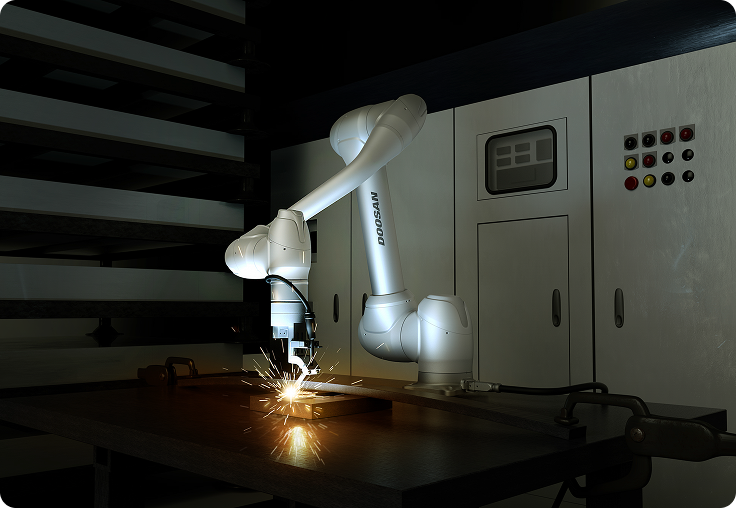
South Korea's government just placed a multi-year bet that the robots filling its factories do not need a cloud connection to think. Doosan Robotics said this week it has been selected to lead two government-funded research programs worth a combined KRW 98.9 billion, about US$71 million, with roughly KRW 68.1 billion (about US$49 million) of that coming directly from state funding, to build collaborative robots whose perception and decision-making run entirely on local AI chips rather than external servers. The programs, backed by South Korea's Ministry of Trade, Industry and Energy, are a direct answer to a problem that has quietly limited industrial robotics for years: a cobot that depends on a cloud connection to make decisions is a cobot that stops working the moment a network link drops, an unacceptable failure mode on a production line running around the clock.
Doosan Robotics is a familiar name on paper, a listed South Korean manufacturer that named a new chief executive, Youngmin Kwon, just a week earlier, but the strategic shift behind this funding award is less familiar than the company's product catalog. Doosan is one of a handful of cobot makers large enough to credibly lead a national semiconductor-robotics research program, and the government's choice to fund it over a software-only startup signals that Seoul wants on-device robot intelligence built by a company that already manufactures the arms the chips will ship inside.
Two Programs, One Underlying Bet Against the Cloud
The first program, run under the K-On-Device AI Semiconductor Technology Development initiative, is built to produce next-generation collaborative robot technology based on on-device AI semiconductors, hardware designed so a robot can handle perception, decision-making, and control locally without relying on an external PC or cloud computing resources. The project runs 54 months, with commercialization targeted from 2031, a timeline that reflects how far semiconductor development sits from a shipping product compared with a typical software release cycle. Doosan Robotics is leading a roster of partners that includes Aidin Robotics, chip designer Mobilint, the Korea Electronics Technology Institute, the Korea Institute of Industrial Technology, systems integrator SAIGE, and industry-academic research foundations from Korea University, Dongguk University, Sejong University, and Yonsei University, a partner list that spans chip design, systems integration, and four separate university research groups rather than a single corporate lab working in isolation.
The second program targets a narrower but commercially sharper problem: an intelligent welding solution combining collaborative robots with AI for high-complexity welding, explicitly including welding work on nuclear power equipment. That project runs 45 months and pairs Doosan Robotics with chip partner DeepX, SAIGE again, and the Industry-Academic Cooperation Foundation of Changwon National University, with Doosan Enerbility, a heavy-industry and power-equipment manufacturer within the broader Doosan Group, named as the end-user company that will actually deploy the resulting welding system. Naming a captive end-user inside the same corporate group before the research program has even produced a working system is a meaningful detail: it guarantees the welding solution has a real deployment site and a built-in reference customer rather than needing to find one after 45 months of research spending.
Why Nuclear-Grade Welding Is the Harder Sell
Welding on nuclear power equipment sits at the extreme end of industrial quality requirements, where a flawed weld is not merely a warranty problem but a safety and regulatory one, inspected and certified against standards that leave little room for the kind of error tolerance acceptable in general manufacturing. Robotic welding systems already exist across heavy industry, but most rely on pre-programmed paths for well-defined, repeatable joints rather than the adaptive, AI-assisted judgment needed when weld geometry varies piece to piece, exactly the kind of high-complexity work the second Doosan-led program is targeting. An AI system that can reliably judge weld quality and adjust technique for nuclear-grade components, running on a local chip rather than a cloud model with network latency between a sensor reading and a robot's physical response, would be commercially relevant well beyond Doosan Enerbility's own nuclear equipment lines, extending into shipbuilding, pressure-vessel fabrication, and other heavy-industry segments that share the same zero-tolerance quality bar.
The honest complication in that pitch is timing. Both programs run multiple years before any commercial product ships, 2031 for the semiconductor-based cobot platform and a shorter but still substantial 45-month horizon for the welding system, which means none of this funding translates into a robot a procurement team can order this year or next. Government-funded, multi-year research programs of this kind have a mixed track record of reaching commercial scale on the timeline originally announced, and South Korea's own robotics and semiconductor sectors have seen ambitious national programs slip before. The more immediate signal for buyers is not the eventual product but what the funding award reveals about where Seoul and its largest industrial robotics manufacturer both expect the next competitive edge in cobots to come from.
The Edge-Versus-Cloud Fight Already Reshaping Robotics
On-device AI is not a Doosan-specific idea. NVIDIA has pushed its Jetson line of edge AI chips specifically to cut robot compute power draw while keeping inference local, and robotics buyers across the industry have grown increasingly wary of cloud-dependent systems after repeated incidents where network outages, latency spikes, or cybersecurity concerns disrupted automated production lines that depended on an external connection for core decision-making. Doosan's two programs put South Korea's government funding squarely behind the local-processing side of that argument, at a moment when semiconductor nationalism and supply-chain security have become as central to industrial policy in Seoul as they are in Washington and Beijing. A national program that builds robot-specific AI chips domestically also reduces South Korea's exposure to export restrictions on foreign-made AI accelerators, a vulnerability that has already disrupted other countries' AI ambitions when access to advanced chips tightened.
For a procurement manager evaluating cobots today, the practical lesson is less about Doosan's specific roadmap and more about which capability to weight going forward: network independence is quietly becoming a differentiator buyers should ask vendors about directly, the same way uptime guarantees or service-level agreements already are, rather than an assumed feature every AI-enabled robot has by default. A cobot that performs flawlessly in a vendor demo with a strong Wi-Fi connection is not the same product as one certified to keep making correct decisions on a factory floor where network reliability cannot be guaranteed, and the gap between those two claims is exactly what Doosan's government-funded semiconductor work is trying to close.
What the Research Partner List Reveals About Doosan's Strategy
The breadth of academic and corporate partners across both programs points to a strategy of distributed risk rather than concentrated in-house development. Doosan Robotics is leading both efforts but is not attempting to build the underlying AI chips alone, leaning instead on specialist chip designers Mobilint and DeepX for the semiconductor work itself while contributing its own cobot platforms, manufacturing scale, and systems-integration relationships. That division of labor mirrors how semiconductor-adjacent robotics programs tend to succeed elsewhere: a hardware manufacturer supplies the physical platform and the commercial deployment pathway, while specialized chip partners handle silicon design that a cobot maker has no core competency building internally. Four separate university research foundations round out the roster, a sign that Seoul's industrial policy is using these programs as talent-pipeline investments as much as product-development contracts, training the graduate researchers who will staff South Korea's robotics and chip sectors for the next decade regardless of whether either specific product ships on schedule.
Doosan's selection for both programs, rather than splitting the semiconductor work and the welding work across separate companies, also consolidates South Korea's national robotics-chip strategy inside a single commercial entity more than a multi-vendor approach would. That concentration cuts both ways for competitors and customers watching from outside Doosan's ecosystem: it gives Doosan a head start on commercializing on-device AI across its own cobot lineup once the research matures, but it also means the success or failure of South Korea's entire bet on edge-processing cobots now rests substantially on one company's execution across two demanding, multi-year engineering programs running in parallel.
The next milestone worth tracking is whether Doosan Robotics or its partners publish interim technical results before the 2031 commercialization target, since early benchmark data on how an on-device AI cobot performs against existing cloud-dependent systems would be the first real evidence of whether South Korea's bet against the cloud is paying off on schedule.
There is also a quieter industrial-policy story embedded in the funding structure itself. By routing the money through the Korea Planning & Evaluation Institute of Industrial Technology rather than a pure research-grant body, Seoul has built commercialization milestones and an end-user company into both programs from the outset, a structure meant to avoid the familiar failure pattern where a government-funded robotics prototype performs well in a lab demonstration but never reaches a factory floor because no commercial partner was lined up to take delivery of it. Doosan Enerbility's role as the named end-user for the welding program is the clearest example of that design choice, and it is one other governments funding similar edge-AI robotics research, including programs in Japan, Germany, and the United States, have not always built in as explicitly.
This analysis synthesizes government and company disclosures as of the publication date and should not be read as investment, financial, or professional advice; it is provided for general information purposes only.