From Factory Floor to Warehouse: How AMR and AGVs Are Deployed
Amazon runs more than one million robots across 300-plus facilities while a family-owned logistics firm is going live with exactly 24, and everything a buyer needs to know sits between those two numbers. Post 3 of our AMR/AGV foundations series maps where mobile robots are actually deployed: the four industries that dominate the verified record, the task patterns that repeat across them, flagship cases from BMW Regensburg to FAW Toyota's 2,000-robot fleet, and an original readiness framework that matches four deployment archetypes to the organisations realistically able to copy them.
The most revealing statistic in mobile robotics is not a market forecast. It is a deployment count. Amazon has publicly confirmed that it operates more than one million robots across a network of over 300 facilities, which makes a single retailer the world's largest manufacturer and operator of mobile robotics. At the other end of the scale, a family-owned American third-party logistics provider announced this week that it will go live with a fleet of exactly 24 collaborative mobile robots across two warehouses. Between those two extremes sits the entire practical story of how autonomous mobile robots (AMRs) and automated guided vehicles (AGVs) are actually put to work. For the procurement leader, the lesson of this article is simple: deployment patterns, not product brochures, tell you what these machines are genuinely good at, and the verified record now spans every major industrial sector on three continents.
This is the third article in our ten-part foundations series on the AMR and AGV asset class. The first article explained the technology fundamentals, including the difference between infrastructure-guided vehicles and robots that navigate by simultaneous localization and mapping (SLAM). The second mapped the six vehicle classes a buyer can shortlist. Today we move from taxonomy to territory and examine where these machines are deployed, who is deploying them at scale, and what the deployment record reveals about where your own operation might fit.
Primary Industries
Four industries dominate the verified deployment record: e-commerce and third-party logistics warehousing, automotive manufacturing, electronics production, and the new energy supply chain spanning battery and photovoltaic plants.
Warehousing and logistics is the anchor market. The International Federation of Robotics (IFR), the industry's primary statistical body, reports that transportation and logistics robots are the largest class of professional service robot, with 102,900 units sold worldwide in 2024, a rise of 14 percent year on year. The same body records that robots-as-a-service (RaaS) subscription models, under which fleets are rented rather than purchased, grew 42 percent, which matters for this article because rental economics are pulling smaller warehouses into a market once reserved for giants. Geek+, the Hong Kong-listed warehouse robotics specialist that its own listing documents describe as the world's largest AMR warehouse fulfilment provider by revenue, reported revenue of RMB 3,171 million (about USD 443 million) for 2025, up 31.6 percent, driven overwhelmingly by warehouse fulfilment deployments.
Automotive manufacturing is the second pillar, and the oldest. The AGV was born on factory supply routes, and carmakers remain the heaviest users of both guided vehicles and their autonomous successors. The deployment examples later in this article, from Bavaria to Tianjin and Chongqing are all automotive because that is where fleet sizes are largest and the operating discipline is strictest.
Electronics and new energy form the third and fourth pillars and they are disproportionately Chinese. Hikrobot, the Hangzhou-based manufacturer that an industry alliance ranked first globally in mobile robot market share for 2025, discloses that its 20,000 plus customers span automotive, electronics, photovoltaics, lithium batteries, third-party logistics, e-commerce, apparel, pharmaceuticals, and tobacco, and that its renewable energy sector business alone has exceeded 500 projects and 10,000 units shipped. Cleanroom-compatible mobile robots moving wafer cassettes and battery cells are among the fastest-growing niches because the payloads are high-value and the environments are hostile to manual handling.
Specific Application Examples
Within those industries, deployments concentrate on a repeatable set of task patterns, and it is the task, not the industry, that determines which vehicle class earns its keep.
The most common warehouse pattern is goods-to-person picking, in which shelf-carrier robots bring inventory pods to stationary pickers. This is the pattern Amazon industrialised after acquiring Kiva Systems in 2012 and the pattern on which Geek+ built its revenue base. The second warehouse pattern is point-to-point tote and carton transport, where robots ferry order totes between picking zones, packing benches, and outbound sorting; the 24-robot deployment announced this week by Robust.AI for the logistics provider O'Neill covers exactly this ground, spanning system-directed picking, transport, and mobile sorting with a go-live planned for the fourth quarter of 2026, with no fixed infrastructure required.
On the factory floor, the canonical pattern is line-side replenishment: delivering parts to assembly stations just in time and in build sequence. Tugger trains handle high-volume small parts, unit-load carriers move bins and pallets, and heavier platform robots carry subassemblies weighing up to a tonne. A second factory pattern, pallet movement between production and warehouse, is increasingly handled by autonomous forklifts, which our previous article identified as one of the most heavily launched vehicle classes of recent years. A third, growing pattern is mixed-fleet orchestration, in which a central traffic control system coordinates tugger trains, platform robots, and forklifts from different manufacturers on shared routes.
Outside the big four industries, hospitals use tug-style robots for meal, linen, and pharmacy transport, and pharmaceutical and tobacco distributors, both regulated and traceability-obsessed, have become reliable adopters of pallet-handling fleets.
China Deployment Example
China is the most instructive deployment theatre because it combines the world's largest manufacturing base with the world's most aggressive robot supplier ecosystem. The scale is best captured by a single manufacturer disclosure: Hikrobot announced in July 2026 that cumulative production of its mobile robots had passed 200,000 units, and that the second hundred thousand took just two years to build after the first hundred thousand took eight. Whatever discount one applies to self-reported figures, the acceleration is the story.
Two automotive deployments disclosed by the same company show what that volume looks like on the ground. FAW Toyota, the Tianjin-based joint venture, operates a fleet of more than 2,000 Hikrobot mobile robots, which stands among the largest disclosed single-site industrial fleets anywhere. At Changan Automobile in Chongqing, a single project put 687 robots into operation, and the company credits the installation with a 20 percent improvement in manufacturing efficiency and a 20 percent reduction in line costs. These claims are the manufacturer's own and should be treated as directional rather than audited, but the fleet sizes are consistent with what the broader Chinese market data implies: the China Mobile Robot Industry Alliance counted 96 new mobile robot product launches globally in the first half of 2026, with 81 percent coming from Chinese companies.
The pattern a buyer should note is that Chinese automotive deployments skip the pilot-project stage that Western plants often linger in. Fleets are specified in the hundreds at contract signature, integration is compressed into months, and the robots are treated as line equipment rather than as an innovation experiment. That procurement posture is one reason Chinese vendors can quote aggressive prices: they amortise engineering across enormous single orders.
Global Deployment Example
The Western benchmark deployments are just as instructive, and they bracket the two dominant use patterns.
In warehousing, Amazon remains the reference case. Its millionth robot, announced in mid-2025, was delivered to a fulfilment centre in Japan, and the fleet now operates across more than 300 facilities. Three details matter more than the headline number. First, the fleet is heterogeneous: Hercules units lift inventory pods weighing up to 1,250 pounds (about 567 kilograms), Pegasus units carry individual packages on conveyor tops, and Proteus, the company's first fully autonomous unit, navigates freely around employees in open areas rather than behind fences. Second, the fleet is now coordinated by DeepFleet, a generative artificial intelligence (AI) traffic model that Amazon says cuts robot travel time by 10 percent, a reminder that software orchestration is where mature deployments extract their next efficiency tranche. Third, the company reports that its newest robotic fulfilment centre requires 30 percent more employees in reliability, maintenance, and engineering roles, which quantifies a truth every buyer should budget for: mobile robots do not remove labour so much as re-skill it.
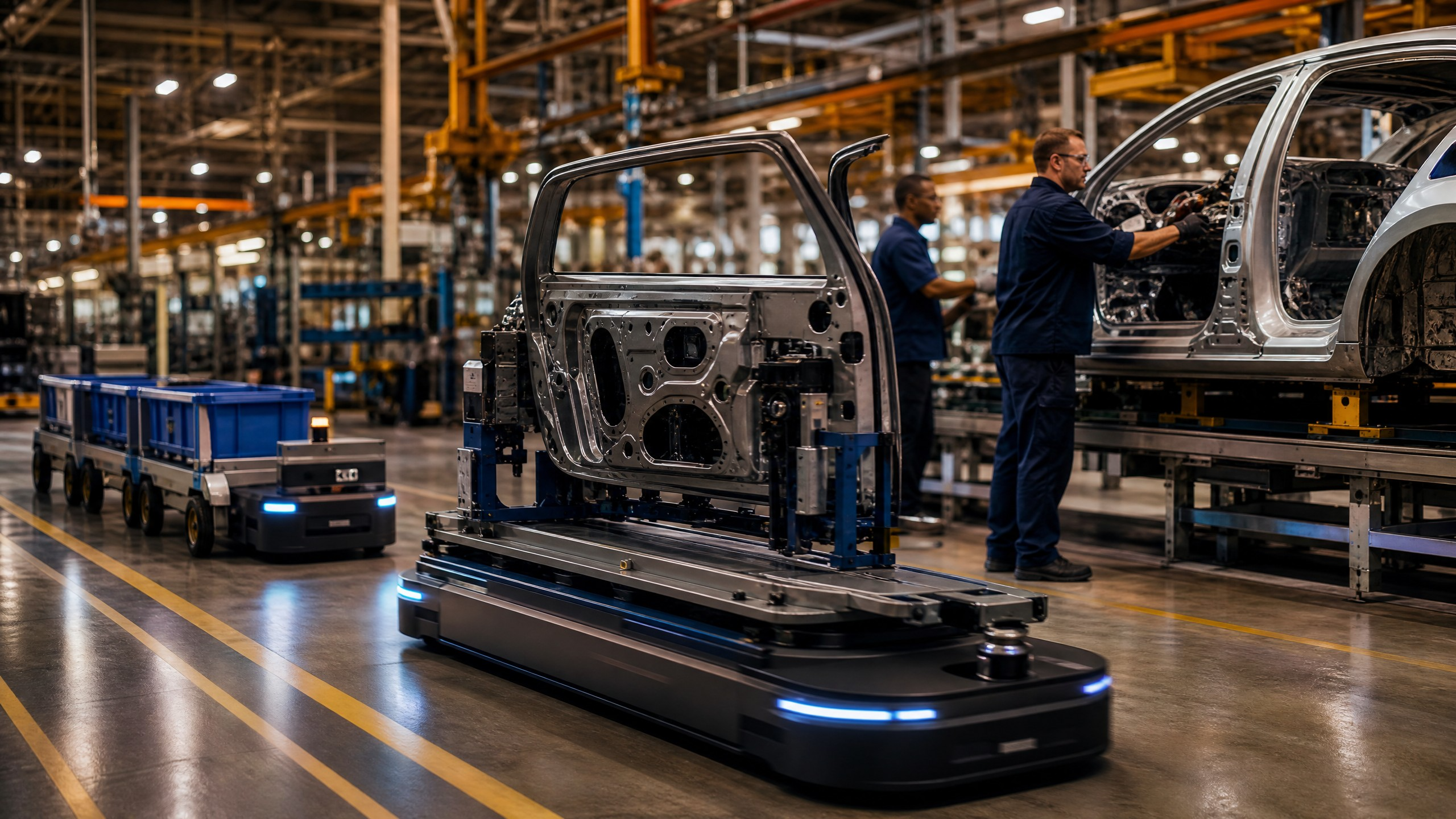
In manufacturing, BMW Group's Regensburg plant is the cleanest public example of mixed-fleet orchestration. The plant runs nearly 50 automated tugger trains and more than 140 Smart Transport Robots, flat platform vehicles developed with the Fraunhofer Institute for Material Flow and Logistics that carry components weighing up to a tonne. Together they complete roughly 10,000 part deliveries every working day, feeding an assembly line that produces a vehicle every 57 seconds. The fleet mixes automated and autonomous vehicles from different manufacturers under one cloud-based traffic control system, and the plant is progressively adding autonomous lifting trucks and forklifts to the same network. For a buyer, Regensburg demonstrates that the orchestration layer, not any individual vehicle, is the real asset.
Emerging Use Cases
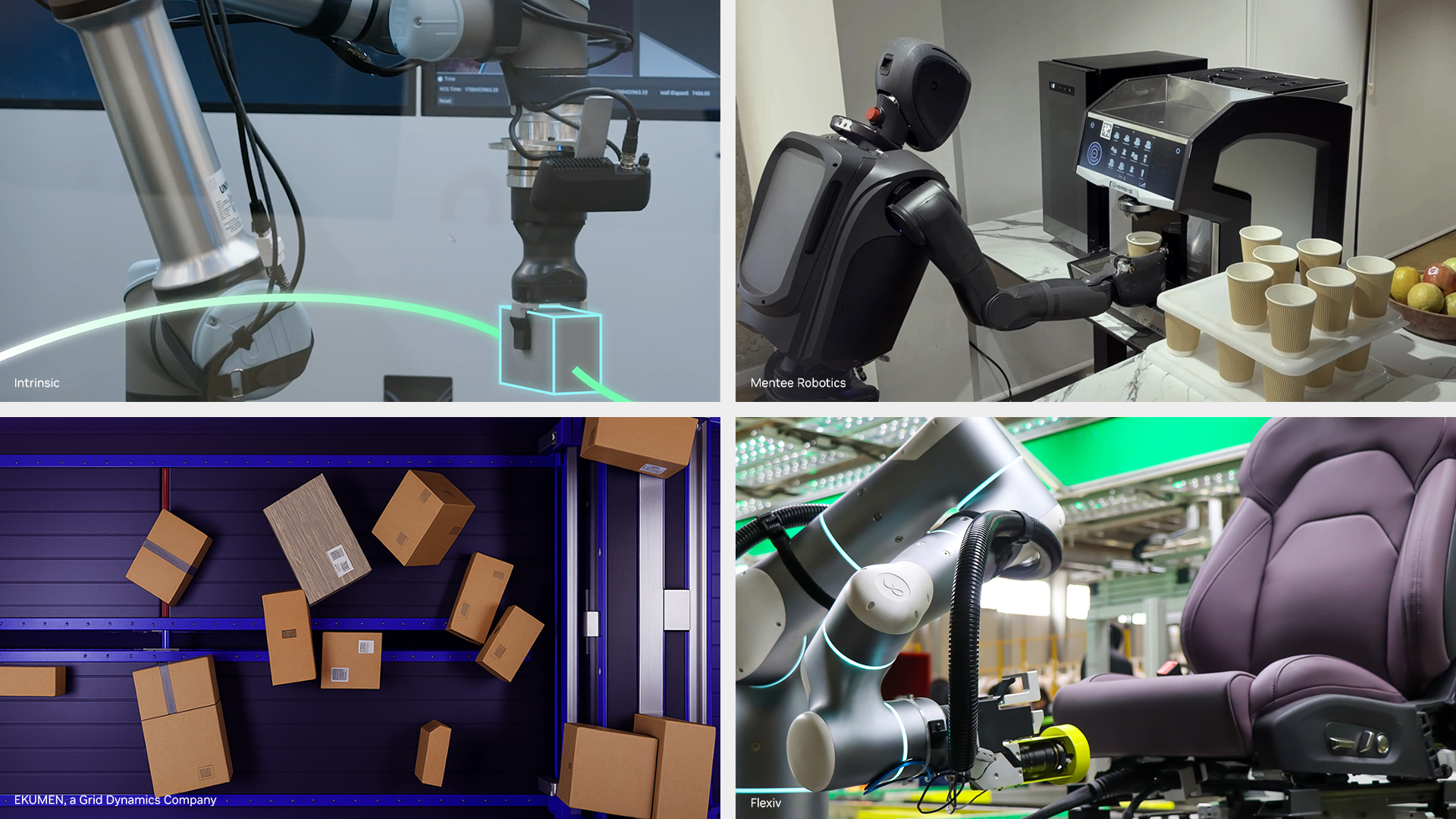
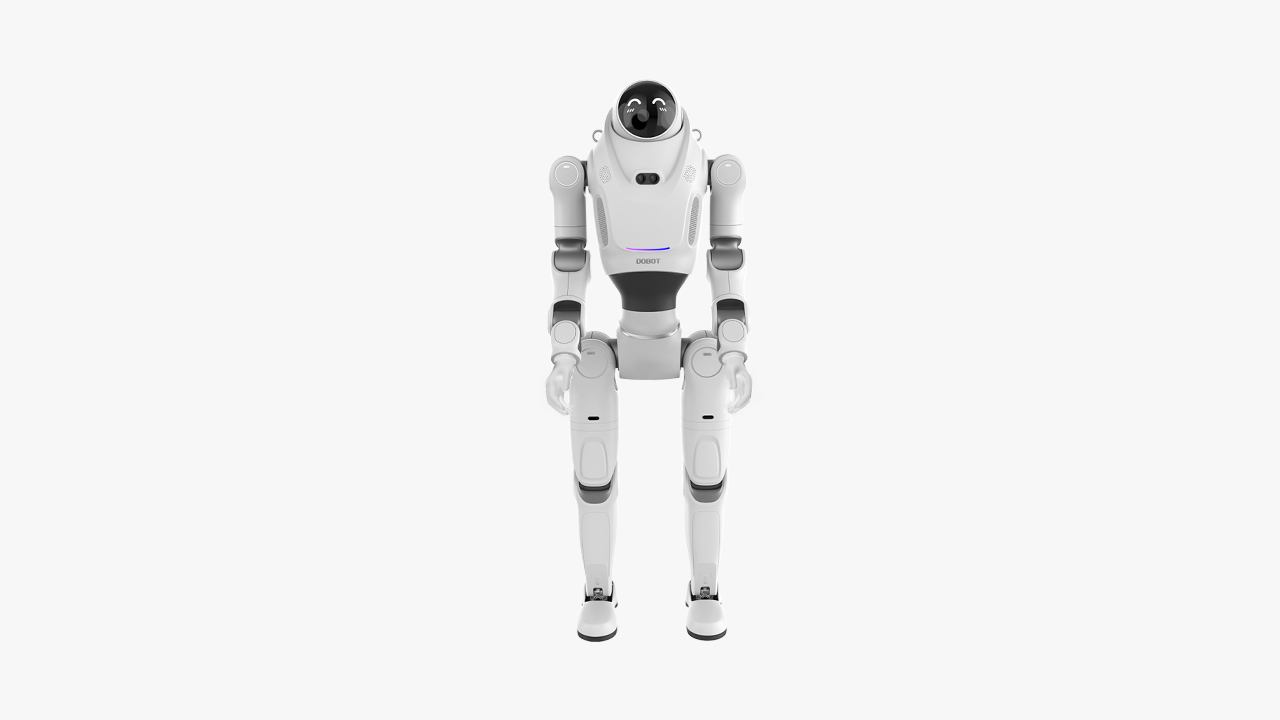
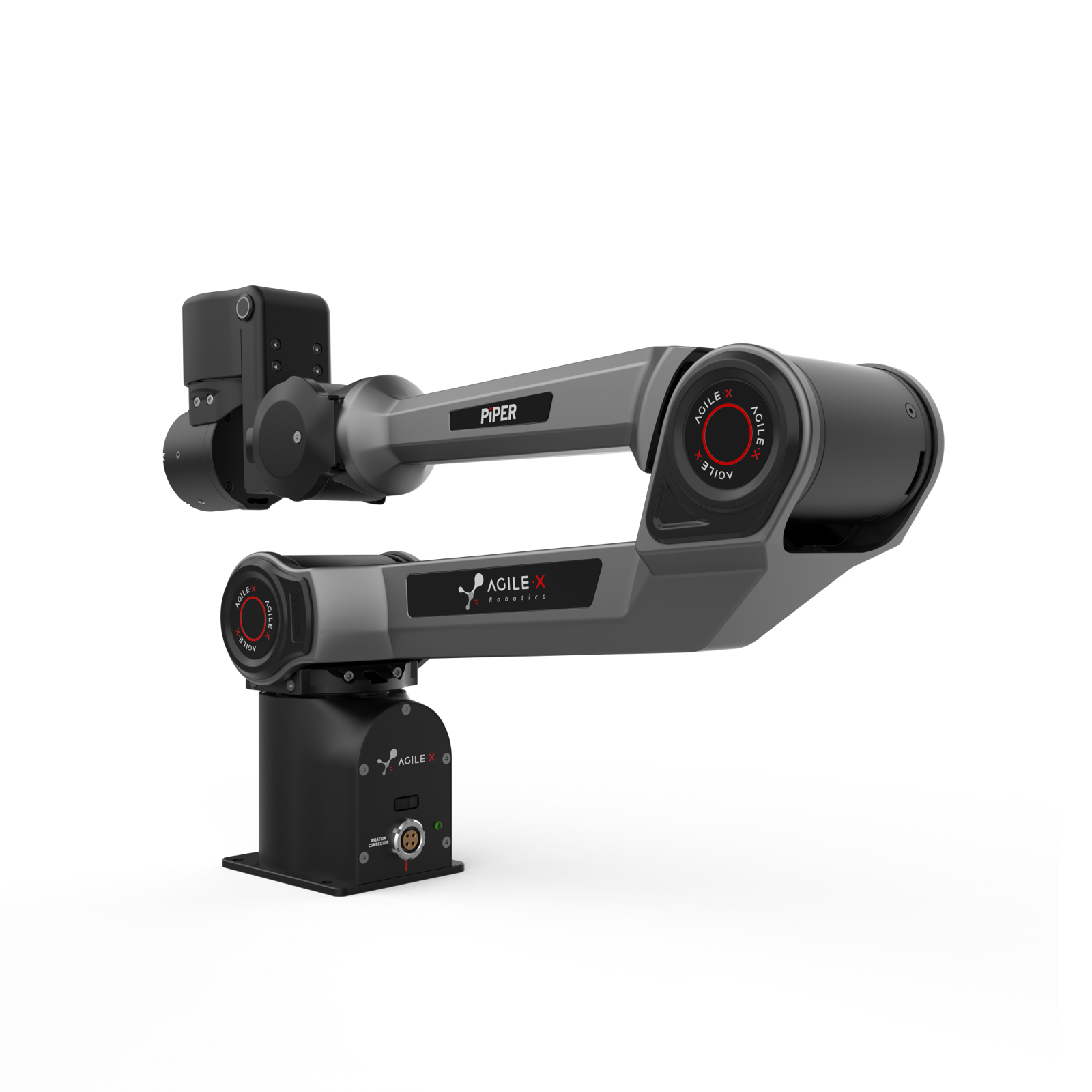
The deployment frontier is moving in three visible directions. The first is manipulation. Our previous article documented that composite robots, mobile bases fitted with arms or full wheeled-humanoid torsos, became the largest new-product category in the first half of 2026 with 41 launches. That launch wave is now reaching production floors: Hikrobot discloses that wheeled humanoid and quadruped robots are undergoing testing in its own manufacturing base for loading, unloading, picking, and transport tasks. The machines that only moved things are learning to touch things.
The second direction is small-fleet, subscription-priced deployment. The IFR's 42 percent growth figure for robots-as-a-service, and this week's 24-robot O'Neill contract with its explicitly performance-based rental model, point to the same conclusion: the entry ticket has fallen from a seven-figure capital project to a monthly operating expense that a mid-sized warehouse can approve at divisional level.
The third direction is AI-driven fleet orchestration, visible at both ends of the scale: Amazon's DeepFleet at a million robots, and cloud traffic control at BMW coordinating a few hundred. As fleets densify, the binding constraint shifts from vehicle capability to traffic management, and buyers evaluating vendors today should weight the fleet software roadmap at least as heavily as the hardware specification.
The Deployment Readiness Lens
To convert the deployment record into a procurement tool, we scored the four verified deployment archetypes described above against the five questions a buyer must answer before committing capital. This framework is original to this publication; its limitation is that it generalises from flagship deployments that are, by definition, better resourced than a typical first project, and it should be read as a positioning aid rather than a predictive model.
The four archetypes are the mega-fulfilment network (Amazon), the orchestrated factory (BMW Regensburg), the compressed-timeline Chinese plant (FAW Toyota and Changan), and the small-fleet RaaS warehouse (O'Neill). The five readiness questions cover task repeatability, facility stability, integration depth, workforce transition, and scaling intent. The scoring detail appears in the accompanying table, but the headline finding is that the small-fleet RaaS archetype is the only one accessible to buyers without dedicated automation engineering teams, while the orchestrated factory archetype delivers the highest return per robot precisely because it demands the deepest integration. Buyers who mismatch archetype and organisation, attempting a Regensburg-style orchestration project with an O'Neill-sized team, account for a large share of the stalled pilots the industry prefers not to publicise.
Table 1: The Deployment Readiness Lens
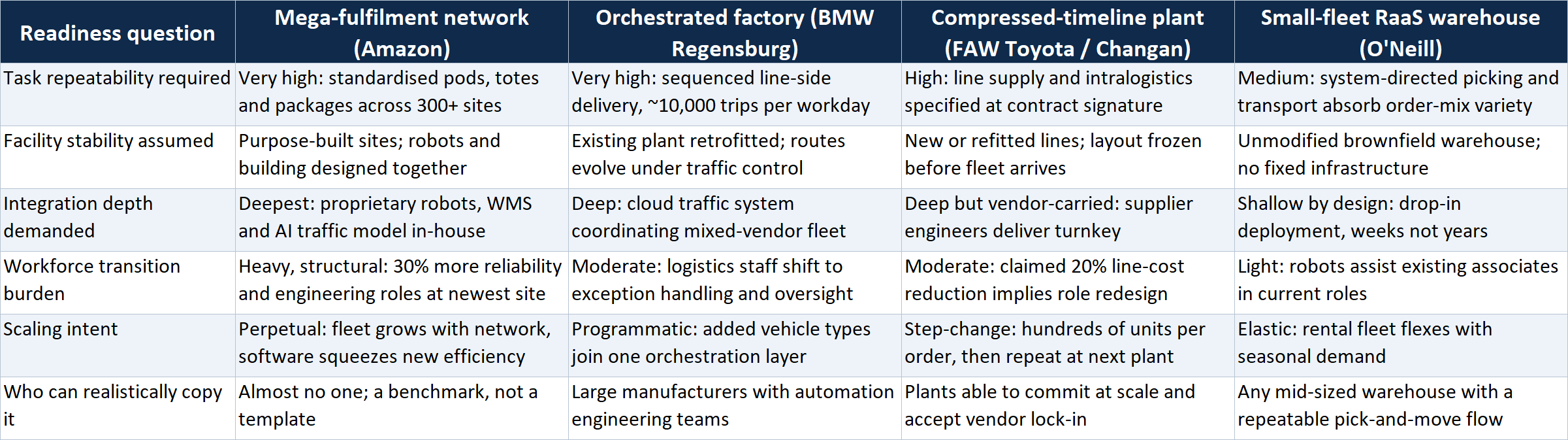
Archetypes are drawn from company-disclosed deployments: Amazon newsroom (Jun 2025), BMW Group press release (Oct 2024), Hikrobot customer disclosures (Jul 2026), and the Robust.AI/ O'Neill Logistics announcement (Jul 2026). Flagship deployments are better resourced than typical first projects; use as a positioning aid, not a predictive model.
A second reference table maps the primary industries to their dominant task patterns and typical vehicle classes, consolidating this article and the previous two into a single page a buyer can circulate internally.
Table 2: Where Mobile Robots Work
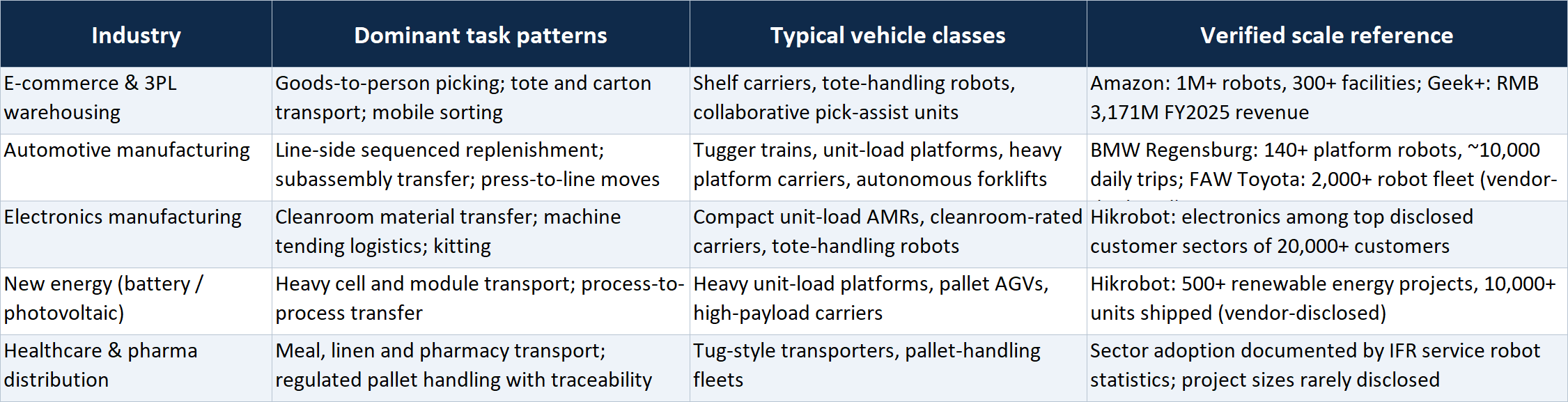
Sources include IFR World Robotics 2025 service robot statistics and self-reported vendor-disclosed figures (which are not independently audited).
The Bottom Line
The deployment record tells a procurement leader three things with unusual clarity. First, this asset class is proven at every scale that matters, from 24 robots on a rental contract to one million robots under central AI control, so technology risk is no longer the right reason to defer. Second, the deployment archetypes differ far more than the vehicles do, and choosing the archetype that fits your organisation's engineering depth matters more than choosing between competing robot brands. Third, the frontier is shifting from movement to manipulation and from hardware to orchestration software, which means the vendor you select should be judged on its fleet management roadmap among other criteria. Tomorrow's article takes the next step every buyer eventually reaches and examines what these machines actually cost, from list prices to the rental economics reshaping the market's entry point.
Disclaimer
This article is provided for general information only and does not constitute procurement, investment, or other professional advice. Figures are drawn from company disclosures, industry body statistics, and press materials believed reliable as of the information cut-off of 28 July 2026, with original currencies stated and approximate United States dollar (USD) conversions provided at indicative rates. Deployment performance claims attributed to manufacturers are self-reported and have not been independently audited. Readers should verify current figures and terms directly with vendors before making commercial decisions.