

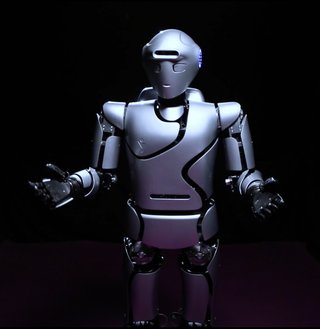
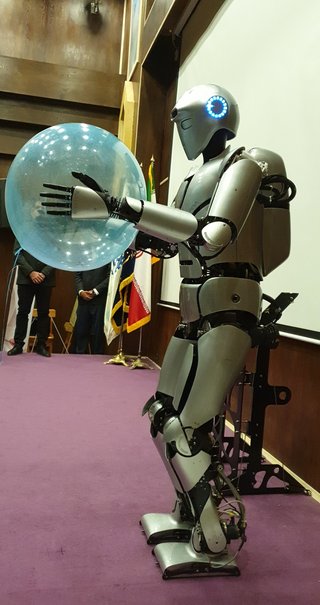
DESCRIPTION
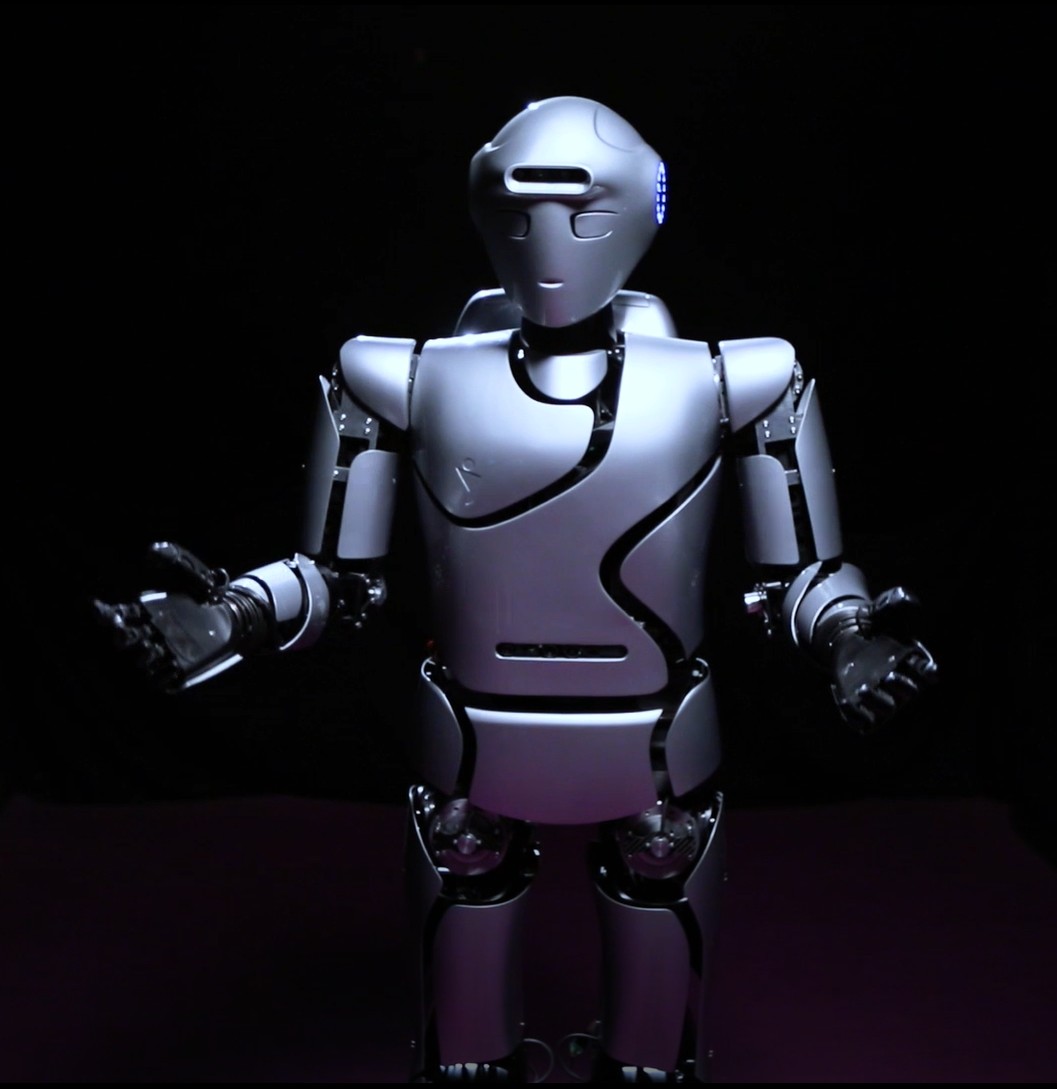
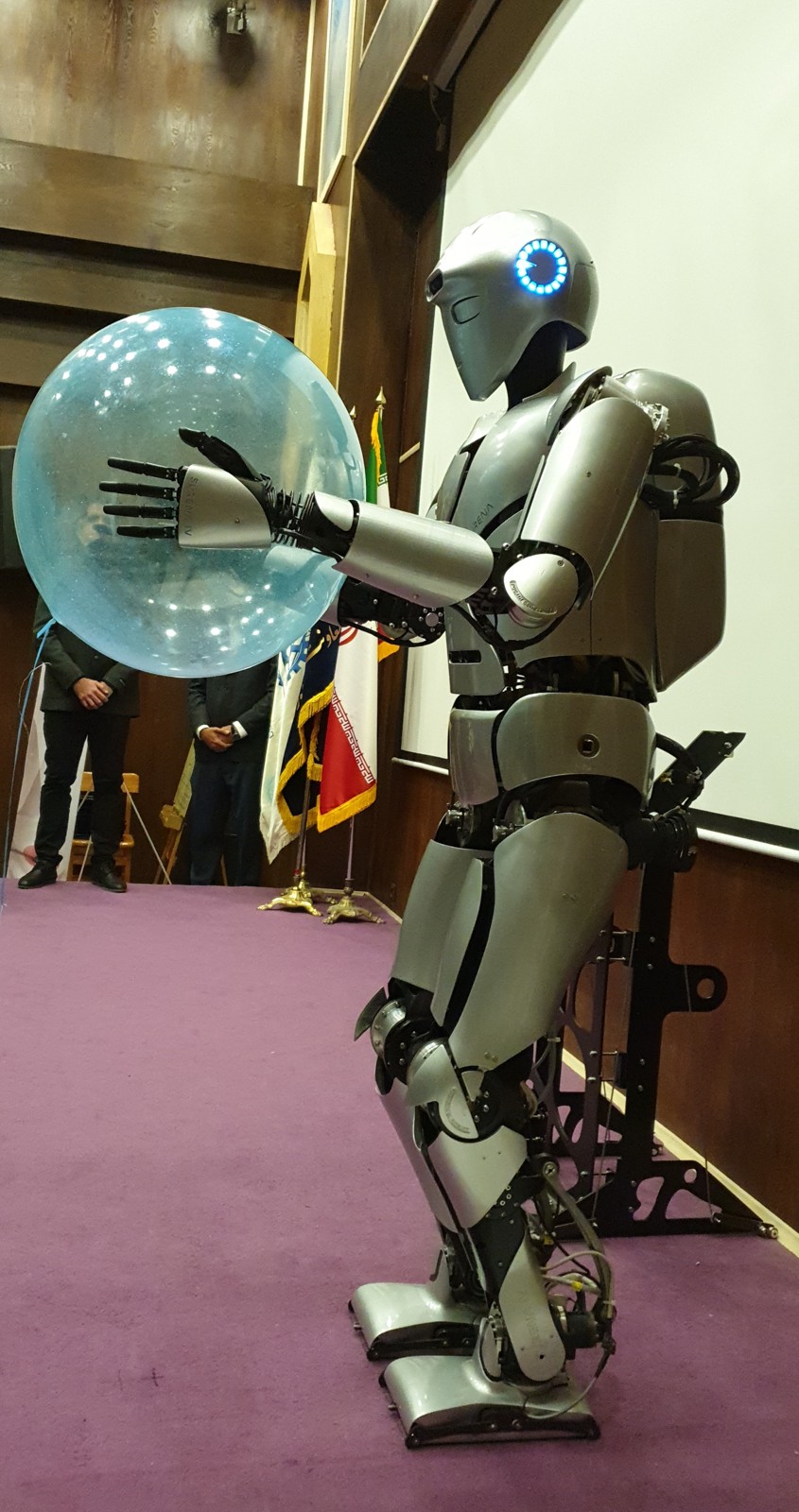
Surena IV is the fourth generation of the University of Tehran's humanoid programme and the one that made the series internationally known. It stands 170 cm, weighs 68 kg and has 43 degrees of freedom: three in the head, seven in each arm, six in each hand, two at the waist and six in each leg. The hands are the visible advance over Surena III. With six degrees of freedom each and force control, the robot grips and manipulates objects rather than simply posing, and it can imitate a person's actions through whole-body motion. It walks on uneven ground and recovers from a push, at a modest 0.7 km/h. CAST designed the actuation itself: 21 custom actuators combining harmonic drives with frameless flat high-torque motors and both incremental and absolute encoders, plus 10 mini and 12 micro servos for the smaller joints. Topology optimisation, an AZ91 magnesium alloy, aluminium and carbon-fibre core structure and a 3D-printed outer shell keep the mass down. Sensing runs to cameras, a gyroscope, accelerometers and an IMU, six-axis force-torque sensors, motor encoders, current sensors, foot contact sensors and a microphone. Onboard computing is an Intel Core i7 at 2.8 GHz with a GTX 1060 GPU alongside an FPGA and microcontrollers, the FPGA giving real-time joint control. The robot detects and follows faces and objects, and both recognises and produces speech.
FEATURES
- Fourth-generation research humanoid from the University of Tehran's CAST laboratory
- Height 170 cm
- weight 68 kg
- 43 degrees of freedom: head 3, arms 7 x 2, hands 6 x 2, waist 2, lower body 6 x 2
- Walking speed 0.7 km/h
- walks on uneven terrain and recovers from pushes
- Six-DOF hands with force-controlled gripping and manipulation
- Imitates human actions through whole-body motion
- 21 custom actuators: harmonic drives with frameless flat high-torque motors and dual encoders
- Plus 10 mini servo actuators and 12 micro servo actuators
- Core structure in AZ91 magnesium alloy, aluminium and carbon fibre
- 3D-printed outer shell
- Sensing: cameras, gyroscope, accelerometers, IMU, six-axis force-torque sensors, motor encoders, current sensors, foot contact sensors, microphone
- Compute: Intel Core i7 2.8 GHz, GTX 1060 6 GB GPU, FPGA and microcontrollers
- Face and object detection and tracking
- speech recognition and synthesis
TECHNICAL SPECIFICATIONS
| Physical | |
| Weight | 68 kg |
|---|---|
| Dimensions | H 1.7 m |
| Mobility | |
| Movement Type | Bipedal |
| Degrees of Freedom | 43 |
| Speed | 0.19 km/h |
| Environment | Laboratory and demonstration settings; walks on uneven terrain |
| Actuators | 21 custom harmonic-drive actuators with frameless flat high-torque motors, plus 10 mini and 12 micro servo actuators |
| Sensing & Compute | |
| Sensors | cameras, gyroscope, accelerometers, IMU, six-axis force-torque sensors, motor absolute and incremental encoders, current sensors, foot contact sensors, microphone |
| Software / AI | Whole-body motion control, action imitation, face and object detection and tracking, speech recognition and synthesis |
TECHNICAL SPECIFICATIONS
| Physical | |
| Weight | 68 kg |
|---|---|
| Dimensions | H 1.7 m |
| Mobility | |
| Movement Type | Bipedal |
| Degrees of Freedom | 43 |
| Speed | 0.19 km/h |
| Environment | Laboratory and demonstration settings; walks on uneven terrain |
| Actuators | 21 custom harmonic-drive actuators with frameless flat high-torque motors, plus 10 mini and 12 micro servo actuators |
| Sensing & Compute | |
| Sensors | cameras, gyroscope, accelerometers, IMU, six-axis force-torque sensors, motor absolute and incremental encoders, current sensors, foot contact sensors, microphone |
| Software / AI | Whole-body motion control, action imitation, face and object detection and tracking, speech recognition and synthesis |
Images
 martti
 martti
Image Contributions
Videos
ROBOT FORUMS
Loading forums...
RATINGS
FREQUENTLY ASKED QUESTIONS
What is the University of Tehran Surena IV?
Surena IV is the fourth generation of the University of Tehran's humanoid programme and the one that made the series internationally known. It stands 170 cm, weighs 68 kg and has 43 degrees of freedom: three in the head, seven in each arm, six in each hand, two at the waist and six in each leg.
Who makes the University of Tehran Surena IV?
The University of Tehran Surena IV is made by University of Tehran, a robotics company based in Iran.
How much does the University of Tehran Surena IV cost?
University of Tehran has not publicly announced pricing for the University of Tehran Surena IV. You can enquire through RobotAIGeek for current pricing.
What is the University of Tehran Surena IV used for?
The University of Tehran Surena IV is designed for development, material-handling, and research. It is used in research and education settings.
How much does the University of Tehran Surena IV weigh?
The University of Tehran Surena IV weighs 68 kg.
How fast is the University of Tehran Surena IV?
The University of Tehran Surena IV can move at speeds of up to 0.19 km/h.
How many degrees of freedom does the University of Tehran Surena IV have?
The University of Tehran Surena IV has 43 degrees of freedom.
When was the University of Tehran Surena IV released?
The University of Tehran Surena IV was announced in 2019 and is not yet generally available.
COMPARE WITH SIMILAR ROBOTS
See how this robot stacks up against its closest alternatives
- University of Tehran Surena IV vs Toyota T-HR3
- University of Tehran Surena IV vs ROBROS IGRIS-C
- University of Tehran Surena IV vs Tokyo Robotics Torobo
- University of Tehran Surena IV vs Tokyo Robotics Torobo-kun
- University of Tehran Surena IV vs Red Rabbit Robotics RX1