
Yaskawa Electric Shares Plunge Following Q1 Profit Collapse
Shares of Japanese factory automation giant Yaskawa Electric fell sharply after the company reported a 19 percent drop in operating profit, driven by severe IT system migration disruptions.
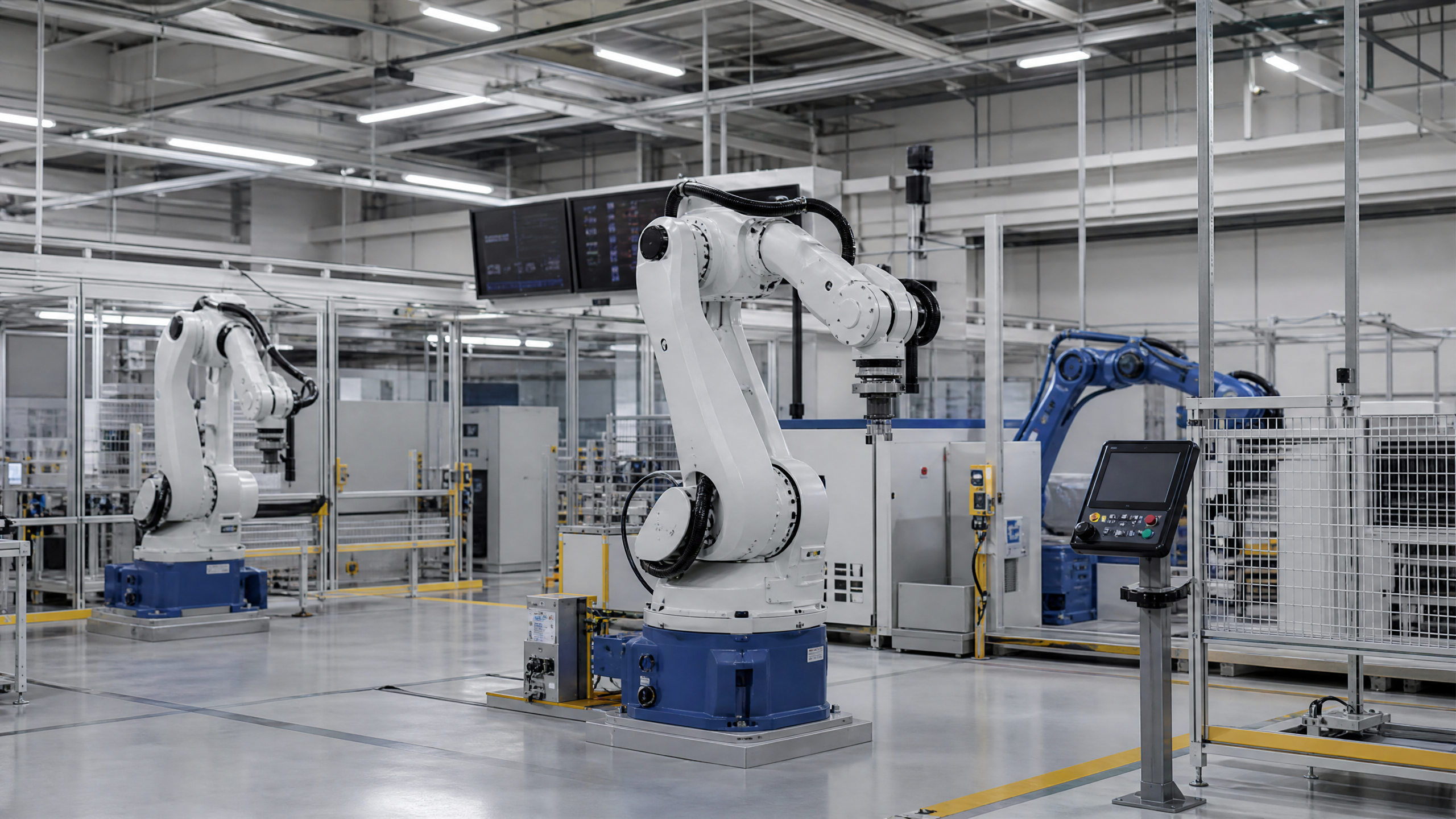
Shares of Yaskawa Electric, a major Japanese manufacturer of robotics and motion-control systems, plunged 14.3 percent to JPY 5,972 on July 13, 2026. The sharp sell-off followed the release of the company's financial results for the first quarter of fiscal year 2027, which revealed a significant deterioration in profitability despite top-line revenue growth. The earnings report triggered sympathy selling across the Japanese industrial machinery sector, impacting peers such as Fanuc and Omron. Yaskawa Electric, headquartered in Kitakyushu, Japan, is a core constituent of the Nikkei 225 index. The company's financial performance is closely monitored by investors and analysts as a bellwether for global demand in factory automation and industrial robotics.
IT Disruption Erodes Profit Margins
For the quarter covering March through May 2026, Yaskawa reported that operating profit fell approximately 19 percent year-over-year to roughly JPY 8.5 billion (approximately US$56.6 million). This decline occurred even as overall revenue climbed more than 10 percent during the same period. Net profit for the quarter slid by 23 percent.
Management identified the primary cause of the profit collapse as a larger-than-anticipated disruption resulting from an ongoing migration of its core Enterprise Resource Planning (ERP) and IT systems. The negative impact of this system transition significantly exceeded the company's internal estimates formulated in April. The financial drag was further compounded by costs associated with business restructuring operations in Europe.
Recovery and Sector Impact
Despite the near-term earnings damage, Yaskawa indicated that production operations are gradually recovering from the IT disruptions. Management expects operations to fully normalize during the subsequent June-August quarter. Signaling confidence in the company's longer-term trajectory, Yaskawa opted to leave its full-year financial guidance unchanged.
However, investors focused heavily on the immediate operational missteps, driving the stock down and contributing to a 1.1 percent decline in the broader Nikkei 225 index. The market reaction highlights the sensitivity of the factory automation sector to execution risks, even when underlying demand appears robust enough to support revenue growth. The incident underscores the critical importance of stable internal infrastructure for manufacturers attempting to scale production to meet global automation needs.
The Hidden Cost of Digital Transformation
For operations leaders, Yaskawa's stumble is a stark reminder that the biggest risks in automation often have nothing to do with the robots themselves. The failure here was not a mechanical breakdown on the factory floor, but a collapse in the digital nervous system that manages the business.
Enterprise Resource Planning (ERP) migrations are notoriously complex and risky. They require integrating legacy data, aligning disparate business units, and retraining personnel, all while attempting to maintain normal operations. When these migrations fail or encounter friction, the impact is immediate and severe, rippling through inventory management, order fulfillment, and ultimately, the bottom line. The irony is palpable: a company that builds the machines that automate the world struggled to automate its own internal data flows.
Understanding the ERP Bottleneck
To understand why an IT issue caused a 19% profit drop, one must understand the role of an ERP system in modern manufacturing. It is not just accounting software.
An ERP system coordinates everything. When a customer orders 50 robotic arms, the ERP system checks inventory for the necessary servo motors, orders more if needed, schedules the production time on the factory floor, coordinates the shipping logistics, and generates the invoice. If the ERP system goes down, or if data is corrupted during a migration, the factory doesn't necessarily stop running, but it stops running efficiently. Parts are ordered late, shipments are delayed, and the company incurs massive expedite costs to fix the errors manually. This operational friction destroys profit margins, even if overall sales remain high.
The Myth of Invulnerable Incumbents
A common assumption in the robotics industry is that established, legacy manufacturers like Yaskawa, Fanuc, or ABB are immune to the operational hiccups that plague startups. Their decades of experience and massive scale are viewed as a protective moat.
Yaskawa's Q1 results shatter this assumption. Legacy companies often carry significant technical debt—outdated software architectures and siloed data systems that were built decades ago. Upgrading these systems is akin to performing open-heart surgery on a marathon runner mid-race. While startups struggle with hardware scaling, incumbents often struggle with digital modernization.
Strategic Implications for the Automation Supply Chain
The immediate market reaction—dragging down competitors like Fanuc and Omron—demonstrates how tightly correlated the factory automation sector has become. Investors view these companies not just as individual entities, but as proxies for global industrial health.
For procurement managers relying on these Japanese giants, this incident warrants a review of supplier risk profiles. While Yaskawa expects a full recovery in the next quarter, the disruption highlights the vulnerability of highly concentrated supply chains. Diversification and dual-sourcing strategies become increasingly critical when even the most reliable tier-1 suppliers prove susceptible to internal execution failures.
Competitor Benchmarking: The Japanese Robotics Oligopoly
Yaskawa operates in a highly concentrated market dominated by a few key Japanese players.
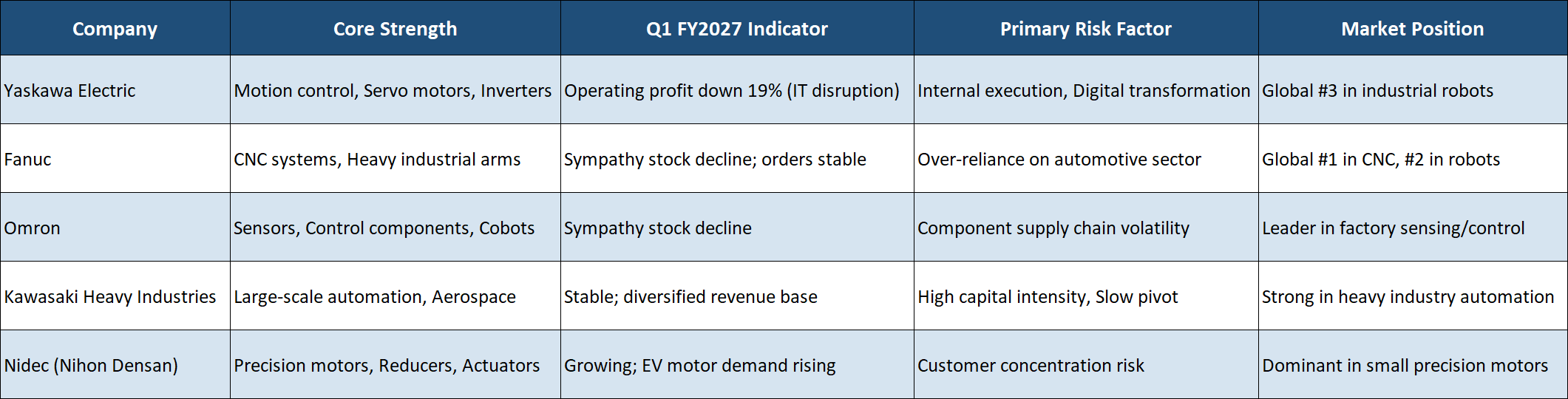
The interconnected nature of these companies means that a stumble by one often impacts the market perception of all. The challenge for Yaskawa is to prove that this IT disruption is a localized, temporary issue rather than a symptom of deeper organizational sclerosis.
The Vulnerability of Legacy Architectures
The severe impact of Yaskawa's ERP migration highlights a systemic vulnerability within many established industrial giants: the fragility of their legacy IT architectures. Companies that have grown over decades through acquisitions and regional expansions often operate on a patchwork of disparate, customized software systems.
These legacy systems, while perhaps stable in isolation, are incredibly difficult to integrate into modern, cloud-based platforms. The data structures are often incompatible, the codebases are obsolete, and the institutional knowledge required to maintain them is retiring. When a company attempts a "rip-and-replace" migration to a unified modern ERP, the hidden complexities of these legacy systems inevitably cause friction. The resulting data corruption, process misalignment, and operational downtime can cripple a company's ability to fulfill orders, even if the physical manufacturing equipment is functioning perfectly. This incident serves as a warning that digital modernization is not merely an IT project, but a high-risk operational transformation.
The Geopolitical Context of Japanese Automation
Yaskawa's performance must also be viewed within the broader geopolitical context of the global automation market. Japan has historically dominated the production of high-precision industrial robots and critical components like servo motors and reducers.
However, this dominance is increasingly challenged by the rapid rise of Chinese domestic manufacturers, who are aggressively moving up the value chain. While Chinese firms initially focused on lower-cost, lower-precision applications, they are now directly competing with Japanese incumbents in advanced manufacturing sectors. In this hyper-competitive environment, execution missteps like Yaskawa's IT disruption are particularly damaging. They not only impact near-term profitability but also provide an opening for agile competitors to capture market share. To maintain its leadership position, the Japanese robotics oligopoly must prove that it can innovate digitally as effectively as it has historically innovated mechanically.
The Challenge of Integrating Acquired Technologies
Yaskawa's IT disruption also sheds light on the difficulties of integrating acquired technologies into a unified corporate structure. Like many large industrial firms, Yaskawa has expanded its portfolio through strategic acquisitions, bringing in specialized companies with their own distinct software ecosystems and operational processes.
When a parent company attempts to force these acquired entities onto a single, centralized ERP system, the cultural and technical resistance can be immense. The acquired companies often rely on customized workflows that the new, standardized ERP cannot easily accommodate. This forces a painful choice: either heavily customize the new ERP (increasing cost and risk) or force the acquired companies to change their established processes (disrupting operations and morale). The Q1 profit collapse suggests that Yaskawa underestimated the friction involved in this integration process, a common pitfall for conglomerates attempting to rationalize their digital infrastructure.
Reassessing the Value of Vertical Integration
The supply chain vulnerabilities exposed by the IT failure may prompt a reassessment of vertical integration strategies within the robotics sector. In recent years, the trend has been toward outsourcing non-core components to specialized suppliers, relying on complex digital networks to coordinate the flow of materials.
However, when the digital network fails, the decentralized supply chain grinds to a halt. Companies may begin to see renewed value in bringing more critical manufacturing processes back in-house. While vertical integration requires higher capital expenditure and reduces flexibility, it offers greater control over the production process and insulates the company from external digital disruptions. The balance between the efficiency of a decentralized supply chain and the resilience of a vertically integrated operation will be a key strategic debate for industrial manufacturers in the wake of incidents like Yaskawa's Q1 stumble.
This analysis synthesizes corporate financial filings, market trading data, and management statements regarding the first-quarter performance.
Disclaimer: This article is produced for informational purposes only. The analysis represents the views of the editorial team and does not constitute investment advice, endorsement of any company, or recommendation to buy or sell any security. All facts have been verified against primary sources to the best of our ability.














