
World Robot Conference 2026 dates set for Aug 19 to 23, A-share robot stocks rally
China has scheduled the World Robot Conference 2026 for Aug 19 to 23 at the Beiren Yichuang convention center in Beijing E-Town, following a July 6 announcement by Zhao Yunfeng of the China Institute of Electronics. A-share robot concept stocks rose on July 7, with Julun Intelligent briefly hitting the daily limit-up as traders positioned for show-driven news.
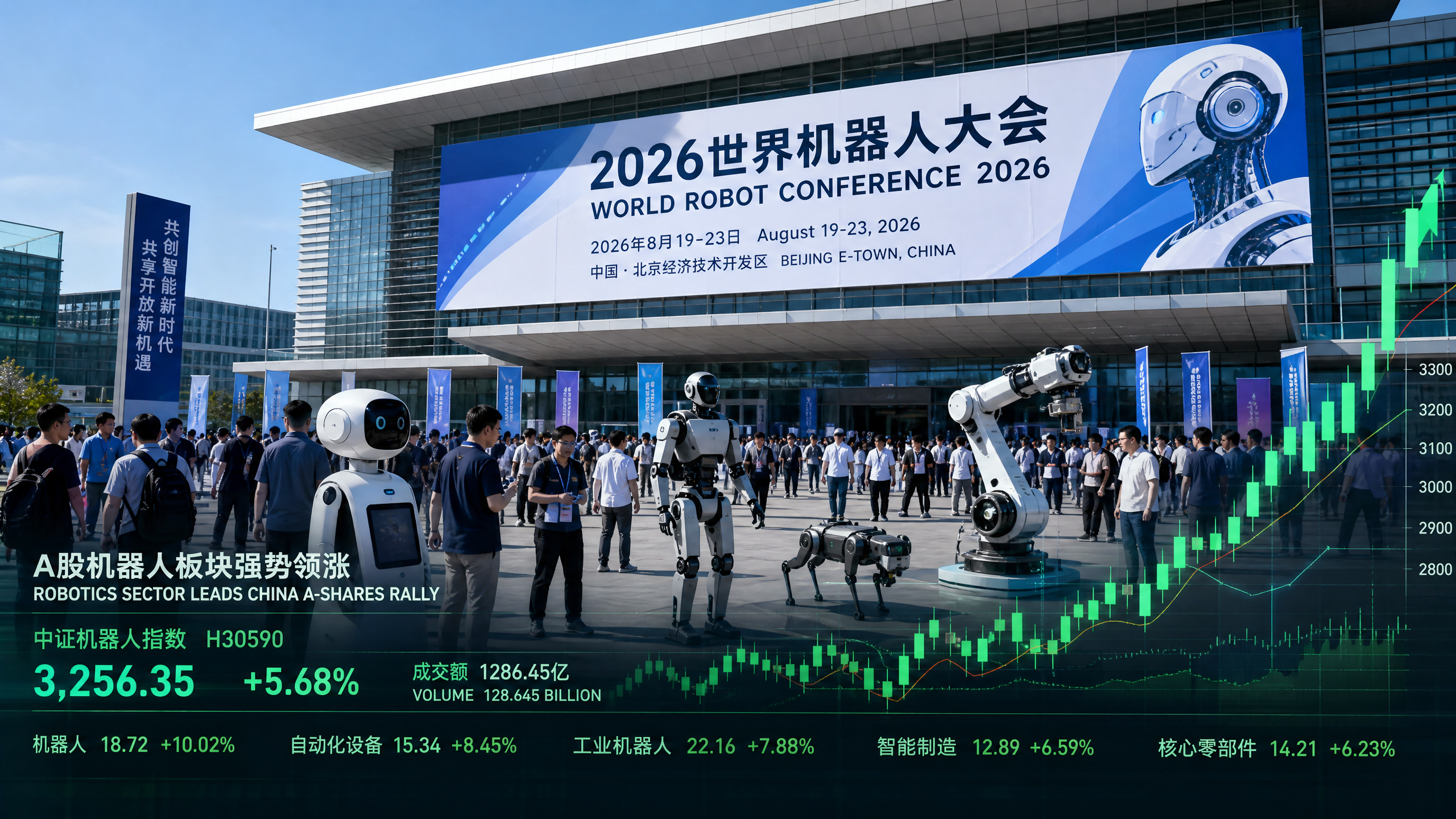
Beijing, July 7. The World Robot Conference 2026 will take place from August 19 to 23 at the Beiren Yichuang International Convention and Exhibition Center in Beijing E-Town, according to an official announcement made on July 6 by Zhao Yunfeng of the China Institute of Electronics. The confirmation triggered a rally in A-share robot concept stocks on July 7, with Julun Intelligent briefly touching the daily limit-up.
The dates put one of China’s flagship robotics gatherings in late summer, shortly after July’s World Artificial Intelligence Conference in Shanghai. The timing clarifies the domestic exhibition window for robot makers, integrators, and component suppliers, and it gives investors a visible milestone for product launches, order intake, and policy signals that often concentrate around major trade shows.
What happened
Zhao Yunfeng announced the World Robot Conference 2026 schedule on July 6. Organizers set the venue as the Beiren Yichuang International Convention and Exhibition Center in Beijing E-Town, a hub for advanced manufacturing on the city’s southeastern side. The event will run across five days, August 19 to 23, and will combine an exhibition floor with conferences and technical forums.
On July 7, shares tied to the robotics theme advanced in China’s A-share market. Julun Intelligent, a robot and automation play by investor theme classification, briefly hit the exchange-imposed upper trading limit before easing. Turnover in several robotics and industrial automation names was active as traders positioned around the newly fixed exhibition timetable and the coming wave of product demonstrations and partnership announcements that tends to accompany WRC.
Market reaction and what it signals
The swift move after the date reveal underscored how sensitive China’s robotics theme can be to near-term catalysts. In A-shares, concept baskets often trade around event schedules, procurement windows, and policy milestones. A hard date for a top-tier show consolidates expectations about exhibitor reveals, municipal showcases, and on-site procurement drives.
Investors typically track a cross-section of listed companies ahead of WRC. These include upstream component makers for reducers, servomotors, drives, precision bearings, machine vision cameras, and controllers. Midstream system integrators and robot manufacturers often stage new models or present refreshed roadmaps. Downstream adopters in automotive, electronics, logistics, and healthcare use the floor to vet suppliers and schedule trials. While performance varies by name and the broader tape, the cluster effect of a definitive exhibition schedule can help synchronize marketing pushes and customer engagement, which in turn can influence quarterly order flow.
The limit-up in Julun Intelligent highlighted the speculative and momentum-sensitive nature of China’s themed trading. Limit mechanics in A-shares create sharp thresholds of supply and demand each day. That structure can amplify event-driven sentiment when investors anticipate a burst of news in a concentrated time frame.
Why the dates matter for the robotics industry
WRC is one of China’s premier dedicated robotics events. It has been hosted in Beijing since the mid-2010s and is co-organized with the China Institute of Electronics among other partners. The conference and expo platform covers industrial robots, service robots, humanoids, and enabling technologies. Its forums typically bring together researchers, executives, policymakers, and international exhibitors. The show floor focuses on demos and procurement, while keynote tracks explore standards, safety, and the path from research to market.
This year’s placement in late August effectively solidifies an exhibition season that starts with WAIC in July, then continues with WRC. That cadence allows AI model and platform announcements to roll into robotics hardware and deployment showcases a few weeks later. For buyers, the back-to-back scheduling compresses the vendor comparison cycle and can speed up proof-of-concept discussions. For sellers, it offers clear staging for press, customer briefings, and channel partner convenings.
Event logistics and venue context
The Beiren Yichuang International Convention and Exhibition Center sits within Beijing E-Town, an industrial zone that houses advanced manufacturing, electronics, and automotive supply chains. The venue is designed for large industrial exhibits, including heavy equipment and live robot cells. That supports demonstrations that need wide aisles, safety perimeters, and power for multi-axis rigs, mobile robot fleets, and vision-guided systems.
Beijing E-Town’s proximity to manufacturing clusters and academic labs makes it suitable for side events that blend commercial demos with research workshops. Exhibitors tend to split space among robot arms, autonomous mobile robots, integrated workcells, and service robot live zones. Organizers also create innovation corners that spotlight startups, components, and software stacks.
How a fixed show window supports commercial execution
Trade shows still matter in robotics because many deals require hands-on validation. Customers want to see cycle times, repeatability, safety behavior under edge cases, and maintenance workflows. For integrators, a show offers a way to book meetings with multiple suppliers in one trip and to compare, under similar conditions, the maturity of control software, the openness of APIs, and the stability of ecosystem plug-ins.
A locked-in WRC week lets vendors plan test cells, allocate demo units, and line up engineers for live troubleshooting. Marketing can pre-brief customers, secure media interviews, and schedule closed-door sessions with key accounts. Sales teams can bundle show promotions with after-show trials. For public companies, the calendar also frames guidance narratives about pipeline health, channel inventory, and the likely timing of purchase orders that straddle the quarter boundary.
What investors will watch in the run-up
· Exhibitor roster and floor-plan allocations, which reveal which sub-sectors are leaning in and how much space they book.
· Keynote agenda and special forums, where policy direction, standards, and funding programs can surface.
· Humanoid and service robot demos, which have become focal points for attention and for component demand stories.
· Component breakthroughs in reducers, servo drives, machine vision, force sensors, and edge AI controllers.
· On-site announcements with local governments, such as pilot deployments, procurement frameworks, or industrial park incentives.
· International participation, which can indicate cross-border supply-chain openness and export momentum.
These elements do not guarantee order conversion, but they tend to shape near-term narrative and channel checks that analysts run after the show.
A-share mechanics around event-driven trades
China’s A-share market sets daily price movement bands for most stocks. Many non-special treatment names observe a 10 percent limit in either direction, with enhanced volatility controls in certain cases. When a theme heats up, the bands can create stair-step price action as buy orders accumulate on the limit and liquidity tightens for several names at once. Event announcements, even those focused on scheduling, can act as catalysts if investors see them as timing points for product cycles or policy communication.
Robot and automation concept baskets in China span several layers of the value chain. Upstream suppliers include precision gear makers, harmonic and RV reducer manufacturers, servo and drive specialists, motion control vendors, cable and sensor suppliers, and vision system firms. Midstream companies integrate robots into factory lines or logistics centers, often blending software, safety systems, and custom end-effectors. Downstream adopters in electronics manufacturing services, automotive body shops, battery plants, and distribution centers represent the demand side. The WRC calendar can activate positioning across that chain when investors anticipate show-related demonstrations or contracts.
How WRC sits alongside other 2026 calendars
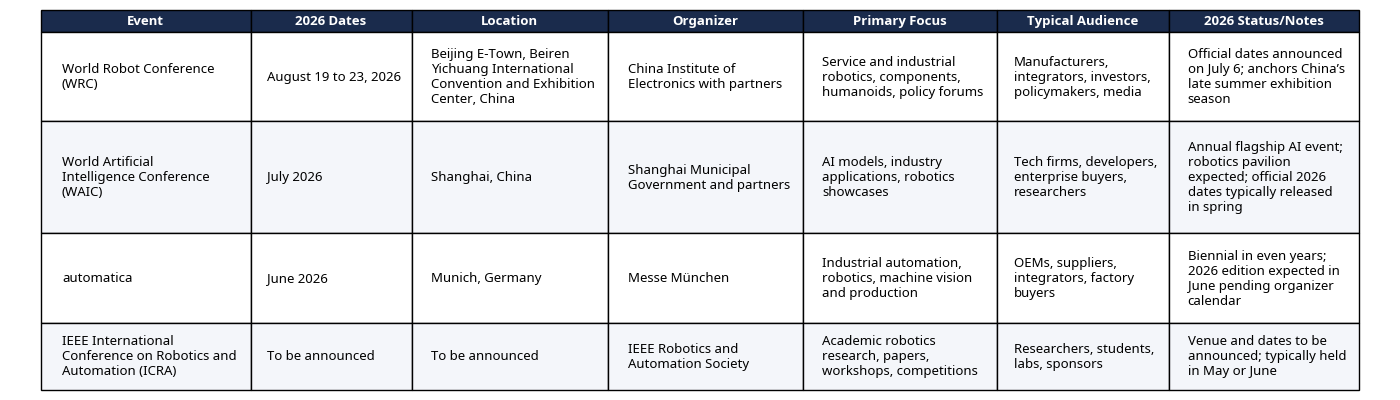
The market often frames WRC in relation to other high-profile events. WAIC in July centers on AI models, platforms, chips, and industry solutions, with a growing robotics presence. Automatica, a European industrial automation trade fair typically held in June in Munich, focuses on production automation, collaborative and industrial robots, and machine vision. ICRA is the leading academic robotics conference run by IEEE, usually in late spring or early summer, where research papers and workshops preview the ideas that may reach commercial readiness later.
The path from research paper to production line can take years. That is why investors use ICRA to sense medium-term direction, Automatica to gauge supplier competitiveness and distribution strength, WAIC to assess AI platform and chip trajectories, and WRC to view China’s domestic ecosystem depth and deployment appetite.
Near-term watch list
With dates set, attention now turns to the following checkpoints:
· Opening of exhibitor registration windows and the first batch of confirmed anchor tenants on the show floor.
· Early keynote and special forum topics that indicate whether standards, safety certification, or application-specific pushes will take center stage.
· Any municipal or ministerial notices about robotics adoption programs timed to the show window.
· Signals from integrators about demo-unit availability and customer trial pipelines for the third quarter.
· Travel and logistics updates for international participants.
Each item shapes expectations more than it guarantees outcomes. However, the cadence of pre-show releases can move stocks if investors infer a heavier or lighter flow of near-term orders.
Comparison: major global AI and robotics exhibitions in 2026
The calendar below places WRC alongside other cornerstone events. Final dates and venues for some international shows are typically confirmed closer to the year and may change.
The bottom line
The World Robot Conference 2026 now has fixed dates, August 19 to 23, and a set venue in Beijing E-Town. The scheduling clarity was enough to lift attention and prices across A-share robotics names on July 7, with Julun Intelligent briefly locked at the limit-up. The event will frame a key stretch of China’s technology exhibition season that follows July’s AI showcase in Shanghai and precedes the fall manufacturing calendar. For companies, the date certain supports go-to-market planning, demo builds, and customer outreach. For investors, it offers a defined waypoint to assess pipelines, policy messaging, and supplier momentum in the second half.
Sources
· Southern Finance (南方财经)
· 东方财富














