Unitree sets US$9 billion Shanghai IPO as DeepSeek backs robotics expansion
Unitree priced its STAR Market listing at RMB 150.8 per share, valuing the company at RMB 61 billion and targeting RMB 6.1 billion in proceeds, with subscriptions opening August 10. DeepSeek is a strategic investor as Unitree pivots from quadrupeds to humanoids and invests heavily in growth.

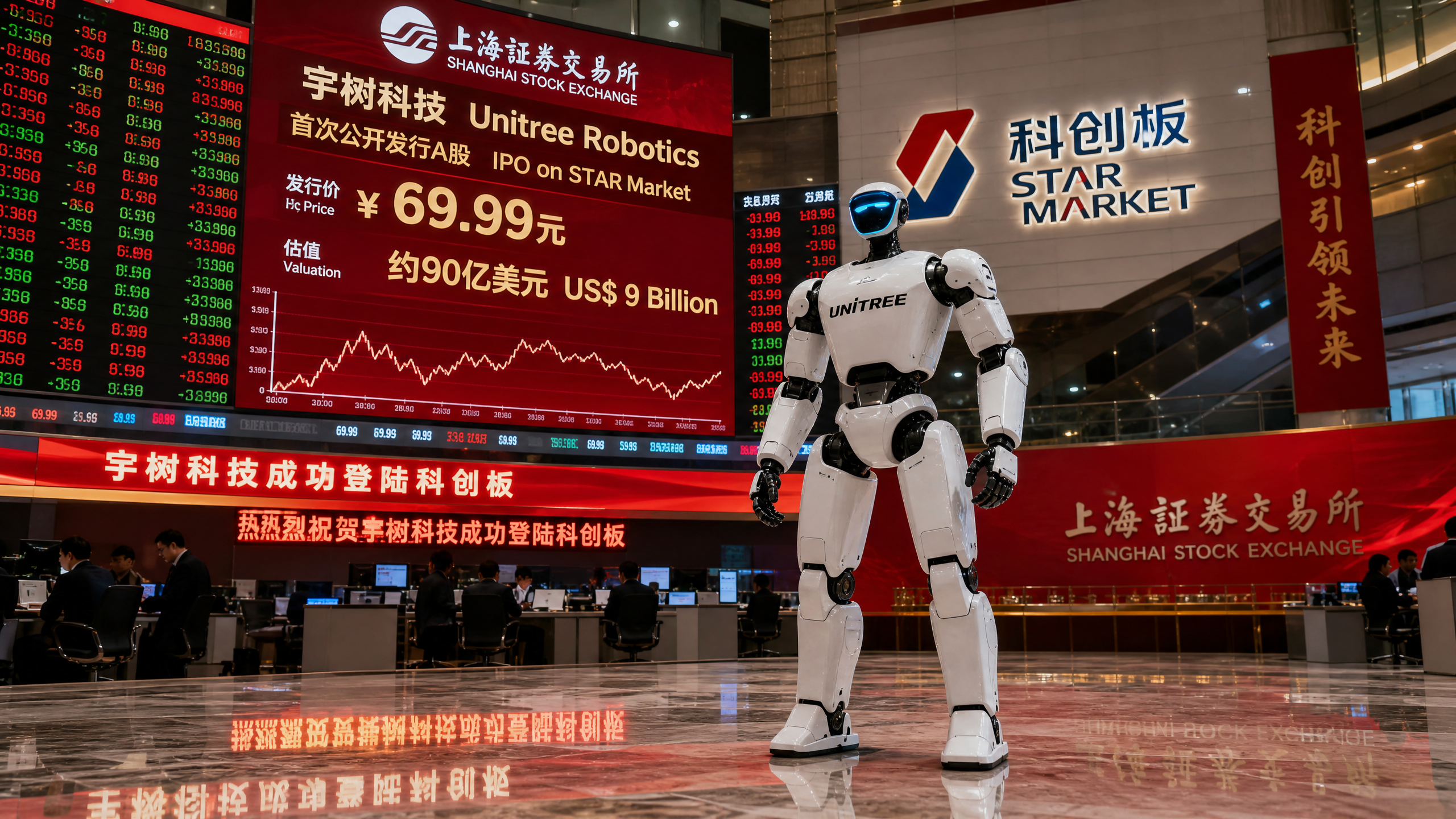
Unitree is headquartered in Hangzhou has built its reputation on cost efficient legged robots that blend proprietary actuators with perception software. The company emerged with consumer priced and professional quadrupeds has shifted resources into humanoid platforms as demand for flexible automation grows across logistics, light manufacturing and services. The STAR Market listing locks in capital to scale production and fund research while Unitree battles for a foothold in a field where money, supply chains, and software ecosystems matter as much as hardware.
The pricing aims to cement a leading role in China’s robotics push
Unitree’s decision to price at RMB 150.8 per share for a RMB 61 billion valuation roughly US$9.04 billion signals confidence in a growth curve that is steep but uneven. Revenue quadrupled to RMB 1.7 billion in 2025 as the company sold more units and broadened its catalog. In the first quarter of 2026, revenue rose 68.5 percent to RMB 422.8 million, yet net profit fell 52.6 percent to RMB 40.3 million on heavier research and marketing outlays. Those numbers capture the reality of an industry moving from prototypes to pilots to scaled deployments. The first wave rewards exposure, while the second punishes any shortfall in durability, safety, or application fit.
The proceeds target of RMB 6.1 billion will go toward capacity expansion, component vertical integration and platform software, according to people familiar with the deal. That aligns with a national push. Chinese industry planners have flagged humanoid robotics as a next wave general purpose technology and provincial governments have opened funding channels for factories, pilot zones and integrator partnerships. For Unitree, the STAR Market is also the venue of choice for hard tech valuations that reflect policy backing for advanced manufacturing.
The revenue mix has tilted toward humanoids as volumes ramp
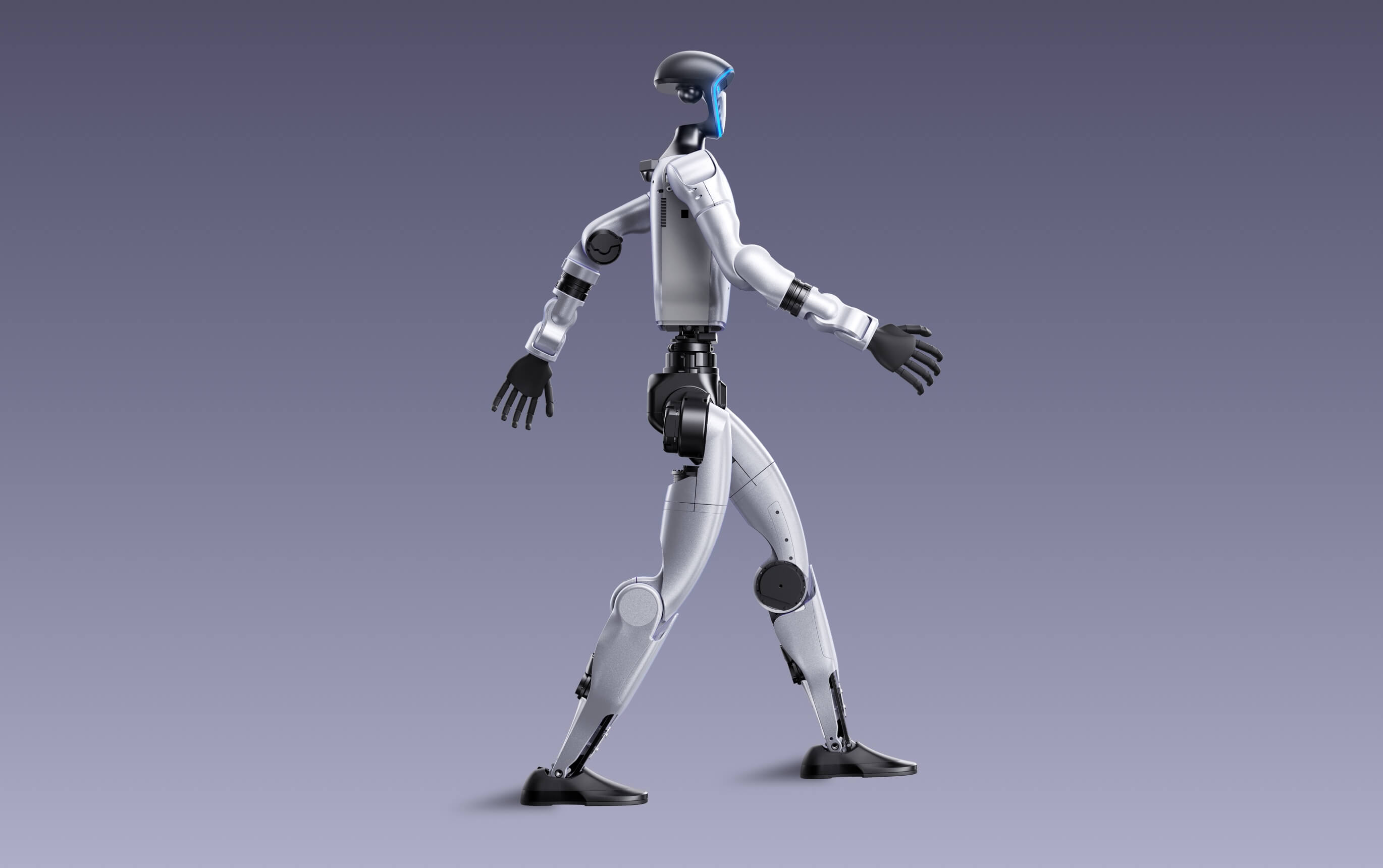
Unitree’s revenue streams once hinged on quadruped robots used by researchers, security contractors and industrial trial sites. In 2025, humanoid robots generated RMB 867.8 million, overtaking quadrupeds as the largest business. That pivot matters for two reasons. First, humanoids command higher average selling prices and can be tailored for a broader set of tasks where a roughly human form factor simplifies integration into workplaces built for people. Second, the engineering stack requires more power dense actuators, more efficient battery systems, and more adaptable control software, which raises fixed costs but creates defensible IP.
Unitree’s catalog spans entry level quadrupeds priced for enthusiasts and labs, through industrial grade machines with swappable payloads and weather sealing, to developmental humanoids aimed at light duty manipulation and mobility in constrained spaces. The company’s approach to actuators and reducers is central. Legged robots live or die on the torque, heat dissipation and longevity of their joints. Sources in the supply chain say Unitree has invested in in house or co developed electric motors, harmonic or cycloidal reducers and compact servo drives to keep bill of materials cost under control while preserving performance. Combined with modular frames and common controllers, that strategy reduces the cost per new model and speeds updates.
The capital allocation plan seeks vertical integration and global reach
The planned raise gives Unitree options. Expanding actuator and reducer production would reduce dependency on Japanese and European suppliers whose lead times and pricing can swing with global cycles. Building final assembly and testing capacity in coastal China supports throughput and export documentation. Investment in perception and control software alongside cloud fleet management would improve the stickiness of the installed base.
International expansion is vital. The company reported that the United States accounted for 13.3 percent of revenue last year. Europe, the Middle East, and parts of Asia form the rest of overseas sales. Direct to customer online channels helped early hobbyist adoption, but enterprise sales rely on integrators and service partners that can support deployments over years. The IPO proceeds can fund channel development, warranty reserves, and field application engineering in key markets. That is expensive, but it is how hardware companies become platforms rather than one off suppliers.
A plain language analogy applies here. Hardware without a deep partner network is like selling cars without dealerships or service bays. The initial sale looks good until maintenance issues pile up. Unitree’s task is to finance not only the factory but the service grid that convinces enterprises to commit robots to shifts and workflows.
DeepSeek’s role links foundation models with embodied AI
DeepSeek’s participation as a strategic investor adds a software dimension that is increasingly central to robot usability. Foundation models trained for language and vision are being adapted to embodied tasks. A robot that understands commands, models its surroundings, and plans sequences can be far more useful than a machine locked into fixed scripts. DeepSeek has become a prominent Chinese developer of large-scale models and its investment suggests deeper collaboration on device inference, multimodal perception and centralized learning systems.
The catch is that running advanced models on robots is constrained by compute budgets, latency and power draw. Data center class training remains dependent on high end GPUs that are subject to US export controls. On the edge, robots mix embedded systems from Nvidia, Intel, or Arm based vendors with custom accelerators. Chinese alternatives are improving, yet porting across stacks can be slow. Unitree will need to balance ambition with hardware realities by quantizing models, optimizing pipelines and relying on hybrid cloud edge architectures that preserve responsiveness without draining batteries.
US exposure brings tariffs and policy risks that could curb overseas growth
Unitree has warned that US tariffs, limits on government purchases, and export controls could hurt overseas growth. The company’s 13.3 percent revenue exposure to the US amplifies this vulnerability. Tariff lines on Chinese electronics and machinery increase end prices for American customers. Procurement rules that restrict public sector purchases from certain Chinese manufacturers can shut out sales to universities, agencies, and municipal services. Export controls can also bite in subtle ways by limiting access to high end compute modules or specialty sensors that the robots rely on, especially for higher tier models.
There are mitigations. Localizing final assembly in third countries can alter tariff treatment. Structuring US sales through independent distributors focuses compliance on the partner while keeping Unitree at arm’s length. Offering versions with alternative compute or radio modules reduces the risk that a single restricted component blocks shipments. Yet these tactics have limits. The United States is also considering broader restrictions on advanced robotics in sensitive sectors, citing security concerns. That political variable is hard to hedge.
Supply chain control is the differentiator in electric muscles and silicon brains
Legged robots are complex electromechanical systems. Their availability and performance hinge on a supply chain that includes permanent magnet materials for motors, high precision reducers, carbon fiber or aluminum structural parts, lithium ion battery cells, cameras and LiDAR, embedded compute, and real time control software. Several of these components face geopolitical bottlenecks.
Neodymium iron boron magnets are crucial for high torque density motors. China dominates upstream rare earth processing, which is a strength for Unitree but also a policy lever that Beijing and trading partners watch closely. Harmonic reducers and high precision bearings have historically come from Japanese and European suppliers, though Chinese firms are gaining ground. Batteries are abundant in China, but export and transport regulations require careful logistics planning. Compute modules from US chipmakers remain widely used across the industry. If export rules tighten, Unitree must secure domestic or nonS alternatives that meet performance and software compatibility needs.
Unitree’s strategy appears to favor deeper control of actuators and servo drives. That is a sensible focus because those parts account for a large share of the bill of materials and define robot feel and durability. A push into custom motor windings and integrated motor driver boards can shave cost and improve efficiency. For compute, a hybrid approach is more practical. Maintaining software that runs on Nvidia Jetson class modules for international versions while sustaining ports to Chinese accelerators for domestic use spreads risk but increases engineering workload.
Competitive dynamics intensify as humanoid programs scale up
The competitive field is crowded and well financed. In quadrupeds, Unitree faces Boston Dynamics, Ghost Robotics in the US and Chinese peers such as DeepRobotics and Xiaomi in the consumer tier. In humanoids, capital heavy projects from Tesla, Figure and Agility Robotics in the US, and UBTECH, Fourier Intelligence and other Chinese entrants are staking claims. Each camp is racing to demonstrate repeatable tasks in warehouses and factories, such as case handling, tote shuttling and machine tending.
Unitree’s edge is cost and iteration speed. The company brought usable quadrupeds to market at price points that undercut Western rivals, proving it can compress bills of material and ramp production. Translating that playbook to humanoids is tougher. Manipulation requires reliable hands or grippers, balance under moving loads and safety systems that slow robots near humans. The winners will not only move elegantly but also plug into enterprise software, safety certifications and maintenance cycles. Hardware is the entry ticket. Serviceability and application libraries will decide renewals.
A skeptical counterpoint is warranted. Many humanoid demonstrations remain choreographed. Warehouse prototypes carry lightweight boxes with attentive handlers nearby. The difference between a lab demo and a work shift is like the gap between a concept car and a taxi fleet. Unitree’s revenue surge shows market demand for machines with legs and arms, but the margin pressure suggests that real world deployments require expensive customer engineering, field updates and downtime management. The IPO increases resources, yet it will not alter the physics of wear, power, or human acceptance.
Profit pressure reflects platform ambition rather than a sales slump
The first quarter drop in profit alongside higher revenue underscores a tradeoff. Unitree is investing in R and D and brand marketing to anchor its position before rivals lock in customers. Gross margins in early-stage robotics swing with volumes and warranty costs. Spending now to refine actuators, improve joint sealing and test compliant control can reduce failures later. Similarly, marketing spend raises awareness among integrators who make or break enterprise pilots.
Investors should expect continued volatility in quarterly earnings as the company balances growth with quality. The humanoid pivot magnifies both upside and risk. Higher price points increase revenue per unit and support service contracts. Failures in the field can be more expensive due to liability and repair complexity. The path to steady margins runs through reliability thresholds where robots can operate multiple shifts with minimal intervention and where software updates improve performance without requiring requalification.
--- Disclaimer: This article is for informational purposes only and does not constitute financial or investment advice.