
TetraBOT’s Two-Tier Robot Platforms Put Development Access on a New Price Curve
TetraBOT has launched two distinct development platforms: the accessible T4-C wheeled humanoid and the specialized TIM-F200 explosion-proof quadruped. This dual-pronged strategy lowers the barrier to entry for general robotics research while simultaneously addressing the high-end, hazardous-environment industrial market.
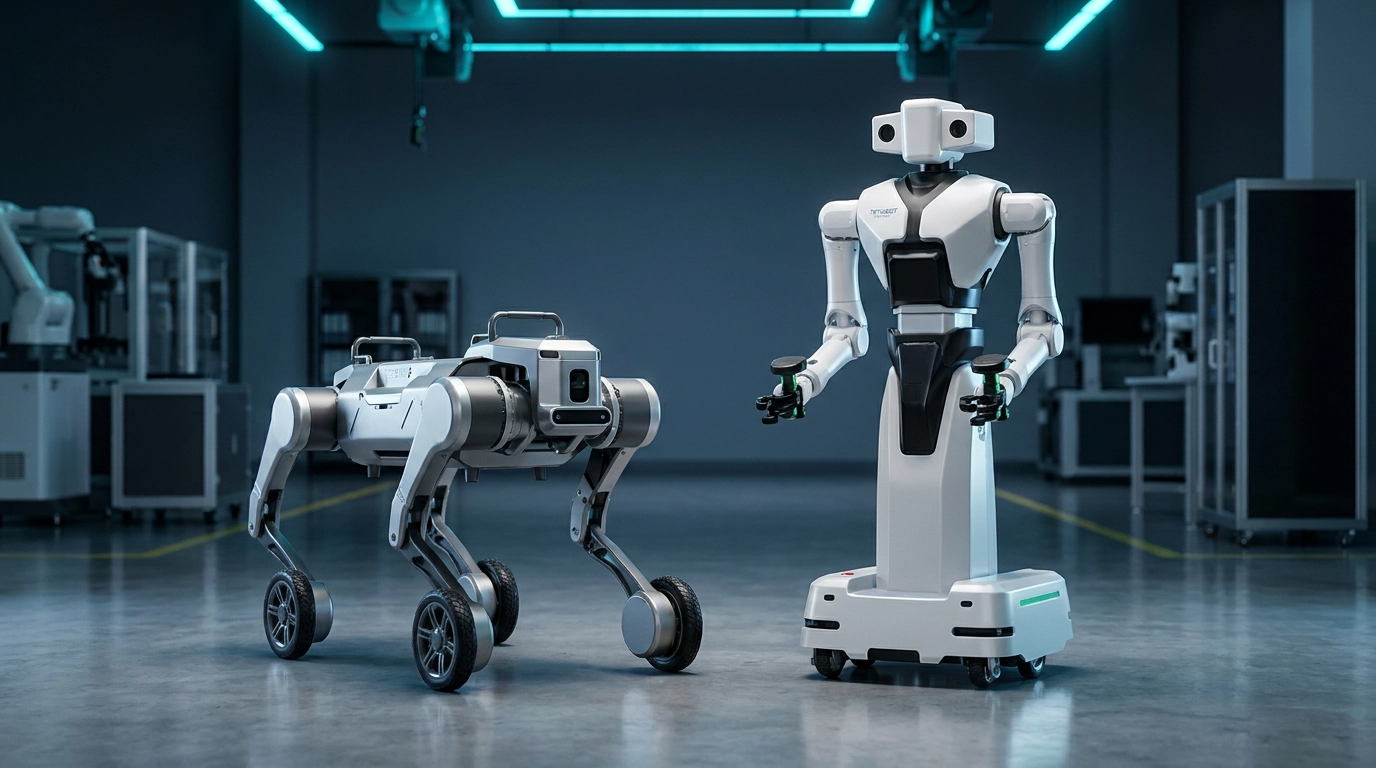
The robotics development market has long been constrained by a steep barrier to entry, where capable hardware platforms demand significant capital investment before any software engineering can begin. On July 16, 2026, TetraBOT, formally known as Nanjing Tianchuang Intelligent Technology Co., Ltd., introduced a dual-pronged product strategy that directly challenges this constraint. The Nanjing-based company, which operates a headquarters and production base in its home city alongside subsidiaries in Beijing and Guangzhou, specializes in robotics for complex and hazardous environments. By simultaneously launching the T4-C wheeled humanoid development version and the TIM-F200 explosion-proof four-wheeled robot dog development version, TetraBOT is attempting to serve two distinct procurement realities: the need for highly accessible general research platforms and the requirement for specialized, ruggedized hardware in industrial settings.
This product release is not merely an expansion of a hardware catalog; it represents a deliberate pricing ladder designed to capture different segments of the robotics developer ecosystem. The T4-C, starting at RMB 23,900 (approximately US$3,300), lowers the financial threshold for embodied artificial intelligence research, while the TIM-F200, priced at RMB 159,800 (approximately US$22,000), addresses the premium requirements of hazardous industrial deployments. For procurement managers and automation strategists, this dual launch signals a maturing supply chain where foundational mobility and perception hardware are becoming commoditized, allowing vendors to compete on specialized environmental adaptations and full-stack open development ecosystems.
The Strategic Logic of Dual-Tier Platform Pricing
Why would one robotics supplier launch a low-cost wheeled humanoid platform and an explosion-proof quadruped platform on the same day? TetraBOT is addressing diverging market needs. General researchers need affordable development hardware on which to test algorithms, while industrial integrators need platforms designed around more demanding operating environments. The official July 16 announcements verify the two product categories and their public prices. They do not publish the detailed payload, sensing, lifting, or certification data that a buyer would need for a final technical decision, so those specifications must remain outside the public assessment until TetraBOT supplies an official datasheet or test record.
The T4-C wheeled humanoid development version is positioned as the accessible entry point in the pair. Its verified starting price is RMB 23,900, approximately US$3,300. That public price is substantially below the US$15,999 list price published for the Elephant Robotics Mercury X1, an illustrative reference platform in the broader wheeled humanoid research category. Price alone does not establish equivalent capability, software access, payload, sensing, support, or readiness. It does show that a buyer can now encounter a publicly listed wheeled humanoid development product at a price once associated with smaller educational systems. The procurement opportunity is therefore real, but it begins with requesting the missing official specification sheet rather than assuming that two platforms with a similar physical format are interchangeable.
Conversely, the TIM-F200 is officially described as an explosion-proof four-wheeled robot dog development version and carries a verified public price of RMB 159,800, approximately US$22,000. That description places it in a specialized industrial product class, but the launch page does not expose the certification class, payload, ingress protection, temperature range, or test documentation needed to determine where it may legally and safely operate. The relevant comparison is therefore category and price positioning, not an assertion of technical equivalence. Woob Robotics publishes an explosion-proof quadruped reference with a 30-kilogram payload and an EX d IIB T5 Gb designation, but those Woob specifications cannot be transferred to the TIM-F200. Buyers should treat the TIM-F200 announcement as the opening of a technical diligence process, not the completion of one.
Translating Technical Specifications into Operational Reality
To understand the operational impact of the two announcements, it is helpful to compare a laboratory test vehicle with a vehicle sold for a regulated work site. The first can be useful because it makes experimentation affordable. The second commands a premium because the intended environment may require documented protections, controlled components, maintenance procedures, and third-party verification. TetraBOT's official pages establish a nearly seven-fold price gap between the two development versions, but they do not disclose which technical requirements account for that gap. The plain-language conclusion is simple: the price ladder signals different intended buying conversations, while the missing documentation determines whether either product can perform a buyer's actual task.
This distinction is critical for procurement teams evaluating development platforms. A low listed price does not make the T4-C appropriate for a hazardous environment, and an explosion-proof product name does not by itself prove that the TIM-F200 meets a particular site's regulatory classification. Procurement should begin with the operating zone, hazard class, required task, integration interface, service model, and acceptance test. Only then should the buyer map those requirements to official product documentation. TetraBOT's strategy creates two clear starting points for that process, but disciplined diligence must supply the technical detail that the launch announcements do not.
The Reality of Hardware Commoditization
A common misconception in the robotics industry is that the physical hardware, including the motors, joints, and chassis, remains the primary driver of value and differentiation. The reality is that foundational mobility hardware is rapidly commoditizing, particularly in the Chinese manufacturing ecosystem. The aggressive pricing of the T4-C demonstrates that the cost of assembling a functional wheeled humanoid base has fallen dramatically. The true differentiation now lies in software ecosystems, open development capabilities, and specialized environmental adaptations.
The verified pricing also changes what buyers should ask of a development-platform vendor. Hardware vendors cannot anticipate every use case or develop proprietary software for every niche application, so the commercial value increasingly depends on interfaces, software development tools, documentation, service, and integration support. TetraBOT's launch pages do not provide enough public detail to score those factors. That absence is itself decision-relevant. A development platform is only as useful as the buyer's ability to inspect its interfaces, reproduce its behavior, obtain spare parts, and receive support when an experiment moves beyond a demonstration.
Comparative Analysis of Development Platforms
When evaluating these platforms against the broader market, the strategic positioning becomes clearer. The following table compares only the verified public categories, status, timelines, and pricing. Competitor specifications are included as qualified reference points rather than claims that the products are technically equivalent.
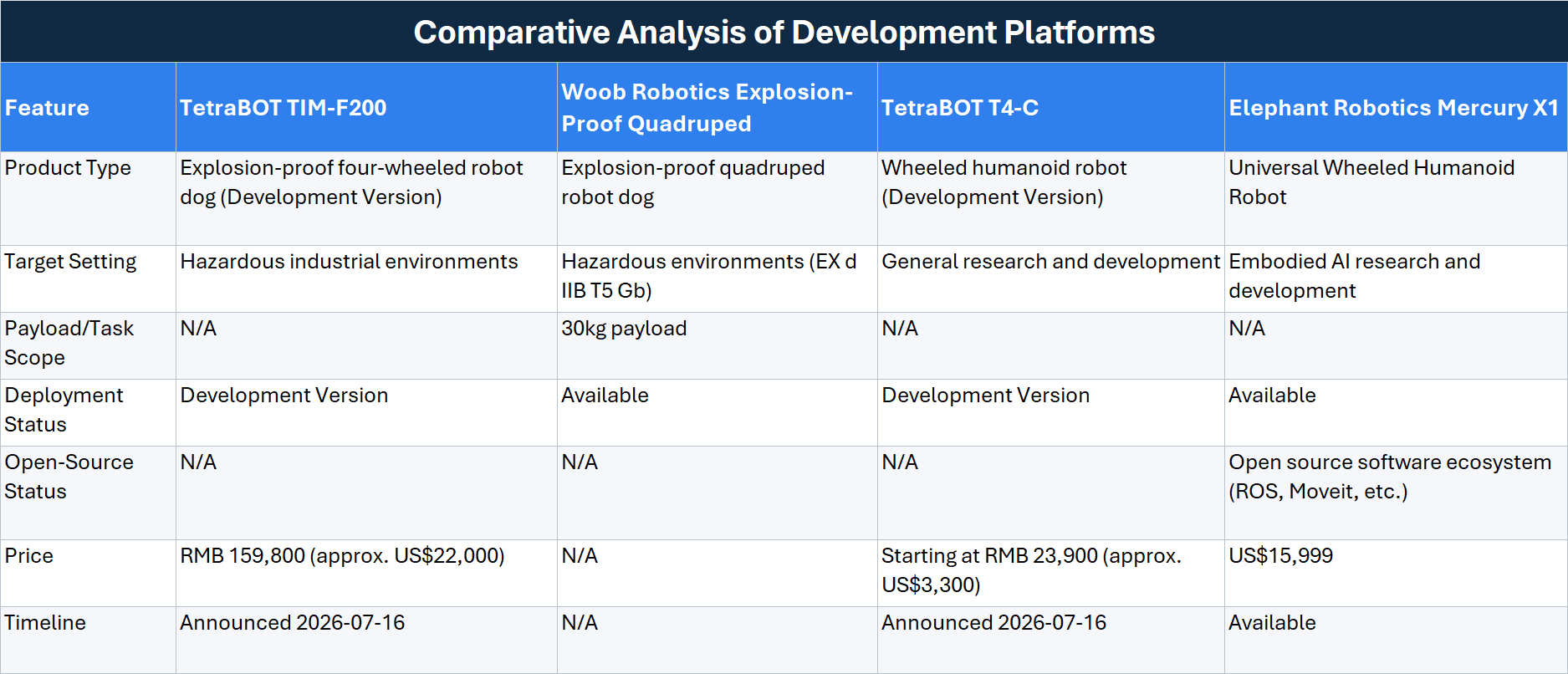
This comparison illustrates the aggressive verified pricing of the T4-C relative to the Mercury X1, but it does not establish feature parity. The TIM-F200 also establishes a rare public list price for a development product marketed as explosion-proof. Its certification class and task capacity remain N/A because the official launch page does not publish them. That restraint matters: an unavailable specification should trigger a supplier question, not an editorial estimate.
Commercial Implications for Automation Buyers
For automation buyers and industrial decision-makers, the introduction of these platforms has several immediate implications. First, the listed acquisition threshold for a wheeled humanoid development version has moved lower. Academic institutions, startups, and corporate innovation labs can evaluate a RMB 23,900 entry point before committing the larger budgets associated with many established research platforms. Whether that translates into a lower total cost of experimentation depends on interfaces, tooling, support, shipping, replacement parts, and the time required to make the hardware useful. The acquisition price opens the door, but integration economics determine whether a project advances through it.
Second, industrial operators that investigate robotics for hazardous sectors now have a newly announced TIM-F200 development product with a public price. That is useful market information, but it is not proof of suitability for oil and gas, chemical manufacturing, mining, or any specific classified zone. The buyer still needs the formal certificate, scope of certification, environmental limits, maintenance obligations, and payload interface before designing an inspection or manipulation application around the platform. The announcement can shorten market discovery. It cannot replace engineering approval.
Finally, this dual-tier strategy highlights the importance of aligning procurement decisions with deployment realities. The gap between demonstration performance and deployment reality is often widened by selecting hardware before defining the intended environment and acceptance criteria. TetraBOT's segmentation forces buyers to state whether they are funding general development work or investigating a platform marketed for more demanding environments. The next step is not a purchase order. It is a requirements matrix matched against official documentation, support terms, and a controlled acceptance test.
The robotics industry is transitioning from an era dominated by bespoke, high-cost hardware toward a market with more accessible and more clearly segmented development products. TetraBOT's July 16 announcements provide a verified pricing ladder that spans an entry-level wheeled humanoid development version and a substantially more expensive explosion-proof four-wheeled robot dog development version. The harder truth is that a pricing ladder is not yet a capability ladder. Market leadership will depend on the quality of official documentation, software and hardware interfaces, support, spare-parts availability, validated environmental performance, and evidence from repeat deployments. TetraBOT has made the opening prices visible. It must still give buyers the technical and commercial evidence required to move from interest to approval. For procurement teams, that combination of lower entry price and incomplete public detail creates a useful but disciplined next step: request the datasheets, define the acceptance test, compare total integration cost, and treat every unavailable field as an unresolved decision rather than a favorable assumption.
This analysis synthesizes company statements and public market activity to assess the strategic positioning of new robotics development platforms.
Disclaimer: This article is provided for informational purposes only and does not constitute investment, financial, legal, procurement, or other professional advice. Readers should verify specifications, pricing, availability, regulatory requirements, and commercial terms directly with the relevant company or authority before making decisions.














