
Teleoperated Humanoid Robots Complete Live Surgery for the First Time
Engineers and surgeons at UC San Diego report the first successful use of teleoperated humanoid robots to perform live surgery, with a five foot, 27 kilogram robot named Surgie completing a gallbladder removal in a preclinical trial published in Nature.
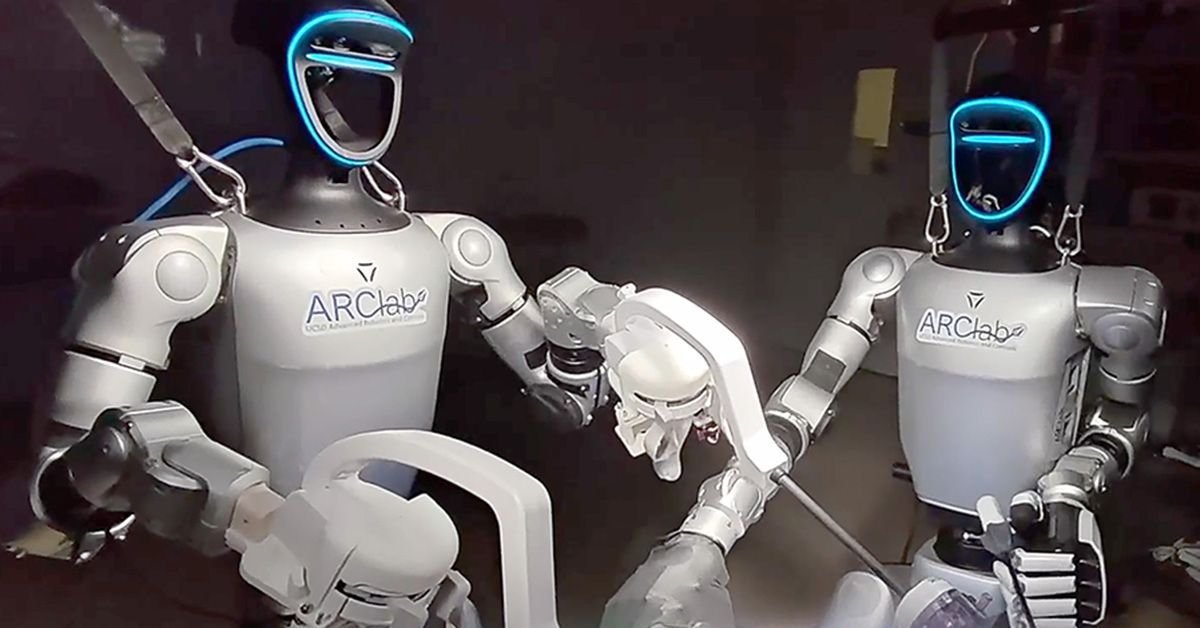
Engineers and surgeons at the University of California San Diego report that two teleoperated humanoid robots have completed live surgeries for the first time, according to a study published in the journal Nature on July 8. In a preclinical trial, one procedure involved a human surgeon working with a single humanoid robot to remove a gallbladder, while a second procedure was completed entirely by two humanoid robots operating together as a team. Both surgeries were performed on large nonprimate mammals rather than human patients.
The robots, nicknamed Surgie, stand about five feet tall and weigh roughly 27 kilograms, about 60 pounds, designed to be lightweight and mobile enough for use in remote or resource limited settings rather than being built into a fixed, room sized surgical system.
Did Robots Really Perform Surgery on Their Own
In a UC San Diego preclinical trial published in Nature on July 8, 2026, teleoperated humanoid robots named Surgie completed two live surgeries on large nonprimate mammals, one with a human surgeon controlling the robot and one with two robots working together, both under direct human teleoperation rather than fully autonomous control.
The Simple Explanation
Robotic surgery already exists in hospitals today, but current systems, such as the widely used da Vinci platform, are large, fixed installations that stay in one operating room and require significant infrastructure to set up. A humanoid surgical robot is different because it is mobile and general purpose, meaning it can, in principle, be moved between rooms or even transported to locations that lack a dedicated surgical robotics suite. Teleoperation means a human surgeon controls the robot's movements remotely in real time, similar to advanced remote control, rather than the robot deciding on its own how to operate.
How the Trial Worked
The UC San Diego team, working with its Center for the Future of Surgery, built adapters that let Surgie hold and use standard surgical tools already found in operating rooms, rather than requiring specialized instruments. The researchers tested the system progressively, starting with basic benchtop tasks, moving to dry lab practice runs, and finally to live procedures on large nonprimate mammals, a structured escalation designed to validate safety and performance at each stage before attempting a full procedure.
The study found that the humanoid platform could perform core laparoscopic tasks, including tissue retraction, dissection, clipping, and full gallbladder removal, with precision comparable to established teleoperated surgical robots. The main limitation researchers identified was longer procedure times, caused by the need to recalibrate the robots during surgery, an issue the team expects to improve as the technology and operator experience mature, similar to the learning curve seen with earlier generations of robotic surgery systems.
Why It Matters
The most immediate significance of this trial is not that humanoid robots will replace existing surgical systems soon, but that a mobile, general purpose robot platform can match core performance benchmarks of specialized surgical equipment. That distinction matters because fixed surgical robots are expensive to install and maintain, which limits their availability to well resourced hospitals, while a mobile humanoid platform could, if it clears the much longer path to clinical approval, extend advanced surgical capability to underserved, rural, or field medicine settings that could never justify a dedicated fixed installation.
The Industry Reality
It is important to be precise about what this trial actually demonstrated. This was a preclinical, in vivo feasibility study conducted on large nonprimate mammals, not a clinical trial on human patients, and the researchers themselves describe it as an early stage evaluation of feasibility rather than a finalized clinical breakthrough ready for hospital use. Procedures also took longer than with established robotic systems due to recalibration needs. Meaningful clinical deployment would require substantial further testing, regulatory review, and refinement before Surgie or any similar platform could be used on human patients.
The Bigger Signal
This trial fits into a broader pattern in which general purpose humanoid robot platforms, originally developed for manufacturing or logistics tasks, are being adapted into specialized domains that previously required dedicated, purpose built equipment. If mobile, teleoperated humanoid platforms can eventually reach clinical grade reliability, the economics of advanced surgical capability could shift meaningfully, making high precision procedures accessible in settings that today have no realistic path to acquiring a fixed surgical robot.
Market Context: Robotics Moving Into Medicine
Surgical robotics has been a well established but narrow field for more than two decades, dominated by fixed-installation systems built specifically for operating rooms in well resourced hospitals. The UC San Diego trial represents an attempt to bring the mobility and general purpose design philosophy of humanoid robotics, developed primarily for manufacturing and logistics use cases, into a domain that has so far required entirely separate, purpose built hardware.
If mobile humanoid platforms eventually prove reliable enough for real clinical use, the economic case for advanced surgical robotics could shift meaningfully. Fixed surgical robot systems represent a large capital investment that only high volume hospitals can typically justify, while a mobile, general purpose platform could in theory be shared across departments or even transported between facilities, lowering the effective cost per procedure for smaller or resource constrained hospitals, rural clinics, and field medicine deployments such as disaster response or military medical units.
That said, the distance between this preclinical trial and any real clinical deployment remains substantial. Regulatory approval for surgical robotics is one of the most rigorous approval pathways in medical technology, and the researchers themselves frame this work as an early feasibility study rather than a platform ready for hospital adoption. The Nature publication provides peer reviewed validation of the technical results, which strengthens the credibility of the claims relative to a company press release alone, but peer review of a feasibility study is not equivalent to regulatory clearance for patient use.
What to Watch Next
Because this was a preclinical trial on nonprimate mammals rather than a clinical trial on human patients, the realistic path to any hospital use of Surgie or similar platforms will involve years of additional testing, regulatory submission, and likely further peer reviewed publications before clinical trials on human patients could even begin. Readers should watch for follow up publications from the UC San Diego Center for the Future of Surgery detailing progress on reducing recalibration time, any partnership announcements with medical device companies interested in commercializing the platform, and whether regulatory bodies such as the Food and Drug Administration issue any early guidance specific to mobile, general purpose humanoid surgical platforms as a distinct category from existing fixed surgical robot systems.
Why It Matters
The most immediate significance of this trial extends beyond the specific gallbladder procedure performed. A mobile, general purpose humanoid platform that can match core performance benchmarks of dedicated surgical equipment suggests the underlying manipulation and control technology developed for industrial and logistics humanoids is mature enough to be adapted into far more precision demanding domains than warehouse picking or factory assembly. That adaptability, if validated further, would support a broader argument that investment in general purpose humanoid platforms pays dividends across multiple industries rather than being locked into a single use case, strengthening the economic case for continued investment in the underlying robotics research even when any single application, such as surgery, remains years from real deployment.
The Strategic Perspective
Hospital administrators and medical device investors should treat this trial as an early signal to monitor rather than a technology ready for procurement conversations today. The realistic timeline from a preclinical feasibility study to an FDA cleared clinical product for a genuinely novel robotic surgery platform typically spans many years and multiple additional trial phases, and humanoid surgical robots would likely face at least as much regulatory scrutiny as the fixed platforms that came before them, given how new the mobile, general purpose design is to this specific application. The more immediate opportunity for hospitals and medical technology companies is watching which existing manufacturing or logistics humanoid platforms, if any, begin exploring healthcare specific adaptations, since that would signal where cross-industry robotics investment is heading next.
The Bottom Line
The UC San Diego team says its next steps focus on improving recalibration speed and expanding toward autonomous or semi-autonomous support tasks, such as fetching tools and assisting with operating room cleanup, before any consideration of broader clinical trials involving human patients. Even short of full clinical adoption, the underlying teleoperation and manipulation advances validated in this trial are likely to migrate back into industrial and logistics humanoid platforms, since precision gains developed for surgical applications tend to raise the performance bar for general purpose robot manipulation more broadly. Surgical training programs may also need to begin considering how teleoperated humanoid platforms would change resident training curricula, since operating a general purpose humanoid safely under time pressure is a meaningfully different skill from operating today's fixed, purpose built robotic surgery consoles.
Source Evidence
UC San Diego Today (official): https://today.ucsd.edu/story/surgeons-use-teleoperated-humanoid-robots-to-perform-live-surgery-a-world-first
Nature study overview: https://humanoid-surgeon.github.io/














