
Tang Mu’s XBOT Raises Hundreds of Millions RMB as It Moves from Labs to Cafes
XBOT closed two financing rounds totaling several hundred million RMB and publicly launched XOS 3.0 plus three robot models on June 30, 2026. The company published unit prices for the C3 and I3 and reported over 1,000 deployed units and 2025 revenue above 100 million RMB.
What is the latest funding and product news for XBOT?
XBOT raised hundreds of millions of RMB across two financing rounds, including a 200 million RMB Series A and a 300-500 million RMB Series B. On June 30, 2026, the company launched its XOS 3.0 operating system, an AI store manager, and three new catering robots in Beijing.
What happened
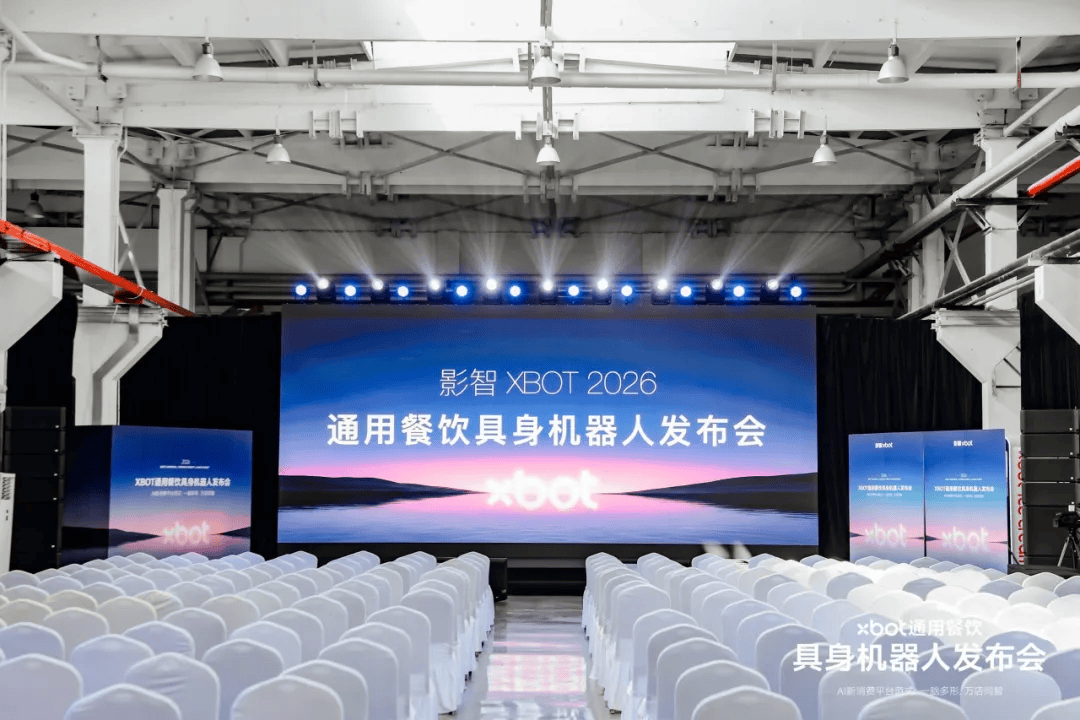
XBOT, officially Yingzhi XBOT and operating under Aibo Intelligent Technology in Shandong and Beijing Yingzhi Technology in Beijing, moved from stealth growth to commercial scale with a public product rollout and fresh capital. On June 30, 2026 the company held a Beijing event where it announced XOS 3.0, an operating system built around a one-brain, multiple-forms architecture, the Aibao Store Manager AI agent, and three robots, named C3, I3, and X1. The C3 coffee robot and the I3 ice cream robot come with published prices, 219,000 RMB and 179,000 RMB respectively. The X1 general catering humanoid robot is expected in late 2026. XBOT also markets the XBOT CUBE food truck.
Funding was reported publicly around July 6, 2026, with two financing rounds totaling hundreds of millions of RMB. Series A was 200 million RMB invested by Hong Kong's GPTX, known in Chinese as 简坤资本. Series B was reported at between 300 and 500 million RMB, raised from a mix of government funds, US-dollar funds, and industrial investors. Some outlets published an estimate near 1 billion RMB, but that figure is unverified and conflicts with the documented round sizes. Reports that assigned a July 8 date for the funding arrived slightly later than the initial July 6 reporting.
XBOT says its machines have been deployed in more than 100 cities worldwide, exceeding 1,000 units in service, and the fleet has produced more than 4 million cups of coffee. The company reported revenue above 100 million RMB for 2025. The product and systems announcements in Beijing emphasize a platform approach, the company calling its operating system XOS 3.0 and putting the Zhiwei Catering Large Model, based on DeepSeek, at the center of its intelligence stack. The strategic timing of this product launch, coupled with the substantial capital injection, positions the company to aggressively pursue market share in the rapidly evolving automated catering sector. By combining hardware innovation with a robust software ecosystem, the firm aims to address the growing demand for efficient, reliable, and cost-effective robotic solutions in the hospitality industry.
Commercial signal and where this could push the market
XBOT is presenting itself as a commercialization-first robotics company, one that is moving from pilot deployments into scaled, pay-to-deploy units with published prices. The combination of an OS release, an AI agent tailored for store management, and machine models with public price tags marks a shift in messaging away from concept demos and toward conversion into customer contracts. That matters for buyers and rivals because concrete pricing changes the negotiation dynamic between robot providers and hospitality chains.
The Series A and Series B financings provide liquidity to accelerate manufacturing and channel expansion. With reported 2025 revenue above 100 million RMB and more than 1,000 deployed units, XBOT can reasonably claim revenue traction and product-market fit in automated beverage and quick-serve categories. The backing from government and US-dollar funds in the second round signals investor appetite for domestic robotics firms that can move quickly into commercial rollouts. For customers who have been watching lab prototypes, the company’s publicly stated unit prices let operations teams model total cost of ownership and payback windows.
For the market, XBOT’s launch and capital raise tighten competition on two fronts. First, automated beverage providers that previously focused on software or single-form hardware must consider multi-form product suites that centralize intelligence in a catering large model. Second, physical integrators and franchised foodservice chains gain a clearer benchmark for procurement, a necessary condition for larger scale rollouts rather than scattered pilots.
How XBOT stacks up against rivals
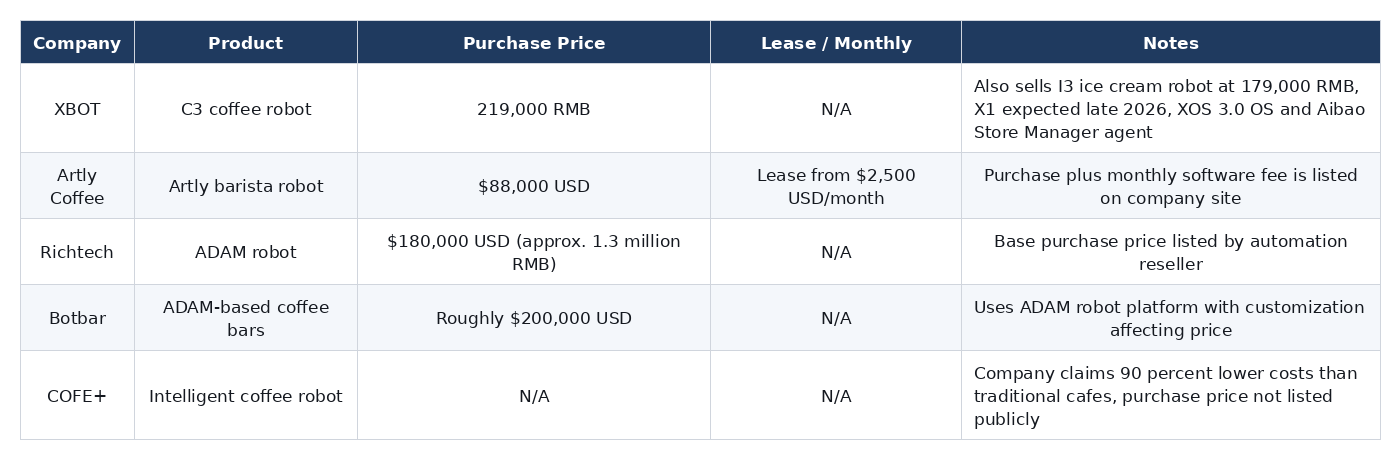
Below is a quick comparison of XBOT and several competitors, showing product types and public price points where available.
Procurement and strategic considerations for buyers
For procurement teams evaluating robotic catering systems, the first practical advantage of XBOT’s public pricing is predictability. The stated 219,000 RMB price for the C3 and 179,000 RMB price for the I3 allow operations teams to model per-unit capital expense. The published numbers also let finance teams compare leasing or software subscription offers against outright purchase.
Strategically, buyers should compare total cost of ownership including software licensing, maintenance, spare parts, and consumables. XBOT’s platform claim, centered on XOS 3.0 and a catering large model, suggests future upgrades may come through software and model improvements, not just hardware swaps. Confirming warranty and software update terms is essential before a multi-site roll out.
A regional quote to pin to headlines
"XBOT’s machines are now a deployed fleet, not a future promise. With hundreds of millions in new capital and an OS release, the company is asking the market to treat robot cafes as a current option for scale."
Company background and leadership
Legal names and registration include Aibo Intelligent Technology, based in Shandong, and Beijing Yingzhi Technology Co., Ltd, operating in Beijing under the Yingzhi XBOT brand. The company was founded in 2022 by Tang Mu, a product and ecosystem executive who previously led Tencent CDC where he worked on classic QQ avatar design, and who also served as Vice President on Xiaomi’s ecosystem chain, contributing to products such as Xiaomi Router and Xiaoai Speaker.
XBOT’s product line now includes the C3 coffee robot, priced at 219,000 RMB, the I3 ice cream robot at 179,000 RMB, an X1 general catering humanoid robot expected in late 2026, and the XBOT CUBE robot food truck. The June 30, 2026 product launch in Beijing was the company’s public bid to transition from deployments and pilots to a packaged offering that customers can price and buy.
Technology highlights publicized by the company include XOS 3.0, the operating system that implements a one-brain, multiple-forms architecture. The intelligence core, described as the Zhiwei Catering Large Model, is based on the DeepSeek technology stack. The company also unveiled an AI agent for store management branded Aibao Store Manager.
Financially, XBOT closed two recent financing rounds. Series A was a 200 million RMB investment by Hong Kong investor GPTX, known in Chinese as 简坤资本. Series B raised between 300 and 500 million RMB from a combination of government funds, US-dollar funds, and industrial investors, bringing cumulative fundraising into a range of several hundred million RMB. Funding was widely reported around July 6, 2026. Some outlets published higher cumulative figures, but those estimates are unverified and inconsistent with the documented round sizes.
The company says its installed base exceeded 1,000 units in more than 100 cities, and that its machines produced over 4 million cups of coffee. XBOT reported revenue above 100 million RMB for 2025, a signal of commercial traction ahead of this round.
What to watch next
Expect the company to use the new capital on three fronts, subject to confirmation in company announcements. First, production scale up to meet order books and channel expansion. Second, software and AI model development around XOS 3.0 and the Zhiwei Catering Large Model. Third, international channel and installation support for a company that already reports global city deployments.
Because XBOT made unit pricing public for two of its robots, competitors and customers now have a concrete benchmark. That will make future pricing negotiations less opaque and should accelerate procurement decisions at foodservice chains that need clear capex numbers to allocate budgets.
For potential customers, confirming service terms, mean time between failures, and the real world throughput of machines under heavy use is crucial. Published unit prices answer one part of the procurement equation, but long term value depends on service quality and software support.
Closing observations
XBOT’s announcements mark a clear commercialization phase, combining capital and a product portfolio with public prices. The combination of an OS, a catering large model, and priced hardware signals an offer to businesses that want to move beyond pilots. The funding and product launch together give buyers and competitors a firmer basis to compare cost and capability, which usually precedes either rapid adoption or a renewed round of engineering competition.
Sources
1. 36Kr report on XBOT funding (Chinese): https://36kr.com/p/3886829001816705
2. Sohu coverage of the XBOT product launch (Chinese): https://www.sohu.com/a/1045256675_104421
3. Sohu coverage of the funding rounds (Chinese): https://www.sohu.com/a/1046695747_655634
4. NetEase coverage of the product launch (Chinese): https://www.163.com/dy/article/L0RTJVRH05118HA4.html
5. 36Kr Global English coverage: https://eu.36kr.com/en/p/3882361033322755
6. Artly barista robot pricing page: https://www.artlybaristabot.com/pricing
7. Richtech Robotics ADAM product page: https://www.automationhub.com/products/adam














