
Swancor to Debut Shape-Shifting Quester1 Robot at WAIC 2026
Chinese manufacturer Swancor Advanced Materials will unveil the Quester1, a personal robot capable of automatically switching between bipedal and quadrupedal forms, at the World Artificial Intelligence Conference.
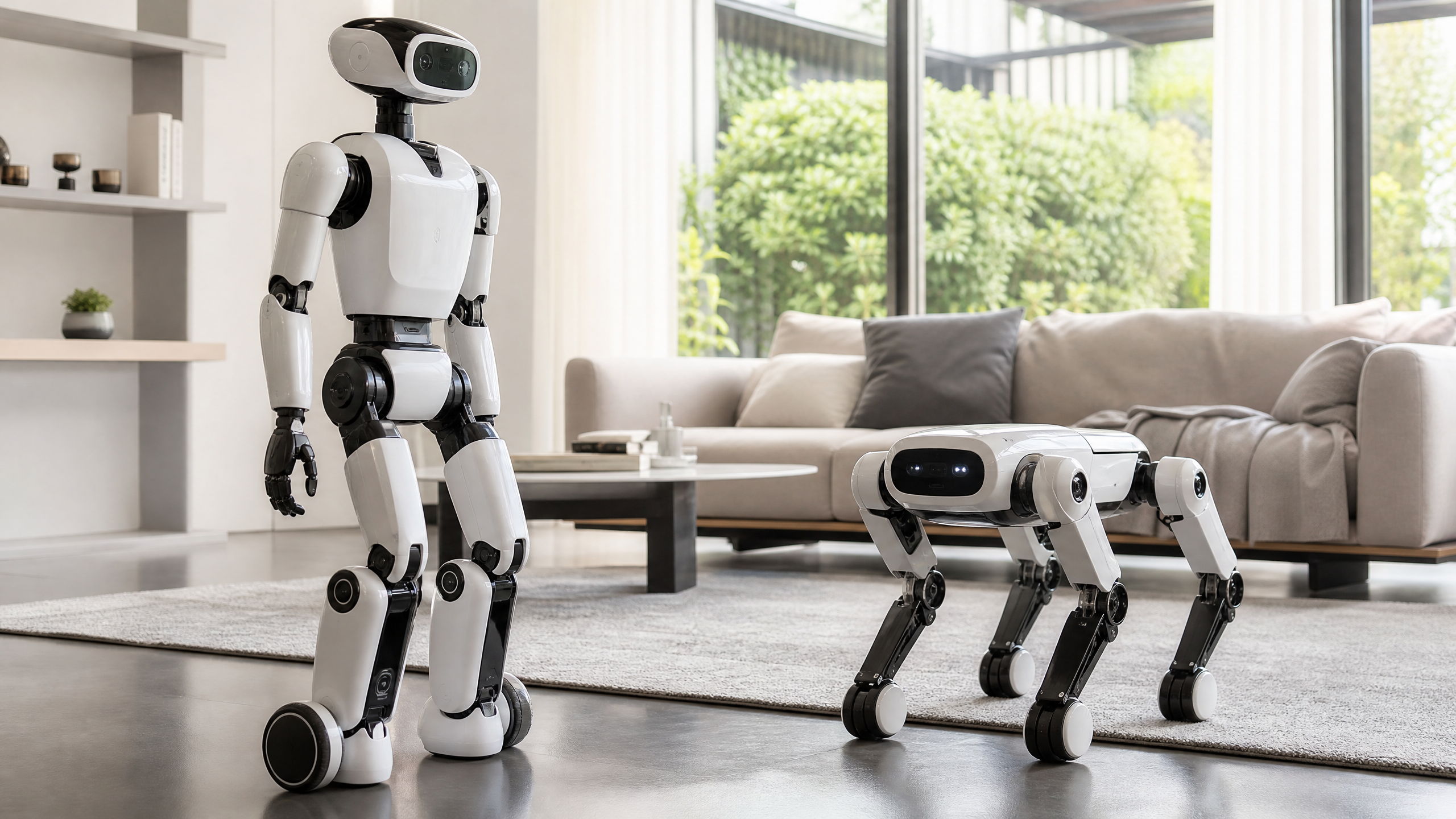
Chinese enterprise Swancor Advanced Materials Co. will debut its Quester1 shape-shifting personal robot at the 2026 World Artificial Intelligence Conference (WAIC), which opens in Shanghai on July 17. The robot is designed to automatically switch between wheeled bipedal and quadrupedal forms, representing a departure from the fixed-morphology designs that currently dominate the commercial robotics sector. Swancor, a company primarily known for its work in composite and circular materials, is leveraging its manufacturing expertise to enter the rapidly expanding embodied AI market. The launch highlights a growing trend among Chinese domestic enterprises to develop multi-morphology robots for household, commercial, and industrial applications.
Cross-Morphology Architecture
The Quester1 is built around a single chassis utilizing what the company describes as an industry-first "transformer cross-morphology integrated architecture." This system enables fully automatic and smooth switching between its different physical forms. The flexibility allows the robot to select the most suitable configuration based on spatial constraints, road conditions, and specific task requirements.
The dual-morphology design targets real-life scenarios such as home companionship, outdoor escort, and smart filming. By combining the stability and payload capacity of a quadruped with the height and maneuverability of a wheeled biped, the Quester1 aims to overcome the environmental limitations often faced by single-form robots.
A Broader Trend in Deformable Robotics
The introduction of the Quester1 aligns with a broader push into deformable and modular robotics within the Chinese market. This trend is supported by technological spillover from other industries. Expertise from new-energy vehicle manufacturers in chassis control and powertrains, combined with advancements in edge-side chip optimization from mobile phone makers, has lowered the technical barriers for cross-sector innovation in robotics.
Recent examples include LimX Dynamics' TRON 2, a modular robot capable of switching between dual-arm, bipedal, and wheeled-bipedal configurations, and Unitree Robotics' GD01, a manned transformable mecha. These developments indicate a strategic shift toward versatile, multi-purpose platforms that leverage China's established supply chains in servomotors, sensors, and lightweight composite materials.
The Engineering Logic of Shape-Shifting
For technology evaluators, the appeal of a multi-morphology robot is rooted in fundamental physics. Bipedal robots (two legs) are excellent for navigating environments built for humans, such as narrow hallways or stairs, and their height allows them to interact with countertops and shelves. However, they are inherently unstable and consume significant energy just to remain upright.
Quadrupedal robots (four legs), like robot dogs, offer superior stability, higher payload capacities, and better performance on uneven outdoor terrain. By combining both forms, Swancor is attempting to solve the primary limitation of general-purpose robotics: the environment dictates the optimal hardware. If a robot can lower its center of gravity and deploy four points of contact for heavy lifting or rough terrain, and then stand up on two wheels to navigate a crowded room, it dramatically increases its operational utility.
Translating Morphological Complexity
To understand the difficulty of building a "transformer" robot, consider the complexity of control systems. A standard robot requires a control algorithm to manage its balance and movement based on its fixed physical structure.
When a robot shifts from two legs to four, its center of mass, weight distribution, and the physics of its movement change entirely. The Quester1 must seamlessly hand off control between two entirely different algorithmic models in real-time, without falling over during the transition. This requires immense computational power at the "edge" (on the robot itself) and highly responsive actuators capable of executing the structural shift fluidly. It is an engineering challenge far more complex than simply bolting extra legs onto a chassis.
The Gimmick vs. Utility Debate
A common critique of transformable robots is that they are over-engineered novelties designed to generate viral videos rather than solve real-world problems. Skeptics argue that a robot designed to do two things will inherently do both poorly, compared to specialized machines optimized for a single task.
While there is truth to the argument that specialization breeds efficiency, the consumer and commercial service markets require versatility. A household or small business is unlikely to purchase a separate robot dog for outdoor security and a separate bipedal robot for indoor tasks. The Quester1 represents a bet that the market will reward a "Swiss Army knife" approach, even if it requires compromises in specialized performance. The true test will be whether the mechanical complexity of the transformation mechanism introduces unacceptable points of failure and maintenance costs.
Strategic Implications for the Chinese Ecosystem
Swancor's entry into the robotics market underscores a unique dynamic in China: the rapid pivot of established industrial companies into embodied AI. Swancor is a materials company, not a traditional software or robotics firm.
This highlights how China's deep supply chains and mature manufacturing ecosystems lower the barrier to entry for complex hardware. Companies can source off-the-shelf servomotors, sensors, and edge-computing chips, allowing them to focus on novel chassis designs and integration. This rapid cross-pollination of expertise—from materials science to EV powertrains to robotics—is accelerating the pace of hardware iteration in China far beyond what is typical in Western markets.
Competitor Benchmarking: The Rise of Multi-Morphology
The Quester1 is part of a growing cohort of adaptable robotic platforms emerging from China.
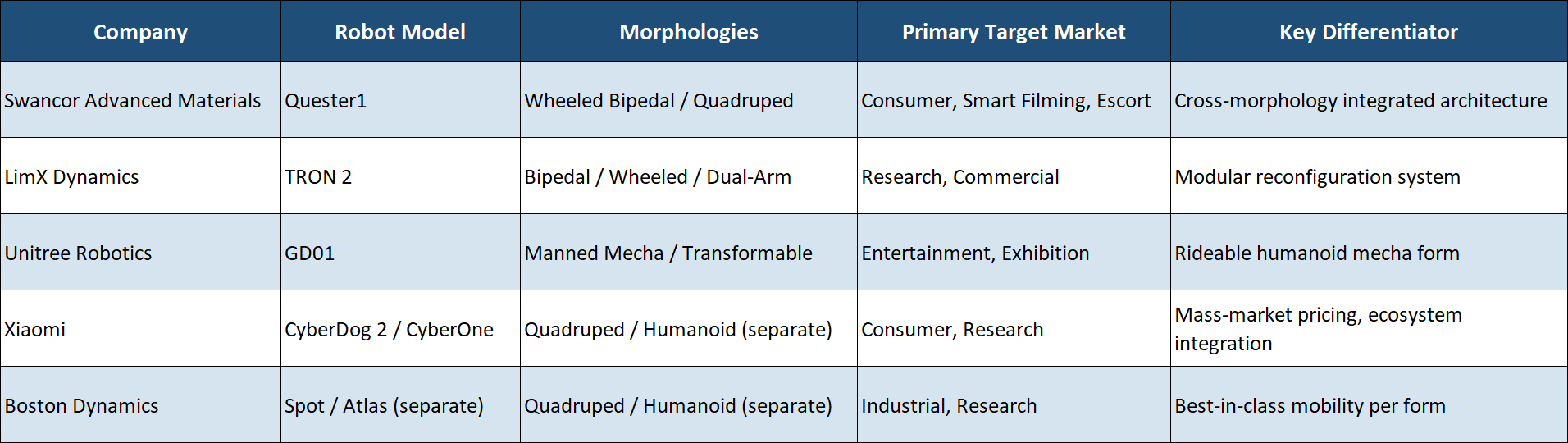
The proliferation of these designs at WAIC 2026 indicates that Chinese manufacturers view adaptability as a key differentiator in a crowded market. The success of these platforms will depend heavily on their software integration and real-world reliability, moving beyond the impressive trade show demonstrations.
The Challenge of Actuator Density and Weight
One of the most significant engineering hurdles in developing a multi-morphology robot like the Quester1 is managing actuator density and overall weight. Every degree of freedom—every joint that allows the robot to bend, twist, or transform—requires a dedicated actuator (motor).
In a single-form robot, engineers can optimize the placement and size of these actuators for a specific range of motion. In a shape-shifting robot, the actuators must be powerful enough to support the robot in multiple configurations, which often leads to redundancy and increased weight. If the robot is too heavy, its battery life plummets, and its mobility is compromised. Swancor's background in advanced composite materials is likely a critical advantage here, allowing them to offset the weight of the complex transformation mechanisms with ultra-lightweight structural components. However, balancing the mechanical complexity required for transformation with the need for a lightweight, energy-efficient platform remains a formidable challenge.
The Role of Edge Computing in Dynamic Morphology
The ability of the Quester1 to smoothly transition between bipedal and quadrupedal forms relies heavily on advanced edge computing. The robot cannot rely on a cloud server to calculate its balance during a transformation; the latency (delay) in transmitting data back and forth would cause the robot to fall over.
Instead, the robot must process vast amounts of sensor data—from gyroscopes, accelerometers, and vision systems—locally, in real-time. It must constantly recalculate its center of mass and adjust the torque of its actuators in milliseconds as its physical structure changes. This requires highly specialized, low-power AI chips capable of executing complex kinematic models directly on the device. The development of these multi-morphology platforms is therefore driving significant innovation not just in mechanical engineering, but in the design of edge-side silicon optimized for embodied intelligence.
The Limitations of Current Battery Technology
The ambition of the Quester1 and similar multi-morphology platforms is currently constrained by the physical limits of battery technology. The energy density of lithium-ion batteries has improved steadily, but it still falls short of what is required for extended, high-intensity operation of a shape-shifting robot.
The act of transforming from a quadruped to a biped requires a massive, instantaneous surge of power to the actuators. Once in bipedal mode, the robot must continuously expend energy simply to maintain its balance, unlike a wheeled robot that can rest passively. If the Quester1 is to be useful for outdoor escort or smart filming, it must operate for hours, not minutes, away from a charging station. Until there is a step-change in battery chemistry—such as the commercialization of solid-state batteries—these multi-morphology robots will remain tethered to short operational windows, limiting their practical utility outside of controlled demonstrations.
The Consumer Acceptance Hurdle
While the engineering behind the Quester1 is impressive, the consumer acceptance of a shape-shifting robot remains an open question. The uncanny valley effect—the feeling of unease when a machine appears almost, but not quite, human or animal—is amplified when the machine's physical structure is fluid and unpredictable.
A robot dog is familiar; a humanoid is familiar. A machine that suddenly unfolds from a quadruped into a towering biped may be perceived as threatening or unpredictable by the general public. Swancor and other manufacturers must carefully design the transformation process to be smooth, deliberate, and clearly telegraphed, avoiding sudden, jerky movements that could startle users. The success of these platforms in the consumer market will depend as much on user experience design and psychological acceptance as it does on mechanical engineering and edge computing.
This analysis synthesizes corporate product announcements, industry exhibition data, and technical specifications regarding the new robotics platform.
Disclaimer: This article is produced for informational purposes only. The analysis represents the views of the editorial team and does not constitute investment advice, endorsement of any company, or recommendation to buy or sell any security. All facts have been verified against primary sources to the best of our ability.














