
SK Telecom’s AI-RAN Pilot Moves Physical AI Into the Network Layer
SK Telecom was selected to lead a Hyper-AI network demonstration in South Korea. Over two years it will pilot AI-RAN features for three physical AI services, staging trials at Incheon and Pangyo before extending to Pyeongtaek. The work targets uplink capacity, latency, distributed computation, mobility, and reliability.
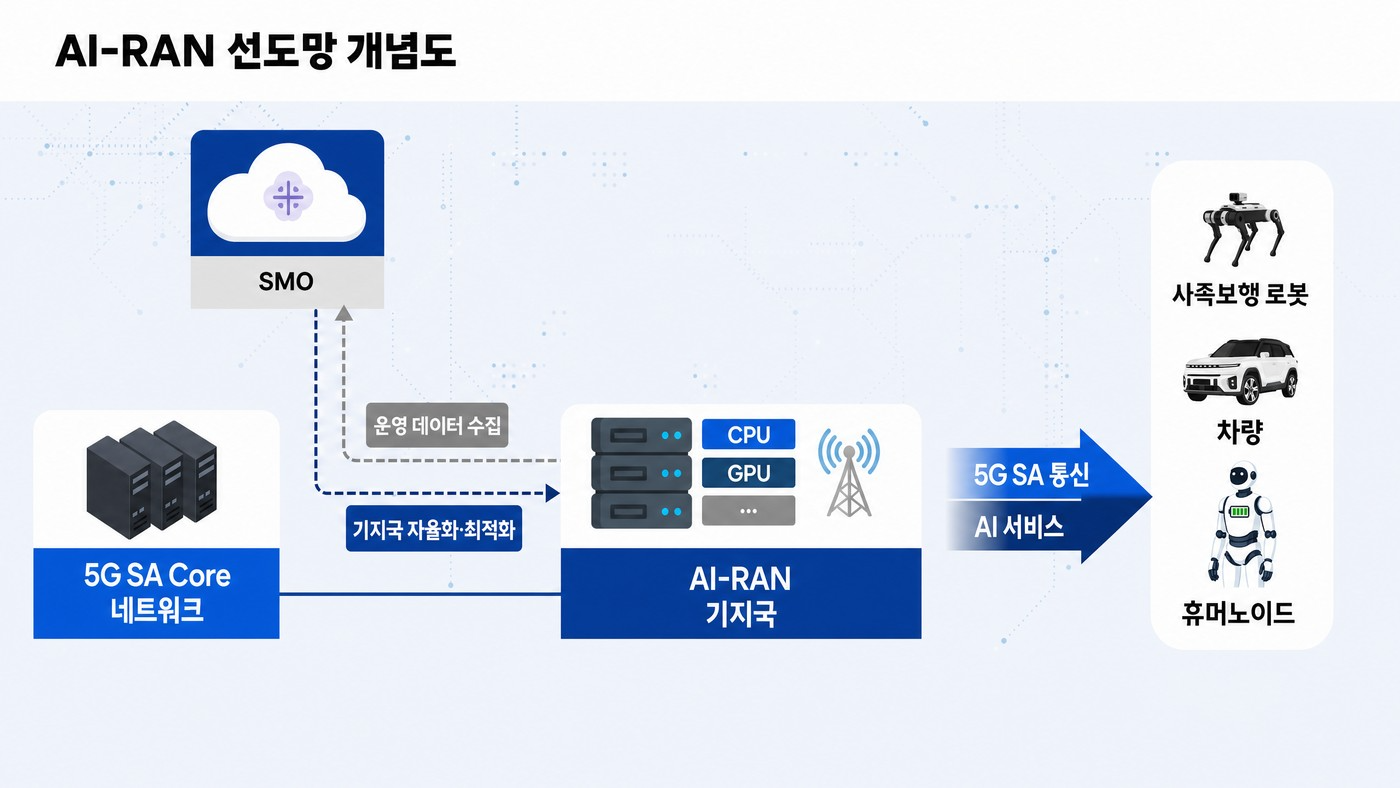
SK Telecom, a Seoul-headquartered telecommunications operator advancing fifth generation standalone and artificial intelligence native network architecture, has been selected for a Hyper-AI network infrastructure demonstration led by South Korea’s Ministry of Science and Information and Communications Technology and the National Information Society Agency. The program will build an artificial intelligence radio access network pilot and test three physical AI services over two years, using fifth generation standalone capabilities, network slicing, service management and orchestration, and artificial intelligence based network automation.
The announcement matters because it shifts part of the robotics infrastructure debate away from the robot alone and toward the radio access network, edge compute placement, uplink performance, and service reliability. For automation buyers, the practical question is not whether artificial intelligence radio access network sounds advanced. The question is whether a managed cellular network can carry robot perception, monitoring, and computation workloads with enough predictability to justify operational dependency.
What SK Telecom will test and how buyers should read it
Buyers should treat this as a network evidence program, not a turnkey replacement for existing connectivity. SK Telecom plans a staged two-year pilot in South Korea that measures uplink capacity, latency, distributed computation, mobility, and reliability for three robot-relevant services. The outcome that matters is task-level performance data, not a headline term or a generic feature claim.
SK Telecom is not announcing a nationwide commercial rollout. It is launching a two-year artificial intelligence radio access network pilot for physical AI services in South Korea. The pilot will test three use cases: a quadruped patrol robot streaming high definition video for hazard detection, unmanned autonomous transport using Light Detection and Ranging data and a network hosted digital twin, and a humanoid low power mode that distributes artificial intelligence computation to base station resources.
The first year sites are Incheon and Pangyo. The second year plans to expand autonomous transport to KG Mobility’s Pyeongtaek factory and add the humanoid low power test. This sequencing indicates initial service validation before an industrial site expansion rather than a finished national service.
The key buyer signal is infrastructure allocation. SK Telecom is treating robotics workloads as managed network services that require measured uplink capacity, latency, distributed computation, mobility, and reliability. That is a meaningful step for factories, logistics sites, refineries, campuses, and municipal operators evaluating robots that depend on live video, remote artificial intelligence inference, or continuous fleet supervision.
The key caution is also clear. The pilot has not yet proven commercial scale economics, sitewide reliability, or transferable cost savings across different facilities. Procurement teams should view the program as evidence generation rather than a ready replacement for Wi-Fi, wired, or local edge deployments.
Why the infrastructure question is larger than the robot itself
Most robot procurement discussions begin with the machine: payload, reach, runtime, safety rating, gripper, camera stack, autonomy level, battery strategy, and service plan. SK Telecom’s artificial intelligence radio access network pilot places a different question in front of buyers. What happens when the network becomes part of the robot’s functional architecture.
That question matters most for robots that cannot be reduced to isolated local automation. A fixed industrial robot inside a guarded cell can operate with deterministic local controls and wired industrial networking. A mobile robot, quadruped, drone, or humanoid may need continuous situational awareness, remote monitoring, model updates, fleet coordination, and safety escalation. The more the machine moves across a facility, the more connectivity quality becomes part of operational risk.
Artificial intelligence radio access network in this context is not only higher speed mobile broadband. It is a plan to combine radio access, artificial intelligence workload placement, and network management so that physical AI systems can use the network as a shared compute and control support layer. Network slicing can reserve or prioritize service characteristics for different workloads. Service management and orchestration can place resources across infrastructure. Artificial intelligence based network automation can adjust network behavior based on changing conditions. For buyers, this is less about headline speed and more about whether the network can make performance commitments that match the needs of a robot task.
A patrol robot streaming high definition video may need strong uplink throughput more than downlink speed. An autonomous transport system may need reliable mobility and low jitter across factory zones. A humanoid using low power mode may need edge computation close enough to the radio network to reduce onboard compute load without creating unsafe response delays. These are not the same requirements, which is why the pilot’s measurement categories matter.
The program is designed to quantify uplink capacity, latency, distributed computation, mobility, and reliability. Those metrics are the procurement hinge. Without them, artificial intelligence radio access network remains a network architecture claim. With them, buyers can start comparing cellular based robot infrastructure against private fifth generation, Wi-Fi, wired edge, and fully onboard autonomy designs.
Why networked robots need an air traffic control layer
Think of a robot as a worker who needs to see, think, and report while moving. Wi-Fi is like giving that worker access to a building’s office internet. It can be fast, familiar, and cost effective. It works when the building has strong coverage, limited interference, and manageable traffic. Many factories and warehouses use Wi-Fi for tablets, scanners, autonomous mobile robots, and supervisory systems.
An artificial intelligence radio access network is more like giving the worker a managed radio lane that can also connect to nearby computing resources. The network is built around cellular architecture with fifth generation standalone features, service controls, and potential edge compute support. Instead of only carrying data, the network can help decide how much capacity a robot service receives, where computation runs, and how the service behaves as the robot moves.
For a simple robot that follows fixed routes and uses onboard compute, Wi-Fi may be enough. For a robot that streams high definition video, shares Light Detection and Ranging data, uses a digital twin, or pushes artificial intelligence inference to nearby infrastructure, a more managed network may offer advantages. The trade off is that an artificial intelligence radio access network needs telecom grade planning, radio design, integration, cybersecurity review, and service accountability. It is not a plug in replacement for a well tuned local network.
For procurement teams, the simple rule is this. Wi-Fi is often the default starting point for site connectivity, while an artificial intelligence radio access network becomes more relevant when mobility, uplink heavy sensing, service isolation, and edge computation become binding constraints.
Latency claims versus robot safety
Low latency is not one number, and it is not the same as safe robot behavior. A robotics buyer needs to separate radio latency, application latency, perception latency, inference latency, control loop timing, and human safety response. A fifth generation network can deliver low radio latency under controlled conditions, but a full robot service includes cameras or Light Detection and Ranging, data encoding, uplink transmission, edge processing, decision logic, downlink commands, local actuation, and safety checks. Each segment adds delay or variability.
For many physical AI tasks, jitter and reliability can be as important as average latency. A system that averages a low response time but has occasional spikes may be unacceptable for mobile autonomy near people, vehicles, or hazardous equipment. Coverage transitions also matter. A robot that performs well in open areas but loses service near tanks, racks, corners, elevators, loading docks, or reinforced walls may require local autonomy strong enough to handle degraded network conditions.
This is why SK Telecom’s plan to quantify uplink capacity, latency, distributed computation, mobility, and reliability is the right measurement set. The results must be task specific. A quadruped patrol robot can often tolerate more delay than a fast moving autonomous vehicle. A humanoid carrying out non safety critical perception may offload computation differently from a humanoid manipulating parts near people. One latency claim cannot cover every robot behavior.
The procurement lesson is direct. Do not buy a general latency label as a generic feature. Ask for service level measurements tied to your site layout, robot task, safety case, duty cycle, and exception handling plan.
“AI-RAN turns connectivity from a support utility into part of the robot’s operating architecture, which means procurement teams must evaluate radio coverage, edge compute, uplink performance, and service accountability alongside the robot itself.”
How SK Telecom’s pilot differs from NVIDIA and T-Mobile’s effort
SK Telecom’s initiative sits beside a broader artificial intelligence radio access network and edge physical AI movement. A March 2026 initiative from NVIDIA, T-Mobile, and Nokia used NVIDIA RTX PRO 6000 Blackwell Server Edition infrastructure with Nokia software and an ecosystem of physical AI developers. That pilot centered on distributed vision and reasoning agents for city operations, utility inspection, facility management, and industrial safety. Its architecture was designed to offload heavy computation to edge locations.
The comparison is useful because both efforts treat artificial intelligence workloads as network edge services. Both are pilots that do not establish commercial scale economics. Both address the same pressure point. Physical AI applications often generate data heavy, compute heavy workloads that are difficult to support using only onboard hardware or conventional cloud routing.
The difference is use case framing. The NVIDIA, T-Mobile, and Nokia effort emphasizes distributed vision and reasoning agents across public and enterprise operational scenarios. SK Telecom’s pilot is more robot specific. It includes a quadruped patrol robot, unmanned autonomous transport with Light Detection and Ranging and a network hosted digital twin, and a humanoid low power mode tied to base station compute resources. (Refer to table below.)
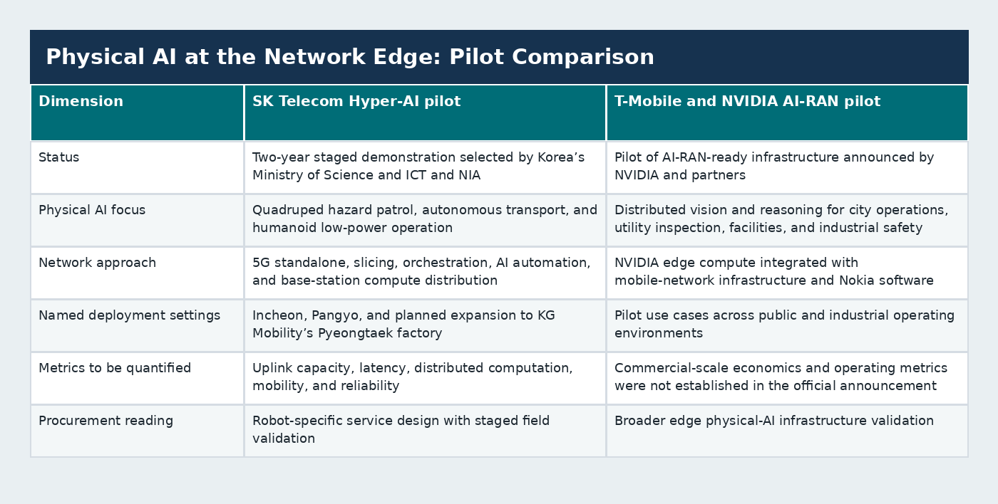
That distinction matters for procurement. Vision agents for city operations or facility management can often be evaluated as camera, sensor, and analytics systems. Robot services add motion, safety, localization, battery constraints, maintenance logistics, and physical interaction with the worksite. When a robot depends on network hosted computation, the buyer must assess both digital performance and physical failure modes.
A side by side reading should not be turned into a ranking. The tasks, sites, infrastructure assumptions, and measurement methods are not equivalent. The shared buyer evidence gap remains consistent across both efforts. Site level performance data and repeatability are essential, task by task service level benchmarks are required, the split between onboard, edge, and cloud computation must be clear, measured performance under congestion, mobility, and degraded coverage needs to be disclosed, and pricing, service accountability, uptime terms, and integration cost must be made explicit before scale decisions.
What industrial buyers should require from the pilot
The first takeaway is that connectivity architecture needs to be defined early. Buyers often select a robot, then ask information technology or operations to make connectivity work. That sequence becomes risky when the robot depends on high definition video, Light Detection and Ranging data exchange, edge inference, or digital twin synchronization. For artificial intelligence radio access network enabled physical AI, the connectivity design should be part of the requirement from day one.
The second takeaway is vendor boundary management. In a project like SK Telecom’s pilot, responsibility can span the telecom operator, radio equipment providers, network software suppliers, robot or application firms, and site operators. If a robot fails to complete a patrol, who owns the root cause. The robot vendor may point to signal loss. The network provider may point to application design. The application provider may point to site conditions. Procurement contracts need clear responsibility matrices, escalation paths, data access rights, and acceptance criteria.
The third takeaway is safety separation. Network hosted computation may be useful for perception, analytics, route planning, monitoring, or workload reduction. Safety critical behavior still requires strict analysis. A robot should have defined local responses for loss of connection, delayed inference, inconsistent digital twin data, and degraded sensor feeds. For buyers in petrochemical, automotive, warehousing, or public space operations, safe fallback behavior should be tested rather than assumed.
The fourth takeaway is cybersecurity. Artificial intelligence radio access network connected robots increase the attack surface. Video streams, Light Detection and Ranging data, fleet commands, edge compute nodes, base station resources, and service application programming interfaces all need protection. Network slicing can help isolate services, but isolation is not a full security program. Buyers should ask how identities are managed, how data is encrypted, how updates are handled, how logs are retained, and how incident response is coordinated across vendors.
The fifth takeaway is lifecycle cost. A network dependent robot service may shift cost from robot hardware to subscription services, edge compute, managed connectivity, integration engineering, and ongoing site optimization. That may be acceptable if uptime, labor leverage, inspection coverage, or safety outcomes improve. It is not acceptable if the buyer cannot measure service value against total operating cost. The SK Telecom pilot does not disclose commercial pricing, service levels, or cost savings, so procurement teams should not infer an economic model yet.
What this pilot signals for physical AI adoption
SK Telecom’s artificial intelligence radio access network pilot is best read as an infrastructure experiment with direct robotics consequences. The robot industry has spent years improving onboard sensing, actuation, autonomy, and artificial intelligence models. The next adoption barrier may be less visible. How to support connected intelligence across real sites without overwhelming local networks, batteries, or support teams.
The caveat is that a smarter network does not make an unreliable robot safe or economical. Artificial intelligence radio access network services can provide compute access, mobility continuity, and service isolation, but they cannot replace local fallback behavior, validated task performance, or clear vendor accountability. The pilot must prove system level reliability, not only network capability.
If the pilot provides measurable gains in uplink reliability, edge compute access, mobility continuity, and service isolation, it could become an option for high value robot deployments in industrial and public infrastructure settings. If it cannot show task level reliability and clear economics, it will remain an architecture looking for disciplined use cases.
For now, procurement teams should track the pilot for the metrics it produces, not for branding attached to it. The decisive shift is that physical AI is moving into a shared infrastructure discussion, and the winners will be the buyers and vendors who validate the network, the robot, and the operating model as one system.
This analysis synthesizes official company statements and publicly available operating disclosures.
Disclaimer: This analysis is for informational purposes only and does not constitute investment, financial, or procurement advice. The views expressed are based on public information and industry trends as of the publication date. No vendor is endorsed, and no technology performance is guaranteed.














