
Rokae Surges 15 Percent in Hong Kong Debut as Capital Backs China’s Cobot Champion
Rokae Robotics made a strong debut on the Hong Kong Stock Exchange under Chapter 18C, rising 15.21 percent on its first trading day. The listing gives China’s flexible collaborative robot leader fresh capital for capacity expansion, embodied AI research and international growth, while also signaling stronger public market confidence in deployable robotics platforms.

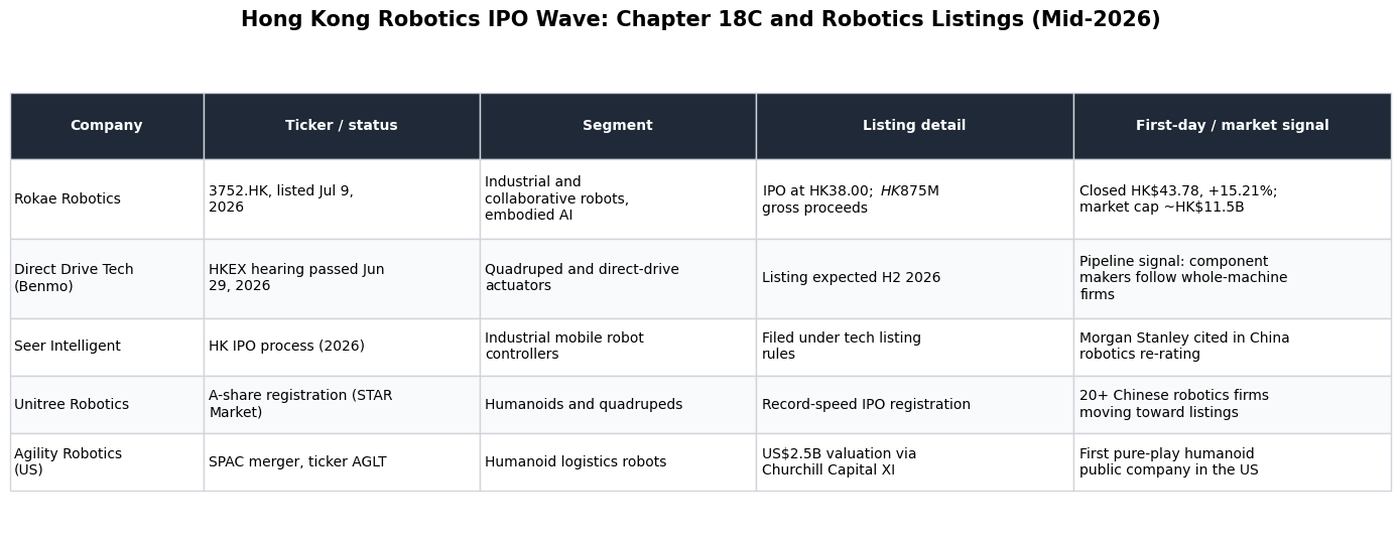
Rokae, Shandong Robotics Group, 3752.HK, delivered a strong first day on the Hong Kong Stock Exchange on July 9, 2026, with shares opening at HK$38.02 and closing at HK$43.78, a 15.21 percent gain on debut [1]. The listing, completed under Hong Kong’s Chapter 18C framework for specialist technology companies, raised approximately HK$875 million in gross proceeds and lifted Rokae’s market capitalization to about HK$11.5 billion [2].
The first day move matters because Rokae is not simply another hardware listing. The company is one of China’s most visible domestic collaborative robot suppliers, with a reported 34 percent share of China’s flexible collaborative robot market [4]. Its portfolio spans industrial robots, collaborative robots and embodied AI oriented systems, led by the xMate series and its self developed xCore control platform [5]. In practical terms, the IPO gives public investors a direct vehicle for exposure to one of the most strategically important segments in industrial automation, flexible robots that can be deployed into real factories, reconfigured for changing production needs and increasingly upgraded through software.
This article does not revisit the subscription mechanics already covered in prior IPO coverage. The key development now is the public market verdict. Rokae’s first day surge suggests that investors are assigning value not only to current market share, but also to the company’s ability to convert capital into manufacturing capacity, research depth, sales coverage and future installed base growth.
The Chapter 18C Signal
Rokae’s use of Chapter 18C is central to understanding the listing. The framework was designed to help specialist technology companies access public capital even when their financial profiles do not fit traditional profitability or revenue thresholds [6]. For robotics companies, this matters because the path from research to scaled industrial adoption is capital intensive. Product development requires mechanical design, sensing, motion control, safety validation, software integration, application engineering, field service and production capacity. These costs are front loaded, while customer adoption can scale unevenly across industries.
The market’s willingness to support a robotics issuer through Chapter 18C indicates that investors are becoming more comfortable valuing deep technology companies on strategic factors beyond near term earnings. In Rokae’s case, those factors include domestic market leadership, product breadth, supply chain localization, embodied AI positioning and exposure to China’s manufacturing upgrade cycle.
The proceeds also have operational significance. The approximately HK$875 million raised gives Rokae capital to expand production capacity, strengthen research and development in embodied AI, and support international expansion, particularly in Southeast Asia and Europe [8]. Those are not abstract corporate goals. In robotics, capacity and deployment are directly linked. A supplier that cannot manufacture at scale, certify systems, deliver application support and maintain service coverage will struggle to convert demand into installed units. Fresh public capital reduces that constraint.
The Evaluation
For industrial and collaborative robotics, the most important ARPI factors include production capacity, application readiness, integration ecosystem, affordability, support infrastructure, customer trust and financing depth.
Rokae’s 15.21 percent listing day surge and Chapter 18C capital raise are important signals because they represent public market validation of a company that already has commercial traction in flexible collaborative robotics. Investor demand does not deploy robots by itself, but it can fund the bottlenecks that determine how many robots actually reach factory floors.
The first bottleneck is capacity. If Rokae allocates IPO proceeds toward manufacturing scale, it can increase output of xMate and related robot lines, reduce lead times and support larger enterprise orders. In ARPI terms, that raises the supply side ceiling for deployed units.
The second bottleneck is application engineering. Collaborative robots rarely succeed through hardware alone. Customers need grippers, vision systems, fixtures, safety configuration, workflow redesign, programming support and process validation. Capital can expand Rokae’s application engineering teams and partner network, which improves deployment speed. Faster deployment directly improves penetration.
The third bottleneck is confidence. Public listing status can make a robotics vendor more acceptable to large industrial buyers that require financial transparency, continuity and long term support assurance. For customers in automotive, electronics, new energy, healthcare and precision manufacturing, vendor stability is a procurement issue. Rokae’s first day market reception strengthens the perception that it has the backing to support multiyear automation programs.
The fourth bottleneck is research translation. Embodied AI is only valuable when it improves real world task performance, setup time, adaptability or safety. IPO proceeds can help Rokae move software advances into field tested robot capabilities. If the xCore platform becomes more capable at perception driven control, adaptive manipulation and task level autonomy, then each deployed robot can cover a broader set of use cases. That broadens the addressable deployment base.
Taken together, the implication is clear. The 15 percent first day rise is not merely a trading headline. It is a signal that public capital markets are willing to finance the next stage of physical AI deployment. For Rokae, that financing can translate into future deployed unit growth through higher production capacity, stronger field support, wider integration coverage and faster commercialization of embodied AI features.
Technological Positioning: xMate and xCore
Rokae’s market position is built around the xMate series of flexible collaborative robots and the xCore control platform. The xMate line is known for a cabinet free design and built in torque sensors in each joint [9]. This architecture supports force and position hybrid control, which is essential for tasks that require precision, compliance and safe interaction with human workers.
Torque sensing gives a collaborative robot the ability to detect resistance and adjust motion accordingly. In a factory, that capability can matter during assembly, polishing, inspection, machine tending, electronics handling and medical or laboratory tasks where rigid motion would increase risk or reduce quality. It also supports safer operation near people, reducing the need for extensive guarding in some applications, subject to the appropriate risk assessment and local safety standards.
The cabinet free design supports flexible deployment. In modern manufacturing, especially in electronics, new energy components and customized production, companies often need to reconfigure lines quickly. A robot that requires less floor space and less infrastructure can be moved or redeployed more easily. That makes collaborative robots attractive not only to large factories, but also to small and medium manufacturers that cannot afford long installation cycles.
The xCore platform is equally important. Robotics competition is moving beyond mechanical arms and into control systems, software tools, data feedback and ecosystem integration. A self developed industrial control platform gives Rokae more control over motion performance, safety behavior, application compatibility and future AI integration [10]. It also allows the company to align hardware, firmware and software development rather than depend entirely on external control architectures.
That vertical integration may become increasingly important as embodied AI features mature. A robot that can learn from demonstrations, adjust to part variability, interpret visual information or recover from errors needs tight coordination between sensing, control, planning and actuation. Companies that control more of the stack may be better positioned to deliver reliable autonomous functions, not just laboratory demos.
Competitive Landscape and Domestic Supply Chain Maturation
Rokae’s reported 34 percent share of China’s flexible collaborative robot market reflects a broader transition in the country’s automation sector [4]. For years, high end robotics was dominated by Japanese and European suppliers, especially in core industrial robot categories. Foreign firms built advantages in reducers, servo systems, controllers, reliability, application libraries and global service networks. Domestic Chinese robotics companies had to overcome perceptions around precision, durability and software maturity.
That gap has narrowed. Chinese robotics suppliers have improved in motion control, mechanical design, sensing integration and application specific deployment. At the same time, China’s manufacturing base has created a large domestic proving ground. Local suppliers can work closely with customers in electronics, new energy vehicles, batteries, photovoltaics and precision assembly, which are sectors that demand rapid customization and fast iteration.
Rokae benefits from this environment. It is positioned not only as a domestic alternative to foreign cobot brands, but also as a supplier aligned with China’s push for local industrial technology capabilities. Supply chain localization gives domestic robotics companies practical advantages, including shorter delivery cycles, closer customer support, more flexible customization and potentially lower total cost of ownership.
The competitive basis is also changing. In earlier phases of industrial automation, buyers often compared payload, reach, repeatability and price. Those metrics remain important, but collaborative robot adoption increasingly depends on ecosystem readiness. Can the robot be programmed easily? Can it work with machine vision? Are there certified grippers and accessories? Are there local integrators who understand the process? Does the vendor have templates for inspection, loading, dispensing, welding or assembly? Can the software be updated without destabilizing the production line?
Rokae’s full series intelligent robot strategy gives it a wider product base for serving customers with different automation needs. A manufacturer may need conventional industrial robots for high speed or heavy payload operations, collaborative robots for flexible workstations, and embodied AI capabilities for tasks involving perception or adaptation. A supplier that can address multiple needs may gain account level advantages over narrower competitors.
Internationally, however, Rokae will face a more demanding test. Southeast Asia offers strong automation demand as manufacturers expand capacity and seek productivity gains. Europe offers sophisticated customers, but also stricter safety expectations, entrenched competitors and higher service requirements. If Rokae can translate domestic success into credible international deployments, the IPO proceeds could become a lever for global expansion rather than simply domestic consolidation.
Procurement Implications
For industrial buyers, Rokae’s IPO changes the procurement conversation in several ways.
First, it reinforces the credibility of domestic collaborative robot platforms. A strong public listing does not guarantee product fit, but it indicates that the company has achieved enough scale, visibility and investor confidence to support longer term planning. Procurement teams evaluating cobots can now treat Rokae as a scaled supplier rather than an emerging niche vendor.
Second, the listing may improve vendor stability. Robotics deployments often require multiyear support, spare parts, software updates and integration continuity. Public market access gives Rokae a broader capital base, which can support service expansion and product road maps. For customers considering large automation programs, that reduces perceived supplier risk.
Third, the capital raise may accelerate product availability. If Rokae expands manufacturing capacity and supply chain depth, buyers could benefit from shorter delivery times and improved support coverage. In cobots, lead time can be decisive because automation projects are often tied to new product launches, labor constraints or seasonal production peaks.
Fourth, customers should still evaluate systems through real application trials. Collaborative robots are not interchangeable. Success depends on payload, reach, cycle time, end effector choice, fixture design, safety assessment, software integration and operator training. Rokae’s market position is significant, but buyers should validate performance against the specific task rather than assume broad suitability.
Fifth, procurement teams should pay closer attention to software and AI road maps. As embodied AI becomes a larger part of robot differentiation, the value of a platform will increasingly depend on ease of programming, perception capability, learning tools, simulation, remote diagnostics and integration with factory software. Hardware price alone will be an incomplete benchmark.
Investment and Market Implications
For investors, Rokae’s debut strengthens the case that industrial robotics is moving into a new public market phase. The sector has long carried a tension between strategic importance and difficult economics. Hardware companies require heavy investment, gross margins can be pressured by manufacturing costs, and adoption cycles can be slower than software investors prefer. Chapter 18C offers a pathway for companies that need capital before they reach a mature profitability profile.
Rokae’s first day performance suggests that investors are willing to underwrite robotics growth when the issuer has a clear strategic position. The company brings together several themes that public markets are currently rewarding: domestic technology substitution, manufacturing automation, embodied AI, industrial productivity and China’s advanced manufacturing policy priorities.
The listing may also serve as a benchmark for other robotics companies considering Hong Kong listings. If Rokae performs well as a public company, demonstrates revenue growth, expands deployments and maintains technical credibility, it could encourage more specialist robotics and automation firms to use Chapter 18C. That would deepen the public market ecosystem for physical AI and industrial technology.
At the same time, the public market will impose new expectations. Rokae will need to show that the IPO proceeds can be converted into measurable operating progress. Investors will watch order growth, production capacity, margin trends, overseas expansion, research output and the pace at which embodied AI features become commercially meaningful. A strong debut is only the opening signal. Sustained validation will depend on execution.
Risks to Watch
Rokae’s opportunity is substantial, but the company faces risks common to robotics scale ups.
Competition is intensifying. Chinese cobot manufacturers are proliferating, and foreign incumbents still have deep experience, strong brand recognition and established global channels. Price competition could pressure margins, especially if customers view cobots as increasingly commoditized.
Technology expectations are rising. Embodied AI is a powerful narrative, but the transition from controlled demos to reliable industrial autonomy is difficult. Robots must operate safely, repeatably and economically in variable real world environments. Overpromising AI capability could create customer disappointment if deployments require more integration work than expected.
International expansion will require local compliance and support. Entering Europe or Southeast Asia is not just a sales exercise. It requires certification, channel development, service networks, training, documentation and adaptation to local customer requirements. These investments can take time before producing meaningful revenue.
Finally, capital deployment discipline will matter. IPO proceeds can accelerate growth, but only if allocated effectively. Expanding capacity ahead of demand, overextending internationally or investing in too many research directions at once could dilute focus. The most important indicator will be whether capital spending leads to more deployed robots, higher utilization of installed systems and stronger customer retention.
Conclusion
Rokae Robotics’ 15.21 percent first day gain on the Hong Kong Stock Exchange marks a significant moment for China’s collaborative robot sector. The company’s Chapter 18C listing raised approximately HK$875 million and positioned Rokae as a public market proxy for flexible automation, domestic robotics capability and embodied AI commercialization.
The significance goes beyond stock performance. Public capital can help convert Rokae’s market position into larger production capacity, stronger application support, accelerated research and broader international reach. Through the ARPI lens, that is the central point: the listing validates a robotics company with real deployment potential and gives it resources that can translate directly into future installed unit growth.
Rokae now enters the next phase of scrutiny. Its challenge is to prove that investor enthusiasm can become operational scale. If the company uses its new capital base to expand capacity, improve software capability and deliver reliable deployments across priority industries, its IPO may be remembered not only as a successful Hong Kong debut, but as a milestone in the public financing of embodied AI robotics.
Disclaimer: This article is for informational purposes only and does not constitute financial, investment or technical advice.
References
[1] RobotAIGeek. “Rokae Robot HK IPO: China’s Cobot Leader Raises Capital.” 2026.
[2] Baker McKenzie. “Baker McKenzie Advises Rokae Robotics on Hong Kong IPO.” July 9, 2026.
[3] Reuters. “Six companies seek up to $2.5 billion in Hong Kong offerings.” June 16, 2026.
[4] RobotAIGeek. “Rokae Robot HK IPO: China’s Cobot Leader Raises Capital.” 2026.
[5] ROKAE Robotics. “About ROKAE.” 2026.
[6] HKEX Group. “18C, Explained.” 2026.
[7] HKEX. “Newly Listed Securities.” July 9, 2026.
[8] Minichart. “ROKAE, Shandong Robotics Group Inc. IPO Analysis.” July 5, 2026.
[9] ROKAE Robotics. “ROKAE xMate CR Series Cobot.” 2026.
[10] ZTEC. “Collaboration with Rokae Cobots.” 2026.
[11] Elite Robots. “Top 10 Cobot Manufacturers from China in 2026.” April 30, 2026.














