
RoboSense LiDAR Sales to Robots Surge 510 Percent in First Half 2026
RoboSense reported that LiDAR sales to robotics customers grew 510 percent year over year in the first half of 2026 to 282,600 units, overtaking growth in its traditional autonomous driving business and reinforcing its position as the top robotics LiDAR supplier worldwide.
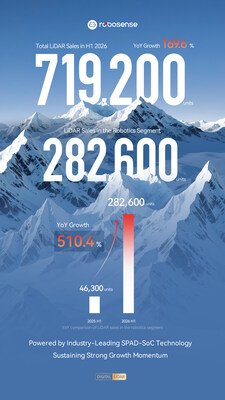
In the middle of a year dominated by splashy humanoid reveals and mega funding rounds, a quieter signal arrived that matters more for people who actually build and deploy robots. RoboSense, a Shenzhen based LiDAR maker listed in Hong Kong, reported that LiDAR sales to robotics customers jumped 510 percent year over year in the first half of 2026, reaching 282,600 units. Market reality is no longer just announcements and demo videos, structural shift has started at the sensor layer of robotics infrastructure, and the implication is that deployment scale in China is moving from pilot to production at a pace that can reorder supply chains and investment priorities.
The story is not only about a single quarterly number. It is about a supplier shifting the center of revenue gravity away from automotive applications and toward embodied machines, which in turn signals that real robots are leaving labs and becoming volume consumer and industrial products. For investors, manufacturers, and procurement teams, RoboSense is now living proof that sensors have become a primary battleground in the race to commercialize Physical AI.
A Quiet Component Company Turns Centre Stage
RoboSense began as a specialized supplier to the automotive market, making light detection and ranging sensors for advanced driver assistance systems and autonomous driving pilots. Over the last two years the company steadily built out proprietary chip designs and solid state production lines. Its E1R and Airy product families represent that engineering push, combining on chip processing with tightly integrated optics to reduce cost while maintaining point cloud fidelity.
The company went public to scale that work into automotive volumes. What changed in 2026 is that robotics customers, from cleaning and lawn care robots to warehouse logistics machines and robotaxis, started ordering at scale. RoboSense says it now serves more than 3,400 robotics clients and that its first half total LiDAR shipments reached 719,200 units. Robotics units accounted for 282,600 of those shipments, while automotive ADAS shipments reached 436,600 units. The quarterly cadence matters too, with second quarter totals showing continued momentum, and first quarter robotics shipments having already spiked dramatically earlier in the year.
The Numbers That Changed the Narrative
Numbers have a way of reframing strategy. For RoboSense robotics LiDAR sales to grow 510 percent year over year means the company has converted a segment once considered marginal into a major revenue driver. Total company LiDAR shipments rose 169.6 percent year over year in the first half of 2026. Within that, robotics sales grew 510.4 percent while ADAS sales increased 98.0 percent. In the first quarter robotics units alone rose by nearly fifteen hundred percent year over year, briefly overtaking ADAS units within a single quarter.
There are two technical levers behind that surge. One is chip integration, with more functionality moved onto custom silicon to reduce per unit costs and to enable higher production throughput. The other is a move to solid state designs that have fewer moving parts, making the sensors cheaper, more durable, and easier to validate at scale. Those two factors are the difference between a sensor that can be hand calibrated for a test fleet and one that can be dropped into a million consumer machines without a service team chasing failures.
Why LiDAR Unit Counts Track Actual Robots
LiDAR is the spatial nervous system for many robots. It works by emitting rapid laser pulses into an environment and timing the return to build a three dimensional point cloud. Unlike cameras that rely on light and texture, LiDAR returns precise distance measurements and is robust across a wide range of lighting conditions. For a robot navigating crowded aisles, a cluttered living room, or a dynamic factory floor, LiDAR supplies the depth and obstacle resolution necessary for safe motion planning.
This makes sensor shipments a useful proxy for real world deployment. Robot makers can exaggerate production timelines in marketing decks, and venture rounds can create the impression of scale without substance. A component supplier on volume contracts with hundreds or thousands of manufacturers has less incentive to inflate unit counts for any single robot model. When a LiDAR supplier reports hundreds of thousands of units going to robots, it usually means many finished machines are being built and shipped to customers or integrators.
Technically, the shift also reflects a move from expensive scanning systems to solid state arrays. Solid state LiDAR produces fewer moving parts and allows wafer scale production that benefits from semiconductor cost curves. That is what opens robotics to unit economics that matter for consumer and industrial markets alike.
How This Rewrites Competitive Advantage
RoboSense is not operating in a vacuum. Global competitors include Hesai, Ouster, and Luminar among others. Historically those companies competed head to head in automotive sensing, but most Western suppliers treated robotics as a secondary market. RoboSense now claims an early lead in robotics unit share by focusing on cost per point, supply chain scale, and customizing optics and firmware for small form factor robots.
China’s manufacturing ecosystem gives local suppliers a further edge. Smaller assembly lines, closer proximity to parts vendors, and a domestic demand pool all lower time to iterate and cost per unit. That does not guarantee permanent dominance. Rival suppliers with large balance sheets can pivot production, especially if margins in robotics remain attractive. The critical question is whether competitors can match both the chip level integration and the manufacturing intensity RoboSense has established, while also scaling the customer support and validation processes required by high volume robot makers.
A New Layer of the Robotics Stack
What used to be a single vendor relationship between a robot maker and a chip partner is breaking into distinct layers. Investors and supply chain architects increasingly view perception hardware and edge AI as stand alone businesses with their own unit economics, roadmaps, and multiples. RoboSense’s pivot is a case study in that separation. The company is positioning itself as infrastructure for a Physical AI economy, selling a component that will be embedded in many different robot brands and product categories.
This has consequences. First, it changes negotiation dynamics. Robot makers will compete on systems integration, software, and end user services, while the sensor battle will shift to price, reliability, and availability. Second, it changes the investment calculus for system integrators who previously had to build perception stacks from scratch. Now there is a growing market of validated, lower cost sensors that reduce time to market.
What Robot Makers and Integrators Should Do Next
Procurement teams should treat this as an inflection point, not as a fait accompli. Scale matters, but so does fit. A LiDAR validated outdoors for robotaxi operations will not behave identically in a dusty indoor warehouse or a water sprayed commercial cleaner. Buyers must demand performance metrics that map to their use case, including failure rates, mean time between failures, latency under load, and software update policies.
Ask for sample life cycle data, test reports from independent labs, and field failure mode analyses. Negotiate support for sensor calibration and replacement logistics, because after sales service is a hidden cost that will shape lifetime operating expenses. Finally, plan for multi sourcing in critical applications to avoid single supplier dependency risk that can emerge when a vendor becomes incumbent.
What Investors Should Watch
For investors the key question is sustainability. A 510 percent year over year increase is easier to achieve from a smaller base, and growth will likely moderate as the robotics market matures. Watch the sales mix, margins, and backlog dynamics in the next three quarters. Pay attention to whether the company can maintain gross margin while scaling to lower price points, and whether ADAS demand rebounds or remains secondary.
Also watch competitor moves. If other suppliers aggressively reorient production to robotics or if large tier one automotive suppliers expand offerings, RoboSense’s advantage could compress. Conversely, if RoboSense continues to capture share while improving per unit economics, the company could define the perception layer for a new generation of robots and command infrastructure level multiples.
The Broader Signal for China and Global Supply Chains
RoboSense’s surge is part of a larger Chinese industrial pattern in 2026. When component makers scale, they make it easier for smaller system companies to ship products profitably. That feeds a virtuous cycle where more robot makers enter market niches, which in turn enlarges the addressable market for sensors and compute. For global supply chains it means more design wins in China, and potentially tougher price competition for suppliers manufacturing in higher cost regions.
At the policy level this trend also intersects with national strategies to localize core components and foster an export oriented robotics industry. A domestic sensor champion enables faster iteration between hardware makers and system integrators, and that alone reduces friction for mass deployment.
A Practical Takeaway
If you are a corporate procurement lead, an investor, or an engineering founder, treat RoboSense’s numbers as a market signal. Robotics is entering a commercial phase where components can be bought off the shelf at volumes that matter. That changes product roadmaps, go to market plans, and capital allocation. It also means that the winners will not only be the robot makers with the flashiest demos, but the companies that build reliable, scalable stacks at the sensor level and the integrators that know how to turn validated parts into durable, maintainable fleets.
RoboSense’s surge in robotics LiDAR sales is more than a quarterly headline. It is a structural nudge toward an architecture of robotics where perception hardware is a commodity layer, while software, integration, and service determine long term value. For a year that started with hype around humanoids, the quiet reality is that millions of cheaper, purpose built robots equipped with robust sensors may be the real revolution in Physical AI.
This analysis synthesizes company reported shipment figures and public company disclosures, together with industry observation and supply chain analysis. Readers should conduct independent due diligence before making procurement or investment decisions.














