
Persona AI Deploys Humanoid Welding Robot in Houston Shipyards
Houston-based Persona AI (founded 2024) has deployed a humanoid welding robot and signed an MOU with HD Hyundai (world's largest shipbuilder) for shipyard applications. The 175cm, 85kg robot is designed to fit the same physical envelope as human welders in confined shipyard spaces. The article covers the teleoperation-first development approach, the economics of shipyard welding ($150K-200K fully loaded cost per welder), the cross-border supply chain strategy, and why the humanoid form factor makes genuine sense for constrained environments that cannot be redesigned.
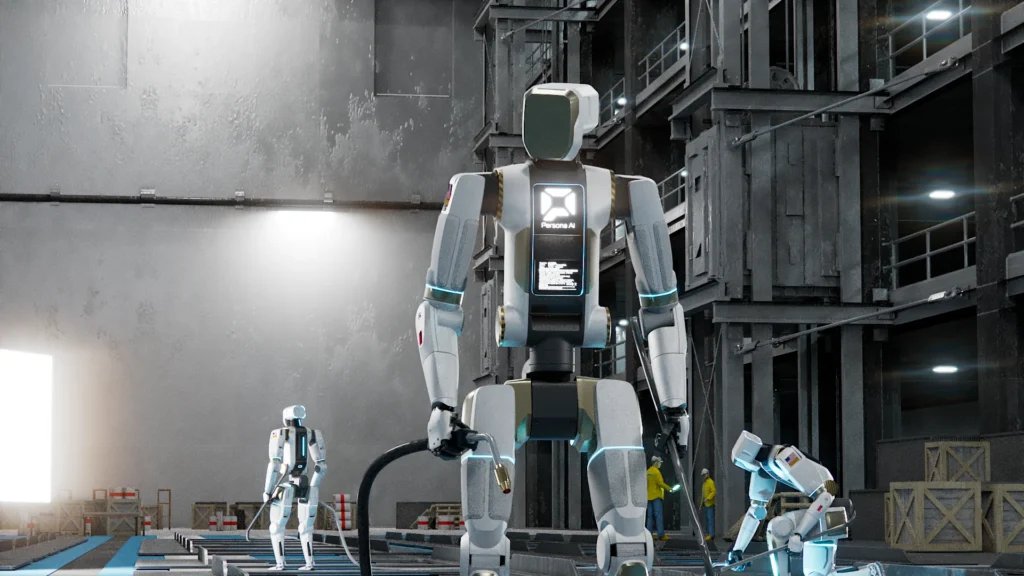
Persona AI has deployed a humanoid welding robot at its Houston facility and signed a memorandum of understanding with HD Hyundai for shipyard welding applications. The Houston based startup, founded in 2024 and specializing in humanoid robots designed specifically for heavy industrial welding tasks, represents a new category of entrant in the humanoid robotics sector. Rather than pursuing general purpose humanoid capabilities, Persona AI has narrowed its focus to a single high value application where the humanoid form factor provides a genuine operational advantage over traditional industrial robot arms.
The company's robot stands 175 centimeters tall and weighs 85 kilograms, dimensions chosen to match the physical envelope of a human welder working in confined shipyard spaces. The humanoid form factor allows the robot to access the same work positions, use the same scaffolding, and navigate the same passageways as human welders without requiring facility modifications. This is a meaningful distinction from traditional welding robots that require purpose built workcells and cannot operate in the constrained, irregular environments typical of ship construction.
Strategic Partnerships in Maritime Automation
The MOU with HD Hyundai, the world's largest shipbuilder by order book value, provides Persona AI with access to one of the most demanding welding environments in heavy industry. Shipyard welding involves working on curved hull sections, in confined double bottom tanks, on elevated structures, and in positions that are ergonomically challenging or physically dangerous for human workers. The partnership also includes collaboration with Korean industrial partners, suggesting a cross border supply chain strategy that leverages Korean shipbuilding expertise with American robotics engineering.
HD Hyundai operates shipyards in Ulsan, South Korea that employ thousands of welders and face the same demographic workforce challenges as Chinese shipyards. The average age of Korean shipyard welders has increased steadily, and recruitment of younger workers into physically demanding welding roles has become increasingly difficult. A humanoid robot that can perform welding tasks in the same physical spaces as human workers addresses this workforce constraint without requiring the multi billion dollar facility redesigns that traditional robotic welding systems demand.
The partnership structure, with prototype delivery targeted for end of 2026 and commercial testing beginning in 2027, indicates that the technology is still in the pre commercial validation phase. Procurement teams should interpret this as a technology watch item rather than an immediate purchasing opportunity. However, the involvement of a major shipbuilder as a development partner significantly reduces the risk of the technology being developed in isolation from real operational requirements.
The Fully Loaded Cost of Human Labor Replacement in Shipyards
Shipyard welding is among the highest cost manual labor categories in heavy industry. A certified shipyard welder in the United States earns between 75,000 and 120,000 dollars annually, with fully loaded costs including benefits, safety equipment, workers compensation insurance, and supervision reaching 150,000 to 200,000 dollars per year. Korean shipyard welders earn less in absolute terms but face similar fully loaded cost structures when adjusted for productivity and overtime requirements.
The economic case for humanoid welding robots in shipyards is stronger than in most other industrial applications because of the combination of high labor cost, severe ergonomic risk, persistent workforce shortage, and the impracticality of traditional automation solutions. A humanoid robot operating two shifts per day at 85 percent uptime could theoretically replace 1.5 to 2.0 full time equivalent welders, producing a payback period of two to three years at current labor costs.
However, the economic model depends critically on weld quality consistency and uptime reliability. A robot that produces welds requiring frequent rework or that experiences frequent downtime for maintenance may not achieve the theoretical payback. The commercial testing phase in 2027 will provide the first real data on these critical parameters.
The Teleoperation First Development Approach
Persona AI has adopted a teleoperation first development strategy, meaning that the robot initially operates under remote human guidance while collecting operational data that will eventually enable autonomous operation. This approach reduces the technical risk of full autonomy while still delivering immediate value by removing the human welder from dangerous physical positions. The teleoperator can guide the robot from a comfortable, safe control station while the robot performs the physical welding in hazardous locations.
The teleoperation approach also accelerates the collection of training data for machine learning. Every teleoperated welding session generates paired data of human decision making and robot execution that can be used to train autonomous control policies. This data flywheel means that the system becomes progressively more autonomous over time without requiring a separate research and development phase.
For procurement teams evaluating humanoid welding solutions, the teleoperation first approach offers a lower risk adoption path. The robot delivers immediate value in its teleoperated mode while building toward full autonomy. This contrasts with fully autonomous systems that must achieve high reliability before delivering any commercial value.
Cross Border Supply Chain Dynamics
The partnership between a Houston based startup and a Korean shipbuilder reflects the increasingly global nature of robotics supply chains. Persona AI benefits from access to the American venture capital ecosystem, proximity to NASA and energy sector robotics expertise in Houston, and the deep pool of robotics engineering talent in Texas. HD Hyundai provides access to the world's most demanding shipbuilding environment, Korean manufacturing precision, and a customer base that spans global maritime construction.
This cross border structure also creates geopolitical complexity. A humanoid robot developed in the United States for deployment in Korean shipyards may face export control scrutiny if its capabilities are deemed dual use. The maritime construction sector has defense implications, and autonomous systems operating in shipyards that build naval vessels may require additional regulatory clearance.
The Practical Reality of Humanoid Form Factor Advantage
Consider why a human shaped robot makes sense for shipyard welding when it makes less sense for warehouse logistics. In a warehouse, the environment can be redesigned around the robot. Shelves can be repositioned, aisles can be widened, and workflows can be optimized for non humanoid machines. In a shipyard, the environment is fixed by the physics of ship design. Hull curvature, tank dimensions, and structural member spacing are determined by naval architecture, not by automation convenience. A robot that must work in these spaces must fit the same physical envelope as the human workers it replaces.
This is the genuine use case for humanoid form factor in heavy industry. Not general purpose versatility, but specific environmental compatibility with spaces designed for human bodies. Procurement teams should evaluate humanoid robots for applications where the physical environment cannot be modified, rather than for applications where purpose built automation would be more efficient.
The deployment of a humanoid welding robot in Houston and the partnership with the world's largest shipbuilder confirms that industrial welding in constrained environments is emerging as a viable commercial application for humanoid robotics. The timeline remains pre commercial, but the combination of genuine market need, credible industrial partner, and focused application strategy positions this as a technology worth monitoring through 2027.
The competitive positioning of Persona AI against Chinese welding robot startups is worth examining. While Chinese companies benefit from lower manufacturing costs and faster regulatory approval in domestic markets, Persona AI benefits from proximity to Western shipyard customers, alignment with US defense supply chain requirements, and access to American venture capital. The US Navy's shipbuilding program, which faces chronic welder shortages at yards including Newport News and Bath Iron Works, represents a potential defense sector customer that would be inaccessible to Chinese competitors regardless of technical capability.
The Houston location provides Persona AI with strategic advantages beyond access to shipyard customers. The city hosts NASA's Johnson Space Center, which has decades of experience in humanoid robotics through the Robonaut program. The energy sector's concentration in Houston creates a secondary market for humanoid robots in offshore platform maintenance and refinery inspection, applications that share the confined space access challenges of shipyard welding. The University of Houston and Rice University provide a pipeline of robotics engineering talent, and the city's relatively low cost of living compared to Silicon Valley reduces the burn rate for a venture backed startup.
The workforce transition implications of humanoid welding robots in shipyards deserve careful consideration. Experienced welders possess decades of accumulated knowledge about material behavior, joint preparation, and quality assessment that cannot be easily replicated by AI systems. A hybrid approach where human welders supervise and validate robot work while handling the most complex joints may represent the optimal deployment model for the near term, preserving human expertise while leveraging robotic endurance and consistency for routine tasks.
The insurance and liability framework for humanoid robots operating in shipyards remains undeveloped. Traditional industrial robots operate within defined safety zones, and liability for incidents is allocated through established frameworks. A humanoid robot moving through shared workspaces creates novel liability questions about responsibility for collisions, weld defects, and property damage. The development of appropriate insurance products and liability frameworks will be necessary before scaled deployment can proceed, and the timeline for these frameworks is uncertain.
This analysis synthesizes company announcements, partnership disclosures, and public market activity as of July 2026.














