Orbbec brings robot free data platform to Japan at ROSCon JP 2026
Orbbec introduced a robot free data collection platform for Physical AI at ROSCon JP 2026 in Tsukuba. The EGO, UMI, and WristCam units target first person observation, hand interaction, and wrist level sensing, with a Dual Ego prototype showcased for synchronized egocentric capture.
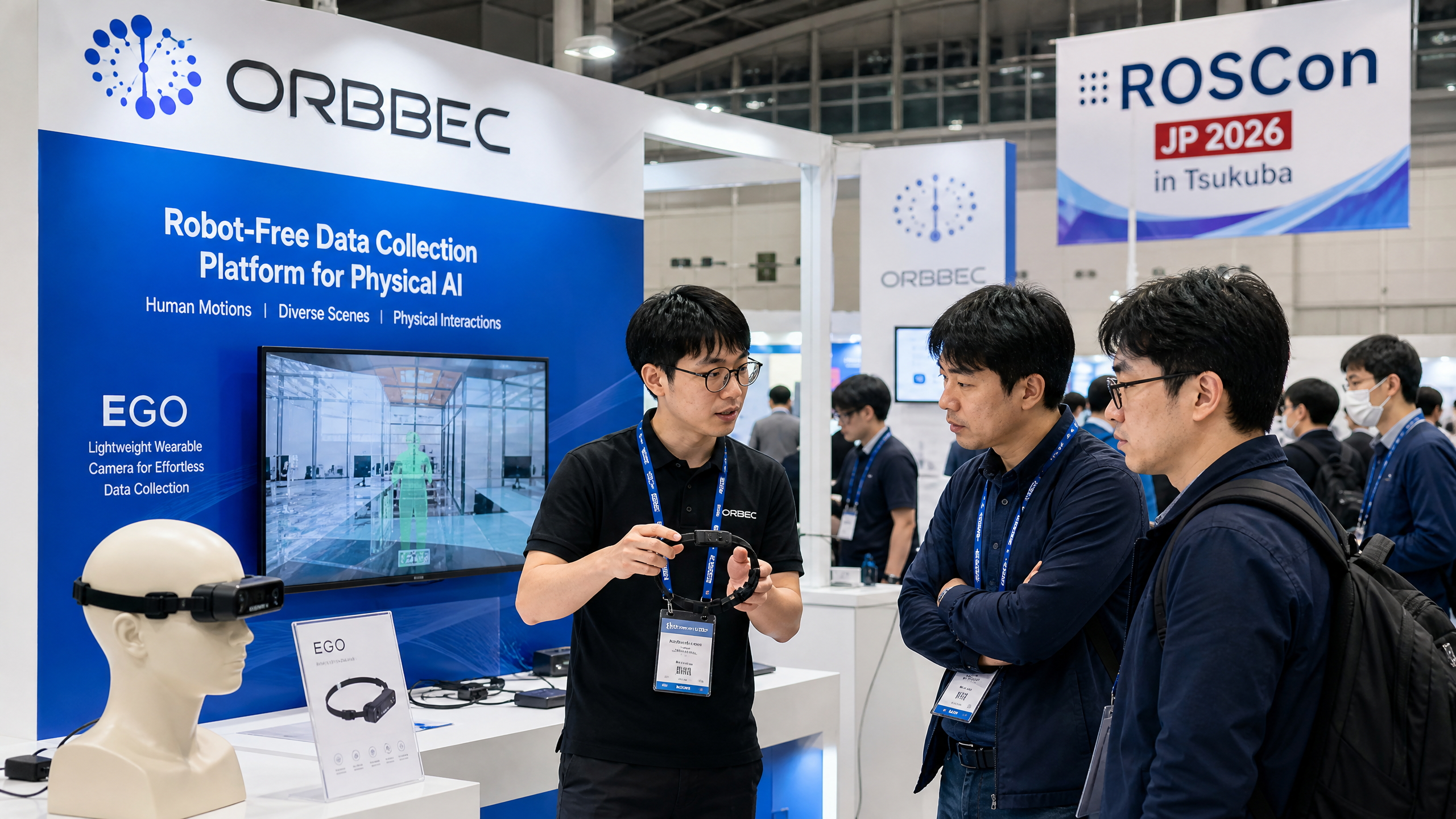
Orbbec presented a robot free data collection hardware platform for Physical AI in Japan for the first time at ROSCon JP 2026 held on 4 and 5 August 2026 in Tsukuba. The platform centers on three devices named EGO, UMI, and WristCam that support first person observation, hand object interaction capture, and wrist level near field data collection for training robot skills.
The company demonstrated a Dual Ego prototype with dual 2-megapixel fisheye cameras, one millisecond synchronization accuracy, a one thousand hertz six axis IMU, and roughly two hundred grams total weight. The EGO RGB D series brings chip level depth output combined with an algorithm it calls LingBot Depth to handle transparent and reflective surfaces common in retail and healthcare settings.
Orbbec is headquartered in Shenzhen and has built a reputation in 3D vision for robotics, logistics, and retail systems. The company produces depth cameras and sensors that plug into robot perception stacks and it is now moving up the stack into data collection for Physical AI. Its gear is already used in Hitachi’s CO URIBA hands free shopping setup and in an autonomous hospital logistics robot by a top three Japanese automaker, giving Orbbec direct exposure to real world operating constraints in Japan.
Orbbec positions human worn sensing as the new robot data workhorse
The core idea is simple and commercially pragmatic. Rather than relying on large fleets of expensive robots to generate interaction data, strap lightweight synchronized sensors on human workers and research participants, then harvest hours of well labeled egocentric sequences that can train manipulation and navigation policies. In plain terms, this is a dashcam and measuring tape for the human body.
Physical AI models need paired observations of what the wearer saw, what their hands did, and what the environment contained at fine temporal resolution. Orbbec’s EGO provides a first person RGB D stream, UMI targets hand object interaction views, and WristCam captures close range, occlusion prone scenes that often trip up robots. The Dual Ego prototype adds tight synchronization, which matters when fusing multi viewpoint data for tasks like contact rich manipulation or fast regrasping.
For Japanese developers building service robots, this approach lowers the upfront cost and complexity of dataset generation. Universities and enterprise labs can start with people and sensors instead of fielding full robots in hospitals, stores, or factories. It reduces safety approvals and speeds iteration, which suits the measured yet demanding procurement culture in Japan.
The company anchors the platform around EGO UMI and WristCam
EGO is the head mounted unit designed for egocentric capture with RGB D output at the chip level. That chip level depth matters because it lowers power draw and latency compared with offloading depth calculation to a general-purpose processor. Orbbec couples it with LingBot Depth, an enhancement pipeline that aims to recover depth on glassy and glossy objects that historically defeat stereo and structured light systems.
UMI is aimed at the hands and the fine-grained region where tools and products interact. This is the micro theatre of manipulation where viewpoint matters most. Mounting a secondary wide or narrow field camera closer to the hands raises the chance of capturing the moment a gripper would need to see, such as the twist of a bottle cap or a zipper alignment.
WristCam provides an even closer vantage point. Wrist level cameras may appear redundant, yet they often produce the most useful data for grasping and insertion because they see under the line of sight of a head mounted unit. WristCam data helps teach policies to resolve occlusions and to plan trajectories that avoid self-collisions or table edges.
The Dual Ego prototype rounds out the hardware story. Dual two-megapixel fisheye cameras synced to one millisecond precision and paired with a one thousand hertz six axis IMU deliver lab grade time alignment. That level of sync gives researchers confidence when correlating rapid hand motions with visual changes, which is vital for training models that rely on precise temporal coupling of action and observation.
Depth at the chip with LingBot enhancement tackles glass and glare
Transparent and reflective materials are a notorious failure mode for depth sensors. Retail shelves with shrink wrap, pharmacy counters with acrylic dividers and stainless steel hospital carts can produce invalid depth returns. Orbbec’s bet is that an integrated depth pipeline combined with proprietary enhancement will close those gaps enough to keep policies from overfitting to ideal scenes.
Chip level depth implies a dedicated depth processing block adjacent to the sensor, which should reduce jitter and latency. That opens up more stable ego motion compensation and cleaner alignment with IMU data, both critical for odometry and for reconstructing short lived contact events. The LingBot Depth enhancement is pitched as an add on layer that uses learned priors to fill in tricky surfaces without hallucinating gross errors.
The Japanese market is a prime testbed for that claim. Retailers prize neat presentation, and hospitals maintain high hygiene standards with shiny fixtures. If EGO units can produce consistent point clouds in these conditions, developers will save hours of annotation cleanup and policy debugging. If they cannot, the stacks built on those data will inherit brittleness that surfaces later in pilots.
Japan offers a practical proving ground for Physical AI data collection
Japan’s demographics and industrial make up create a strong pull for service automation. An aging population and persistent labor shortages in retail, logistics, and healthcare are pushing companies to adopt assistive systems that reduce repetitive strain and free staff for customer facing tasks. At the same time, expectations for reliability and safety are high, and procurement cycles demand evidence built in local conditions.
ROSCon JP captures that pragmatism. It is a technical gathering where researchers, integrators and corporate R D teams compare notes on what compiles and what does not in ROS based deployments. Showing up with synchronized egocentric rigs and depth cameras that have already been proven in a Hitachi retail experiment and a hospital logistics robot gives Orbbec more credibility than a pure slide deck announcement.
Tsukuba also matters. The city hosts leading research institutions and corporate labs focused on robotics and materials science. Proximity to universities and national labs increases the chance that the platform gets tested against real evaluation frameworks, such as manipulation benchmarks and navigation in structured buildings. Japanese developers are known to push vendor hardware through stress tests before any purchase decision.
Retail and hospitals illustrate near term demand signals
The CO URIBA hands free shopping program hints at a pathway to scale. Hands free shopping systems require reliable shopper identification, shelf inventory sensing, and behavior understanding to minimize shrink and charge correctly. Egocentric data is a powerful way to train models to follow object interactions from the customer viewpoint, which then informs store camera models tasked with recognizing the same interactions without wearing sensors.
Hospitals offer a different but equally relevant demand profile. Autonomous logistics robots need to handle carts, doors, and elevators, and must operate without disrupting staff. To train a robot to grip handles or to navigate crowded corridors, egocentric recordings from nurses and orderlies provide ground truth about timing and motion patterns that floor mounted cameras miss. WristCam and UMI modules could supply the hand centric data needed for robust manipulation of IV poles, bins, and trays.
Japan’s top automakers increasingly invest in hospital robots as proving grounds for advanced autonomy. The hospital environment has structured but variable patterns that test perception, planning, and human robot interaction. A top three automaker using Orbbec 3D vision in a hospital robot suggests the company’s sensors meet baseline durability and calibration requirements. Adding a human worn data stack fits as a precursor to policy training for the next generation of manipulators.
Supply chain implications ripple across optics inertial sensors and compute
Building a synchronized, lightweight egocentric stack is a supply chain exercise as much as it is an algorithmic one. Dual fisheye modules require consistent lens suppliers and tight calibration. Japanese firms like Tamron and Kowa compete with Chinese suppliers such as Sunny Optical and Ofilm for these components. The balance between local sourcing for Japan and scale manufacturing in China will be watched closely by enterprise buyers.
IMU selection and integration carry their own risks and opportunities. One thousand hertz six axis data streams are often sourced from TDK InvenSense parts, which gives Orbbec a potential local partner advantage in Japan. High-rate IMUs draw more power and generate heat, so power management and thermals will influence form factor and wearer comfort. Battery packs must pass Japan’s PSE certification, adding another compliance layer.
Edge compute and storage choices also matter. While the depth pipeline is handled at the chip, egocentric rigs still need to compress and store multi stream video with synchronized metadata. That points to embedded processors and NVMe storage with enough throughput for high frame rate fisheye streams. Integrating ROS friendly middleware on device or over a tether will influence adoption because researchers care about time stamps and bag file integrity.
Serviceability is not a trivial issue. Field replaceable cables and mounts, sweat resistant housings and quick dock charging can make or break pilot projects. If Orbbec packages EGO, UMI and WristCam as modular kits with spares and calibration tools, it will ease procurement objections. If the kits require frequent factory recalibration, total cost of ownership will rise, and Japanese buyers tend to calculate lifecycle costs rigorously.
Competitive pressure intensifies from global and domestic vision suppliers
Orbbec is not alone in chasing egocentric data for robot training. Stereolabs markets ZED cameras that can be head mounted. Luxonis pushes OAK modules with onboard AI acceleration. Intel’s RealSense line has a long tail in labs despite shifting corporate focus. Sony and Panasonic have deep imaging portfolios and a strong channel presence in Japan, and could bundle sensors with enterprise services.
Beyond hardware, big tech research has seeded the market with egocentric datasets and practices. Projects like Ego4D and learned manipulation models from Google, NVIDIA, and university labs shape expectations for data formats and labeling conventions. If buyers decide to standardize on those ecosystems, Orbbec’s value will depend on how efficiently its streams integrate into popular toolchains. ROS compatibility helps, but developers watch for driver quality, firmware stability, and community support.
Local incumbents also matter. Preferred Networks and Toyota Research arms have built internal data pipelines for manipulation and autonomous mobility. They may opt for in house rigs and custom calibration to control IP and quality. That leaves a segment of the market open for off the shelf kits at universities, startups, and tier two integrators. Orbbec’s path to scale in Japan likely runs through those groups and through partnerships with system integrators.
Disclaimer: This article is for informational purposes only and does not constitute financial or investment advice.