NVIDIA's Jetson Orin Nano 2 Cuts Robot Compute Power Draw 40 Percent
NVIDIA's new Jetson Orin Nano 2 robotics computer doubles inference performance and cuts power draw 40 percent, giving drone, home-robot, and vision-AI developers frontier-class edge compute at the entry-level tier ahead of a first-half-2027 launch.

78 Trillion Operations a Second Redraws the Entry-Level Compute Floor
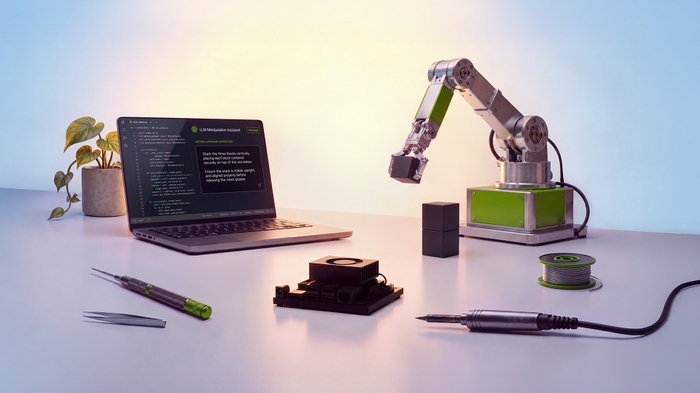
NVIDIA on Tuesday announced Jetson Orin Nano 2, a robotics computer delivering 78 trillion operations per second of AI compute inside the same compact form factor as its predecessor, twice the inference performance of the existing Jetson Orin Nano Super while drawing 40 percent less power in its 15-watt mode. The module and developer kit are set to ship in the first half of 2027, and the announcement matters less for the chip itself than for what it resets: the performance floor available to developers who cannot justify a full-size industrial compute stack but need enough onboard reasoning to run modern vision-language-action models rather than the narrower perception pipelines that entry-level edge boards have historically been built for.
Jetson Orin Nano 2 pairs its 78 TOPS AI engine with 8GB of memory and an 8-core Arm CPU, specifications that read modestly next to NVIDIA's flagship Thor and Orin AGX platforms but that are calibrated for a specific buyer: teams building delivery drones, inspection robots, home robotics platforms, and vision-AI systems where bill-of-materials cost and power budget matter as much as raw throughput. Deepu Talla, NVIDIA's vice president of robotics and edge AI, framed the release as a democratization play rather than a flagship refresh. "The Jetson Orin Nano 2 computer puts that breakthrough within reach of millions of developers, delivering the performance and energy efficiency needed for real-time reasoning at the edge," Talla said, referring to the generative-AI capability NVIDIA has spent the past two years pushing down its product stack from data-center GPUs into embedded form factors.
The 40 percent power reduction is the number worth sitting with longest. Edge robotics platforms are almost always thermally and electrically constrained in ways data-center accelerators are not: a delivery drone's flight time is a direct function of how much of its battery budget compute draws away from propulsion, and a mobile service robot's runtime between charges determines whether it fits into a facility's operating shift or requires an extra charging cycle that eats into utilization. A compute module that holds performance steady while cutting power draw nearly in half does not just make an existing design cheaper to run, it expands the envelope of what is physically buildable within a given battery and thermal budget, which is precisely the constraint that has kept many low-cost robotics form factors limited to simple obstacle avoidance rather than the kind of onboard scene understanding that vision-language-action models require.
Early Adopters Signal Where the Compute Actually Gets Used
NVIDIA named four early-access partners: Cognex, Doosan Bobcat, Matic, and Wing, spanning machine vision, construction equipment, home robotics, and aerial delivery. Wing, Alphabet's drone-delivery subsidiary, is evaluating the module specifically for flight-time economics. "Wing is exploring Jetson Orin Nano 2 to give us a path to more responsive, energy-efficient drones that can help make deliveries quicker and more dependable for customers," said Dinuka Abeywardena, Wing's head of perception. That framing, responsiveness and dependability rather than raw capability, is the tell for how commercial buyers actually evaluate compute upgrades: not "can it run a bigger model" but "does it make the existing service more reliable without changing the vehicle's weight class."
Matic Robotics, a home-robotics startup, is taking the module in the opposite direction, using the additional headroom to add capability rather than trim power draw. "With Jetson Orin Nano 2, Matic can run state-of-the-art AI models at the edge in a compact home robotics platform built for real-time perception, interaction and navigation," said Navneet Dalal, Matic's cofounder and chief executive. The contrast between Wing's efficiency-first use case and Matic's capability-first use case is a reasonably clean illustration of what an entry-level compute upgrade is actually for in 2026: it is not that every buyer wants the same thing from more headroom, it is that a wider design envelope lets different product categories solve their own most binding constraint, whether that is battery life or onboard model complexity, without moving up to a materially more expensive compute tier.
Why the Entry Tier Is Where the Real Volume Sits
NVIDIA's Jetson line has spent the past several product cycles pushing capability that once required a full desktop GPU down into module form factors small enough to bolt onto a mobile robot chassis. What has changed generation over generation is less the ceiling—flagship modules like Thor and Orin AGX have always led on raw throughput—and more where the floor sits. A robotics program with a genuinely constrained bill of materials, a warehouse AMR maker competing on unit price, a drone startup where every gram of payload is contested, a home-robotics company trying to hit a consumer price point rather than an industrial one, has never been able to simply spec the flagship module and pass the cost through, because at consumer or light-commercial price points the compute line item has to stay a small fraction of total product cost. Those buyers are, in unit terms, the largest segment of the robotics compute market even though they generate the least marketing attention, and they are precisely the segment NVIDIA is targeting by moving frontier-class generative AI performance into an entry-level module rather than reserving it for the top of the product stack.
That framing also explains why NVIDIA chose to lead the announcement with efficiency rather than raw throughput. Robotics compute marketing has historically been an arms race measured in TOPS, and by that measure Jetson Orin Nano 2's 78 TOPS figure is a meaningful but not category-defining jump. The more consequential number is the 40 percent power reduction at equivalent performance, because it is the metric that determines whether a given robot form factor is buildable at all rather than merely how fast it runs once built. A vision-language-action model that requires real-time onboard reasoning, understanding a scene, planning a manipulation sequence, and adjusting to unexpected obstacles without round-tripping to a cloud server, has a compute floor below which the robot simply cannot perform the task reliably. Until now, hitting that floor at the entry-level price and power tier has been difficult enough that many "AI-powered" consumer and light-commercial robots have actually shipped with narrower, rules-based perception stacks and marketed the AI capability more aspirationally than functionally. Jetson Orin Nano 2 is NVIDIA's bet that the entry tier can now run the real thing.
The Procurement Calculus Before the First Half of 2027
For a procurement or engineering team currently specifying compute for a next-generation robot, drone, or fixed-vision system, the practical question is timing rather than whether to adopt. NVIDIA has not disclosed pricing, and the module will not ship until the first half of 2027, which means any program with a bill-of-materials decision due before then is by default speccing against the current Jetson Orin Nano Super or a competing entry-level platform rather than Orin Nano 2. The relevant decision for those teams is whether their hardware revision cycle allows a swap-in when the new module arrives, since NVIDIA has generally preserved pin and software compatibility across Jetson generations within a form factor, or whether committing to the current generation now means carrying the power and performance gap through an entire product lifecycle.
The ecosystem list NVIDIA published alongside the announcement, more than 16 named partners including AAEON, ADLINK, Advantech, Aetina, Antmicro, Aptiv, and AVerMedia, is also a signal worth reading directly rather than as boilerplate. These are the carrier-board and systems-integration vendors that translate a bare compute module into a deployable, ruggedized product, and a wide bench of committed integrators at launch typically means a shorter lead time between silicon availability and a buyer being able to purchase a finished, certified board rather than having to design a carrier board in-house. For a mid-size robotics or automation company without a dedicated hardware engineering team, that ecosystem depth often matters more than the raw TOPS figure, because it determines how quickly the new compute tier becomes something an integrator can actually quote and ship rather than a reference design a buyer has to productize themselves.
That ecosystem breadth also shapes negotiating leverage in a way buyers frequently underweight during initial specification. A single-source compute module locks a program into one vendor's pricing and lead times for the life of the product, while a module with more than a dozen board-level integrators competing to package it creates genuine price competition at the systems level even though the underlying silicon comes from one supplier. A procurement team specifying Jetson Orin Nano 2 for a 2027 product launch should treat the carrier-board decision as separable from the silicon decision and request quotes from at least two or three of the named integrators rather than defaulting to whichever vendor supplied the previous generation's board, since board-level pricing, connector layout, and thermal design vary meaningfully across integrators building on the same underlying module.
Buyers should also weigh the gap between announcement and availability against their own program timeline. An eight-to-ten-month lead between a compute announcement and shipping hardware is typical for Jetson-class modules, but it is long enough that a program with a hard launch date in early or mid-2027 needs to decide now whether to design around the new module speculatively, using preliminary specifications and accepting some schematic risk if final specifications shift, or to ship the current generation and plan a mid-life hardware revision once Orin Nano 2 is generally available. Neither choice is obviously correct, and the right answer depends on how much of the product's competitive differentiation rests on the compute tier itself versus other factors like mechanical design, software, or price, but it is a decision worth making deliberately rather than by default.
The quotable fact for anyone benchmarking edge-AI platforms going into 2027 is simple: NVIDIA has now shown it can hold performance flat while cutting power draw by 40 percent within the same silicon generation, which is a materially different curve than the raw-TOPS increases that have defined most edge-compute product cycles to date, and it suggests the next competitive axis in entry-level robotics compute is efficiency per dollar of power budget rather than compute per dollar of silicon.
Disclaimer: This article is for general information purposes only and does not constitute investment, legal, or procurement advice. Readers should verify details with primary sources before making business decisions.