Singapore Wrote a Robotics Strategy and Did Not Call It One
Singapore's refreshed AI strategy runs 41 pages. It commits over S$1 billion to public AI research. It names four national Missions covering around 40% of GDP. Embodied and physical AI appears as a named priority in exactly one clause. Three of the four Missions need machines that move.

Three of four national AI Missions need machines that move. The strategy names embodied AI once.
Forty-one pages, over S$1 billion committed to public AI research, four national Missions covering around 40% of GDP — and embodied and physical AI appears as a named priority in exactly one clause. Opening AIMX Singapore 2026 on 26 August 2026, Senior Minister of State Tan Kiat How told delegates from more than 60 countries that the scarce resource in AI may no longer be the technology but the capability to use it well. Two floors below the address, the exhibition carried embodied AI and humanoid robots from AGIBOT, Weston Robot, R2 Robotics, Robocore, and Five Ages.
The Update to Singapore's National AI Strategy, published by the Ministry of Digital Development and Information on 20 May 2026, argues that AI Research Centres of Excellence are needed to "concentrate national efforts and talent" because concentration accelerates progress. It then distributes robotics across four Missions and ten enablers without a concentrating structure of any kind.
What the NAIS Update Actually Commits
Singapore's NAIS 2.0 Update, published 20 May 2026, refreshes ten enablers and launches national AI Missions in Advanced Manufacturing, Financial Services, Connectivity, and Healthcare. It commits over S$1 billion to public AI research from 2025 to 2030 and names embodied and physical AI once, as an AI Research Centre of Excellence priority.
What are Singapore's national AI Missions?
Singapore's national AI Missions cover four sectors — Advanced Manufacturing, Financial Services, Connectivity, and Healthcare — announced by the Prime Minister at Budget 2026 and anchored by the National AI Council. Together these sectors contributed around 40% of Singapore's GDP in 2025, per the Economic Survey of Singapore 2025 cited in the Update.
The document is specific about its own diagnosis. It cites McKinsey's State of AI in 2025 for the finding that most businesses adopting AI remain in the experimentation phase, with relatively few unlocking enterprise-level returns, and warns of K-shaped outcomes where a small group pulls ahead of a longer tail. The Missions exist to close that gap through sharp problem statements rather than broad capability funding.
Where Robotics Sits in the Document
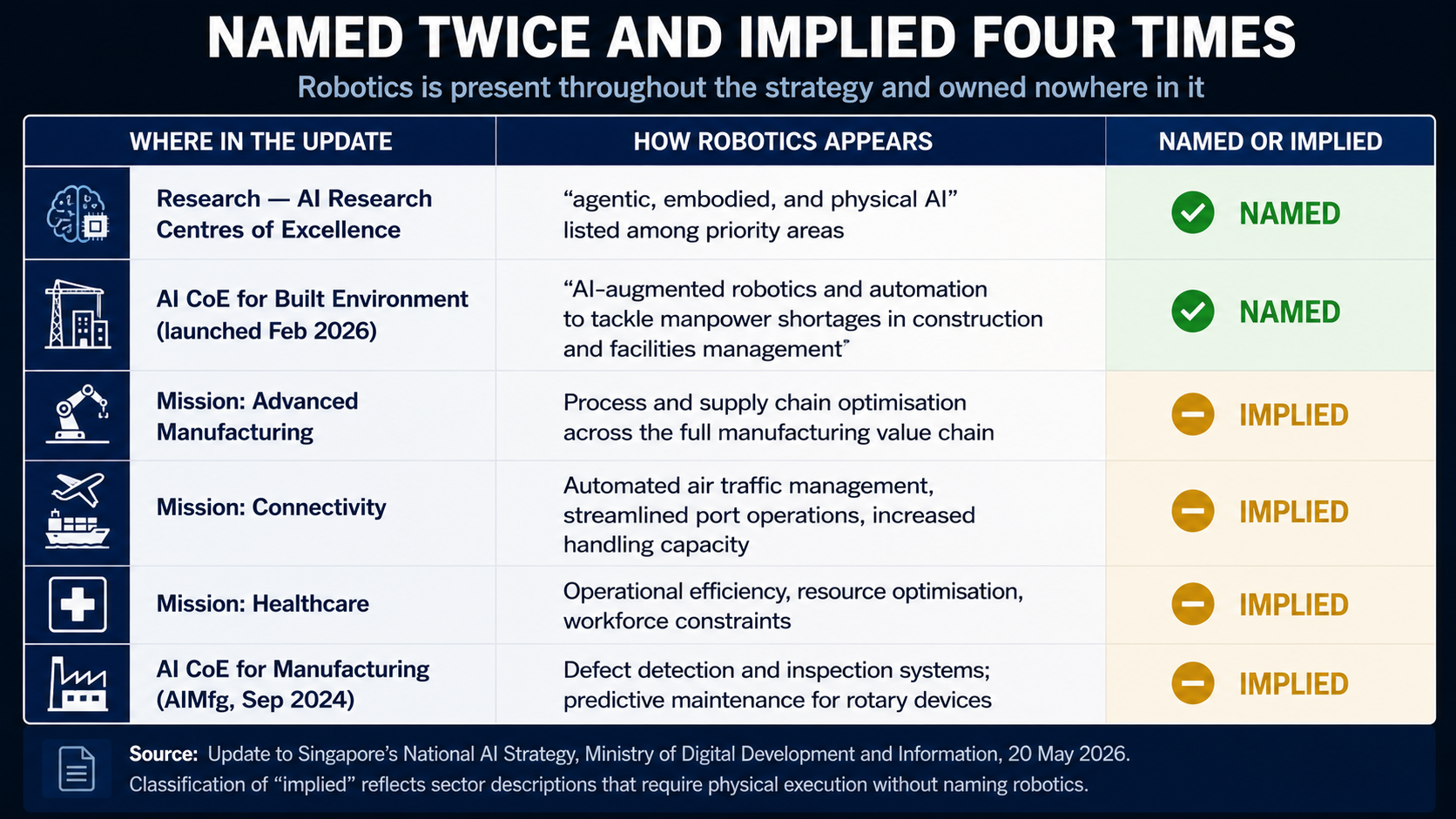
Robotics runs through the Update in more places than its single named mention suggests, and Figure 1 sets out where — named once under Research, implied across three Missions and the Built Environment Centre of Excellence.
Why Dispersion Produces a Data Gap
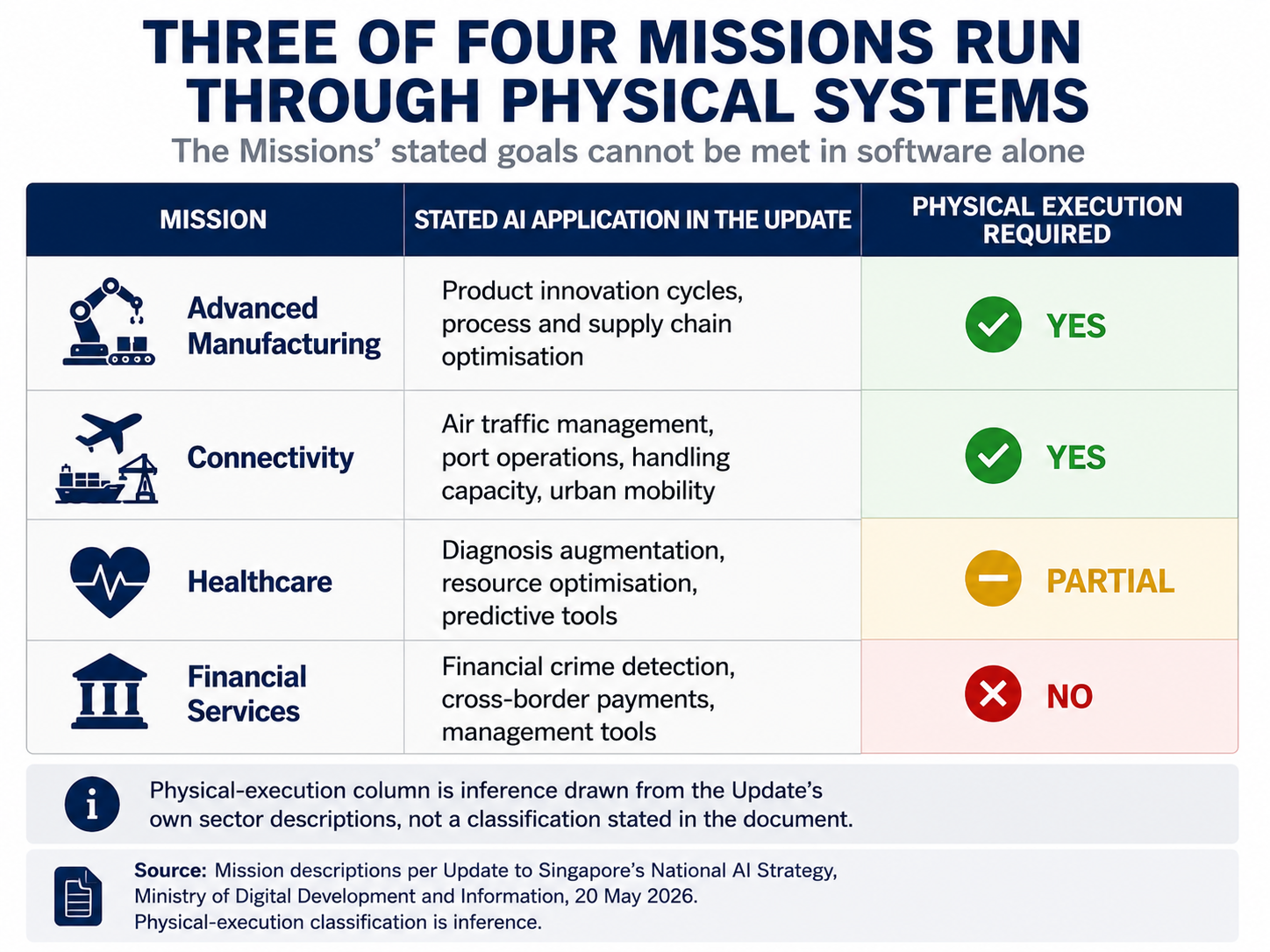
Connectivity is the clearest case. The Update states that Changi Airport and the Port of Singapore are among the world's busiest, that traffic volumes are expected to grow significantly, and that space and manpower constraints will become more binding — then names automated air traffic management, streamlined port operations, and increased handling capacity as the AI response. Delivering any of those at a port requires machines that move containers, and the physical-execution requirement across all four Missions is set out in Figure 2.
Two Readings of the Same Architecture
Senior Minister of State Tan Kiat How's AIMX address makes the case for dispersion directly. Start with the problem, not the technology, he told delegates — technology determines what is possible, people determine what is valuable. On that logic robotics does not need its own enabler, because sectoral demand pulls the capability through, and naming it would be exactly the "what can it do" instinct he warned against.
The position has evidence behind it. Technology-first industrial policy has funded plenty of capability nobody needed, and the Update's own citation of McKinsey's 2025 finding — most adopters stuck in experimentation — supports the diagnosis that problem definition, not capability supply, is where Singapore's gap sits. It also fits the national-capability logic other governments have applied differently.
The counter-argument is in the same document. The Update establishes AI Research Centres of Excellence specifically to "concentrate national efforts and talent, to accelerate research progress" — accepting that some capabilities need concentrating structures. It applies that reasoning to research and not to the robotics layer inside the Missions.
The two readings diverge on one variable: whether robotics adoption in Singapore is limited by unclear problem statements or by buyers not knowing what capability exists. If it is demand, dispersion is right and the Missions solve it. If it is supply visibility — which vendors are credible, which systems are deployed, what has actually worked — dispersion makes it harder, because platform and vendor knowledge accumulates where someone is keeping the record. Neither reading has been tested against Singapore-specific deployment data, because that data does not currently sit anywhere a manufacturer can reach it.
The address opened a conference whose exhibition floor carries embodied AI and humanoid robots from AGIBOT, Weston Robot, R2 Robotics, Robocore, and Five Ages, and whose programme includes a session titled Embodied Intelligence: Bridging AI and Physical Action. The strategy that convened them names their category once, in a list, under Research. That is not an oversight — Senior Minister of State Tan Kiat How's own framing explains why a mission-led strategy would deliberately avoid naming technologies. What it leaves open is who holds the record of what those five companies and the hundreds like them can actually do on a Singapore factory floor, at what cost, with what evidence. The Update commits over S$1 billion and four Missions to the question of what is worth solving. It does not yet say who keeps the list of what already works.
If Singapore's four national AI Missions advance without a concentrating structure for robotics, what surfaces first — a Mission-level procurement bottleneck in Advanced Manufacturing, a vendor credibility problem in the Built Environment CoE, or a data gap that slows all three physical Missions equally? The answer depends on whether the Advanced Manufacturing Mission publishes deployment-level problem statements or capability-level ones.
1. What is NAIS 2.0 and what changed in the 2026 update?
NAIS 2.0 is Singapore's National AI Strategy, launched December 2023, refreshed by the Update published 20 May 2026. The Update revises priorities across ten enablers, launches national AI Missions in four sectors, and reflects the National AI Council set up in February 2026 under Prime Minister Lawrence Wong. It commits over S$1 billion to public AI research and talent development from 2025 to 2030.
2. Does Singapore's AI strategy cover robotics?
Yes, but mostly by implication. Embodied and physical AI is named once, as a priority area for AI Research Centres of Excellence. The AI Centre of Excellence for the Built Environment, launched February 2026, explicitly names AI-augmented robotics for construction and facilities management. Three of the four national AI Missions describe applications requiring physical execution without naming robotics as the mechanism.
3. What does this mean for a Singapore manufacturer planning automation?
Advanced Manufacturing is one of four national AI Missions, and the AI CoE for Manufacturing has supported close to 30 firms since September 2024 — including Sunningdale, whose AI defect detection system showed expected annual savings of over $150,000 per product in early trials. The National AI Impact Programme targets 10,000 enterprises over three years. Robotics-specific support runs through those sectoral channels rather than a dedicated robotics programme.
4. What is AIMX Singapore 2026?
AIMX Singapore 2026 convenes business leaders, policymakers and researchers from more than 60 countries around moving AI beyond pilots into enterprise deployment. Co-organised with TechInnovation and supported by AI Gravity, the international platform of WAIC Shanghai, it features over 100 exhibitors and sessions including Embodied Intelligence: Bridging AI and Physical Action. Senior Minister of State Tan Kiat How delivered the opening address on 26 August 2026.