
MIT and EPFL's Flapping Robot Flies and Swims Like a Bird
Researchers at MIT and EPFL have built a half pound flapping wing robot that swims underwater and then breaks the surface to fly, mimicking diving birds such as puffins, in a design that could let scientists sample oceans without large research vessels.
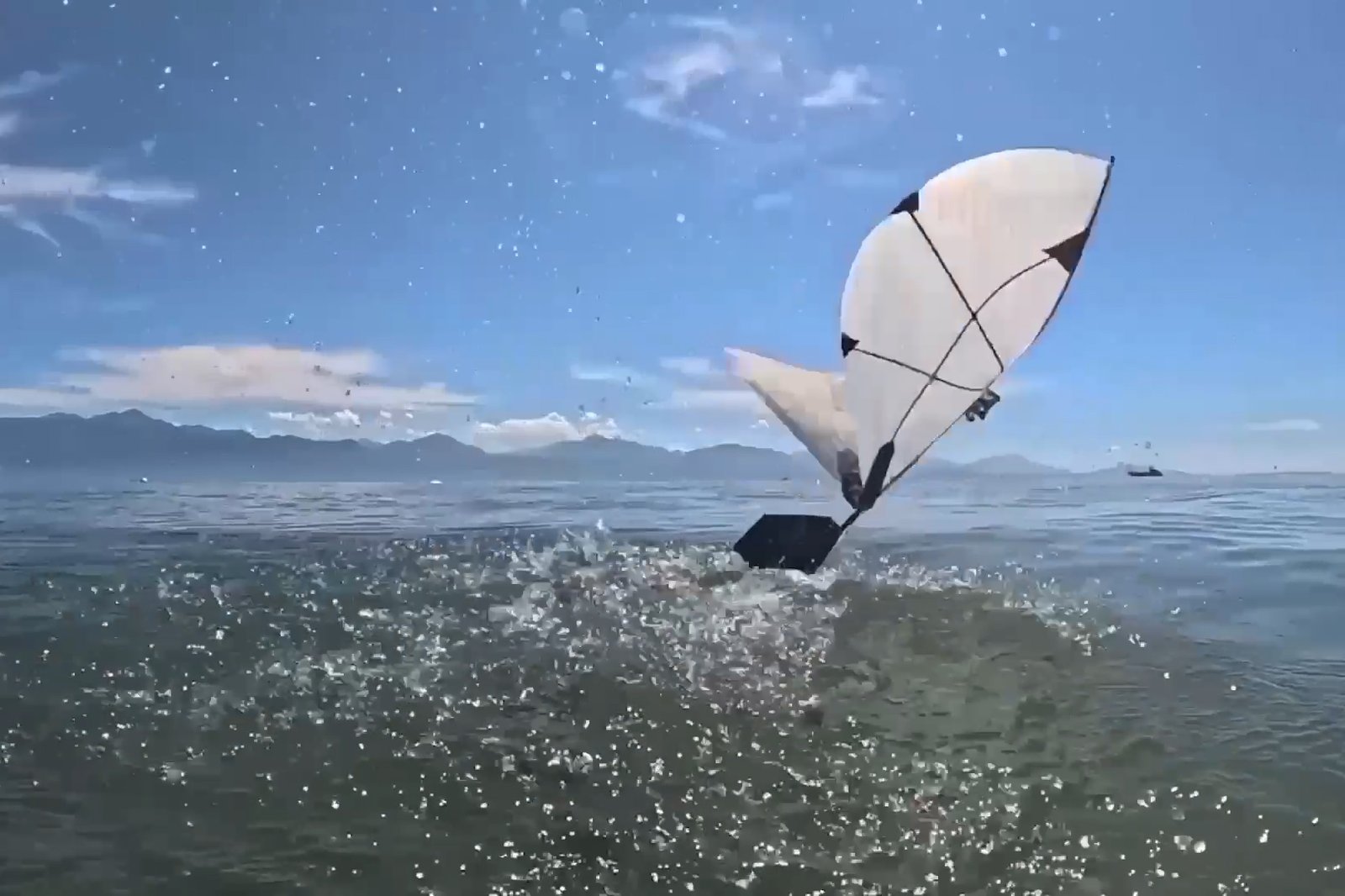
MIT and EPFL Built a Robot That Flies and Swims Like a Diving Bird
The market reality is stark, oceanography is expensive and logistically heavy, and coastal monitoring budgets are constrained. A structural shift is now visible at the intersection of biology and robotics, where a single mechanism moves between air and water using principles borrowed from diving birds, rather than a mechanical compromise that tries to be adequate in both media. The implication for science and industry is immediate, a new class of fieldable platforms could turn one expensive deployment into many low cost missions, if the prototype mechanics scale and survive the real ocean.
In Lausanne and Cambridge a team of engineers built a sub kilogram machine that swims underwater, punches through the surface, and takes off using only a pair of flapping wings. The result reads like a field note from a biologist turned engineer, rigorous and elegant, but its significance is for fund managers, ocean scientists, and robotics teams watching the boundary where vehicles meet water. This is not an incremental paper in a niche conference, it is a proof that the physics of air and water can be bridged by motion rather than machinery.
The Puffin Problem
For decades roboticists have treated air and water as incompatible operating domains. Water is about one thousand times denser than air, which changes everything about lift, drag, and the way control surfaces must interact with a flow. The conventional solution has been to carry two machines, or to combine propellers with complex transformations that tilt, fold, or swap hardware when the vehicle crosses the surface. Those solutions work, but they add mechanical complexity, weight, and often noise that is hostile to wildlife and fragile sensors.
Birds like puffins, loons, and petrels expose the core design insight. They do not retool when they dive, they reconfigure how they use the same surfaces, changing stroke amplitude and tail angle to move from efficient flight to efficient swimming. That biological option flips the engineering question from what hardware to use, to how to control a single mechanism across a thousand fold change in fluid density. The team at MIT and Ecole Polytechnique Federale de Lausanne ("EPFL") pursued exactly that answer, and the result is the Flapping Wing Aerial Aquatic Vehicle, known as FAAV.
The Lab Between Two Continents
The FAAV emerged from a collaboration led by Raphael Zufferey at MIT, working with experimentalists at EPFL and a partner college on the U S Pacific coast. Zufferey runs a lab that builds compact flying and swimming platforms inspired by animal mechanics, with a stated aim of creating unobtrusive tools for ocean and waterway monitoring. The collaboration married MIT expertise in small autonomous aircraft and EPFL experience in aquatic testing, allowing rapid iteration between tank experiments and lake trials.
From the outset the team framed the project as fundamental research rather than an immediate product. The goal was to test whether a single flapping mechanism could provide propulsion and control in both fluids, and to map the combinations of wing geometry, flapping frequency, and tail articulation that make a smooth transition possible. This is the kind of foundational work that venture capital firms tend to underappreciate, but that established aerospace and maritime vendors will mine when they need new platform concepts.
How the FAAV Works
The FAAV is a compact fuselage with two flexible flapping wings and a steerable tail. All components are modular so the team could swap wing shapes, tail sizes, and control linkages during experiments. A small waterproof motor drives the wings through a crankshaft mechanism, producing roughly five beats per second. Underwater the vehicle cruises at about one meter per second, and once airborne it can reach speeds near six meters per second.
The key control variables are wing size, flapping frequency, and tail angle. By tuning them together the robot approaches the water surface at a steep angle of around seventy degrees and then pops out into a flight trajectory without relying on legs, feet, or any external launcher. That steep angle concentrates momentum toward the body axis, helping the vehicle break surface tension and reduce the drag spike at the interface. In plain terms the FAAV does not try to hover its way to the surface, it slices through on a dive and trades vertical speed for aerodynamic lift immediately on emergence.
From a fluid dynamics perspective the FAAV exploits unsteady forces that dominate at the small scales it operates in. A wing moving in water generates strong added mass effects and vortex structures that can be harnessed for thrust, while the same wing, tuned for a different stroke amplitude and frequency, produces aerodynamic lift in air. The challenge is timing and geometry, the strokes that generate thrust in water can be catastrophic in air and vice versa, unless the wing flexibility and kinematics are designed to be multifunctional.
Testing the Transition
The team validated the concept in both a controlled water tank and in lake trials. Those trials were not endurance runs, they were focused experiments to identify the parameter windows where transitions succeed reliably. The robot was filmed with high speed cameras, instrumented to measure forces, and tested across dozens of dives and emergences. The repeated success in a range of conditions convinced the researchers that the mechanical approach is not a fluke, but the data also show this is still early stage hardware.
A number of failure modes remain, small amplitude errors in timing lead to surface impacts, and salt water and waves are a far harsher environment than a calm lake. The current prototype carries little payload capacity, meaning any scientific sensors must be miniaturized and low mass. Range is limited by battery energy and the inefficiencies inherent at this scale, so the FAAV in its present form is best suited to localized sampling missions launched from shore or small boats.
Numbers That Tell the Limits
Concrete figures help set expectations. The prototype weighs under three hundred grams, it flaps at roughly five beats per second, it swims at approximately one meter per second, and it flies at up to six meters per second. The emergence angle is about seventy degrees, a steep posture that allows a direct conversion of dive momentum into flight. These are performance metrics associated with a lab demonstrator, not with a mission ready vehicle.
Payload capacity is minimal, endurance is short, and the system has yet to be stress tested in salty sea states. The next engineering steps are familiar to robotics teams, add structural robustness, increase power density, and scale payload bay volume while maintaining the multifunctional wing kinematics. Each of those steps carries trade offs, increasing weight changes the hydrodynamic and aerodynamic regimes, and larger wings change the flapping dynamics nonlinearly.
How This Compares to Existing Hybrids
Other aerial aquatic prototypes have relied on propellers that tilt or on separate propulsion modes for air and water. Those designs trade mechanical simplicity for modular performance, meaning they tend to be very good in one medium or merely serviceable in the other. Propellers are efficient in air but terrible in water, so engineers have resorted to elaborate gearboxes and tilt mechanisms, which add points of failure and maintenance burdens.
The FAAV follows a different path, it tries to eliminate the modality swap and use a single flapping mechanism. If the approach proves durable and efficient when scaled, it offers a quieter and mechanically simpler alternative to propeller based hybrids. Quiet is not a small factor for marine biology, acoustic disturbance can change animal behavior and contaminate the very measurements researchers seek to make.
Why Investors and Operators Should Care
From an investor point of view this is a classic technology adoption story. A university lab has demonstrated a physics driven capability that changes the design space for a practical problem, scalable engineering and productization will determine commercial winners. Companies with backgrounds in UAV manufacturing, underwater vehicles, or marine sensors could integrate the FAAV concept into products that reduce operational costs for repetitive coastal surveys, leak detection near ports, and wildlife monitoring.
From an operator point of view, the promise is more frequent, lower cost missions. Right now a coastal lab might charter a vessel for a day to sample a single hard to reach eddy or iceberg edge. A hand launchable flying swimmer can instead fly in, sample, and return repeatedly at a fraction of the cost. The immediate wins are near shore and estuarine environments. Deep ocean work still requires larger platforms for endurance and payload, but the FAAV could complement those assets by handling the high cadence, low cost missions that currently go unperformed because of expense.
The Broader Signal
The FAAV publication in a top tier general science journal is a marker that the work is more than a clever demo. It indicates peer reviewers recognize the contribution to fundamental understanding of cross domain locomotion. For the field of bio inspired robotics this matters, it frames the technology as a legitimate engineering solution rather than a laboratory curiosity.
That signal will draw attention from companies in adjacent markets, from defense contractors interested in littoral reconnaissance, to environmental consultancies that need rapid spill assessment tools. The technology also shifts conversations in robotics from component innovation to system level kinematics, where the motion itself is the mechanism that unifies operating domains.
What Comes Next
The path to a fieldable FAAV is clear but hard. Teams must increase payload and energy density, harden materials against salt and mechanical fatigue, and develop practical autonomy for navigation in cluttered coastal environments. Sensor integration is another bottleneck, compact oceanographic instruments are expensive and must be balanced against weight budgets.
Commercialization will likely follow a modular route, universities spin out core intellectual property, specialized companies build scaled prototypes with industry grade electronics, and larger platform integrators fold the concept into hybrid fleets of surface vessels and unmanned systems. Along the way early customers will be research institutions and environmental agencies willing to trade the constraints of a prototype for the opportunity of high cadence sampling.
The Bigger Lesson in Biological Mechanics
The FAAV reconfirms a broader lesson about technological progress, sometimes the right answer is not more complexity but a better way of using what you already have. By tuning motion across two fluids, the MIT and EPFL team turned a century old biological trick into a machine that could change how we observe coastlines and shallow seas. Whether it becomes a commercial product will depend on engineering scale up and the willingness of operators to adopt a new class of tools, but the science community now has a convincing demonstration that flapping wings can bridge air and water at small scale.
For investors and policy makers thinking about the next generation of ocean sensors, the FAAV is a data point that suggests lower cost, higher cadence monitoring is technically plausible, if the engineering and supply chain steps fall into place.














