
MIIT forecasts China humanoid output to top 100,000 units in 2026 ahead of WAIC
China expects production of humanoid robots to surpass 100,000 units in 2026, a senior MIIT official said at a July 7 briefing in Shanghai ahead of the World Artificial Intelligence Conference. The outlook is anchored in a policy mix of nearly 200 relevant standards, a large open source developer base on AtomGit with 11 million users, and an accelerating state backed AI investment fund.
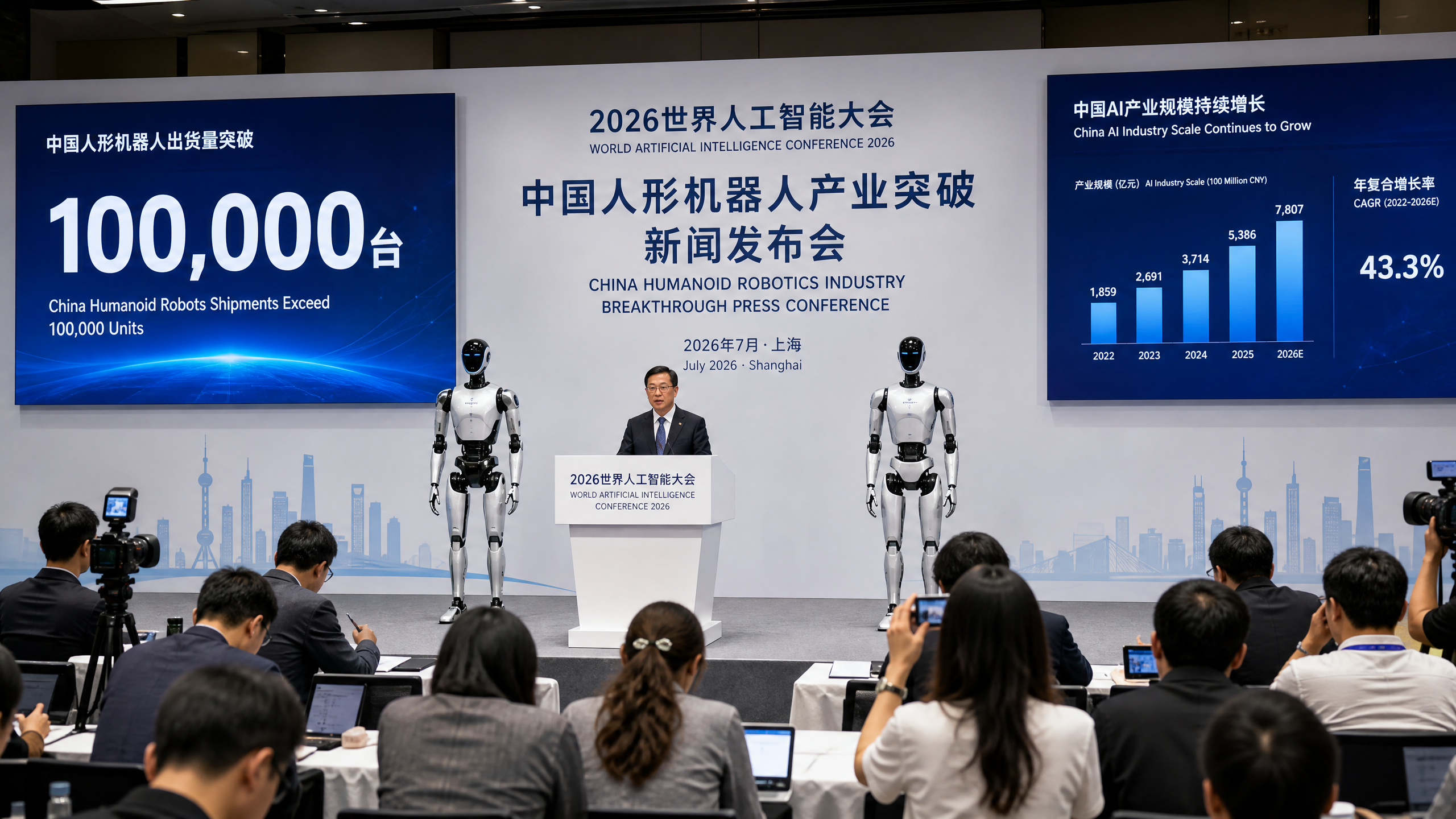
China moved to set expectations for a faster turn from research to production in embodied AI. At a July 7 press conference in Shanghai ahead of the World Artificial Intelligence Conference 2026, a senior official from the Ministry of Industry and Information Technology said national output of humanoid robots is expected to exceed 100,000 units in 2026. The statement places humanoids inside a broader policy push that includes open source infrastructure, standards work, and an expanding state backed investment fund for AI.
What MIIT said at the Shanghai briefing
Gan Xiaobin, deputy director of MIIT’s Department of Science and Technology, said China’s humanoid robot production in 2026 is expected to exceed 100,000 units. The forecast was delivered at a press event in Shanghai on July 7, days before WAIC 2026 opens on July 17. Gan framed the outlook as part of a coordinated effort to accelerate embodied AI from prototype phase to replicable products ready for industrial and service deployments.
The official also cited supporting data that places the forecast in context. In 2025, China accounted for about 90 percent of global humanoid robot shipments, with more than 330 product models catalogued across different stages of maturity. Around 200 key standards relevant to humanoids and embodied AI have been developed, covering safety, motion control interfaces, testing procedures, and systems integration. The AtomGit open source community has reached more than 11 million registered users, mirroring the strategy to pair industrial policy with developer scale. In parallel, a national AI industry investment fund is said to be accelerating its pace of deployment to back strategic projects and to crowd in private capital.
The National Development and Reform Commission added a macro backdrop. Wang Ruomeng, an NDRC official, said the AI related industry surpassed 1 trillion renminbi in scale in 2025, with growth in 2026 forecast at more than 30 percent. That growth rate, if sustained, would add several hundred billion renminbi of output in a single year, which could support both software and embodied AI demand.
The policy engine driving the forecast
The 100,000 unit guidance is not presented as a standalone manufacturing plan. It sits on top of a policy architecture that blends procurement signals, standards development, industrial funds, and open source infrastructure. The portfolio is designed to reduce uncertainty for companies that must commit to motors, actuators, batteries, sensors, and manufacturing lines well before large orders arrive.
Standards work matters first. Nearly 200 standards in place or under development help shape component interfaces and safety baselines. That reduces the integration tax for factories and service operators that want to trial and then scale humanoids. In practice, clear specifications for endpoint effector compatibility, balance and fall testing, and electromagnetic safety can cut weeks from pre deployment checks. It also supports second sourcing for critical parts, which helps both incumbents and startups enter the supply chain.
Open source is the second lever. AtomGit’s stated 11 million registered users signals momentum for common stacks, shared models, and contributed middleware that can make humanoid platforms more modular. Developers who already work on vision, speech, and control modules can shorten the path to field ready behaviors. Hardware vendors benefit if software reusability strengthens the case for platform level ecosystems rather than one off demos.
Capital is the third lever. A national AI industry investment fund that accelerates deployment within target segments can help smooth the choppy cash flow of early customers. Robotics integrators, contract manufacturers, and component makers often face long payment cycles. Bridge capital and co investment alongside local government guidance funds can speed site build outs and pilot programs. If combined with tax incentives or bulk procurement, that support can anchor the demand side of the humanoid market during its first years of scale up.
Why a 100,000 unit year matters
Crossing the 100,000 unit threshold would be significant for multiple reasons. First, it suggests that humanoids will move from lab and demo status into meaningful production volumes. At that scale, learning curves and supplier maturity can start to bring down bill of materials costs for actuators, gear trains, compact batteries, and high torque joint modules. Cost curves in robotics are sensitive to volume, which makes early scale outsized in influence.
Second, a six figure production year would force sharper decisions on product market fit. The 330 plus humanoid models reported in 2025 show a market still experimenting with configuration and use case. In 2026, manufacturers and integrators will likely concentrate on a smaller set of jobs that justify price, reliability, and service contracts. Logistics hubs, routine materials handling in factories, non sterile hospital logistics, inspection tasks in utilities, and retail backroom operations are candidates. If early deployments demonstrate uptime and safety at an acceptable cost, the channel for follow on orders becomes clearer.
Third, a year with more than 100,000 units delivered would influence the wider robotics stack. It would validate investment in domestic suppliers of harmonic drives, strain wave gearboxes, precision encoders, lightweight composite structures, and safety rated depth cameras. It would also pressure software teams to adopt more standardized middleware for locomotion, manipulation, and whole body control, since cross brand deployments benefit from common tools. The long term result could be a more modular value chain that reduces switching costs and encourages healthy competition.
Standards and open source as policy levers
Humanoids will not scale if every contract requires bespoke engineering. That point sits at the center of the standards and open source emphasis. With nearly 200 standards developed or in draft, companies can adopt checklists for safety, stability, and interface compliance. A buyer that already accepts a recognized battery safety standard or a motion interface specification can shorten pre deployment audits. Insurance underwriting for large sites also becomes easier when recognized standards are in place.
AtomGit’s large registered base is less about vanity metrics and more about distribution. Broad developer participation helps maintainers identify edge cases faster and adapt shared code to new sensors or actuators. If a locomotion module gains an update from one integrator to handle slippery factory floors, other users benefit quickly. Over time, the stack improves in the conditions that matter for work, not just in curated labs.
The combination of standards and open platforms is also a defensive measure. It can reduce single vendor lock in and raise the floor for safety. In a field where failure modes can involve human proximity, that is not a trivial advantage.
WAIC 2026 will act as a show window for embodied AI
WAIC 2026, scheduled for July 17 to July 20 in Shanghai, is set to be one of the year’s largest stages for embodied AI and intelligent computing. Organizers outlined a theme of AI Partnership, Co creating the Future. Exhibition space will exceed 100,000 square meters, with more than 1,100 exhibitors and around 3,000 exhibits. The conference expects 300 plus global product debuts. The intelligent computing and embodied tracks each plan to gather more than 200 companies, which would concentrate competing approaches under one roof for buyers and developers to compare.
Trade shows are not policy instruments in the strict sense, but they help translate policy into buyer intent. Large scale exhibits let operators see real robots navigate real obstacles, try grippers on typical payloads, and judge maintenance access. For young categories like humanoids, hands on evaluation can speed the move from curiosity to purchase order.
Deployment signals and adoption baselines
Officials said AI application penetration among industrial enterprises above designated size has exceeded 30 percent. That baseline matters for humanoids, because it implies that many plants already have some level of AI enabled quality control, predictive maintenance, warehouse slotting, machine vision, or scheduling. Sites that already invested in AI are more likely to have the data infrastructure, safety culture, and integration partners needed to absorb embodied systems.
The best early use cases will sit near tasks where robots complement rather than replace existing automation. Examples include bridging gaps between fixed conveyors and storage racks, fetching and carrying in environments that change shape during a shift, or topping up inspection teams in facilities with long walking distances. Humanoids can sometimes slot into human centric layouts without a full redesign, which is appealing when capital budgets are tight.
Risks and constraints to watch
The forecast sets a high bar, and several constraints could delay follow through. Power density and battery safety will limit duty cycles. Uptime hinges on actuator reliability and heat management in high torque joints. Safe autonomy in crowded facilities requires robust scene understanding and fail safe behaviors. Service networks must mature to keep fleets running across provinces. Cybersecurity for connected robots will face closer scrutiny as deployments scale.
Economics will be the decisive test. If total cost of ownership remains too high versus carts, cobots, or minor process redesigns, customers will postpone purchases. The availability of affordable components at high quality will shape pricing. Export controls and supply chain bifurcation could affect access to advanced chips or manufacturing tools. On the policy side, certification processes must keep pace with rapid iteration without diluting safety.
Labor market dynamics add a layer of complexity. In settings with worker shortages, robots that backfill physically demanding or repetitive roles can support output. Where labor is plentiful, buyers may push harder on price and payback periods. Training and change management cannot be skipped if humanoids enter mixed teams on the factory floor.
Strategic implications for suppliers and buyers
For domestic suppliers, a 100,000 unit year would justify investments in capacity for harmonic drives, motors, controller boards, and lightweight structures. Component makers that standardize interfaces and ensure consistent quality will find it easier to win design slots across multiple platforms. Software firms that deliver locomotion, balance, and manipulation stacks with strong diagnostics and fleet tools can become essential partners, not just vendors.
For buyers, the procurement playbook will need updates. Pilots should be scoped to answer specific questions quickly. Examples include uptime under variable floor conditions, time to integrate with warehouse management systems, and minimum safe stopping distances around shared paths. Contract structures can include performance metrics tied to service payments. Multi supplier trials can protect against lock in. Insurance, data governance, and worker safety policies should be reviewed before scale up.
Internationally, the forecast signals that competition in embodied AI will intensify. If China can hit substantial production while maintaining quality, it will influence price expectations and refresh cycles globally. That could shape decisions by peers in the United States, Europe, Japan, and Korea on where to invest and how quickly to push deployments. Standards alignment will be one area to watch, since divergence can fragment markets.
What to watch between now and year end
Several indicators will show whether the 100,000 unit outlook is on track.
· Procurement notices and pilot program announcements from logistics operators, manufacturers, and hospitals. These point to near term demand.
· Component capacity expansions by actuator, gearbox, and controller suppliers. Those moves signal confidence in volume.
· Updates to testing and certification regimes that clarify safety and performance baselines. These reduce friction in deals.
· Evidence of cost per unit declines, especially for joints and batteries. Cost drops enable broader uses.
· Software maturity milestones, including major releases of locomotion and manipulation modules with improved stability across floor types and payloads.
· Integration partnerships between humanoid makers and warehouse management or manufacturing execution system vendors. Interfaces are decisive in complex sites.
WAIC 2026 by the numbers
· Dates: July 17 to July 20, Shanghai
· Theme: AI Partnership, Co creating the Future
· Exhibition area: more than 100,000 square meters
· Exhibitors: more than 1,100
· Exhibits: around 3,000
· Global product debuts: about 300
· Intelligent computing companies: more than 200
· Embodied AI companies: more than 200
Organizers expect global research labs, platform companies, chip designers, and robot makers to use WAIC as a venue for product debuts and partnership announcements. For embodied AI, the event will likely concentrate attention on locomotion, dexterity, safety, and cost. That creates a public feedback loop that can sharpen priorities for the next wave of product roadmaps.
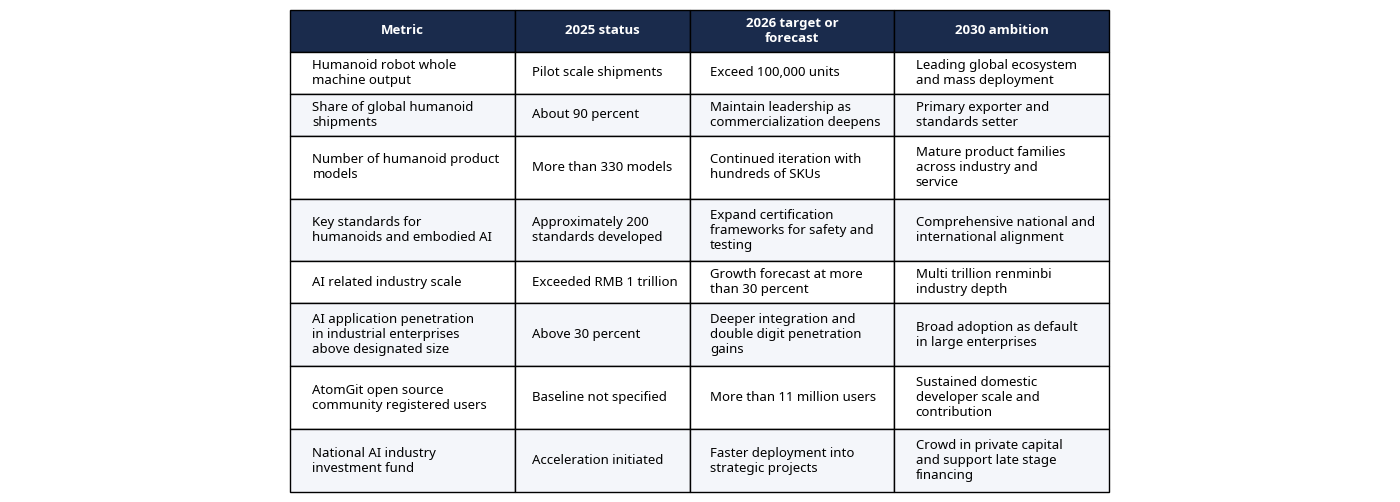
Comparison table: China national AI and robotics policy targets
The following table consolidates publicly stated milestones and directional goals referenced by officials at the July 7 Shanghai briefing, along with longer term national ambitions commonly cited in policy planning. Where a numeric target is not specified, directional language reflects the stated policy thrust.
Methodology and definitions
The outlook reported here is tied to remarks by MIIT and NDRC officials at a July 7 press conference in Shanghai. The humanoid output figure is a national projection for 2026 and is intended to reflect whole machine production rather than shipments net of returns or refurbishments. The share of global shipments in 2025 is a stated approximate share, not a formal audited figure. Product model counts include prototypes, engineering samples, and commercial units and are meant to show breadth rather than maturity.
The standards count aggregates national, industry, and association led documents that affect humanoid systems and embodied AI, spanning safety, interoperability, performance testing, and integration. The AtomGit user tally represents registered accounts, which is a common platform metric but does not directly translate to active contributors. The AI related industry scale reported by NDRC includes software, hardware, and services linked to AI, and is not limited to the narrower definition of AI core industries used in some earlier national plans.
Penetration among industrial enterprises above designated size refers to the Chinese statistical category for firms that exceed a revenue threshold and report detailed industrial data. Penetration means any adoption of AI applications in production, logistics, quality, or management. The national AI industry investment fund refers to a state backed vehicle that co invests with other funds and local governments in AI and robotics. The 2030 ambitions in the table are directional, consistent with stated goals to build a world leading AI ecosystem. Where specific numeric targets are absent, the terms reflect policy direction rather than hard quotas.
Outlook
If the 2026 production forecast is met, humanoids will enter a phase where operational data accumulates quickly. That will feed back into designs, component reliability, and software stability. Cost reductions would become more predictable, which helps buyers write multi year business cases with confidence. Standards and open source infrastructure will keep reducing integration friction. The state backed fund will continue to target bottlenecks in the stack and co finance pilots in sectors with measurable productivity upside.
The next test will be durability in varied environments. Factories, warehouses, hospitals, and utilities present different floor conditions, lighting, electromagnetic noise, and human traffic. Vendors that can demonstrate consistent uptime and safe behavior across these contexts will capture early share. If WAIC 2026 concentrates credible demonstrations and clear roadmaps, it may serve as a tipping point from attention to adoption.
Sources
· Xinhua
· People’s Daily finance
· State Council Information Office, English releases














