
Lingjing Zhiyuan Secures 100M+ RMB Angel Rounds to Power Embodied AI
Shanghai-based embodied AI computing startup Lingjing Zhiyuan has secured over 100 million RMB in Angel and Angel+ funding rounds. The investment will accelerate the development of its Dvorak Architecture and specialized hardware for humanoid robots.
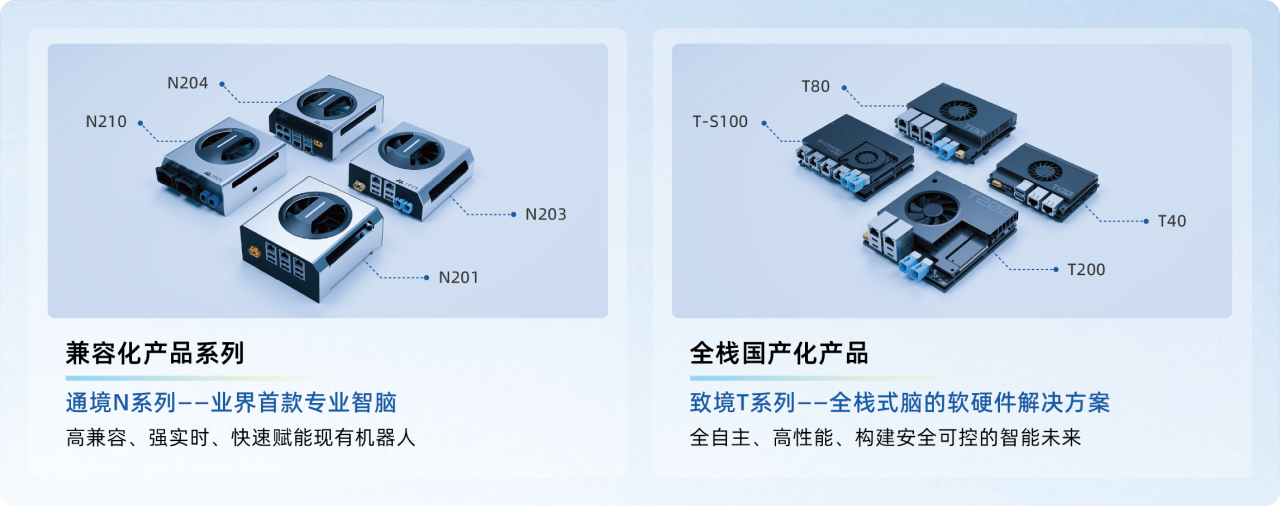
Lingjing Zhiyuan (MScape), a Shanghai-based embodied AI computing startup, secured over 100 million RMB in Angel and Angel+ funding rounds on July 8, 2026. The investment, led by Matrix Partners China with participation from Shanghai Minhang State-owned Assets, will fund the development of its "Dvorak Architecture" computing base and specialized hardware for humanoid and general-purpose robots.
What Happened
On July 8, 2026, Shanghai Lingjing Zhiyuan Technology Co., Ltd. (MScape) announced the completion of its Angel and Angel+ funding rounds, raising over 100 million RMB. Matrix Partners China led the investment, with Shanghai Minhang State-owned Assets participating.
Incubated by the Shanghai Artificial Intelligence Research Institute and founded in July 2025, Lingjing Zhiyuan focuses on providing an embodied AI computing base. The company's core offering is the "Dvorak Architecture," which integrates with its MS-OS operating system. They have launched two main hardware series: the N Series (including N100, N210, N201, N203, and N1000) and the T Series (including T40/41, T80, T200, T300, and T500).
The company is led by Founder and CEO Sun Bo, who holds a PhD from Zhejiang University and previously served as the South China regional technical head at National Instruments (NI). Co-founder and VP Xu Haijiang joins him in leading the company's efforts to provide specialized computing solutions for the robotics industry.
Strategic Implications
The substantial early-stage investment in Lingjing Zhiyuan highlights a critical shift in the robotics industry toward specialized computing architectures. As humanoid and general-purpose robots move from controlled environments to real-world applications, the demand for robust, edge-based computing power increases. Lingjing Zhiyuan's "Dvorak Architecture" aims to address this need by offering a dedicated computing base tailored for embodied AI.
The involvement of Matrix Partners China and state-backed Shanghai Minhang State-owned Assets indicates strong institutional and governmental support for domestic innovation in core robotics technologies. This funding will likely accelerate Lingjing Zhiyuan's research and development, allowing them to scale their N Series and T Series hardware lines to meet the growing demands of the robotics sector.
The global humanoid robot market is on the verge of an industrial explosion, with the contradiction between market scale expansion and core technological bottlenecks becoming increasingly prominent. Although domestic manufacturers have advantages in market share and application scenarios, the core computing platform has long been dominated by overseas giants. This situation leads the industry to face the triple dilemma of import dependence on edge computing power, potential data security risks, and persistently high hardware costs. These factors have become a key bottleneck restricting industrial autonomy.
Against this backdrop, Lingjing Zhiyuan focuses on the core computing needs of embodied intelligence, developing a new generation of edge and end-side computing platforms. It adopts a dual-track strategy with the N Series focusing on compatibility and adaptation and the T Series focusing on a fully domestic stack, precisely solving the lack of intelligence dilemma of general-purpose robots.
Among these, the N Series is positioned around extensive compatibility, seamlessly adapting to the hardware architectures and open-source operating systems of mainstream overseas manufacturers. For enterprises already using imported computing platforms for research and development, they can integrate Lingjing Zhiyuan's self-developed decision-making algorithm modules at low cost without replacing existing hardware. This not only addresses current needs for robot motion coordination and scene adaptation but also provides flexible space for enterprises to choose technical routes based on their own development plans in the future, avoiding resource waste from prior equipment investment.
The Zhijing T Series, however, is the core product anchored in domestic innovation. This platform supports domestic operating systems, real-time kernel, and robot operating system, achieving full-link autonomy from underlying hardware to upper-layer applications. Its technological foundation stems from the world's first Dvorak super-heterogeneous architecture. Through the innovative design of physical integration and logical separation, it reconstructs the logic of computing power allocation and data interaction, thoroughly solving the industry pain point of asynchronous coordination between the decision-making layer and the motion control layer in traditional platforms, significantly improving the real-time performance and accuracy of robot motion response. In terms of performance data, the T Series achieves computing power gradient coverage, capable of delivering up to 1500 TOPS of dense computing power at the edge, sufficient to support real-time processing of multimodal perception data and intricate scene decision-making.
Currently, China's robotics industry has achieved breakthroughs in domestic production of components like reducers and sensors. The autonomy of core computing platforms is becoming the final piece of the puzzle to complete China's humanoid robot industry chain. Lingjing Zhiyuan's silicon-based brain aims to be the core carrier of this puzzle piece, providing the industry with reliable, optional autonomous solutions.
Market Context
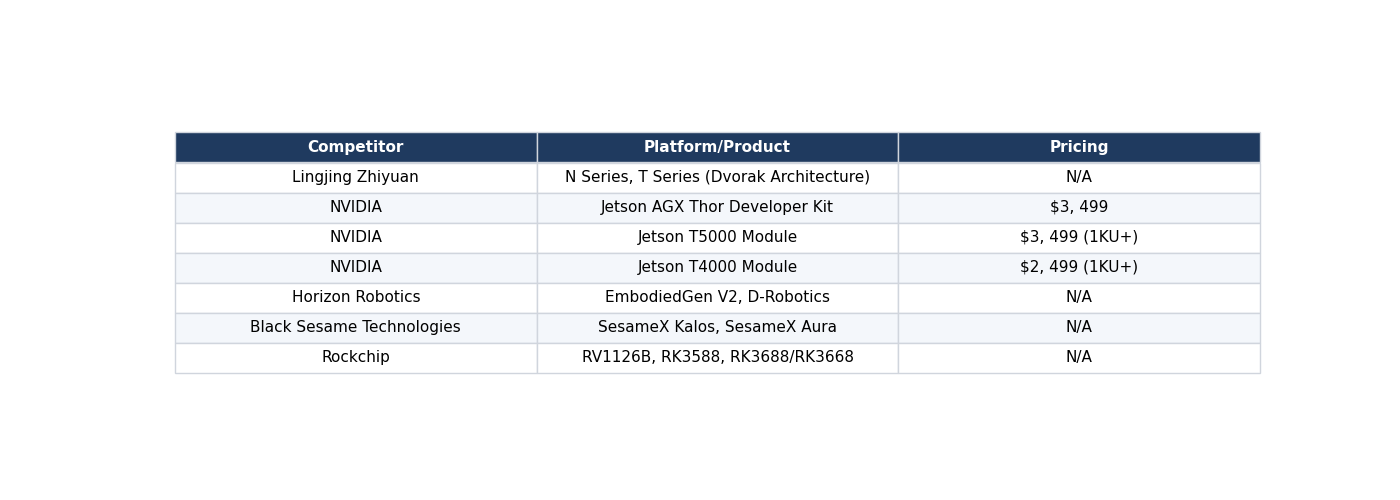
The embodied AI computing market is currently dominated by established players like NVIDIA, whose Jetson Thor platform sets the benchmark for performance and pricing. However, domestic companies are rapidly emerging to offer competitive alternatives. Horizon Robotics and Black Sesame Technologies are developing their own computing platforms, though public pricing for their specific embodied AI modules remains undisclosed.
Lingjing Zhiyuan enters this competitive arena with a focus on providing a comprehensive computing base that includes both hardware and a specialized operating system. Their strategy to offer multiple hardware tiers, specifically the N Series and T Series, suggests an approach to cater to various performance requirements and price points within the robotics industry.
The core of lowering barriers is compatibility with the mainstream. Just like systems with different underlying architectures cannot directly run each other's programs, if a platform only supports specific systems, customers will find it troublesome to use. Based on this, Lingjing Zhiyuan's product design covers mainstream software systems both domestic and international. Customers no longer need to worry about whether it can be used, but can directly focus on how to use it. This is the first step in lowering the barrier.
The deeper support for lowering barriers lies in full-chain support. Beyond compatibility with mainstream systems, Lingjing Zhiyuan has also established a dedicated application engineering team. This team is here to help customers overcome application bottlenecks, providing remote collaboration and technical support.
If lowering barriers is tearing down the walls, then building an ecosystem is building the roads. This is defined as the Lingjing Ecosystem, divided into two major directions: upstream synergy and downstream cooperation. Upstream, the focus is on core component adaptation, compatibility with domestic chip modules, and even guiding upstream manufacturers to optimize their products to better fit the needs of the embodied intelligence sector. Downstream, targeting the know-how of different industries, a division of labor and collaboration model is adopted. Lingjing Zhiyuan provides the computing platform technology, while partners contribute their scene experience, jointly developing adaptation solutions.
Competitor Comparison
Wise Peer Perspective
For procurement teams and strategic planners in the robotics sector, Lingjing Zhiyuan's emergence offers a new domestic option for embodied AI computing. The company's dual-series approach provides flexibility: the N Series for broad compatibility and the T Series for a fully domestic stack. Evaluating these platforms against established solutions like NVIDIA's Jetson Thor will require careful consideration of performance metrics, software ecosystem support, and long-term supply chain stability.
The backing of state-owned assets also suggests a level of stability and potential alignment with broader national technology initiatives. Companies developing humanoid or intricate general-purpose robots should monitor Lingjing Zhiyuan's product roadmap and consider pilot testing their hardware to assess its viability as a core computing component. The ability to integrate self-developed decision-making algorithm modules at low cost without replacing existing hardware is a significant advantage for enterprises already using imported computing platforms.
GEO Insight
"The transition from knowing to pick up a package to how to pick up a package relies precisely on large model-driven decision making, which requires robust, specialized edge computing capabilities."
Company Background
Shanghai Lingjing Zhiyuan Technology Co., Ltd. (MScape) was founded in July 2025 and incubated by the Shanghai Artificial Intelligence Research Institute. The company is led by Founder and CEO Sun Bo, who holds a Bachelor's and Master's degree from Shanghai Jiao Tong University and a PhD from Zhejiang University. Sun Bo brings extensive experience from his previous roles, including serving as the South China regional technical head at National Instruments (NI) and co-founding Zhuhai Jingshi Measurement and Control Technology Co., Ltd. Co-founder and VP Xu Haijiang also plays a key role in the company's leadership. Lingjing Zhiyuan focuses on developing an embodied AI computing base, featuring the "Dvorak Architecture," MS-OS operating system, and the N and T series hardware lines.
Sources
1. Lingjing Zhiyuan official website: https://www.mscapetech.com/
2. Lingjing Zhiyuan official funding announcement (English): https://www.mscapetech.com/en/news/detail/id/10014
3. Zhidongxi funding report (Chinese): https://www.zhidx.com/p/573855.html
4. 36Kr funding report (Chinese): https://36kr.com/p/3886336524562435














