
LG Electronics Starts Mass Production of Its AXIUM Robot Actuator Months Early
LG Electronics has begun full scale mass production of AXIUM, its robot actuator, several months ahead of schedule at its Changwon plant. The company will install the parts first in its own Cloid home humanoid robot as it races to secure a supply position in the fast growing humanoid robot market.
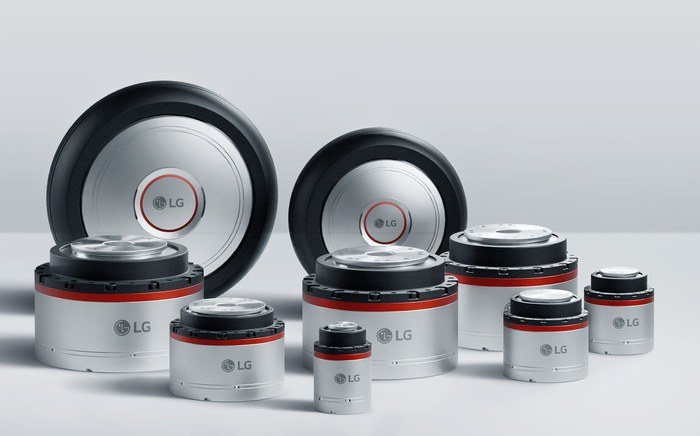
LG Electronics has begun full scale mass production of AXIUM, the actuator it designed to serve as the muscles and joints of robots, several months ahead of its original second half schedule. The move puts the South Korean electronics group into one of the most important hardware bottlenecks in humanoid robotics: reliable, repeatable, high volume joint production.
The early production start matters because actuators are not optional accessories in a robot. They are the parts that turn software commands into physical motion. A humanoid robot may be judged by its artificial intelligence, its hands, its voice interface, or its exterior design, but it cannot walk, turn, lift, reach, or recover from imbalance without actuators that perform safely thousands of times a day. If humanoid robots move from pilot projects to broad commercial and residential deployment, actuator supply will become one of the industry’s defining constraints.
AXIUM Module
LG Electronics recently started producing AXIUM at its plant in Changwon, in South Gyeongsang Province, ahead of the timeline the company had originally planned for the second half of 2026. The early start follows the July 1, 2026 launch of LG’s Robotics Business Center, a unit reporting directly to chief executive Ryu Jae cheol.
The Robotics Business Center is tasked with turning LG into a full robotics solutions provider. That means the company is not only trying to build finished robots. It is also trying to control core components such as actuators, along with the data infrastructure needed to improve robotic performance over time.
AXIUM is a module that combines three key parts: a motor that generates rotational force, a driver that controls electrical signals, and a reducer that adjusts speed and torque. In practical terms, that makes AXIUM a complete robotic joint rather than a raw motor component. A robot maker using a fully integrated actuator can simplify part sourcing, reduce integration work, and potentially improve consistency across multiple joints in the same machine.
LG will first install early production units in Cloid, its AI powered home humanoid robot. The company plans to deploy Cloid units at a dedicated robot data factory it is building in Yangjae, in Seoul’s Seocho District. That sequencing is important. LG is not immediately positioning AXIUM as a mature external product for the broader market. It is using its own robot fleet to produce operating data before pushing the component to outside customers.
How Many Actuators Does One Home Robot Need
Each Cloid unit uses more than 20 AXIUM actuators across nine current models. Those actuators cover joints in the shoulders, waist, elbows, and wrists, as well as the wheels used for mobility. LG plans to deploy about 300 Cloid units at its Seoul data factory this year.
On the numbers provided in the MK Business News report, that deployment would generate more than 6,000 individual AXIUM operating datasets. That figure is one of the most important details in the story. In robotics, especially humanoid robotics, a component’s paper specification is only the beginning. Manufacturers need to understand how a joint behaves after repeated use, under uneven loads, across temperature changes, during unexpected impacts, and in motions that do not match ideal lab conditions.
For a home humanoid robot, the reliability threshold is especially demanding. Industrial robots usually operate in controlled work cells, often with barriers separating them from people. A home robot must move around furniture, children, pets, uneven flooring, and unpredictable human behavior. That environment places different demands on an actuator. It must be strong enough to move useful payloads, precise enough to avoid unsafe motion, quiet enough for residential use, efficient enough to preserve battery life, and durable enough to justify the cost of the robot.
The Simple Explanation
An actuator is the part of a robot that actually moves. It is the mechanical equivalent of a joint and muscle working together. In a humanoid robot, actuators allow limbs to bend, wheels to turn, torsos to rotate, and arms to position themselves for tasks such as reaching, grasping, or opening a cabinet.
This is one of the most difficult and expensive parts of building humanoid robots at scale. A single machine needs many actuators working in coordination. If one joint overheats, slips, becomes noisy, loses calibration, or fails prematurely, the whole robot can become unreliable or unsafe.
That is why actuator manufacturing is emerging as a chokepoint similar to batteries in electric vehicles or semiconductors in consumer electronics. The company that can make reliable actuators at high volume can supply many different robot makers, even if it does not dominate the finished robot brand market. In the long run, the best actuator suppliers may become as strategically important to robotics as chipmakers and battery cell manufacturers are to computing and electric mobility.
Use Case
LG is moving early because credible actuator supply requires more than factory capacity. It requires field data. A robot joint must generate the right amount of force, hold that force for the right amount of time, operate efficiently, and behave predictably after repeated use. Those questions cannot be answered fully by simulation or bench testing.
That is why LG is prioritizing internal deployment inside Cloid units before offering AXIUM broadly to external robot makers. By operating its own fleet, LG can gather data on torque demand, joint temperature, power use, failure patterns, maintenance intervals, and motion profiles. That data can feed design changes and manufacturing adjustments before the company exposes AXIUM to external commercial scrutiny.
The move also signals that LG sees robotics as a system business, not just a finished product business. A company that only assembles robots from externally sourced parts has limited control over cost, performance, and supply availability. A company that controls actuators, robot design, operating data, and software integration can potentially improve faster and protect margins more effectively.
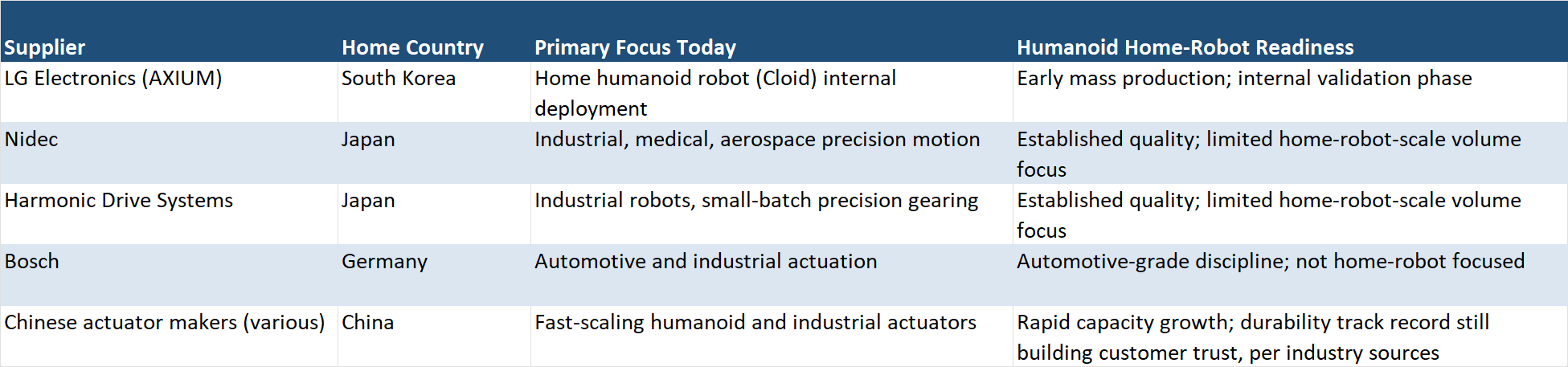
The report notes that the number of companies capable of stably mass producing actuators at scale remains limited globally. Japan’s Nidec and Harmonic Drive Systems and Germany’s Bosch are established players. They bring deep expertise in precision motion, gearing, and industrial quality. However, their historical focus has been industrial, medical, aerospace, automotive, and other specialized applications. Those markets value precision and reliability, but they do not necessarily require the same type of high volume, highly standardized actuator production that a future home humanoid robot market could demand.
Chinese actuator makers are expanding quickly as well, helped by a domestic humanoid robot boom that includes companies such as Unitree and UBTECH. Even so, the report says some customers still question the durability, safety, and long term reliability of fast scaling Chinese actuator suppliers. That creates an opening for LG if it can combine Korean manufacturing discipline, consumer electronics scale, and real fleet data from Cloid.
The Industry Reality
LG’s early move should not be read as proof that AXIUM is already an externally validated component. The company is still in an internal field verification phase. It has not disclosed unit costs, target pricing for outside customers, gross margin expectations, or a confirmed timeline for sales beyond the Cloid line.
That matters because the actuator market is not won by announcements. It is won by operating hours, return rates, cost curves, and customer trust. External robot makers will want to see hard evidence that AXIUM can survive real use at predictable cost. They will also want supply assurances, customization options, repair processes, and clear documentation for integrating the module into their own robots.
Humanoid robots also lack standardized joint specifications across the industry. One robot’s shoulder, elbow, knee, wrist, or wheel module may require different torque, speed, weight, thermal, and packaging characteristics than another robot’s equivalent joint. That is why LG says it needs to move beyond its current nine AXIUM models toward a wider and more customized lineup. The challenge is not simply making one good actuator. The challenge is making a family of actuators that can serve multiple robot designs while still benefiting from manufacturing commonality.
Where AXIUM Fits in the Global Actuator Race
The global market for robot actuators has long been dominated by specialist suppliers rather than large consumer electronics brands. Nidec and Harmonic Drive Systems built strong reputations supplying precision motion components to industrial robot makers, semiconductor equipment builders, medical device companies, and other demanding customers. These businesses prize accuracy, durability, and repeatability. Production runs can be smaller, but reliability requirements are high and failure can be expensive.
Bosch brings a different strength: automotive grade manufacturing discipline. Its experience in mobility and industrial systems gives it deep knowledge of quality control, supplier management, and high volume component production. Even so, Bosch has not historically centered its actuator strategy on consumer humanoid robots.
LG’s bet is different. The company appears to be preparing for a market in which home humanoid robots may eventually require large quantities of similar joint modules. If each robot needs more than 20 actuators, even modest robot volume can create significant component demand. A production run of 10,000 robots could require more than 200,000 actuators. A production run of 100,000 robots could require more than 2 million. Those numbers explain why actuator supply is attracting attention from electronics giants, auto parts companies, and robotics specialists at the same time.
China is the most aggressive capacity wildcard. Chinese suppliers have been moving fast, supported by domestic robotics investment, lower cost manufacturing, and a strong electronics supply base. The risk for those suppliers is not necessarily capability in the short term. It is trust over time. Robot makers selling into homes, hospitals, offices, hotels, and factories need components that can be certified, serviced, and supported over long deployment cycles. LG is trying to position AXIUM as a component with both scale ambition and a controlled validation pathway.
A Consumer Electronics Giant Betting on Industrial Components
LG Electronics is best known globally for televisions, home appliances, and other consumer devices. That makes its actuator strategy notable. The company is not simply adding another finished device to its product lineup. It is moving deeper into the industrial component layer of robotics.
There are reasons LG could be well positioned. It has experience with mass manufacturing, quality control, supply chains, motors, appliance durability, and global service requirements. Many appliances already depend on quiet motion, efficient motors, sensors, thermal management, and long term reliability. Those skills do not automatically translate into humanoid robot actuators, but they give LG a foundation that pure software companies and early stage robotics firms may lack.
The company’s decision to use Cloid as the first deployment channel reflects a disciplined sequencing choice. If AXIUM underperforms, LG will discover many of those problems inside its own data factory rather than through a public customer failure. That limits reputational risk and gives engineers a closed loop for improvement. The tradeoff is transparency. Outside observers will have to rely on LG’s disclosures and future customer announcements to judge whether the internal validation phase is producing strong results.
The approach also gives LG bargaining power later. If the company can show that AXIUM has already accumulated meaningful operating data inside Cloid fleets, it can approach external robot makers with more than a specification sheet. It can present reliability evidence, maintenance data, and design guidance derived from actual robots.
ARPI Lens: What This Means for Autonomous Robot Penetration
The Autonomous Robot Penetration Index, or ARPI, is a useful way to evaluate whether a robotics development is likely to accelerate real world adoption or remain a technical milestone. AXIUM’s early production start affects several ARPI factors.
First, it improves the hardware supply factor. Autonomous robots cannot penetrate homes, offices, logistics sites, or care settings unless critical parts are available at predictable volume and cost. Actuators are among the most important of those parts.
Second, it supports the operating data factor. LG’s plan to deploy 300 Cloid units in a dedicated data factory is not just a showcase. It is an attempt to convert physical robot use into engineering feedback. More operating hours can help LG improve force control, motion smoothness, thermal behavior, and maintenance predictions.
Third, it affects the reliability and safety factor. Home humanoid robots will face stricter trust requirements than warehouse robots operating away from the public. A failed joint in a warehouse may stop a task. A failed joint in a home could cause injury, property damage, or consumer rejection of the entire category. The actuator layer therefore has direct ARPI significance.
Fourth, it influences the cost and scalability factor. If LG can produce actuators in volume, reduce unit cost, and standardize designs across multiple robot models, it could lower the economic barrier for humanoid deployment. If costs remain high or customization becomes too fragmented, adoption will remain limited to pilot programs and premium use cases.
Fifth, it relates to ecosystem readiness. LG’s Robotics Business Center, the Cloid deployment, the Yangjae data factory, and the memorandum of understanding with ROBOTIS on a potential Uzbekistan facility all suggest a broader ecosystem strategy. The company is not treating AXIUM as an isolated component. It is linking component production, robot deployment, data collection, and possible global manufacturing expansion.
On ARPI terms, the AXIUM news is positive for infrastructure readiness, but not yet conclusive for market penetration. The key missing variables are external customer adoption, field reliability metrics, cost data, certification status, and production yield. Until those are visible, AXIUM should be viewed as an important supply chain move rather than proof that home humanoid robots are ready for mass consumer adoption.
Strategic Perspective
For robotics manufacturers and industrial buyers assessing where to source actuators, LG’s approach illustrates a familiar but increasingly important pattern: build internal deployment scale first, collect operating data that proves reliability, then open the component to outside customers with performance evidence in hand.
That pattern is especially relevant in humanoid robotics because the industry is still early and specifications are fluid. Robot makers may not know which joint architectures will dominate. Buyers may not know which form factors will deliver practical value. Suppliers may not know which torque and speed combinations will become standard. In that environment, internal fleets can become strategic assets. They allow companies to learn before the market has fully settled.
LG’s recent memorandum of understanding with domestic robotics company ROBOTIS to review a potential production facility in Uzbekistan also deserves attention. The agreement does not by itself prove that LG will build large overseas actuator capacity. But it does suggest that the company is studying manufacturing footprints beyond South Korea. Procurement teams evaluating long term component supply relationships should watch this closely. Geographic capacity planning often reveals how seriously a company intends to serve external demand.
Significance of the Development
LG’s early production start adds to a broader Korean push into humanoid robot hardware. Samsung has taken a stake in Rainbow Robotics. Hyundai owns Boston Dynamics. Korean auto parts makers are exploring robotics components as vehicle supply chains evolve. Together, these moves suggest that South Korea wants to be more than a buyer of robot technology. It wants to be a supplier of the machines and components that define the next automation cycle.
Actuators are one of the most contested layers because they are physical, repeatable, and potentially supplier neutral. A robot’s software stack may be proprietary. Its brand may be consumer facing. Its task training may be unique. But an actuator can potentially serve many robots if it meets the right performance and integration requirements. That makes the component layer commercially attractive.
The strategic question is whether humanoid robot demand will grow fast enough to justify the manufacturing bets now being made. If adoption is slow, actuator suppliers may face excess capacity or margin pressure. If adoption accelerates, the companies with proven designs, validated data, and scalable factories could become essential suppliers across the sector.
Upcoming Developments
The clearest near term signal will be how quickly LG expands AXIUM beyond its current nine models toward a broader, customer driven lineup. A wider lineup would suggest that LG is preparing for external integration requirements, not only internal Cloid needs.
The second signal will be any disclosure of external sales, pilot programs, licensing deals, or co development agreements. The first outside customer for AXIUM would be a major validation point, especially if that customer is a serious robot maker with demanding performance requirements.
The third signal will be operating data from the Cloid deployment. Useful disclosures would include actuator failure rates, maintenance intervals, average operating hours, energy efficiency, noise levels, thermal performance, and safety incident data.
The fourth signal will be manufacturing scale. If LG moves from early production in Changwon to additional capacity, either in South Korea or abroad, that would strengthen the case that AXIUM is intended to become a broader supply business.
The fifth signal will be pricing. Humanoid robots will not reach broad deployment if their joint systems remain too expensive. AXIUM’s commercial significance will depend not only on quality, but also on whether LG can make the economics work at volume.
References:
1. MK Business News: “LG Electronics begins mass production of actuator AXIUM ahead of schedule,”
2. LG Electronics Robotics Business Center announcement, referenced in MK Business News coverage.
Disclaimer: This article is based on publicly available sources and is provided for general informational purposes only. RobotAIGeek has not independently verified every claim made by the companies, investors, or officials named in the original source material. Figures such as production timing, deployment targets, facility plans, and commercial timelines may be revised as official filings, translations, or company statements are updated. Nothing in this article should be treated as investment, legal, engineering procurement, or safety certification advice. Readers should consult primary sources and qualified professionals before making decisions based on this content.














