Korea Alps Cut Painting Defects 13 Percent and Halved New Product Lead Times by Combining AI With Digital Twin Technology
Korea Alps, a mid-sized Korean auto component manufacturer, deployed AI and digital twin technology to optimize its painting process, cutting defects 13 percent, raising daily output 5 percent to 47,250 units, and reducing new product preparation time from two months to two weeks. The company has accumulated 710,000 process scenario data points and has been designated a regional leading company under Korea's Manufacturing AI Transformation program.
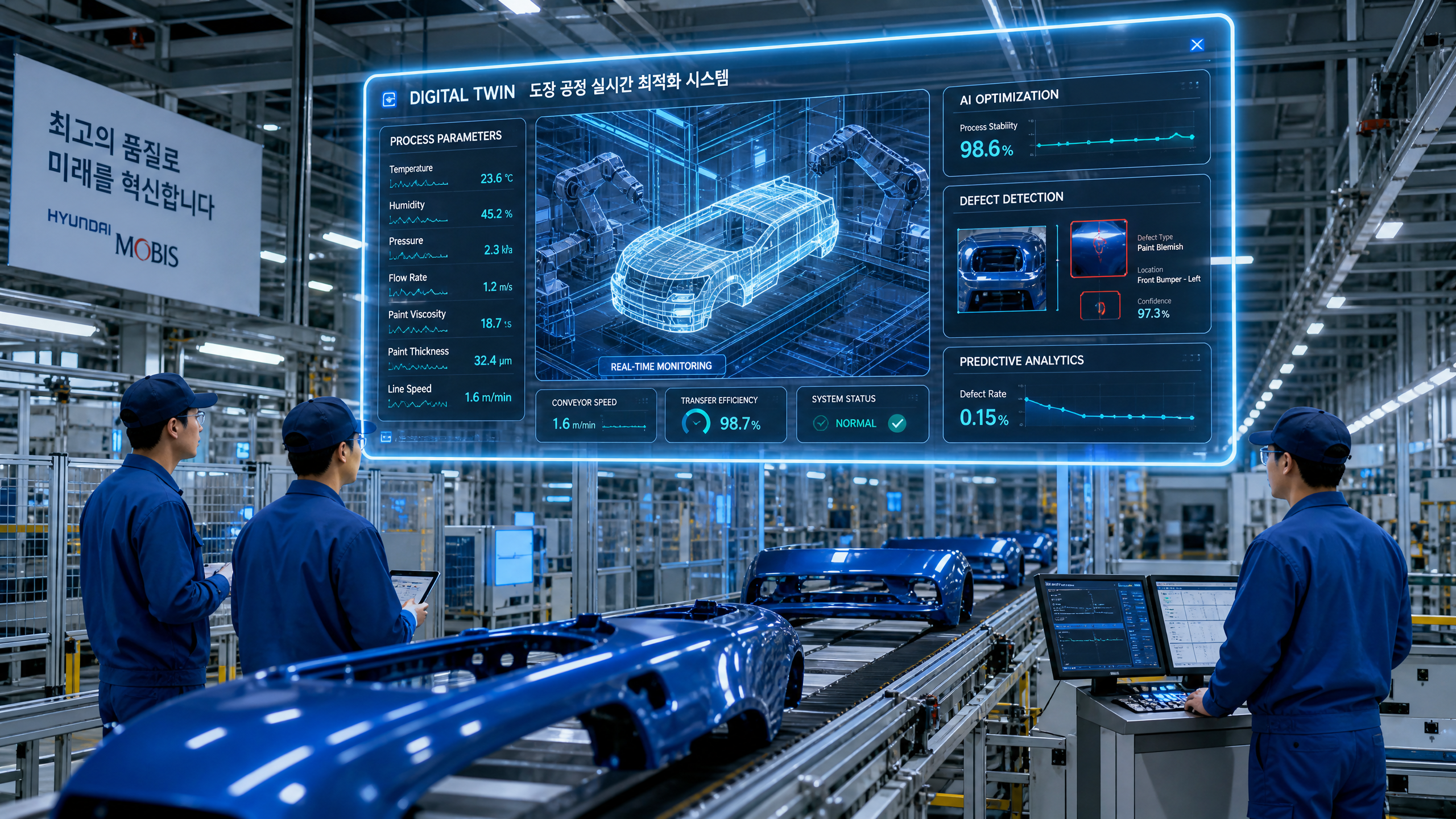
Korea Alps, a mid-sized Korean manufacturer of automotive electronic components with 40 years of operating history, has demonstrated that AI-driven process optimization can deliver measurable, auditable results in a conventional manufacturing environment. The company deployed a combination of artificial intelligence and digital twin technology to optimize its painting process, achieving a 13 percent reduction in defects, a 5 percent increase in daily output, and a reduction in new product preparation time from approximately two months to approximately two weeks.
The results are not a pilot program or a laboratory demonstration. They are operational outcomes from a production line that processes approximately 47,250 units per day and has accumulated more than 710,000 process scenario data points. Korea Alps has been designated a regional leading company under the Ministry of Trade, Industry and Energy's M.AX (Manufacturing AI Transformation) program, which provides government recognition and support for manufacturers demonstrating successful AI integration.
The Technical Approach
The digital twin at the core of Korea Alps' system creates a virtual replica of the painting process that can be tested and optimized in simulation before changes are implemented on the physical production line. This is the key advantage of the digital twin approach -- it allows engineers to run thousands of process scenarios in software, identify the optimal parameters, and then apply those parameters to the physical line without the downtime and material waste associated with physical experimentation.
The AI layer sits on top of the digital twin, continuously analyzing incoming sensor data from the production line and comparing it against the simulated optimal parameters. When the AI detects a deviation -- a temperature fluctuation, a viscosity change in the paint, a variation in component surface preparation -- it can recommend or automatically implement adjustments to bring the process back within optimal range. The result is a painting process that is both more consistent and more responsive to variation than a process managed by human operators alone.
The 13 percent reduction in defects is the headline number, but the reduction in new product preparation time from two months to two weeks may be the more commercially significant result. In the automotive supply chain, the ability to bring a new component into production quickly is a competitive advantage that affects contract wins, not just operational efficiency. A supplier that can respond to a new vehicle program in two weeks rather than two months is a more attractive partner for automakers managing compressed development timelines.
The Data Accumulation Advantage
Korea Alps has accumulated more than 710,000 process scenario data points. This number is significant because it represents a proprietary dataset that competitors cannot easily replicate. The value of AI in manufacturing is not just in the algorithms -- it is in the training data that makes those algorithms accurate and reliable for specific processes and materials.
A competitor that decides to implement a similar system today would need years of operation to accumulate a comparable dataset. Korea Alps' head start in data accumulation creates a compounding advantage -- the more data the system processes, the more accurate its predictions become, and the more difficult it is for a late entrant to match its performance. This is the manufacturing equivalent of the network effect that drives competitive moats in software platforms.
The skeptical counterpoint is that the 710,000 data points are specific to Korea Alps' particular painting process, materials, and equipment configuration. A competitor with different equipment or different materials would need to build its own dataset from scratch. The data advantage is real but not transferable, which means it protects Korea Alps' position in its specific process but does not give the company a broader competitive advantage in the market for AI manufacturing solutions.
The M.AX Program and Government Context
Korea Alps' designation as a regional leading company under the M.AX program reflects the Korean government's broader push to accelerate AI adoption in the manufacturing sector. The M.AX program provides financial support, technical assistance, and market recognition for manufacturers that successfully integrate AI into their production processes. The designation is both a validation of Korea Alps' results and a signal to other manufacturers that the government is actively supporting this type of investment.
The program is part of a larger Korean industrial policy that recognizes the country's manufacturing sector faces structural pressure from lower-cost competitors in Southeast Asia and China, and from automation-driven productivity gains in Germany and Japan. The government's bet is that AI-enabled manufacturing can help Korean companies maintain competitiveness by improving quality and flexibility rather than competing on labor cost alone.
The M.AX program is not unique to Korea -- Germany's Industrie 4.0 initiative and Japan's Connected Industries program pursue similar goals. What distinguishes the Korean approach is its focus on mid-sized manufacturers like Korea Alps rather than exclusively on large conglomerates. The theory is that mid-sized manufacturers are more numerous, more agile, and more likely to implement AI solutions quickly if given the right support, creating a broader base of AI-enabled manufacturing capacity than a large-company-only approach would achieve.
Implications for the Robot Component Supply Chain
Korea Alps' results are directly relevant to the broader discussion of Korea's role in the humanoid robot supply chain. The painting process optimization is a specific application, but the underlying capability -- using AI and digital twin technology to optimize complex manufacturing processes -- is applicable to the precision manufacturing required for robot components.
Actuators, sensors, and structural components for humanoid robots require tight tolerances and consistent quality that is difficult to achieve without sophisticated process control. A manufacturing sector that has demonstrated the ability to deploy AI-driven process optimization at scale is better positioned to meet these requirements than one that has not. Korea Alps' results provide evidence that Korean mid-sized manufacturers can successfully implement these technologies, which is a relevant data point for assessing Korea's broader robot component manufacturing potential.
The practical implication is that the Korean government's investment in programs like M.AX is building manufacturing capabilities that are relevant not just for automotive components but for the emerging robot component market. Companies that develop AI manufacturing expertise in one domain can apply it to adjacent domains, and the robot component market is adjacent enough to the automotive component market that the transfer is plausible.
--- Disclaimer: This article is for informational purposes only and does not constitute financial or investment advice.