
Kaierda Forecasts First-Half Profit Growth Above 1,000 Percent
Hangzhou Kaierda Welding Robot Co., Ltd. anticipates a massive year-over-year net profit increase for the first half of 2026, driven by recovering downstream demand and improved product competitiveness.
A four-digit profit growth rate is an exceptional signal in any industrial sector, but it requires immediate contextualization when the baseline is near zero. Hangzhou Kaierda Welding Robot Co., Ltd. has issued a preliminary earnings forecast for the first half of 2026, projecting a net profit increase of more than 1,000 percent year-over-year. This dramatic percentage reflects a genuine operational turnaround, yet it also highlights the mathematical volatility of recovering from a period of minimal profitability.
What is the exact profit forecast for Kaierda in the first half of 2026?
Hangzhou Kaierda Welding Robot Co., Ltd. estimates its net profit attributable to shareholders for the first half of 2026 will range between 26.15 million RMB and 30.53 million RMB. This represents an estimated year-over-year growth of 1005.75 percent to 1191.07 percent compared to the 2.365 million RMB actual net profit recorded in the first half of 2025.
The Operational Turnaround Behind the Percentage
The headline growth figure commands attention, but the underlying operational shift is the more significant development for the industrial robotics sector. Kaierda, a company headquartered in Hangzhou and listed on the Shanghai STAR Market, specializes in industrial robotics with a strong focus on welding robots. The company's core technology addresses the demanding requirements of automated welding processes, serving a critical niche in manufacturing and heavy industry.
The projected net profit of 26.15 million RMB to 30.53 million RMB marks a substantial recovery from the 2.365 million RMB reported in the same period last year. More importantly, the company's estimated core net profit, which excludes non-recurring items, is expected to reach between 21.97 million RMB and 26.36 million RMB. This is a critical metric because it demonstrates that the core business operations have turned profitable, recovering from a core net loss of 2.73 million RMB in the first half of 2025.
Management attributes this financial improvement to two primary factors: a gradual enhancement in product competitiveness and a relative recovery in downstream market demand. These elements have combined to drive sustained revenue growth. Additionally, the company noted a reduction in share-based compensation expenses, which further supported the bottom-line improvement.
Translating the Base Effect in Financial Reporting
To understand why a company can report a 1,000 percent profit increase without fundamentally altering the global robotics landscape, it is helpful to consider the concept of the base effect. Imagine a small manufacturing facility that produces only one specialized component per month during a severe industry downturn. If market conditions improve slightly and the facility begins producing ten components per month, its production has increased by 900 percent. The percentage is massive, but the absolute volume remains relatively small in the context of the broader industry.
Similarly, Kaierda's massive percentage growth is mathematically accurate but heavily influenced by the extremely low profit base of 2.365 million RMB in the first half of 2025. The transition from a near break-even state to a solid, albeit modest, multi-million RMB profit generates a spectacular growth multiple. The true measure of success is not the percentage itself, but the fact that the core business has stabilized and returned to profitability.
The Reality of Unaudited Preliminary Figures
While the projected turnaround is a positive indicator for Kaierda and potentially for the broader welding robot market, these figures remain preliminary. The financial data provided in the voluntary disclosure announcement are unaudited estimates prepared by the company's internal financial department. They have not yet been subjected to the rigorous review of external auditors, and the final numbers will only be confirmed upon the release of the formal half-year report.
This distinction is crucial for procurement teams and investors evaluating the stability of automation vendors. A preliminary forecast signals management's confidence in the current trajectory, but it does not carry the same weight as audited financial statements. The robotics sector is capital-intensive, and sustained profitability requires consistent execution over multiple quarters, not just a single strong half-year recovery.
Evaluating the Turnaround in Context
"The transition from a core operating loss to a multi-million RMB profit demonstrates that Kaierda has successfully navigated a challenging demand environment, but the four-digit growth rate is a mathematical artifact of a low base rather than a signal of sudden market dominance."
This insight captures the dual nature of the announcement. The recovery is real and operationally significant, indicating that the company's product enhancements are resonating with customers as downstream demand thaws. However, the scale of the absolute profit remains modest when compared to the massive revenues generated by global robotics leaders.
Market Positioning and Competitor Benchmarking
To contextualize Kaierda's position, it is useful to look at the broader industrial robotics landscape. While direct, like-for-like comparisons are challenging due to differences in scale, product focus, and reporting periods, examining the financial disclosures of other major players provides a sense of scale.
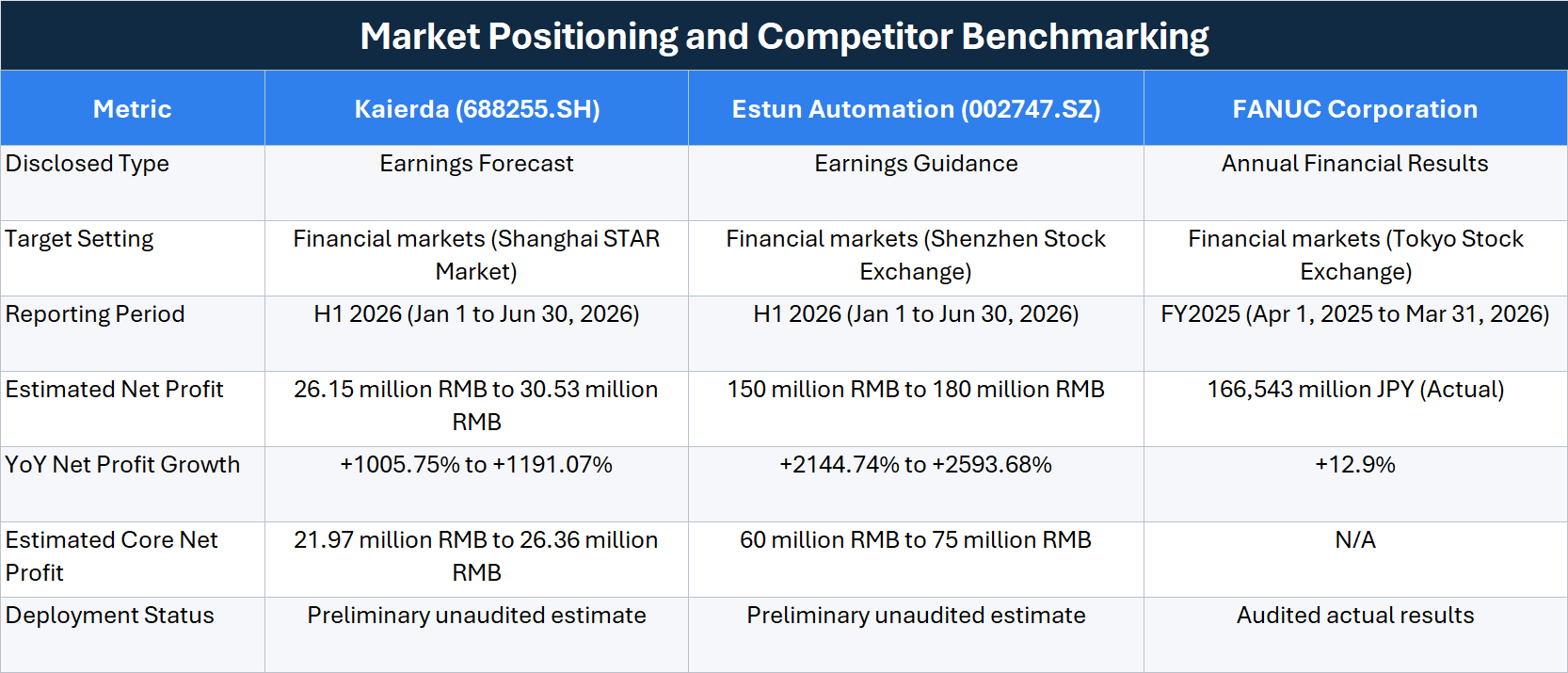
Note: Estun Automation and FANUC Corporation are illustrative reference points representing major competitors in the industrial robotics market, rather than like-for-like identical business models.
This comparison highlights that while Kaierda's percentage growth is exceptional, its absolute profit levels are significantly smaller than those of larger domestic competitors like Estun Automation, and entirely dwarfed by global giants like FANUC. The data reinforces the conclusion that Kaierda is executing a successful recovery within its specific niche, rather than disrupting the top tier of the global robotics market.
Commercial Implications for Automation Buyers
For procurement teams and operations leaders evaluating welding automation solutions, Kaierda's financial update provides a measure of reassurance. A vendor returning to core profitability is generally a more stable partner for long-term deployments, as financial health directly impacts a company's ability to provide ongoing support, maintenance, and product development.
The stated improvement in product competitiveness suggests that Kaierda is actively refining its technology to meet the demands of the recovering downstream market. Buyers should monitor the formal half-year report to confirm these preliminary figures and look for further details on which specific product lines or customer segments are driving the revenue growth. The ability to sustain this momentum in the second half of the year will be the true test of the company's operational resilience.
The Broader Context of Industrial Automation Recovery
The recovery signaled by Kaierda's preliminary forecast is not occurring in a vacuum. It reflects broader trends within the industrial automation sector, particularly in China's manufacturing landscape. As downstream industries, such as automotive manufacturing, heavy machinery, and construction, begin to stabilize and increase their capital expenditures, the demand for specialized automation equipment like welding robots naturally follows.
Welding is a critical process in many manufacturing sectors, and it is also one of the most challenging to automate effectively. It requires high precision, consistency, and the ability to adapt to variations in materials and environmental conditions. Companies that can provide reliable, high performance welding robots are well positioned to benefit from the renewed investment in manufacturing infrastructure.
Kaierda's focus on this specific niche has allowed it to weather the recent downturn and capitalize on the early stages of recovery. By improving the competitiveness of its products, the company has made its solutions more attractive to buyers who are looking to optimize their production processes and reduce their reliance on manual labor.
The Role of Share Based Compensation
One notable detail in Kaierda's announcement is the mention of reduced share based compensation expenses as a contributing factor to the improved bottom line. Share based compensation is a common tool used by technology and manufacturing companies to attract and retain top talent. However, it can also be a significant expense that weighs on profitability, particularly during periods of slower revenue growth.
The reduction in these expenses suggests that Kaierda is taking a more disciplined approach to managing its costs, aligning its compensation structures with its current financial realities. This financial prudence is a positive sign for investors, as it indicates that management is focused on achieving sustainable profitability rather than relying solely on top line growth.
For procurement teams, this disciplined approach to cost management is also reassuring. A vendor that is actively managing its expenses is less likely to face sudden financial difficulties that could disrupt its ability to deliver products and services. It suggests a level of operational maturity that is essential for long term partnerships.
The Importance of the Core Net Profit Metric
The distinction between net profit and core net profit is a critical one in financial analysis, and it is particularly relevant in the case of Kaierda's preliminary forecast. Net profit includes all sources of income and expenses, including non recurring items such as government subsidies, asset sales, or one time restructuring costs. Core net profit, on the other hand, excludes these non recurring items, providing a clearer picture of the underlying profitability of the company's primary business operations.
In the first half of 2025, Kaierda reported a net profit of 2.365 million RMB, but a core net loss of 2.73 million RMB. This indicates that the company's core business was actually losing money, and the reported net profit was driven entirely by non recurring items.
The projected core net profit of 21.97 million RMB to 26.36 million RMB for the first half of 2026 is therefore a much more significant indicator of the company's financial health than the headline net profit figure. It demonstrates that the core business of selling welding robots has turned profitable, generating sufficient revenue to cover its operating expenses and generate a positive return.
This turnaround in core profitability is the true driver of the massive percentage growth reported in the preliminary forecast. It is a clear signal that Kaierda's product enhancements and cost management initiatives are yielding tangible results, positioning the company for sustainable growth in the future.
Navigating the Volatility of the STAR Market
Kaierda's listing on the Shanghai STAR Market adds another layer of context to its preliminary earnings forecast. The STAR Market was established to provide a platform for innovative technology companies, and it is known for its higher volatility and more relaxed listing requirements compared to the main boards of the Shanghai and Shenzhen stock exchanges.
Companies listed on the STAR Market are often in the early stages of commercialization, and their financial performance can be subject to significant fluctuations as they scale their operations and navigate changing market conditions. Kaierda's massive percentage growth in the first half of 2026 is a prime example of this volatility, reflecting the rapid transition from a period of minimal profitability to a more stable financial footing.
Investors and procurement teams evaluating companies on the STAR Market must be prepared to look beyond the headline numbers and analyze the underlying drivers of financial performance. In the case of Kaierda, the focus should be on the sustainability of the core net profit turnaround, the continued improvement in product competitiveness, and the company's ability to maintain its momentum in the face of ongoing market challenges.
Kaierda's preliminary forecast of a massive percentage increase in first-half profit is a mathematically striking result driven by a successful operational turnaround from a very low prior-year base.
This analysis synthesizes company statements and public market information.
Disclaimer: This article is provided for informational purposes only and does not constitute investment, financial, legal, procurement, or other professional advice. Readers should verify specifications, pricing, availability, regulatory requirements, and commercial terms directly with the relevant company or authority before making decisions.














