
Japan Backs Noetra’s National Physical-AI Cloud With 27,500 NVIDIA Rubin GPUs
Japan is treating robot-training compute as national industrial infrastructure, backing Noetra Corp. with roughly US$6.2 billion to build a sovereign physical AI ecosystem powered by 27,500 NVIDIA Rubin GPUs.
The global race for artificial intelligence dominance is shifting from general-purpose language models to the physical world, and Japan is positioning itself to lead the transition. Rather than treating robot-training compute as ordinary cloud capacity, the Japanese government is elevating it to the status of national industrial infrastructure. This strategic pivot acknowledges that developing the foundation models required for physical AI demands computational resources and on-site data at a scale that no single company can secure independently.
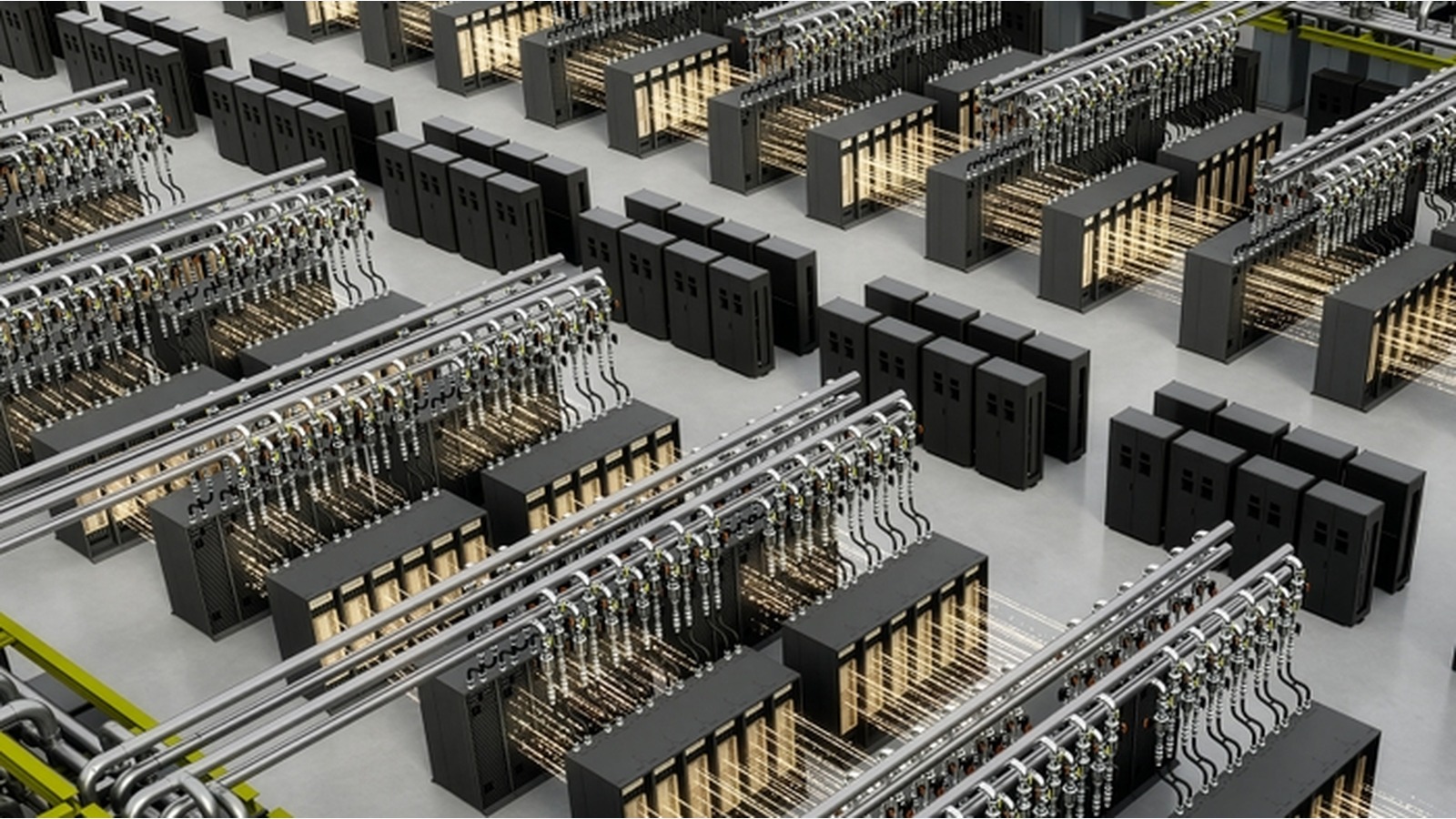
On July 16, 2026, Noetra Corp., a newly established Japanese company backed by major industrial players, announced the launch of a massive national AI infrastructure project. Supported by Japan's Ministry of Economy, Trade and Industry (METI) and the National Institute of Advanced Industrial Science and Technology (AIST), Noetra will build an NVIDIA Vera Rubin AI factory. The facility will be equipped with 13,750 NVIDIA Vera central processing units and 27,500 NVIDIA Rubin graphics processing units, delivering 140 megawatts of data center capacity. The Japanese government will provide around JPY 1 trillion (approximately US$6.2 billion) in development outsourcing funds over a five-year period, including JPY 387.3 billion for fiscal 2026. Construction is scheduled to begin in April 2027, with operations expected to commence in June 2028. Noetra, formerly known as Nihon AI Kiban Moderu Kaihatsu, is backed by 44 companies and organizations, with SoftBank Corp., NEC Corporation, Sony Group Corporation, and Honda Motor Co., Ltd. retaining a majority stake.
Why is Japan treating robot-training compute as national industrial infrastructure rather than ordinary cloud capacity?
Japan is treating robot-training compute as national industrial infrastructure because developing physical AI requires vast computational resources and on-site data that exceed the capacity of individual companies. By centralizing this infrastructure under Noetra and providing significant government funding, Japan aims to secure economic security, reduce reliance on overseas technologies, and capture a significant share of the global AI robotics market.
The Strategic Logic of Sovereign Physical AI
The decision to establish Noetra reflects a calculated industrial policy aimed at leveraging Japan's historical strengths in manufacturing, robotics, and on-site data collection. While the United States and China currently lead the world in general-purpose AI development, Japan intends to differentiate itself by focusing specifically on physical AI. This approach recognizes that the next frontier of artificial intelligence will not be confined to digital screens but will involve systems that can understand, interact with, and manipulate the physical environment.
The infrastructure will provide the computing foundation for Japan's FRONTia Project, which focuses on the development of multimodal foundation models with a view to AI robotics and physical AI. The pretrained weights of Noetra's multimodal foundation models will be made broadly available to domestic model developers and enterprises. This open-access strategy is designed to accelerate innovation across the domestic ecosystem, enabling companies in manufacturing, logistics, healthcare, and telecommunications to build specialized applications on top of a shared national foundation.
By establishing a sovereign physical AI ecosystem, Japan is directly addressing concerns about economic security and technological dependence. The reliance on overseas technologies for core AI capabilities has been a growing concern for policymakers in Tokyo. The Noetra initiative is a direct response to this vulnerability, ensuring that the foundational layer of Japan's future industrial automation is developed and controlled domestically. This sovereign approach is not merely about national pride; it is a strategic imperative to protect the competitiveness of Japan's core industries in an increasingly fractured global technology landscape.
Bridging the Gap Between Digital and Physical Intelligence
To understand the significance of this infrastructure, it is helpful to consider the difference between teaching a computer to write an essay and teaching a robot to assemble a product. General-purpose language models learn by processing vast amounts of text from the internet. Physical AI, however, must learn the laws of physics, spatial awareness, and complex manipulation skills. This requires processing massive amounts of multimodal data, including video, audio, and sensor readings from the real world. The computational power required to train these models is immense, which is why the deployment of 27,500 NVIDIA Rubin GPUs is a critical enabler for Japan's ambitions.
The transition from digital to physical intelligence represents a fundamental shift in the architecture of artificial intelligence systems. While digital models can operate in relatively constrained and predictable environments, physical AI must navigate the chaos and unpredictability of the real world. A robot operating in a factory or a hospital must be able to adapt to unexpected obstacles, variations in lighting, and the unpredictable behavior of humans. Training models to handle this level of complexity requires not only massive computational power but also access to high-quality, real-world data.
This is where Japan's historical strengths in manufacturing and robotics provide a distinct advantage. The country possesses a wealth of on-site data generated by decades of industrial automation. By combining this data with the unprecedented computational power of the Noetra infrastructure, Japan aims to create foundation models that are deeply grounded in the realities of physical operations. This focus on "Real-world Native AI" is what distinguishes the Noetra initiative from other national AI projects that prioritize general-purpose language capabilities.
The Challenge of Cross-Boundary Collaboration
While the scale of the investment and the caliber of the participating companies are impressive, the success of the Noetra initiative is not guaranteed. A key challenge is how much on-site data can actually be shared among the participating companies. Competitors in the manufacturing and automotive sectors are traditionally protective of their proprietary data, and convincing them to pool their resources into a shared foundation model will require careful negotiation and clear incentives.
Furthermore, there is the question of whether the companies involved can deepen collaboration beyond traditional boundaries without repeating the failures of past "all-Japan" alliances in sectors such as semiconductors and liquid crystal displays. The history of state-backed industrial consortia in Japan is mixed, and Noetra will need to demonstrate agile execution and commercial viability to avoid becoming a costly bureaucratic exercise.
The structural friction inherent in such large-scale collaborations cannot be underestimated. Each participating company brings its own strategic priorities, technical standards, and corporate culture to the table. Aligning these diverse interests toward a common goal will require strong leadership and a clear governance framework. The involvement of METI and AIST provides a level of state backing that may help to overcome some of these hurdles, but the ultimate success of the project will depend on the ability of the private sector partners to execute effectively.
"The true test of Japan's national AI infrastructure will not be the number of GPUs deployed, but the willingness of its industrial giants to pool proprietary on-site data into a shared foundation model."
Benchmarking National AI Infrastructure Initiatives
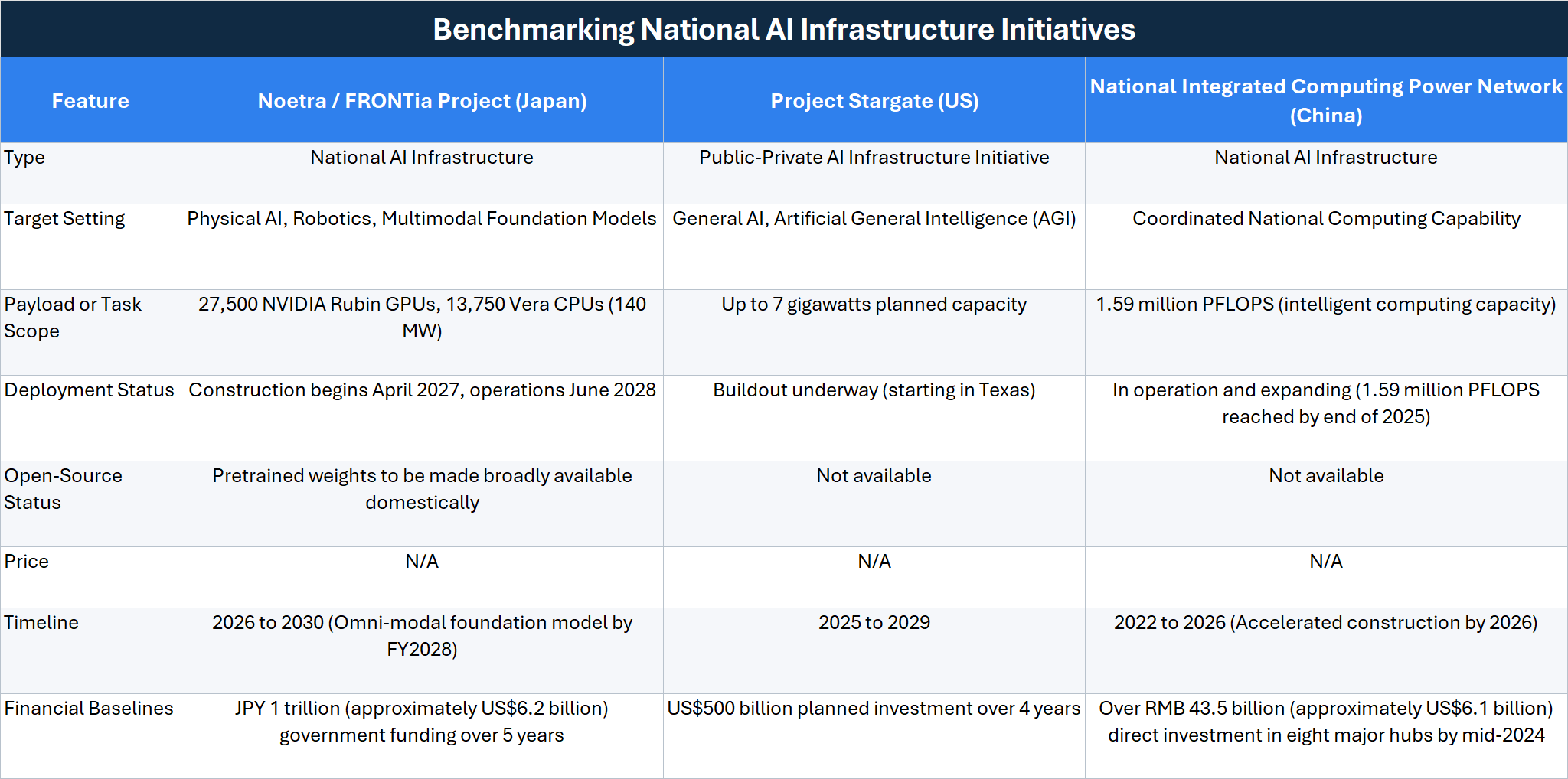
Note: Project Stargate and China's National Integrated Computing Power Network are illustrative reference points for national-scale AI infrastructure investments, rather than like-for-like competitors focused exclusively on physical AI and robotics.
Adoption Signals and Execution Milestones
The broad industry backing for Noetra, with 44 companies and organizations investing in the initiative, provides a strong initial adoption signal. The participation of major players across diverse sectors indicates a shared recognition of the need for sovereign physical AI capabilities. This level of consensus is rare and underscores the urgency with which Japanese industry views the transition to physical AI.
The official timeline sets clear execution milestones. In fiscal 2026, Noetra aims to build a reasoning foundation model equipped with foundational capabilities such as advanced Japanese language understanding, logical reasoning, and instruction following. By fiscal 2028, the company plans to develop an omni-modal foundation model capable of seamlessly processing text, images, video, and audio. The ultimate goal, targeted for fiscal 2030, is the realization of "Real-world Native AI" capable of understanding physical properties such as spatial awareness. These milestones align with Japan's broader AI Robotics Strategy, which sets a goal to capture more than 30 percent of the global AI robotics market by 2040.
The phased approach to development reflects a pragmatic understanding of the technical challenges involved. By starting with a reasoning foundation model and progressively adding multimodal and physical capabilities, Noetra is mitigating the risk of overpromising and underdelivering. This incremental strategy also allows the participating companies to begin integrating early versions of the models into their operations, providing valuable feedback and accelerating the overall development process.
Commercial and Operational Implications
For procurement managers, sourcing leaders, and automation buyers, the Noetra initiative signals a long-term commitment by the Japanese government to subsidize the foundational layer of physical AI. This could eventually lower the barrier to entry for domestic companies seeking to deploy advanced robotics, as they will be able to build upon the pretrained weights of Noetra's models rather than starting from scratch.
The availability of a shared, sovereign foundation model could fundamentally alter the economics of industrial automation in Japan. Currently, companies must either develop their own proprietary models or rely on expensive, closed-source solutions from overseas vendors. By democratizing access to the foundational layer of physical AI, Noetra has the potential to unleash a wave of innovation across the domestic ecosystem, enabling smaller companies to compete more effectively and accelerating the deployment of advanced robotics across a wide range of industries.
However, the operational benefits of this infrastructure will not be realized immediately. With operations scheduled to begin in June 2028, companies must plan their automation strategies with the understanding that sovereign, multimodal foundation models are still several years away from commercial maturity. In the interim, organizations will need to navigate a fragmented landscape of proprietary solutions and early-stage physical AI platforms.
The establishment of Noetra represents a definitive shift in Japan's approach to artificial intelligence, moving from a reliance on overseas general-purpose models to the proactive development of sovereign physical AI infrastructure. By combining massive computational resources with its deep expertise in manufacturing and robotics, Japan is laying the groundwork for a new era of industrial automation.
This analysis synthesizes company statements and public market or policy information.
Disclaimer: This article is provided for informational purposes only and does not constitute investment, financial, legal, procurement, or other professional advice. Readers should verify specifications, pricing, availability, regulatory requirements, and commercial terms directly with the relevant company or authority before making decisions.














