
IFR Barcelona Declaration on Robotics and Automation 2026
Four leading global robotics organizations have signed the Barcelona Declaration on Robotics and Automation 2026, establishing a permanent framework to advocate for pro-automation public policies.

Four of the world's leading robotics and automation organizations have officially signed the Barcelona Declaration on Robotics and Automation 2026. The agreement, formalized on July 13, 2026, establishes a permanent framework for international collaboration to advance a common policy agenda. The initiative aims to position robotics as a strategic priority for economic, industrial, and social development across global governments. The declaration was signed by the International Federation of Robotics (IFR), the Association for Advancing Automation (A3) based in the United States, VDMA Robotics + Automation headquartered in Germany, and the Spanish Association of Robotics and Automation (AER Automation). Together, these organizations represent more than 3,000 companies directly involved in the global robotics and automation sector.
Ten Priorities for Policymakers
The Barcelona Declaration outlines a specific, 10-point roadmap for policymakers, designed to be applicable regardless of a country's current industrial structure or level of automation maturity. The priorities focus on fostering an environment conducive to rapid technological adoption and sustainable growth.
The core priorities include the adoption of comprehensive national robotics strategies and the improvement of general investment conditions through favorable tax policies. The declaration also urges governments to actively use robots in public services, rather than solely focusing on regulation. Educational initiatives are highlighted, with a call to bring robotics into school curricula and to accurately communicate the real impact of automation on employment.
Furthermore, the document emphasizes the need for investment in assistive and care robotics, ensuring the technology is accessible to everyone. It advocates for smart regulation that keeps pace with technological advancement while avoiding unnecessary costs and strongly backs the adoption of international standards over fragmented regional ones. Finally, it calls for targeted efforts to close the gap between initial innovation and widespread commercial scale.
A Long-Term Collaborative Commitment
The significance of the 2026 declaration lies in the formal, long-term commitment undertaken by the signatory organizations. Moving beyond a shared vision, the groups have agreed to maintain a permanent dialogue with governments and public institutions worldwide.
This commitment includes providing technical expertise and industry data directly to policymakers to inform legislative decisions. The organizations will also publish regular progress reports tracking the implementation of the declaration's priorities. The initiative is designed to be inclusive, with plans to progressively open the framework to additional robotics and automation associations globally, establishing the Barcelona Declaration as the international reference point for shaping public policy in the years ahead.
The Strategic Shift from Engineering to Policy
For industrial decision-makers, this declaration signals a maturation of the robotics sector. Historically, the industry has been driven primarily by engineering breakthroughs and commercial competition. Policy and regulation were often viewed as afterthoughts or necessary evils.
The Barcelona Declaration represents a coordinated effort to proactively shape the regulatory environment before it shapes the industry. By presenting a unified front, these organizations are attempting to prevent the fragmentation of standards that could cripple global supply chains. They are moving from a defensive posture reacting to proposed regulations, moving on to an offensive one, actively defining what "smart regulation" should look like.
Demystifying "Smart Regulation"
The term "smart regulation" is frequently used but rarely defined. In the context of the Barcelona Declaration, it means creating rules that ensure safety and ethical use without stifling innovation.
Imagine regulating the early internet. If governments had imposed strict, prescriptive rules on how data could be transmitted before the technology matured, the modern digital economy might never have developed. "Smart regulation" for robotics involves setting outcome-based standards (e.g., "the robot must not injure a human") rather than prescriptive technical requirements (e.g., "the robot must use this specific type of sensor"). This allows engineers the flexibility to solve problems innovatively while still meeting safety objectives.
The Danger of Regulatory Fragmentation
A significant risk highlighted by the declaration is the threat of regional fragmentation. If the European Union, the United States, and China each develop fundamentally different safety standards and certification processes for robotics, it will severely hinder the ability of manufacturers to scale globally.
This is not a theoretical concern. We have already seen the impact of regulatory divergence in the data privacy sphere (e.g., GDPR vs. US state laws). If a robotics company must redesign its hardware and rewrite its software for every major market, the cost of development will skyrocket, slowing adoption and disproportionately harming smaller startups. The push for international standards is a direct attempt to mitigate this risk.
Strategic Implications for National Competitiveness
The call for comprehensive national robotics strategies is perhaps the most geopolitically significant aspect of the declaration. The organizations recognize that automation is no longer just a tool for improving corporate margins; it is a fundamental driver of national economic competitiveness.
Nations that fail to establish clear, supportive frameworks for robotics adoption risk falling behind in the global manufacturing hierarchy. This is particularly relevant when observing Beijing's systematic conversion of automation into national power. The declaration serves as a warning to Western governments that passive observation is no longer a viable economic strategy.
Comparing Global Robotics Policy Approaches
To understand the context of the Barcelona Declaration, it is useful to compare how different regions are currently approaching robotics policy.
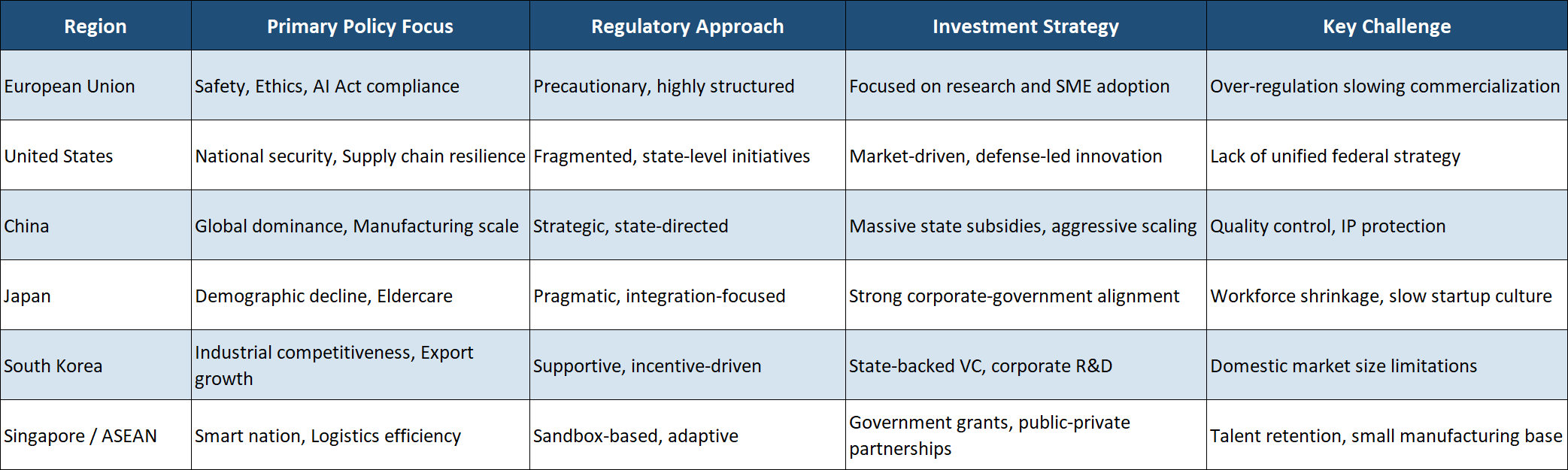
The Barcelona Declaration is, in many ways, an attempt to bridge the gap between the EU's precautionary approach and the more aggressive, state-directed strategies seen in Asia, advocating for a middle path that balances safety with rapid commercialization.
The Challenge of Enforcing International Standards
While the Barcelona Declaration strongly advocates for the adoption of international standards over fragmented regional ones, the practical mechanism for enforcing this preference remains a significant challenge. International standards bodies, such as the ISO (International Organization for Standardization), move deliberately and require consensus among competing national interests.
In contrast, national governments, driven by domestic political pressures or the desire to protect local industries, can enact legislation rapidly. If a major market like the European Union implements strict, localized safety requirements for collaborative robots, manufacturers are forced to comply, effectively creating a de facto regional standard regardless of the IFR's preferences. The success of the Barcelona Declaration will depend not just on articulating a unified vision, but on the ability of these organizations to actively lobby and persuade national regulators to defer to slower, but more universally applicable, international frameworks.
The Role of Assistive and Care Robotics
The declaration's specific emphasis on assistive and care robotics highlights a critical demographic reality facing many developed nations: aging populations and a shrinking workforce in the care sector. While industrial automation dominates the headlines, the long-term societal impact of robotics may be most profoundly felt in healthcare and eldercare.
However, deploying robots in these environments presents unique regulatory and ethical challenges. A robot assembling a car must be safe; a robot assisting an elderly person out of bed must be safe, gentle, empathetic, and capable of handling extreme unpredictability. The call for targeted investment in this sector acknowledges that the market forces driving industrial automation are not sufficient to overcome the complex hurdles of care robotics. It requires deliberate public policy, targeted subsidies, and specialized regulatory frameworks that prioritize human dignity and safety over raw operational efficiency.
The Intersection of Policy and Trade
The push for standardized robotics policy cannot be separated from the broader context of international trade and tariffs. As automation becomes central to manufacturing competitiveness, the hardware itself becomes a geopolitical flashpoint.
If the organizations behind the Barcelona Declaration fail to establish universally accepted safety and operational standards, countries may use localized regulations as non-tariff barriers to trade. For example, a nation could mandate that all industrial robots deployed within its borders use a specific, domestically produced safety controller, effectively locking out foreign competitors. The declaration's emphasis on international standards is not just about engineering efficiency; it is a strategic effort to maintain free trade in the robotics sector and prevent the balkanization of the global automation market.
Addressing the Labor Transition Reality
While the declaration touches on education and accurately communicating the impact of automation on employment, it often relies on the traditional industry narrative: robots take tasks, not jobs, and ultimately create more high-value employment.
However, for policymakers, this narrative is often insufficient. The transition period of low-skill tasks are automated but the workforce has not yet been retrained for the new, high-value jobs creates significant economic and political friction. Smart policy must go beyond simply encouraging robotics adoption; it must include robust, funded mechanisms for worker transition. If the industry fails to proactively support these transition policies, it risks facing severe public backlash and restrictive legislation driven by labor anxiety, ultimately slowing the pace of automation adoption that the Barcelona Declaration seeks to accelerate.
This analysis synthesizes official statements, policy documents, and organizational commitments regarding the Barcelona Declaration.
Disclaimer: This article is produced for informational purposes only. The analysis represents the views of the editorial team and does not constitute investment advice, endorsement of any company, or recommendation to buy or sell any security. All facts have been verified against primary sources to the best of our ability.














