
Hyundai Motor Workers Strike Over Robot Job Security and AI Deployment
Unionized workers at Hyundai Motor have initiated a partial strike, demanding income guarantees and formal negotiations before the automaker deploys Atlas humanoid robots in its factories.
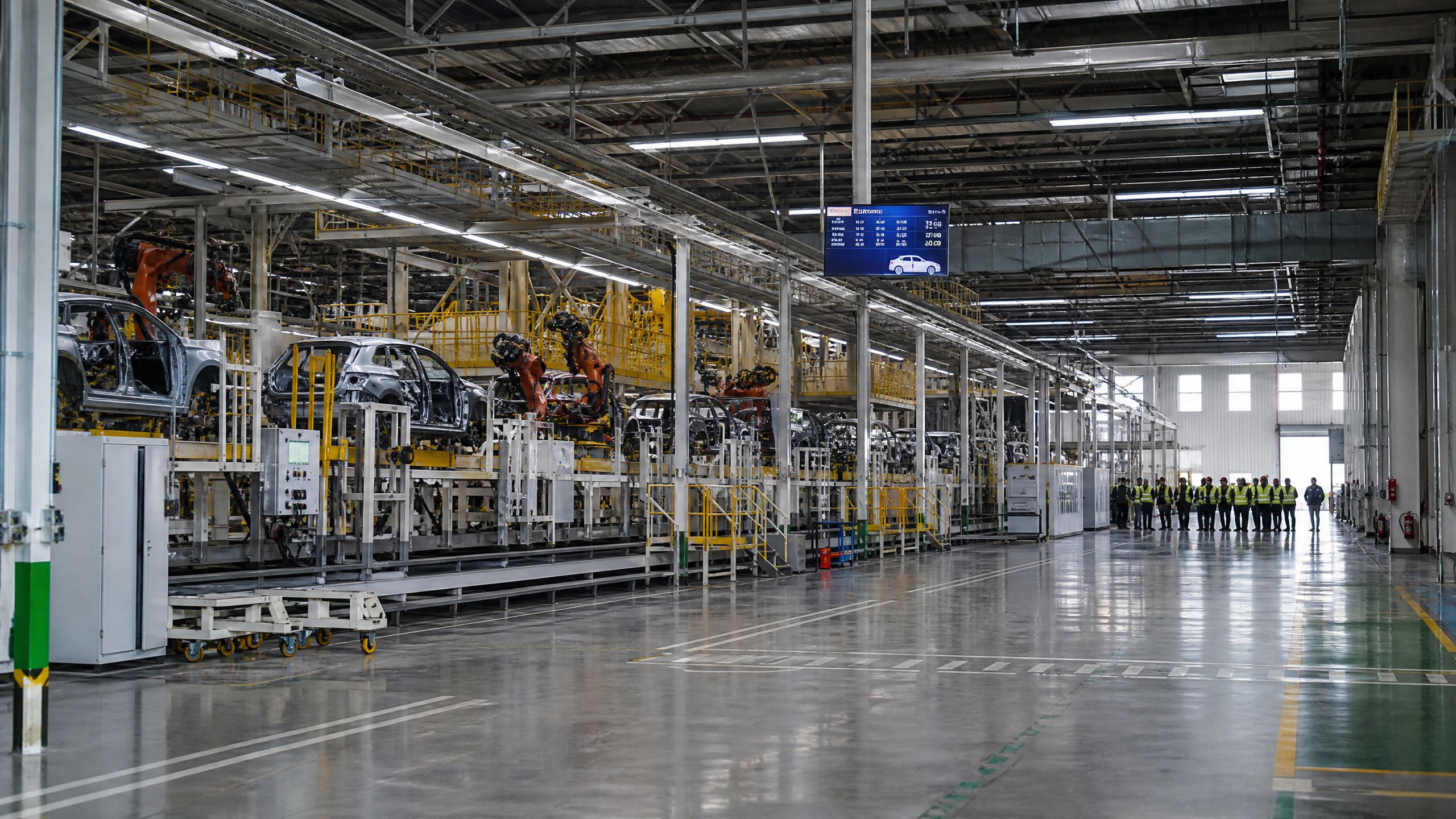
Production workers at Hyundai Motor Co., South Korea's largest automaker, initiated a three-day partial strike on July 13, 2026, walking off the job two hours ahead of their scheduled shift end. The labor dispute centers on union demands for larger performance bonuses and formal guarantees that jobs and fixed incomes will not be lost to the deployment of artificial intelligence and humanoid robots on the factory floor. The strike highlights the growing tension between organized labor and the automotive industry's aggressive push toward advanced automation. Hyundai Motor, headquartered in Seoul, operates a massive global manufacturing network, with South Korea serving as its logistical anchor. The company produces over one million vehicles locally for export each year, accounting for nearly half of its global sales volume.
Automation and Income Security
Hyundai Motor workers find themselves on the frontline of the transition to advanced factory automation. The automaker plans to deploy the Atlas humanoid robot, developed by its Boston Dynamics unit, into its manufacturing facilities. The initial rollout is slated for 2028 in United States factories, focusing on high-volume, repetitive tasks such as kitting vehicle components, before expanding to more complex assembly work by 2030.
In response, the union is pushing management to guarantee income security through formal negotiations prior to any deployment of Atlas robots. A key demand is the implementation of a full monthly salary system designed to insulate fixed incomes from any potential drop in human labor hours driven by automation. Additionally, the union is seeking an extension of the retirement age from 60 to 65, allowing employees to work longer.
Bonus Expectations Fueled by Tech Sector
Beyond the issue of automation, the strike is fueled by heightened expectations for performance bonuses. The union has maintained a long-standing demand to secure a bonus tied to 30 percent of the previous year's consolidated net profit. This demand has gained renewed traction recently, following massive payouts by technology giants Samsung Electronics and SK Hynix, who shared windfall profits generated from the AI boom with their workers.
The union is also demanding an increase in regular bonuses to 800 percent from 750 percent of monthly pay, alongside a base pay increase of KRW 149,600 (approximately US$100). During negotiations last week, Hyundai offered a base-pay increase of KRW 89,000, a lump-sum performance bonus of 350 percent plus KRW 10 million (approximately US$6,600), and 15 shares of company stock. The union rejected this proposal as insufficient.
Potential Production Impact
The work stoppage threatens significant disruption to Hyundai's manufacturing output. Previous industrial action provides a stark precedent; during a similar rolling strike last year, 16 hours of partial walkouts resulted in an estimated production shortfall of roughly 7,000 vehicles, costing the company more than KRW 300 billion (approximately US$200 million) in lost revenue. Current estimates suggest the ongoing strike could incur losses exceeding KRW 18.7 billion (approximately US$12.4 million) per hour.
Any prolonged bottleneck at the South Korean facilities could quickly impact the company's global supply chains and dealership inventories. Management has warned against using industrial action to enforce profit demands, stating that the company will not make concessions or compensate for lost wages resulting from the strike.
The Changing Dynamics of Labor Negotiations
For operations leaders, this strike represents a fundamental shift in how labor negotiations will be conducted in the era of physical AI. Historically, disputes centered primarily on wages, benefits, and working conditions. Now, the core issue is the fundamental definition of a job and the right to perform it.
The union's demand for a "full monthly salary system" regardless of actual hours worked is a direct response to the threat of task displacement. If a robot can perform 30% of a worker's tasks, the union wants to ensure the worker's income is not reduced by 30%. This shifts the financial risk of automation entirely onto the employer, fundamentally altering the ROI calculations for deploying humanoid platforms.
Understanding the Atlas Deployment Strategy
To understand the union's anxiety, one must understand the technology being deployed. The Atlas robot is not a traditional, stationary industrial arm. It is a highly mobile, dynamically balanced humanoid capable of navigating unstructured environments and manipulating a wide variety of objects.
Think of a traditional industrial robot as a highly specialized tool, like a specialized wrench designed to turn one specific bolt perfectly every time. Atlas, by contrast, is designed to be a general-purpose worker. It can walk across the factory floor, pick up a bin of parts, carry it to an assembly station, and then begin kitting those parts for the human workers. This versatility is what makes it so threatening to traditional labor structures; it doesn't just automate a single task, it automates the interstitial work that connects tasks.
The Myth of the "Lights Out" Factory
A persistent misconception is that automakers are striving for "lights out" manufacturing—factories entirely devoid of human workers. While this may be a theoretical endpoint decades in the future, the near-term reality is far more nuanced.
The goal of deploying robots like Atlas is not to eliminate the workforce, but to optimize it. Humanoids are currently too expensive, too slow, and too fragile to replace the entire assembly line. Their value lies in taking over the most ergonomically demanding, dangerous, or tedious tasks, thereby reducing workplace injuries and allowing human workers to focus on tasks requiring higher cognitive flexibility or delicate manipulation. The challenge for management is communicating this nuance to a workforce that views any automation as an existential threat.
Strategic Implications for Global Automakers
The outcome of this strike will set a critical precedent for the entire automotive industry. If Hyundai concedes to the union's demands for income guarantees tied to automation, it will establish a new baseline for labor negotiations globally.
Other automakers, such as General Motors and Ford, who are also exploring humanoid deployments, will be watching closely. The task displacement pattern already visible in logistics is now moving to the factory floor, and the friction it generates will be a defining characteristic of industrial relations for the next decade.
Competitor Benchmarking: Humanoids in Auto Manufacturing
Hyundai is not alone in its pursuit of humanoid automation. The following table illustrates how major automakers are approaching this technological shift.
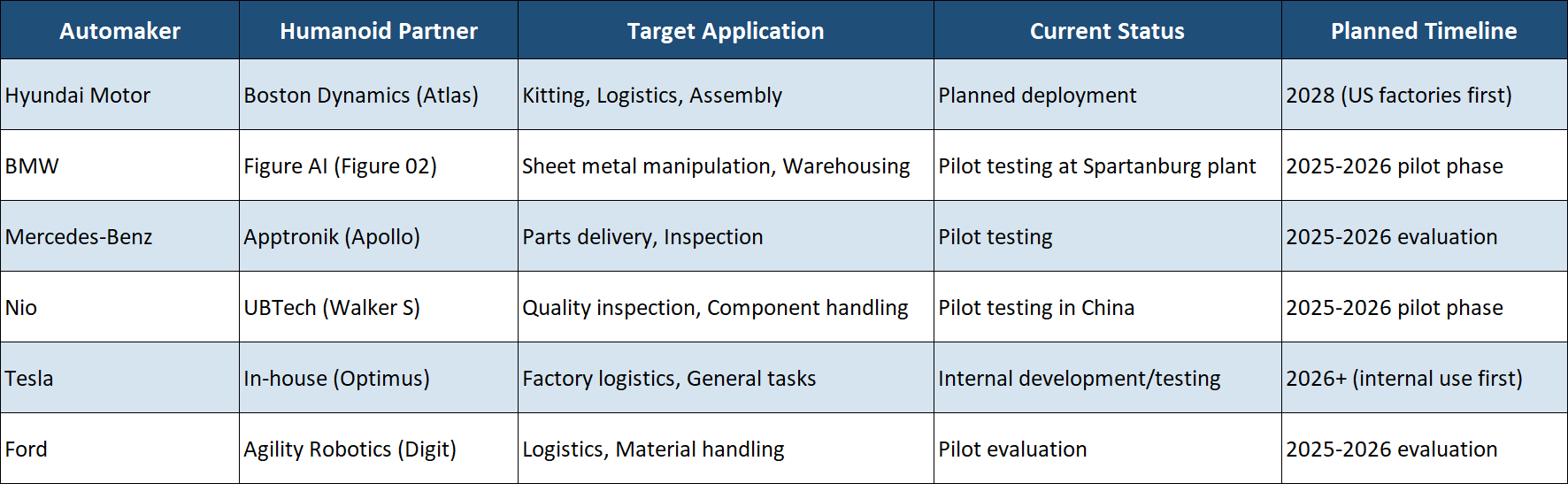
The key takeaway is that the entire industry is moving in the same direction simultaneously. The competitive advantage will not necessarily go to the company with the best robot, but to the company that can successfully integrate that robot into its existing workforce without triggering crippling labor disputes.
The Psychological Impact of Humanoid Form Factors
The intensity of the union's response to the Atlas deployment highlights a crucial, often overlooked factor in automation: the psychological impact of the humanoid form factor. When automakers introduced traditional, single-arm industrial robots decades ago, there was certainly labor friction, but the machines were clearly identifiable as specialized tools. They were bolted to the floor, enclosed in safety cages, and performed tasks that were obviously mechanical.
A humanoid robot like Atlas, however, fundamentally alters the dynamic. By mimicking the human form—with a head, torso, arms, and legs—it visually communicates a direct replacement of the human worker. It is no longer a tool assisting the worker; it appears as a synthetic worker designed to take the human's place on the line. This visual cue triggers a visceral, existential anxiety among the workforce that traditional automation does not. Management teams must recognize that deploying humanoids requires not just technical integration, but a sophisticated change-management strategy to address the psychological friction generated by the technology's form factor.
The Limits of the Atlas Platform in Automotive Assembly
While the Boston Dynamics Atlas is arguably the most dynamically capable humanoid robot in the world, its immediate utility in automotive assembly is constrained by the realities of the manufacturing environment. The initial planned deployment for kitting and logistics tasks reflects these constraints.
Automotive assembly requires a combination of brute strength, microscopic precision, and rapid tactile feedback. While Atlas excels at mobility and gross manipulation, tasks like routing a flexible wiring harness through a complex dashboard or identifying a subtle paint defect remain extraordinarily difficult for current physical AI models. The robot's strength lies in its ability to navigate the unstructured spaces between specialized workstations, moving materials and preparing kits for human workers. The union's fear of total displacement must be weighed against the current technical limitations of the platform; Atlas is currently a sophisticated logistics assistant, not a master mechanic. The long-term challenge for Hyundai will be expanding the robot's repertoire of skills without compromising the speed and quality required by modern automotive production lines.
This analysis synthesizes labor union statements, corporate responses, and production impact estimates regarding the ongoing industrial action.
Disclaimer: This article is produced for informational purposes only. The analysis represents the views of the editorial team and does not constitute investment advice, endorsement of any company, or recommendation to buy or sell any security. All facts have been verified against primary sources to the best of our ability.














