
Hyundai MobED vs Samsung Dremo: The Form Factor Debate
Hyundai and Samsung are testing contrasting consumer robotics architectures. Hyundai’s MobED concepts center on a reusable mobility base with posture control. Samsung’s Dremo, Minimo, and PUCO center on a persistent AI identity across home and portable companions. Awards signal intent, not product readiness.
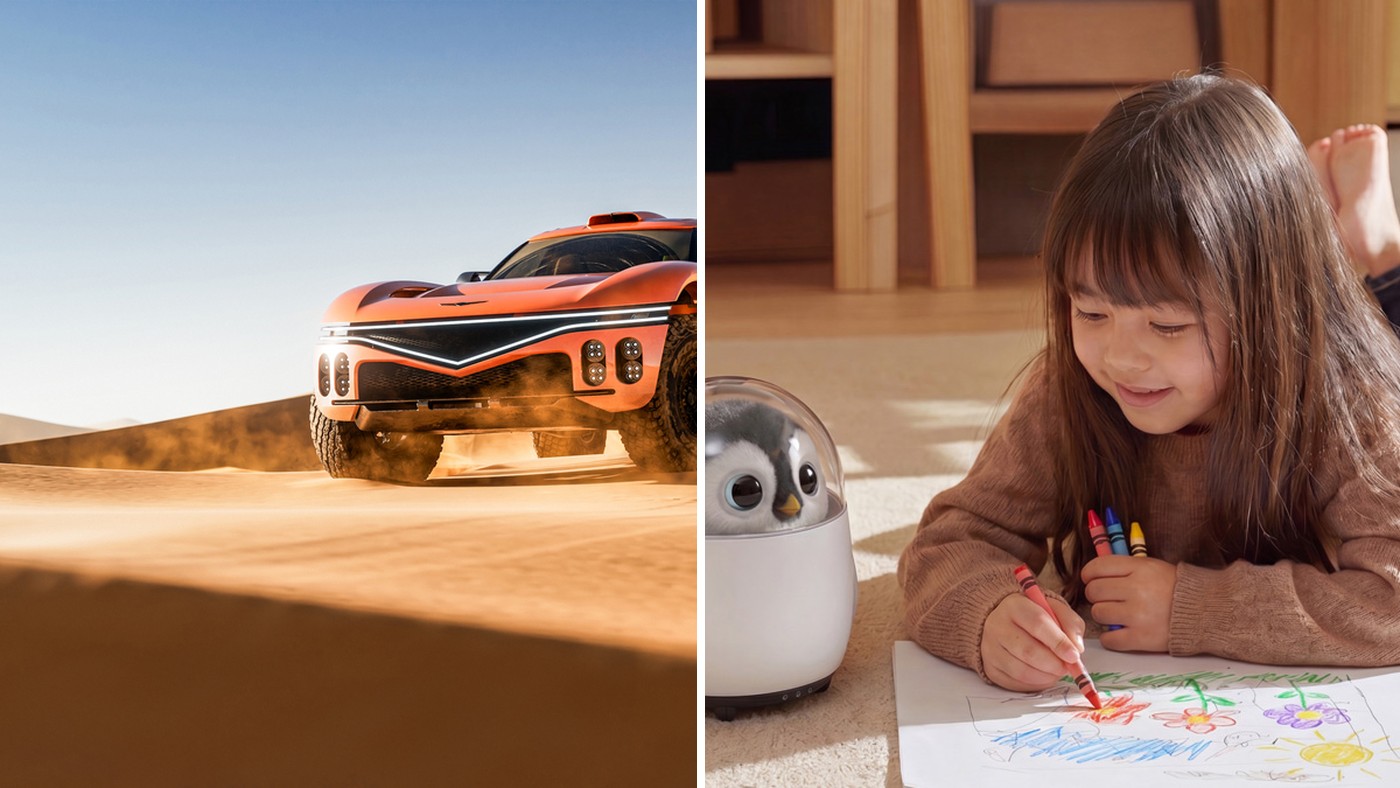
Two consumer robot architectures need different commercial gates
Hyundai is betting on a reusable mobility base that can keep a level posture over uneven ground, while Samsung is betting on a persistent AI identity that spans home and portable companions. Buyers should not pick a favorite design. They should ask which architecture can meet safety, privacy, service, and support gates with evidence.
Hyundai Motor Group and Samsung Electronics are offering different answers to a core consumer robotics question. Should a robot be a reusable platform that changes tasks, or should it be an identity layer that follows the user through different objects? That split frames the form factor strategy behind Hyundai’s MobED Urban Hopper and MobED Golf concepts on one side, and Samsung’s Dremo, Minimo, and PUCO concepts on the other.
Hyundai’s Mobile Eccentric Droid platform is built around a mobility base, a Drive and Lift module, and an eccentric posture control mechanism that is intended to keep the platform level across uneven ground, slopes, and curbs up to 20 centimetres high. The company’s strategy is modular hardware. If the base can move well enough and stay stable enough, interchangeable top modules can turn it into different products.
Samsung separates the continuity layer from the chassis. Dremo is described as the main robot body used at home, Minimo is a portable companion intended to maintain continuity when the child is away from the home, and PUCO is a context aware home companion that uses projection and articulated nonverbal expression. The strategy is identity continuity across objects. The AI character, its name, voice, personality, and interaction history become the continuity layer, while the physical object can change based on location and use case.
For procurement managers and automation buyers, the sharper question is not which concept looks more appealing. It is which architecture has clearer commercialization gates and can pass them with evidence, not intention.
How Hyundai Frames MobED as a Reusable Mobility Base
Hyundai’s MobED concepts put the argument on wheels. The same underlying base could support different upper modules, such as a personal mobility configuration in Urban Hopper or an autonomous caddie configuration in MobED Golf. The commercial logic is platform reuse, shared components, and potential service economies across multiple product variants.
The Drive and Lift module and eccentric posture control mechanism are the important technical claims in the MobED concepts. The stated capability, maintaining a level posture over uneven ground, slopes, and curbs up to 20 centimetres high, addresses a common constraint in small wheeled robots. Homes, sidewalks, golf courses, campuses, hotels, and mixed indoor outdoor venues are not smooth lab floors. Door thresholds, ramps, sidewalk edges, turf transitions, and drainage slopes introduce balance and payload issues. A platform that can keep the upper module level can reduce the burden on whatever is mounted above it, whether that module is a seat, a carrying tray, a golf bag holder, sensors, or another task device.
Mounting rail compatibility is intended to support interchangeable top modules. If the rail interface is standardized, Hyundai could create a platform business where upper modules are swapped, upgraded, repaired, or configured for different markets. In procurement terms, that could support asset reuse. A buyer might view the base as the capital asset and the top module as the use case specific attachment. That model is familiar in industrial automation, where end effectors, tooling, and payload modules are changed around a shared motion platform.
There is a skeptical view that consumer robotics does not reward theoretical modularity unless the modules are real, priced, certified, and easy to service. That skepticism is warranted. A modular base only becomes commercially meaningful when attachment, electrical integration, software recognition, load limits, safety constraints, and warranty terms are defined. The rebuttal is that a validated base can reduce repetitive engineering across use cases. But until the attachment and certification picture is concrete, modularity remains a design direction rather than a procurement advantage.
For Urban Hopper, the commercialization gates would be especially demanding because personal mobility puts human safety at the center. Buyers would seek evidence on braking distance, stability under shifting human weight, fall risk, emergency stop behavior, battery fault handling, water and dust exposure, incline limits, turning radius, user training, and liability coverage. A personal mobility robot that looks appealing in concept form still has to satisfy the practical expectations of mobility aids, campus transport devices, or consumer rideable products.
For MobED Golf, the gate set is different. A golf caddie robot must handle turf, slopes, bag weight, weather, route planning, golfer following behavior, course rules, charging logistics, and fleet maintenance. Golf courses would ask about battery runtime per round, charging time, wet grass performance, geofencing, cart path behavior, damage risk to greens, storage footprint, and service costs during peak season. The same base may support both Urban Hopper and Golf as concepts, but the validation programs would not be the same.
Hyundai’s platform thesis is straightforward. Mobility is the hard shared problem. If a platform can move across real surfaces while keeping its payload level, then different applications can be built on top of the same base. Motors, suspension, drive control, battery systems, braking, structural protection, and service procedures consume a large share of development cost before any application specific tooling is added. Reuse could concentrate investment and service around the base.
How Samsung Frames Dremo, Minimo, and PUCO as Identity Companions
Samsung’s Dremo and Minimo concept pair is built around a different commercial insight. In child facing home robotics, the strongest product value may not come from a machine that performs a single physical task. It may come from continuity of interaction. A child recognizes the AI character, its name, its voice, its personality, and its behavior. The robot’s identity becomes portable, while the body can be split between a home unit and a smaller companion object.
That design choice reduces some physical burden and increases the software burden. Minimo does not have to be a full home robot if its main purpose is continuity away from the home. Dremo does not have to accompany the child everywhere if it can remain the primary home presence. This separation may allow different size, power, durability, and interface assumptions for each object. A home body can have more sensors, larger speakers, a larger battery, or a more expressive physical form. A portable object can focus on comfort, familiarity, and safe carry.
The tradeoff is that identity continuity is not just a design feature. It is a data governance commitment. If a child’s interests, developmental stage, voice preferences, routines, and interaction history travel between Dremo and Minimo, buyers need to know how that information is stored, processed, transferred, limited, deleted, and reviewed by parents. The same feature that makes the product feel personal also creates privacy, safety, and trust requirements.
AI Home Companion PUCO extends Samsung’s interaction thesis into the home companion category. A context aware home companion that uses projection and articulated nonverbal expression can create presence without relying only on a screen or a humanoid shell. Projection can place information into the user’s environment. Articulated nonverbal expression can signal attention, mood, or status without continuous speech. For household adoption, that may matter. Not every consumer wants a humanoid robot in the home. Some may accept a smaller expressive object that communicates through light, projection, motion, and brief voice interaction.
For procurement managers evaluating education, childcare, hospitality, or family service concepts, Samsung’s approach raises a different list of commercial gates than Hyundai’s. The key questions include whether the system has age appropriate content filters, parent approval flows, explainable data settings, opt out modes, local processing options, microphone and camera controls, retention limits, breach response procedures, update commitments, and clear account transfer rules. If the product is positioned around children, safety is not only mechanical. It is cognitive, emotional, privacy related, and content related.
Samsung Electronics announced eight Red Dot Design Concept awards, including Best of the Best recognition for Samsung Kids Robot Dremo and Minimo. Users can configure the AI character’s name, personality, and voice, and Samsung says the pair is intended to adapt interactions to a child’s interests and development. AI Home Companion PUCO received Winner recognition and is described as a context aware home companion that uses projection and articulated nonverbal expression.
Samsung’s broad consumer device footprint could support such a strategy if the concepts ever move toward products. The company participates in phones, TVs, appliances, smart home platforms, displays, and semiconductors. That could make a companion identity layer easier to connect across household devices. For a buyer, ecosystem strength is not a substitute for product evidence. The commercial question remains whether Dremo, Minimo, or PUCO can meet measurable standards in privacy, safety, reliability, and support.
What the Awards Do and Do Not Signal
Hyundai Motor’s MobED Urban Hopper and MobED Golf concepts received Red Dot Design Concept Best of the Best recognition and a Luminary nomination. The concepts are based on the Mobile Eccentric Droid platform, developed by Hyundai Motor Group Robotics LAB, the Seoul, South Korea based robotics organization within Hyundai Motor Group focused on mobility robotics, robotic platforms, and future physical AI applications for transport, service, and human assistance markets. The platform’s Drive and Lift module and eccentric posture control mechanism are designed to maintain a level posture over uneven terrain, slopes, and curbs up to 20 centimetres high. Urban Hopper is presented as a personal mobility concept. MobED Golf is presented as an autonomous caddie concept. Mounting rail compatibility is intended to support interchangeable top modules.
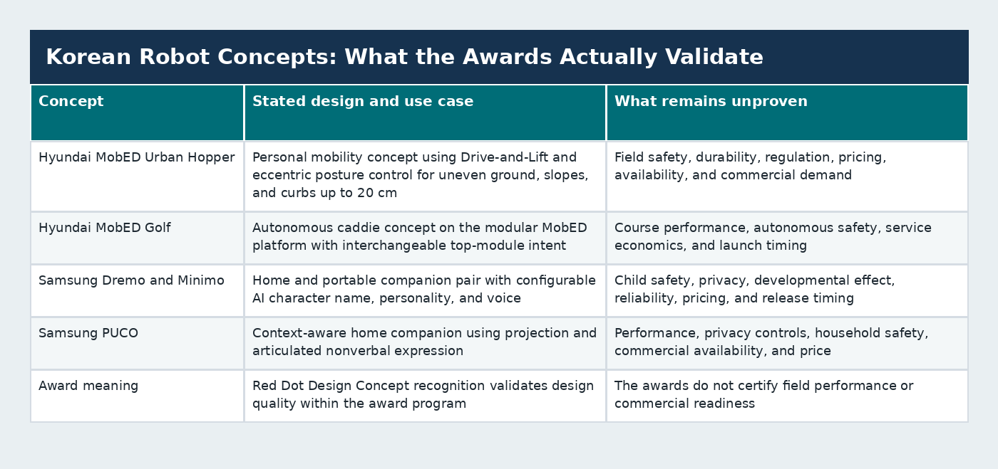
These awards signal design quality and strategic intent. They do not verify commercial readiness. The factual boundary matters. These are design concepts, not announced commercial products. The awards do not certify field performance, safety, child development value, privacy protections, pricing, release timing, durability, service operations, or procurement readiness. They are useful evidence of form factor thinking. They are not evidence that a finished product can pass safety testing, survive field use, or meet buyer total cost requirements.
Why a shared mobility base differs from a companion identity
Think about Hyundai’s approach like a smart skateboard with different backpacks. The skateboard is the hard part because it has to move safely over bumps, slopes, and curbs while keeping the backpack level. One day the backpack might carry golf clubs. Another day it might carry a person or a different tool. The goal is to reuse the moving part.
Think about Samsung’s approach like a character that lives in more than one toy. At home, the character is in a bigger robot. Away from home, the same character is in a smaller object. The child still feels like it is the same companion because the name, voice, personality, and memory travel with it. The goal is to reuse the relationship rather than the wheels.
That simple split explains why the commercialization gates are so different. Hyundai has to prove movement, stability, payload handling, braking, and field durability. Samsung has to prove trust, privacy, parental control, content safety, and identity continuity. Both need strong software. Both need safety validation. But the center of gravity is different, one is mechanical platform reuse, the other is interaction continuity across devices.
Awards cannot substitute for field economics
A design award can assess originality, coherence, user experience intent, and physical design quality. It does not prove that a robot can run eight hours without service, survive drops, pass child safety standards, avoid privacy risk, maintain parts availability, or produce a buyer return case. It does not tell a golf course whether MobED Golf can complete a season with acceptable maintenance cost. It does not tell a parent whether Dremo and Minimo can protect a child’s data or avoid unhealthy attachment patterns. It does not tell a retailer, school, resort, or senior living operator what the product will cost, who owns the account, or how warranty claims will be handled.
For Hyundai, the hard proof will be field performance under varied ground conditions and real payload behavior. The curb figure of up to 20 centimetres is relevant because it speaks to mobility ambition, but buyers will need far more detail. They will ask whether the platform can detect surface changes, what happens when one wheel loses traction, whether the robot can stop safely on slopes, and how it behaves around pedestrians, pets, children, golf carts, or furniture.
For Samsung, the hard proof will be governance and long term support. A child companion cannot rely on novelty alone. It must show parental controls, privacy by design, safe speech boundaries, content moderation, account recovery, offline behavior, update schedules, and deletion rights. If an AI character adapts to a child’s development, buyers will ask what measures define that adaptation, who reviews them, and how parents can override or audit them.
“Hyundai’s MobED concepts ask whether one stable mobile base can carry many business cases, while Samsung’s Dremo, Minimo, and PUCO concepts ask whether one AI identity can carry many user contexts. The winner will not be the concept with the most charming form. It will be the architecture that makes safety, privacy, service, and support measurable before a buyer signs.”
Commercial readiness depends on evidence beyond awards
The next serious milestone for either approach would be evidence that a defined version of the concept can operate in a defined setting for a defined period with measured results. For Hyundai, that could mean controlled trials of MobED based systems in golf course, campus, or personal mobility scenarios with published performance parameters. For Samsung, that could mean structured user testing with documented privacy controls, parent supervision models, interaction boundaries, and support terms.
Procurement teams should resist comparing these concepts on visual design alone. Hyundai and Samsung are answering different buyer problems. Hyundai is asking how much value can be created by a mobile base that accepts different task modules. Samsung is asking how much value can be created by a companion identity that persists across home and portable objects. The commercial winner will be the approach that converts its core promise into verifiable operating data and manageable ownership costs.
For now, the disciplined read is straightforward, Hyundai has the clearer mechanical platform thesis, Samsung has the clearer interaction continuity thesis, and both remain precommercial concepts until safety, privacy, performance, service, pricing, and support evidence are available. That is the standard buyers should apply, and it is the standard the consumer robotics sector must meet.
This analysis synthesizes official company statements and publicly available operating disclosures.
Disclaimer: This analysis is for informational purposes only and does not constitute investment, financial, or procurement advice. The views expressed are based on public information and industry trends as of the publication date. No vendor is endorsed, and no technology performance is guaranteed.














