
Holiday Robotics Secures US$103.4 Million Series A to Scale Humanoid Manufacturing
South Korean humanoid startup Holiday Robotics has raised US$103.4 million in the country's largest-ever Series A round, targeting mass production of its manufacturing-focused FRIDAY robot.
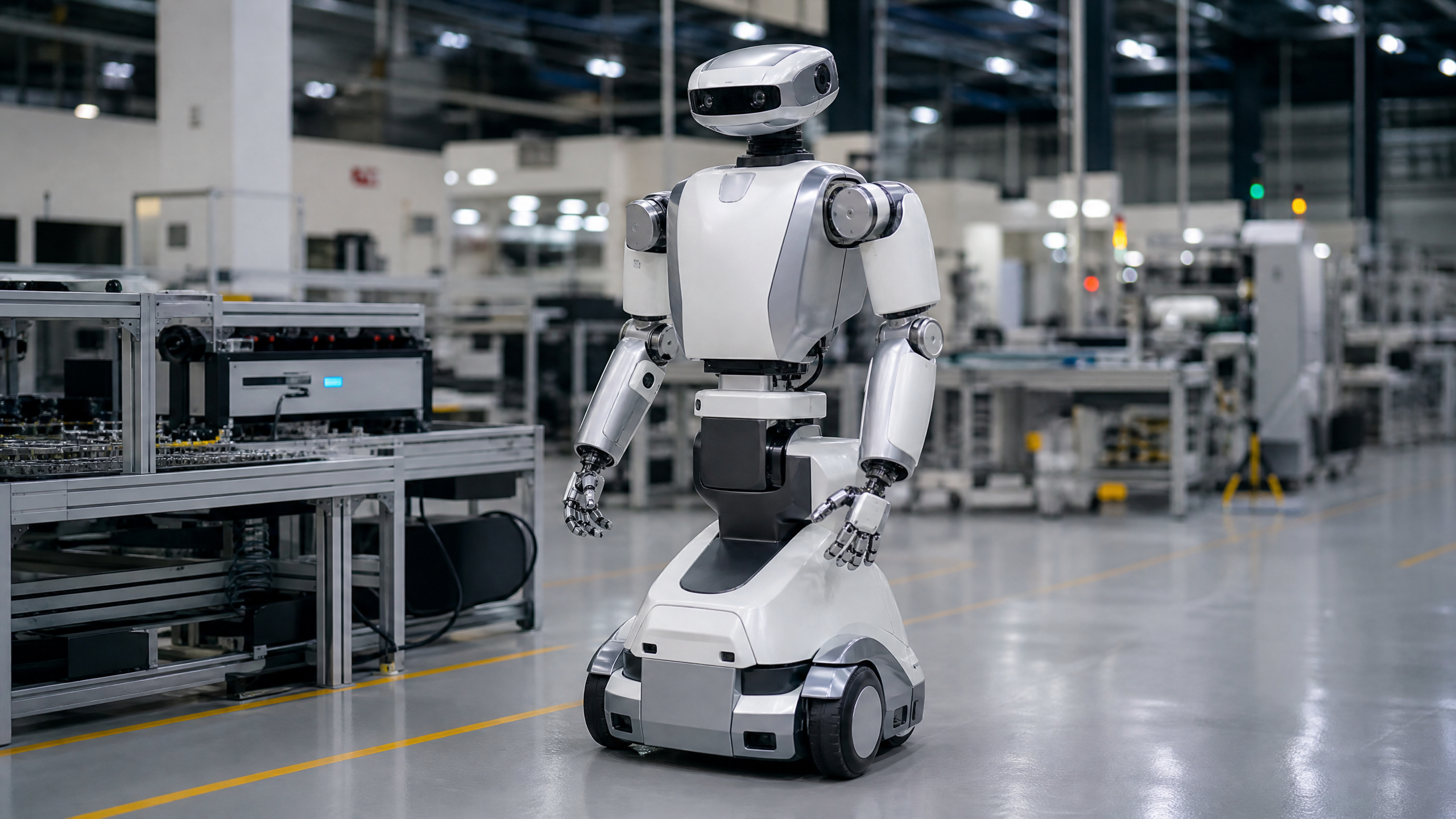
Holiday Robotics, a South Korean physical AI startup headquartered in Seoul, has closed a KRW 155 billion (approximately US$103.4 million) Series A funding round. This marks the largest Series A ever raised by a South Korean startup and the largest single round secured by a domestic humanoid robot specialist to date. The capital injection signals strong investor confidence in the commercial viability of humanoid robotics within manufacturing environments, accelerating the company's push from prototype to mass production. Holiday Robotics was founded by CEO Ki-young Song, who previously established the industrial AI vision company SuaLab in 2013 before its acquisition. The company focuses on automating factory floors using humanoid robots.
The Push for Scaled Manufacturing
The company's flagship product, FRIDAY, is a wheeled mobile manipulator designed specifically for manufacturing environments. Standing 176 centimeters tall and weighing 115 kilograms, the robot features 64 degrees of freedom distributed across its head, arms, hands, waist, and wheels. FRIDAY integrates precise hand manipulation, high-sensitivity tactile sensors, and autonomous mobility to work alongside human operators on repetitive tasks.
Holiday Robotics is currently preparing for mass production ahead of a planned commercial launch in the second half of 2026. The company has set an initial production target of 100 units this year, scaling to 1,000 units annually in 2027. Long-term plans include building manufacturing infrastructure capable of producing more than 10,000 units per year. By achieving economies of scale, the startup aims to reduce the unit price to approximately KRW 100 million (US$66,700).
Broad Investor Base Supports Expansion
The Series A round attracted heavy participation from existing backers, including Stonebridge Ventures, Atinum Investment, Intervest, and Springcamp. They were joined by a large consortium of new investors, such as IMM Investment, SL Investment, KB Investment, BonAngels Venture Partners, Premier Partners, Ulmus Investment, SJ Investment Partners, Dasung Ventures, Atinum Capital Partners, and Goodwater Capital.
Crucially, the round also included participation from state-backed financial institutions, specifically the Korea Development Bank and the Industrial Bank of Korea. This diverse investor base provides Holiday Robotics with a broad foundation for securing future growth capital and facility financing. The fresh funds will be allocated toward upgrading mass-production systems and expanding the research and development workforce from the current 50 employees to more than 100.
Proving Commercial Utility
Holiday Robotics is currently conducting confidential proof-of-concept trials with major domestic and international companies across the automotive, semiconductor, and logistics sectors. These industries, characterized by high volumes of repetitive tasks, represent the primary initial target market for the FRIDAY robot.
The successful commercialization of humanoids in these settings is critical for proving their practical utility and economic value. The company's strategy focuses on establishing a strong foothold in manufacturing before potentially expanding into service and home robotics in the future.
Understanding the Economics of Humanoid Deployment
For procurement managers evaluating humanoid platforms, the core metric is the payback period. If a robot costs US$66,700 and operates for two shifts a day, five days a week, it effectively replaces two human workers per day. In South Korea, where the average manufacturing wage is relatively high, this represents a significant cost offset. Assuming an annual fully burdened cost of US$45,000 per human worker, the robot could potentially pay for itself in less than ten months, provided it achieves comparable throughput and uptime.
However, this theoretical calculation often ignores the hidden costs of deployment. Integration, maintenance, downtime, and the need for specialized safety infrastructure can rapidly inflate the total cost of ownership. The true test for Holiday Robotics will not be producing 1,000 units, but ensuring those units operate reliably enough to justify the initial capital expenditure. The gap between demo performance and deployment reality remains the primary hurdle for widespread adoption.
Translating Physical AI to the Factory Floor
At its core, physical AI is about translating digital intelligence into physical action. Think of it like teaching a person to catch a ball. A traditional robot is programmed with exact coordinates: "move hand to X:10, Y:20, Z:30 at exactly 2:00 PM." If the ball is slightly off-course, the robot misses. Physical AI, however, allows the robot to "see" the ball, calculate its trajectory in real-time, and adjust its hand position dynamically.
For Holiday Robotics, this means the FRIDAY robot doesn't just execute a pre-programmed sequence. It uses its tactile sensors and vision systems to adapt to variations in the manufacturing environment. If a part is slightly misaligned on an assembly line, the robot can detect the error and adjust its grip, much like a human worker would. This adaptability is what separates a humanoid robot from a traditional industrial arm.
The Fallacy of Immediate Job Replacement
A common narrative surrounding humanoid robotics is the imminent threat of mass job displacement. This view often assumes that robots will seamlessly drop into existing workflows and immediately render human labor obsolete. In reality, the transition is far more complex and gradual.
The current generation of humanoids, including the FRIDAY robot, are best suited for specific, highly structured tasks within controlled environments. They excel at repetitive, ergonomically taxing work that humans often find undesirable. They do not possess the general intelligence or adaptability required to navigate unstructured environments or handle unexpected exceptions. The immediate impact of these robots is more likely to be task augmentation rather than complete job replacement.
Strategic Implications for the Automation Sector
The sheer scale of this Series A round indicates that investors are moving beyond speculative bets and are now funding the infrastructure required for mass production. This shift from prototype development to manufacturing scale is a critical inflection point for the industry.
For global competitors, particularly those in China and the United States, the emergence of a well-funded South Korean challenger adds a new dimension to the market. South Korea's established expertise in hardware manufacturing, combined with aggressive state-backed financing, positions companies like Holiday Robotics as formidable contenders in the race to commercialize humanoid platforms.
Competitor Landscape and Benchmarking
When evaluating the FRIDAY robot, it is essential to contextualize its capabilities against existing market leaders. The following comparison highlights key differences in design philosophy and target applications.

The most notable distinction is Holiday Robotics' choice of a wheeled bipedal design. While true bipedal robots (like Digit or Figure 01) offer greater versatility in unstructured environments (e.g., climbing stairs), wheeled bases provide superior stability, higher payload capacity, and longer battery life on flat factory floors. This design choice underscores the company's laser focus on near-term commercial viability in specific industrial settings.
Navigating the Geopolitics of Automation
Beijing's systematic conversion of automation into national power has forced other nations to respond. South Korea's aggressive investment in domestic robotics startups, evidenced by the participation of state-backed banks in this funding round, is a clear countermeasure.
By securing a domestic supply chain for advanced automation technologies, South Korea aims to protect its vital manufacturing sector from over-reliance on foreign suppliers. This dynamic is transforming the robotics industry from a purely commercial endeavor into a strategic imperative for national competitiveness.
The Reality of Integration Friction
Beyond the impressive specifications and production targets, the most significant barrier to the scaled adoption of humanoid robots like FRIDAY is integration friction. This term encompasses the myriad, often unquantifiable challenges of inserting a novel, complex machine into an existing, human-centric workflow.
Manufacturing environments, even highly automated ones, are deeply optimized for human ergonomics and human decision-making loops. When a humanoid robot is introduced, it rarely functions as a simple 1:1 replacement for a human worker. The surrounding infrastructure—from the height of the workbenches to the lighting conditions and the digital interfaces of legacy equipment—often requires modification to accommodate the robot's specific sensor modalities and kinematic constraints. Furthermore, the human workforce must be retrained not just to operate alongside the robot safely, but to manage its inevitable exceptions and edge cases. This integration friction significantly extends the time-to-value for humanoid deployments, forcing procurement teams to look beyond the base unit price and carefully model the total cost of integration.
Evaluating the "General Purpose" Claim
A critical distinction must be made between a robot that is physically capable of performing many tasks and a robot that is economically viable across a wide range of applications. Holiday Robotics has wisely positioned FRIDAY as a manufacturing-focused platform, implicitly acknowledging the limitations of current physical AI.
The term "general-purpose robot" is frequently misused in industry marketing. True general-purpose capability implies the ability to seamlessly transition from assembling an automotive component to folding laundry or cooking a meal, with minimal reprogramming. The current state of the art, however, is closer to "multi-purpose within a constrained domain." FRIDAY may be capable of performing dozens of different tasks within a factory, but it requires structured environments, predictable lighting, and carefully mapped digital twins of its workspace to function reliably. By narrowing its focus to manufacturing, Holiday Robotics is prioritizing near-term commercial deployment over long-term, speculative capabilities, a strategy that clearly resonated with its Series A investors.
This analysis synthesizes company statements, product specifications, and public investment records regarding the Series A funding round.
Disclaimer: This article is produced for informational purposes only. The analysis represents the views of the editorial team and does not constitute investment advice, endorsement of any company, or recommendation to buy or sell any security. All facts have been verified against primary sources to the best of our ability.














