HII signs US$900 million agreement with Path Robotics and GrayMatter for Navy shipbuilding automation
HII signed multi-year performance-based production agreements worth up to US$900 million with Path Robotics and GrayMatter Robotics to accelerate physical AI automation across US Navy shipbuilding. The HYPR initiative targets autonomous welding, surface prep, coating, assembly, and inspection with a new sourcing line and a 2026 outsourced hours ramp.
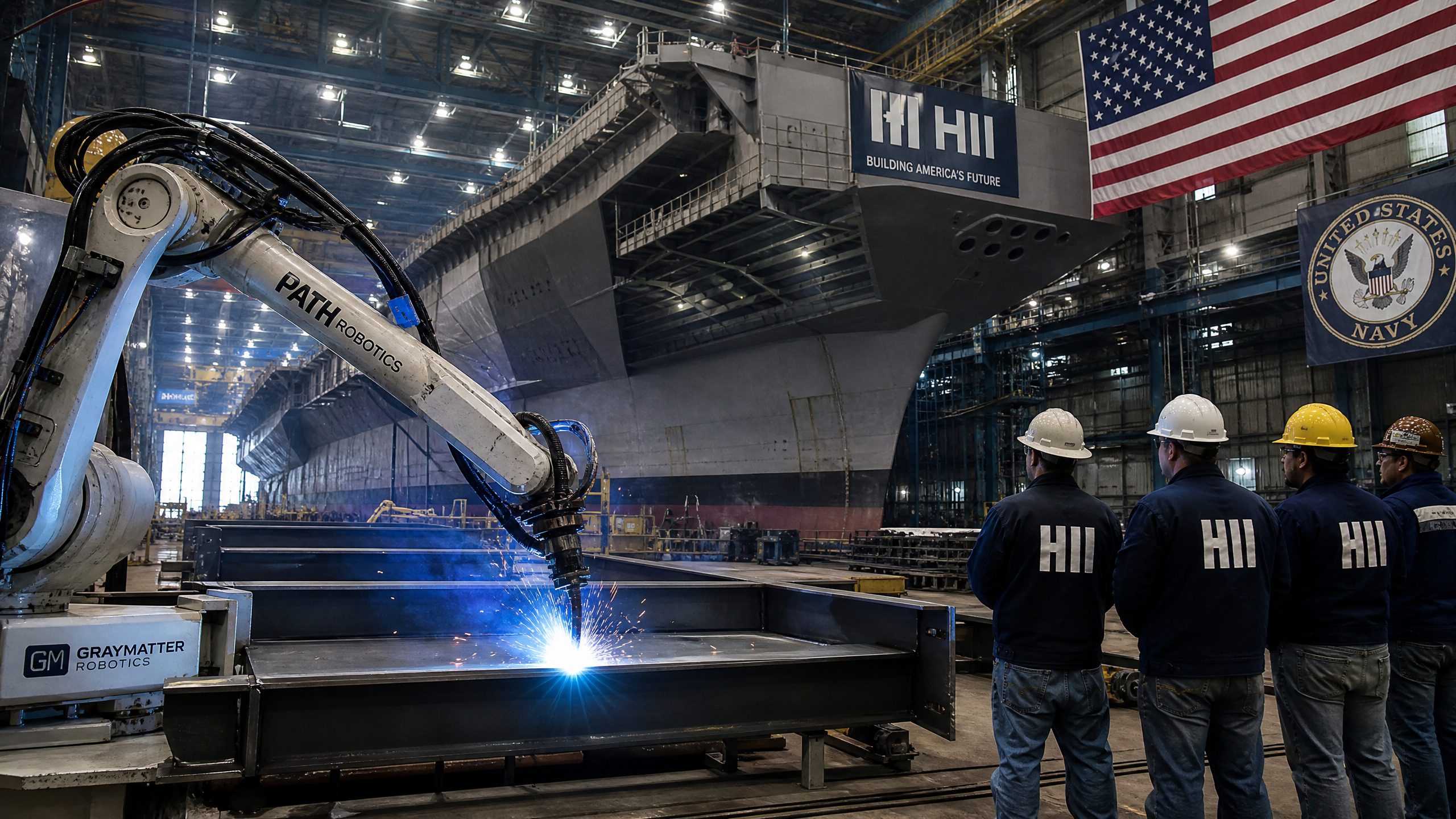
HII has signed long-term performance-based production agreements with Path Robotics and GrayMatter Robotics to deploy autonomous systems across its US Navy shipbuilding operations. The seven-year package is valued at up to US$900 million and spans autonomous welding, grinding, blasting, painting, assembly and inspection with development activity beginning immediately and scaled deployment flowing into active delivery programs. Under the High Yield Production Robotics initiative, HII plans to outsource 2.5 million hours of shipbuilding work in 2026, a 30 percent increase over 2025, through a new sourcing line enabled by the agreements. The framework covers aircraft carriers, submarines, destroyers, frigates, and unmanned vessels, aligning development pilots with production rollout across HII yards.
HII, headquartered in Newport News, Virginia, is the largest US military shipbuilder and the prime contractor on nuclear-powered aircraft carriers and submarines. Its Ingalls Shipbuilding yard in Pascagoula, Mississippi and Newport News Shipbuilding in Virginia anchor the most critical Navy programs. Path Robotics, based in Columbus, Ohio, supplies autonomous welding systems including the Obsidian stationary platform and the Rove mobile welding system. GrayMatter Robotics in Los Angeles provides smart surface preparation, coating, and inspection tools through its Factory SuperIntelligence suite.
The deal reshapes US shipbuilding automation through performance-based contracts
The agreements are performance-based, which means payment and scale depend on measurable outcomes via throughput gains, quality yield improvements, and schedule adherence rather than a simple supply transaction. The remit spans both development and delivery stages. Development covers maturing autonomous welding procedures for naval alloys and geometries, training systems for weld paths and bead placement, and validating robotic blasting and coating over varied surfaces. Delivery covers real work packages flowing to Path and GrayMatter-enabled cells or mobile units that take on modules and sections earmarked for automation. The new sourcing line mentioned by HII suggests a formal intake that parcels qualified tasks to the HYPR partners as capacity grows.
The capital strategy behind buying performance rather than building it
US$900 million over seven years is meaningful for a specialty automation push, yet modest relative to multi-billion-dollar ship programs. Rather than building bespoke automation in-house, HII is buying performance from companies whose business depends on making robots smarter and more rugged with each release. Path and GrayMatter carry the product development risk; HII concentrates its own capital and engineering talent on nuclear work scopes, systems integration and final assembly. The model allows HII to respond to Navy demand surges without committing to fixed assets that might be underutilized in a future budget cycle, and it lets the shipbuilder ride the technology curve at a predictable cost per hour or per task completed.
Path Robotics and GrayMatter fill sequential bottlenecks in the same production flow
Path Robotics brings two complementary systems that address different phases of the welding challenge. Obsidian is a stationary platform tuned for high-deposition structural welding with vision-guided planning that learns joint geometries without extensive fixturing. Rove puts that same intelligence on a mobile base that can travel to large modules or work within sections where moving the part is impractical, a critical capability for Navy hull work because destroyer and carrier sections cannot be rotated on a turntable the way an automotive subframe can. GrayMatter picks up where welding leaves off, targeting what many yards call the last brutal mile. Surface preparation, blasting, coating and inspection often gate overall progress because they are messy, labor-intensive and highly sensitive to environmental conditions. Factory SuperIntelligence uses advanced sensing and path planning to standardize surface finish and film thickness while logging data for quality assurance, so rework can be contained early and quality evidence packages can be generated faster for Navy inspectors. The 2 vendors are not competing for the same tasks; they are filling sequential bottlenecks in the same production flow, which is why HII structured them as a single HYPR team rather than separate contracts.
The operational math behind 2.5 million outsourced hours
HII intends to outsource 2.5 million hours in 2026, up 30 percent from 2025. If autonomous welding cells increase arc-on time and cut setup by learning joints without custom fixtures, each cell can replace multiple manual stations on repetitive seams. If surface prep robots maintain consistent blast profiles and paint thickness, crews can pivot to more specialized work and bottlenecks ease. Think of the yard as a freeway at rush hour where robots add express lanes that keep heavy trucks moving at a steady speed, but only if the entrance and exit ramps are engineered. The ramps in this case are the digital workflows that feed work instructions, the fixtures that enable robot access and the inspection sign-offs that keep modules flowing past test gates. Without those ramps, the express lanes sit empty.
Competitive dynamics across US yards and robotics vendors
For the US shipbuilding industrial base, HII is drawing a bright line. General Dynamics Electric Boat has been investing in process improvement for submarine modules but has been cautious in broadcasting specific robotic deployments. Fincantieri Marinette Marine on the Constellation-class frigate program and Austal USA on steel ship production have advertised selective automation but not at this announced scale or breadth. If HII demonstrates measurable cycle time and quality gains, competitive pressure will force adoption across yards to sustain contract awards. On the vendor side, welding and finishing automation is crowded with global firms including ABB, KUKA, and Yaskawa that excel in automotive and general industry. The naval environment is a tougher duty cycle, and Path and GrayMatter are betting that domain-specific software and mobile systems designed for large modules will outperform generic arms in a shipyard.
Geopolitical urgency pushes automation into the dry dock
Navy modernization is not an abstract goal. China has expanded its fleet count rapidly, fielding larger numbers of surface combatants and submarines while operating some of the world's busiest shipyards. The United States aims to increase readiness and sustain a larger effective fleet while dealing with tight budgets and a constrained labor pool. AUKUS commitments and continued demand for Virginia-class submarines add to the pressure. If HII can deliver modules faster and with fewer defects, schedule margin returns to program managers and operational commanders. The deal is therefore not just a factory upgrade. It is an industrial base bet tied directly to deterrence and the credibility of Navy delivery timelines.
The skeptical view on throughput promises and certification bottlenecks
Not every robot promise survives contact with shipyard reality. Naval materials range from exotic steels to nickel alloys with strict weld procedure qualifications. Curvature, cramped compartments, and access constraints limit robot reach. Maritime coatings are unforgiving and heavy. NAVSEA and other authorities demand rigorous certification for any process change, which can slow rollout even when performance is strong. Integration is a second hurdle -- enterprise resource planning systems, work order management, and quality documentation must synchronize with robot data, and if digital thread gaps persist, crews will still print travelers and take manual measurements, eroding the benefits. Labor relations also matter. Unions at major yards have supported modernization when safety improves and jobs evolve, but they resist moves that appear to reduce headcount or deskill trades. Performance-based contracting can solve the classic adoption problem in heavy industry by pushing partners to shoulder some execution risk, but the metrics -- weld deposition rate, arc-on time, defect rates by class, coating uniformity, first-pass yield at inspector gates -- must be tracked and audited with discipline for the model to deliver on its promise.