
General Motors Grades Suppliers on Automation Maturity Amid Labor Tensions
General Motors is pushing its supply chain toward near-total automation with a new maturity index, raising concerns among suppliers and labor unions about the future of manufacturing jobs.
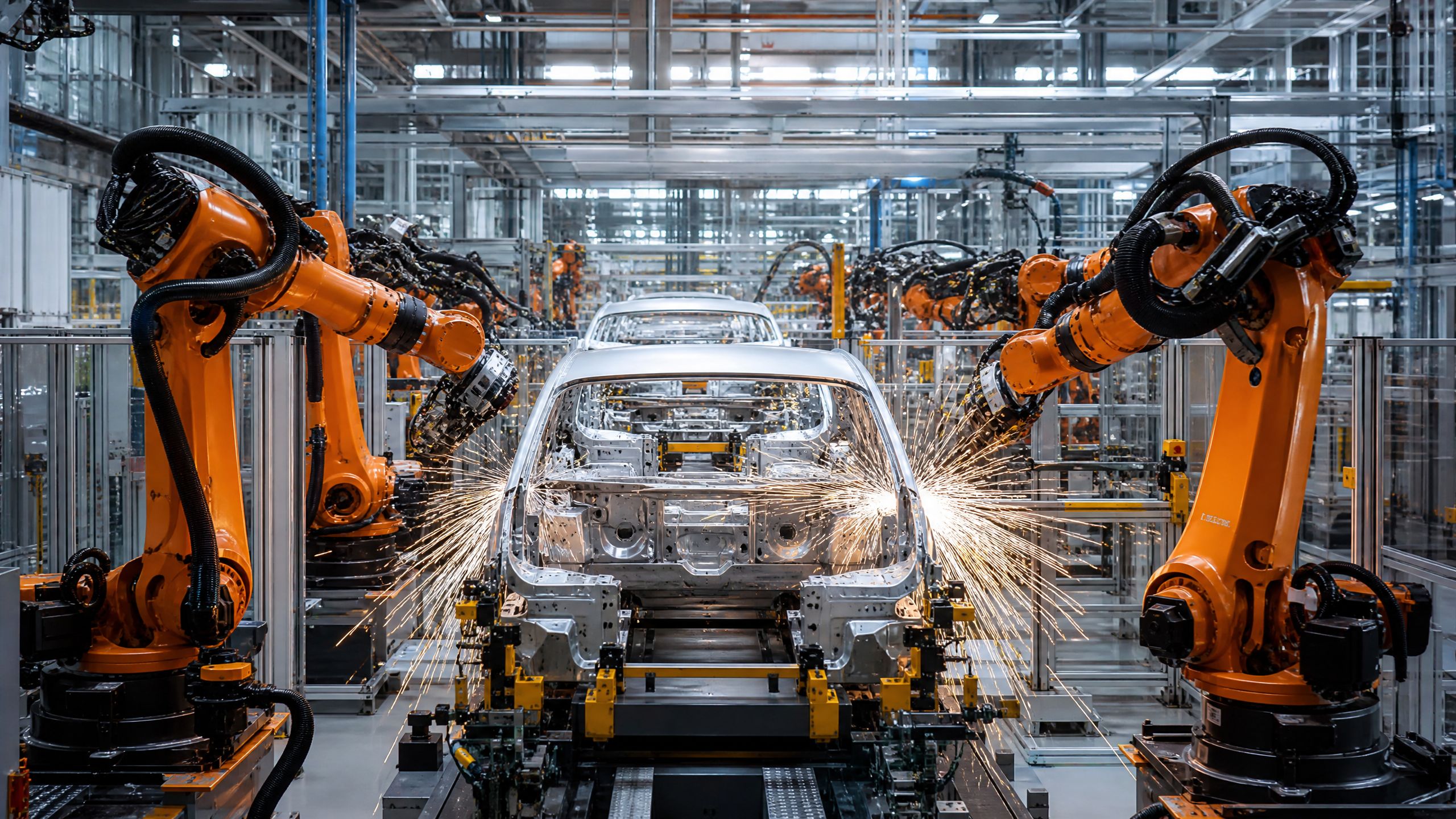
General Motors is aggressively pushing its major suppliers to automate their manufacturing processes, utilizing a newly implemented assessment tool that grades facilities on their reliance on human labor versus robotics. The initiative, known as the Overall Automation Maturity Index (OAMI), signals a structural shift in how the automaker manages its supply chain, demanding high levels of automation to ensure resilience and competitiveness. However, the mandate has sparked concerns among suppliers regarding implementation costs and drawn sharp criticism from labor unions worried about widespread job displacement. General Motors, headquartered in Detroit, Michigan, relies on a vast global network of suppliers to provide components for its vehicle lineup. The efficiency and cost-structure of this supply chain directly impact the automaker's overall profitability and production capacity.
The Five Levels of Automation Maturity
The OAMI framework requires suppliers to audit their entire manufacturing operations, from raw material purchasing through production and final delivery, scoring their level of automation on a five-point scale. The levels progress from manual labor, through basic mechanization and semiautomation, to integrated automation, culminating in the highest tier: smart factory or adaptive automation.
General Motors is reportedly setting a high bar, asking suppliers to target a score of 4.5 out of 5. Achieving a perfect score implies a manufacturing environment with very few workers engaged in hands-on production. In such a facility, human operators function primarily as supervisors, strategic planners, and exception managers, with minimal direct involvement in the physical assembly of parts. While GM maintains that the policy is not a strict mandate with immediate deadlines, supplier executives have expressed concern that failing to work toward these targets could result in the loss of future contracts.
Balancing Productivity and Supplier Friction
The push for automation is designed to create a "resilient, world-class" supply chain, according to GM. The automaker states its goal is to partner with suppliers to set benchmarks that increase productivity, safety, quality, and competitiveness. However, the transition presents significant challenges for the supply base.
Many suppliers are grappling with the financial implications of overhauling their facilities to meet the OAMI targets. Questions remain regarding who will fund the necessary capital expenditures for robotics and AI integration, and how any resulting cost savings will be shared between the supplier and GM. Furthermore, some industry participants question whether the policy forces advanced automation into specific manufacturing processes where it may not be economically or operationally justified.
Labor Pushback and the Factory Zero Context
The implementation of the OAMI coincides with heightened tensions between automakers and organized labor over the role of artificial intelligence and robotics. The United Auto Workers (UAW) union has cast mass automation as a profound threat to employment. This friction was recently highlighted by the installation of approximately 50 Fanuc collaborative robots (cobots) at GM's Factory Zero in Detroit, a facility where more than 1,000 workers remain laid off.
While union officials have linked the layoffs directly to the installation of the robots, characterizing it as a fight for humanity, independent analysis suggests a more complex economic reality. Research indicates that the layoffs at the electric vehicle facility were primarily driven by weaker-than-expected EV demand and a strategic shift toward heavy-duty pickup truck production, rather than the direct replacement of 1,000 workers by 50 robots performing specific tasks like bolting body panels. Nevertheless, the OAMI initiative underscores a definitive long-term trend toward reducing human headcount in automotive manufacturing.
The Economics of Forced Modernization
For procurement managers and supply chain strategists, the OAMI represents a fundamental shift in vendor evaluation. Historically, automakers judged suppliers primarily on piece-price, quality metrics (PPM), and delivery reliability. The internal mechanics of *how* the supplier achieved those metrics were largely their own concern.
By dictating the level of automation required, GM is now deeply involved in its suppliers' capital expenditure strategies. This "forced modernization" aims to insulate the supply chain from labor shortages and wage inflation. However, it also shifts significant financial risk onto the suppliers. If a Tier 1 supplier invests tens of millions of dollars to reach an OAMI score of 4.5, they must secure long-term, high-volume contracts to amortize that investment. If GM alters its production forecasts—as seen with the recent softening in EV demand—the highly automated supplier is left with stranded capital and inflexible fixed costs.
Translating the "Smart Factory" Concept
The term "smart factory" (the highest tier of the OAMI) is often used vaguely. In practical terms, it means moving beyond isolated islands of automation.
Consider a traditional factory: a robotic arm welds a part, a human moves the part to the next station, and another machine paints it. The machines don't communicate. In a "smart factory," the entire process is digitally integrated. The welding robot senses a slight variance in the metal, adjusts its weld, and automatically transmits that variance data to the painting machine down the line, which adjusts its spray pattern accordingly. Humans are removed from the physical handling of the product and instead monitor the digital data flow, intervening only when the system flags an anomaly it cannot self-correct.
The Misattribution of Job Losses
The narrative surrounding the Factory Zero layoffs highlights a critical issue in how automation is perceived. It is intellectually convenient to point to a newly installed robot and blame it for a lost job. However, this often masks broader macroeconomic factors.
The reality is that 50 collaborative robots, designed to assist human workers with specific tasks like bolting, do not possess the capability to replace 1,000 full-time assembly line workers. The layoffs were driven by market forces—specifically, consumer reluctance to adopt EVs at the projected rate—not by a sudden leap in robotic capability. Conflating these issues makes it difficult to have an honest conversation about the real, long-term impacts of automation on the workforce. The task displacement pattern already visible in logistics is real, but it must be analyzed accurately.
Strategic Implications for the Supply Base
The OAMI initiative will likely trigger a wave of consolidation within the automotive supply base. Smaller Tier 2 and Tier 3 suppliers, lacking the capital access required to meet GM's stringent automation targets, may be forced to merge or exit the market.
This consolidation could inadvertently increase risk for GM. While highly automated suppliers are theoretically more resilient to labor shocks, relying on a smaller pool of mega-suppliers creates new vulnerabilities. A disruption at a single, highly integrated "smart factory" could ripple through the entire production network far faster than a disruption at a smaller, manual facility.
Benchmarking Supplier Automation Frameworks
General Motors is not the only manufacturer pushing automation down the supply chain, but the formalization of the OAMI sets a new standard.
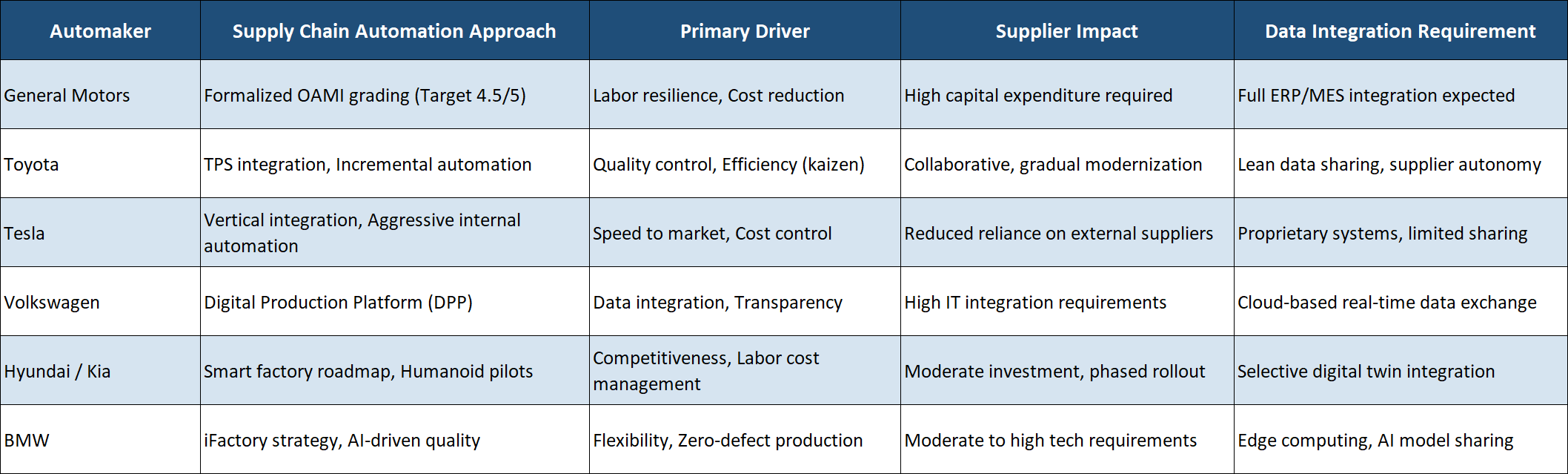
The GM approach is notable for its explicit scoring system and the high bar it sets for human removal. This aggressive posture suggests that GM views advanced automation not just as an operational improvement, but as a critical strategic moat against future labor instability.
The Risk of Over-Automation and Stranded Capital
General Motors' push for a 4.5 out of 5 on the Overall Automation Maturity Index (OAMI) introduces a significant strategic risk for its supply base: the danger of over-automation. While the theoretical benefits of a "smart factory" are compelling, the practical reality is that not all manufacturing processes benefit from extreme automation.
Certain complex, low-volume, or highly variable assembly tasks are still performed more efficiently and cost-effectively by skilled human labor. Forcing suppliers to automate these processes simply to satisfy an arbitrary index score can lead to massive capital misallocation. If a supplier invests heavily in custom robotic cells for a component whose design changes frequently, that capital becomes stranded. The rigidity of hard automation can become a liability in a volatile market. Procurement managers must carefully balance the desire for supply chain resilience with the need for manufacturing flexibility, recognizing that a perfect OAMI score does not automatically equate to a more robust or profitable supplier.
The Data Ownership Dilemma in Smart Factories
As suppliers move toward the integrated automation demanded by the OAMI, a critical, often unaddressed issue emerges: the ownership and control of the manufacturing data. A true "smart factory" generates terabytes of data daily, detailing everything from machine performance and energy consumption to micro-variances in component quality.
General Motors, seeking to optimize its entire supply chain, will inevitably want access to this data to predict bottlenecks and enforce quality standards. However, suppliers view this data as highly proprietary. It contains the core secrets of their manufacturing efficiency and cost structure. If GM gains unfettered access to a supplier's operational data, it gains significant leverage in future price negotiations. The push for automation is therefore not just a physical transformation of the factory floor, but a battle for control over the digital exhaust generated by those new machines. Resolving this data ownership dilemma will be as critical to the success of the OAMI initiative as the physical installation of the robots themselves.
This analysis synthesizes corporate policy documents, supplier surveys, labor union statements, and independent economic research regarding automotive supply chain automation.
Disclaimer: This article is produced for informational purposes only. The analysis represents the views of the editorial team and does not constitute investment advice, endorsement of any company, or recommendation to buy or sell any security. All facts have been verified against primary sources to the best of our ability.














