
Europe Enters the Humanoid Race: UMA’s Northstar and the Talent Diaspora
UMA unveiled its Northstar humanoid design in Paris on July 7, 2026, signaling Europe’s bid to turn research strength and regulatory rigor into commercial momentum. Founded by former Tesla Autopilot engineer Rémi Cadène and backed by AI scientist Yann LeCun, the company aims at manufacturing and logistics, leveraging open-source efforts like LeRobot and building EU AI Act compliance into the product.
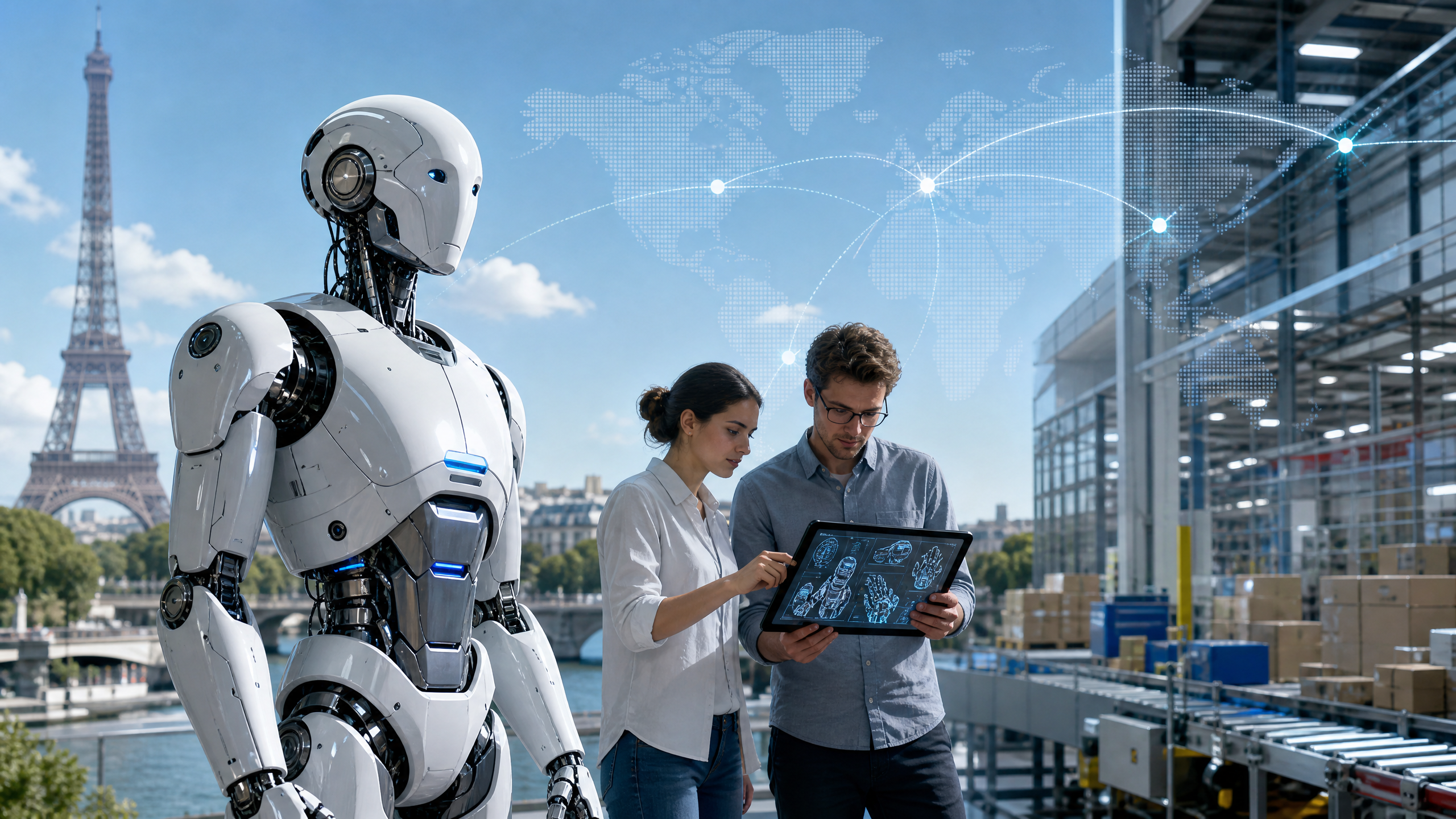
Strategic implication first, Europe is moving to convert its research depth and regulatory rigor into a commercial position in humanoid robotics, and the unveiling of UMA’s Northstar design in Paris shows how the continent plans to do it. On July 7, 2026, UMA, also known as Universal Mechanical Assistant, revealed its full-size humanoid direction, founded by former Tesla Autopilot engineer Rémi Cadène and backed by AI scientist Yann LeCun. That pairing, one part high-volume autonomy execution and one part foundational AI leadership, puts Europe on a new trajectory after years of watching the United States and China set the pace.
A turning point in Paris
The event in Paris did not only introduce a robot design, it introduced a strategy. UMA’s Northstar signals a Europe-first approach to humanoids, aimed at manufacturing and logistics customers who face labor scarcity, inflexible automation, and safety constraints inside brownfield facilities. The company’s founding profile matters. Rémi Cadène brings practical experience from Tesla Autopilot, which blends data infrastructure, real-time perception, and large-scale validation. Yann LeCun’s backing is both endorsement and signal that core AI talent can now anchor serious robotics programs in Europe.
For a decade, European robotics has set global standards in industrial arms, sensors, and safety systems, while full-size humanoids scaled faster in the United States and China. Figure, Agility, and Tesla captured attention with factory pilots and supply chain partnerships. Unitree, UBTECH, and newer players like AgiBot accelerated low-cost mechatronics and agile locomotion. Europe’s strength remained distributed across research labs, cobots, and niche mobility. Northstar is a bet that those pieces can be assembled into a platform business, not just a research program.
The strategic question
Can Europe build a humanoid business before the category consolidates around a handful of platforms? That question sits at the heart of UMA’s launch. Platform consolidation usually follows component standardization, developer ecosystems, and distribution muscle. In humanoids, none of those are locked yet. Actuation, batteries, embedded compute, and dexterous hands are all active design spaces. Software stacks range from teleoperation and imitation learning to model-based control and foundation models for robotics. Integration into real factories still depends on system integrators who want safety, predictability, and service-level commitments more than flashy demos.
This openness creates a window. UMA’s thesis appears simple. Build a credible bipedal platform, connect it to European manufacturing demand, leverage open-source software momentum created by Cadène’s leadership of Hugging Face’s LeRobot project, and navigate the EU AI Act as a feature, not a bug, by designing compliance into the product from day one.
The company decision
UMA’s early decision is to plant its commercial flag in Europe’s factory and logistics backbone rather than chase general household tasks or flashy concierge roles. That choice aligns with four practical realities.
1) Payback periods in manufacturing and logistics are legible. If a humanoid performs pick and place in a goods-to-person cell, or audits inventory on off shifts, the value can be measured against labor costs, downtime, and cycle time improvements. Buyers already run ROI models for cobots and mobile robots. UMA can slot into those spreadsheets.
2) Safety and compliance are paramount. The EU AI Act and the Machinery Regulation require well documented risk management, human oversight, and post-market monitoring. Early adoption by European factories will hinge on CE marking, safety envelopes, and explainable control behaviors. UMA can shape its architecture to satisfy those requirements as a selling point.
3) Brownfield integration is the competitive frontier. Most European factories are not greenfield showpieces. They mix legacy conveyors, forklifts, and safety cages with modern MES and ERP. A humanoid that can traverse stairs, manipulate legacy switches, and interact with existing tooling creates different value than a bespoke cell.
4) Talent is moving home. Senior autonomy and controls engineers are leaving Tesla, DeepMind, and other US giants to found companies in Paris, London, and Munich. UMA can be a magnet for that wave, which accelerates learning cycles and increases credibility with early customers.
Competitive logic in a crowded global field
Competitive logic in humanoids rests on a triangle of capability, cost, and credibility.
· Capability is not only walking and grasping. It is robustness under failures, fine manipulation with repeatability, and safe coexistence with people who are running production at takt time. A robot that recovers from foot slips or sensor glitches without freezing is more valuable than a robot that nails a rehearsed demo.
· Cost is not just bill of materials. It is the learning cost to program new tasks, the maintenance burden on actuators and gearboxes, the energy budget for an eight hour shift, and the service model that keeps uptime above contractual thresholds.
· Credibility is earned in pilots that turn into rollouts. It flows from transparent safety cases, integration partners who sign their names next to deployments, and customers who are willing to be named.
The United States and China today lead on perceived capability and cost. Tesla has data scale and factory leverage. Agility has logistics credibility and a defined parts handling niche. Figure moves quickly across partnerships and talent. In China, Unitree ships at consumer-adjacent prices and has compressed the cost stack of actuators and legs. UBTECH has consumer reach and growing industrial interest. Europe’s path is to win on credibility in regulated environments, to reduce total cost of ownership through careful integration, and to compound capability through an open software ecosystem instead of proprietary lock-in.
What UMA’s pedigree unlocks
Cadène’s prior work leading LeRobot at Hugging Face matters because it shows how software bottlenecks can loosen for European startups. LeRobot provides common datasets, simulator connectors, and learning recipes for manipulation and locomotion. Standardized interfaces reduce the friction of moving from a research notebook to a production controller. That does not make the real world easy, but it shortens the iteration loop.
With LeRobot style abstractions, UMA can develop task libraries that transfer between robots and sites. For example, a palletizing routine can share perception and grasping modules across grippers and camera layouts, while the motion generation adapts to the current robot’s kinematics. This approach does not eliminate the need for on-site tuning, but it avoids rewriting the entire stack for every customer. In a European market that often integrates with diverse PLCs and sensor suites, modularity is an adoption driver.
Europe’s existing base, and why it matters now
Europe already owns key pieces of the robotics puzzle. The continent’s mechatronics supply chain spans servo motors, harmonic drives, and high-precision reducers. Companies like Bosch Rexroth, Maxon, Schaeffler, and Harmonic Drive AG give European builders options for sourcing quality components and for co-developing custom actuators. System integrators that know CE compliance and machine safety are plentiful, especially in Germany, Italy, and France. Universities set a high bar in control theory and legged locomotion, with labs across ETH Zurich, TU Munich, Max Planck institutes, and INRIA.
What has been missing is a flagship humanoid platform that ties these resources together into a narrative customers can act on. UMA’s Northstar answers that by setting a direction rather than only publishing a paper. It can become a rally point for components, integrators, and software contributors who want a European success story they can help build.
The diaspora reshaping robotics hubs
The global talent diaspora is not just a catchy phrase. It is a slow shift in where ambitious engineers choose to build. Three forces are visible today.
· Career compounding, many leaders want to run whole-product efforts rather than remain one team among thousands at a tech giant. Paris, London, and Munich make this plausible with dense ecosystems of suppliers, academics, investors, and early adopters.
· Policy and public funding, European programs, regional grants, and national innovation banks reduce early capital risk for deep tech. Combined with rising costs and visa frictions in the United States, relocation becomes attractive.
· Lifestyle and purpose, founders often cite quality of life and a desire to build technology that aligns with European safety norms and social contracts.
UMA fits this pattern. Cadène brings Tesla-grade exposure to perception and autonomy pipelines. LeCun’s support and France’s AI research community increase gravitational pull. In the United Kingdom, alumni of DeepMind and Oxford Robotics spin out ventures with a strong machine learning core. In Germany, TUM and UnternehmerTUM help translate mechatronics research into startups. The diaspora is not a loss for the United States and China as a whole, but it broadens where frontier robotics products get built and where early deployment learning occurs.
The European field, beyond UMA
· 1X, originally from Norway, is building humanoid systems with an emphasis on learning from large scale teleoperation and supervised autonomy. OpenAI’s involvement raised international attention. The company frames safety and controllability as first class constraints, and it has experimented with both wheeled and bipedal embodiments to optimize utility per dollar.
· Neura Robotics in Germany positions its systems as cognitive robots that fuse perception, speech, and mobile manipulation for industrial and service contexts. While not a pure-play bipedal humanoid, Neura’s approach to human compatible interaction and skill composition has direct relevance for humanoid deployments in factories and warehouses.
· Wandercraft in France built deep expertise in dynamic walking through its Atalante exoskeleton, used in rehabilitation. That mastery of balance and gait at human scale is an on-ramp to humanoid locomotion. The company has steadily expanded clinical deployments and research into hands free walking and fall recovery, skills that humanoids also require.
· Theker and Humanoid UK represent new entrants in the European landscape with limited public detail. Both signal growing founder energy in the United Kingdom and continental Europe that is oriented toward humanoid platforms rather than only component subsystems.
This cohort is not redundant. Each one explores different trade-offs, embodiment choices, and customer paths. Together they create the beginnings of a European humanoid stack that ranges from sensors and joints to AI software and integrator playbooks.
Regulation, moat or friction
The EU AI Act will impose documentation, data governance, and human oversight requirements on general purpose AI systems and high-risk applications. Humanoids in industrial environments intersect this framework, especially when they operate near people, use learned policies, or make decisions with safety implications. Seen narrowly, this is friction. It adds time to audits and favors companies with compliance budgets.
For UMA and peers, the better view is that regulation can become a moat if addressed early. Companies that design explainability into perception and control, that log decisions for post-incident analysis, and that structure datasets with provenance and consent, will have a sales edge with risk-conscious buyers. It also narrows the field to serious operators who can pass conformity assessments. If UMA builds a repeatable pathway to CE marking and structured safety arguments, it reduces sales cycle length and turns compliance into a product feature.
The software lift from open source
Open-source robotics is not a silver bullet, but it moves the bottleneck. LeRobot and similar projects standardize how experiments become deployable skills. They provide dataset schemas for manipulation, and they offer baselines for imitation learning and reinforcement learning that are already wired into simulators like Isaac Gym or MuJoCo. European startups benefit because they do not have to import a full US or Chinese proprietary stack to get started. They can stand on community scaffolding.
This has three practical consequences for UMA and peers.
· Faster prototyping, team members can assemble perception, control, and planning pipelines in days rather than weeks. That speed helps win pilots.
· Easier talent onboarding, contributors from labs already familiar with open-source tooling can become productive quickly. That reduces hiring friction when the company wants to scale to multiple sites.
· Vendor-neutral integration, open interfaces reduce lock-in to any single hardware or cloud vendor. This is important for European buyers who want to maintain sovereign control over data and critical systems.
Open source still requires industrial hardening, with test coverage, redundancy, and real-world telemetry infrastructure. But UMA’s lineage makes it plausible that the company understands which pieces can be shared and which must be hardened in-house for reliability and safety.
Manufacturing reality check
Europe’s supplier base is strong, yet humanoids bring sharp constraints.
· Actuators must deliver high torque density while surviving repetitive duty cycles. Hollow shaft motors, compact cycloidal or harmonic drives, and integrated thermal management need careful selection. Cost curves must bend downward without sacrificing longevity.
· Hands are a frontier unto themselves. Many humanoids today demonstrate basic pinches and power grasps. The leap to robust in-hand manipulation with sensorized fingers and low-latency control is still ahead. Partner ecosystems for grippers and tactile skins will matter.
· Energy and thermal budgets limit task duration. Eight hour shifts require either high density batteries with smart power management or frequent hot-swap strategies paired with downtime-aware job scheduling.
· Serviceability and spares decide uptime. Field-replaceable modules, clear maintenance intervals, and remote diagnostics make the difference between a pilot and a production rollout.
UMA will have to orchestrate these realities into a bill of materials that customers can afford and a service model that integrators can support. Europe’s network of contract manufacturers and precision shops is an asset, but it must be woven into a repeatable supply chain, not a heroic one-off effort for each prototype.
Deployment patterns that work first
Humanoids are unlikely to replace a fully optimized robot cell on day one. They win where flexibility beats raw speed, where human-compatible form factor avoids expensive retooling, and where safety procedures can be clearly defined. Early wins often look like this.
· Off-shift tasks, inventory scanning, quality audits, and material movement when fewer people are on the floor.
· High mix, low volume lines, where reprogramming a fixed cell would be too slow or costly.
· Bridge automation, temporary deployments in plants undergoing reconfiguration, where a humanoid can keep operations flowing during transition.
· Ergonomic relief, tasks that are physically taxing or injury prone, such as high reaching or repetitive box handling.
A Europe-first strategy aligns with these patterns because many factories have heterogeneous equipment and strict safety cultures. UMA can pilot in sites that appreciate methodical validation and publishable safety cases.
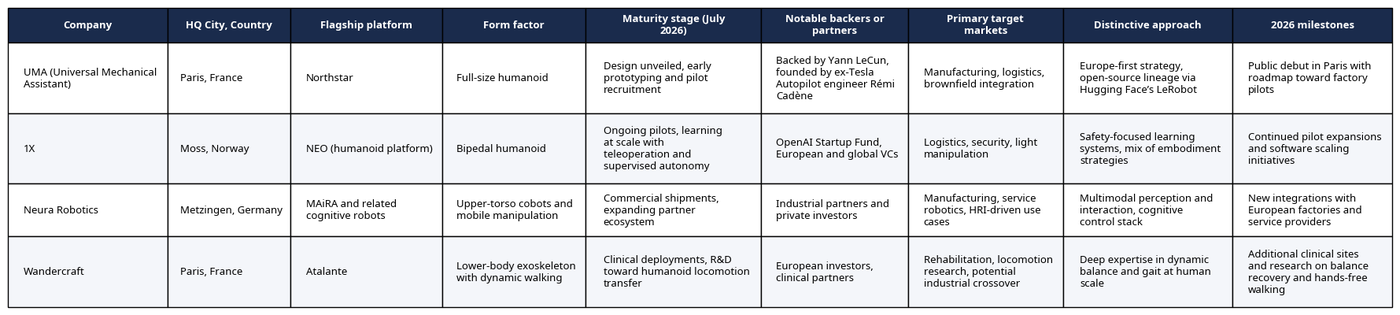
Comparison table: European humanoid and advanced robotics startups
Below is a side-by-side view of four visible European players. UMA is new to the list with Northstar, while 1X, Neura Robotics, and Wandercraft bring complementary approaches.
UMA’s early priorities, presented as a checklist
· Publish a clear safety case. Buyers will look for hazard analyses, performance levels for safety functions, and incident response procedures. The documentation should map to EU requirements.
· Land three named pilots with integration partners. Co-selling with known integrators shortens trust-building. Focus on plants ready to publish learnings.
· Lock a component strategy. Confirm actuator suppliers, hand partners, and embedded computing choices that do not trap the company in single-vendor risk.
· Instrument everything. Telemetry across joints, perception modules, and task execution will power rapid iteration and remote diagnostics.
· Build a task library. Start with high-leverage skills that recur across sites. Packaging, palletizing, inspection, and material transfer are common and measurable.
Scenarios to watch in the next 12 to 24 months
· Positive flywheel, UMA secures two to three European factory pilots that hit uptime and safety targets, publishes credible case studies, and attracts a contributor network around its software stack. Component partners co-design actuators that reduce cost per joint by a measurable margin, and a service playbook emerges that integrators can replicate.
· Mixed progress, early pilots validate navigation and basic manipulation, but hand reliability and task speed lag customer expectations. UMA leans more on teleoperation and shared autonomy to meet service levels while investing in better grippers. Sales cycles stretch, but no structural blockers emerge.
· Headwinds, supply chain lead times and energy budgets constrain field performance. A competitor locks a high-visibility European contract that sets a speed benchmark. UMA must shift focus to a subset of tasks where it can exceed reliability targets and defend a price premium with safety and compliance advantages.
Risks and unknowns
· Hardware fatigue, joint durability and heat management often limit duty cycles. UMA’s actuator selection and cooling strategies will be decisive.
· Hands and sensing, tactile feedback, force control, and grasp planning still require heavy engineering. Partnerships with gripper specialists will matter.
· Data and privacy, if UMA uses teleoperation or cloud-based learning, it must handle data residency and worker privacy under EU law with care.
· Unit economics, bill of materials and service costs must come down without destroying reliability. Pricing that aligns with three to five year payback in European factories is the practical hurdle.
What this means for buyers and integrators
If you evaluate humanoids in Europe, treat UMA’s launch as a sign that credible supply options are forming. The screening process should emphasize operational fit rather than headline capability.
· Site survey first. Map floor surfaces, slopes, light conditions, and human traffic. Humanoids excel when the environment is legible and well mapped.
· Task decomposition. Identify short-duration, repeatable tasks with measurable outputs. Avoid first deployments that require broad dexterity until hands mature.
· Safety envelope definition. Collaborate on speed and separation monitoring, emergency stops, and geofencing. Confirm documentation for audits.
· Integration plan. Connect to MES or WMS through clear interfaces. Favor pilots that need simple data flows before attempting complex bi-directional integrations.
· Service and uptime model. Ask for spares plans, on-site response times, and telemetry dashboards. Confirm escalation paths.
UMA will be judged by how quickly it can turn this advice into a repeatable customer rhythm. Europe has waited for a clear humanoid flag. Northstar plants it and invites a coalition to gather.
Wider market implications
The world does not need dozens of identical humanoids, it needs a few robust platforms that integrate well and a wider ecosystem that contributes software, hands, and services. UMA’s presence should encourage European venture funds to back suppliers of key enablers, like compact cycloidal drives, affordable finger sensors, and safety rated depth cameras. It should also prompt policy makers to streamline testbed creation and cross-border certification within the EU to speed deployment learning.
For the United States and China, European assertiveness is healthy competition. It may compress the premium that early leaders hoped to charge, and it will push everyone to publish safer and more transparent operating practices. It also diversifies where the hardest problems in manipulation and reliability are attacked, which benefits the field as a whole.
Bottom line
UMA’s Northstar is not the first humanoid to capture attention, but it may be the one that lets Europe convert its strengths, research, compliance, and integration discipline, into a commercial foothold. The strategy is legible, the timing is favorable, and the talent is here. The work, as always in robotics, begins after the unveiling.
Sources
· UMA, Universal Mechanical Assistant, press event and materials, Paris, July 7, 2026
· Hugging Face LeRobot, project documentation and GitHub repository
· EU AI Act and EU Machinery Regulation, official texts and guidance
· 1X, company website and investor announcements
· Neura Robotics, company website and product literature
· Wandercraft, company website and clinical deployment updates
· Industry background on Tesla, Figure, Agility Robotics, Unitree, AgiBot, and UBTECH from public company websites and prior public reporting














