
Dexmal Unveils DM0.5 Embodied Foundation Model with 31 Percent Zero-Shot Navigation Jump
Dexmal has launched DM0.5, a 4-billion-parameter embodied foundation model that improves zero-shot robot navigation by 31 percent and cuts fine-tuning costs by 60 percent. The release targets the software bottleneck holding back robot deployment in dynamic commercial spaces.
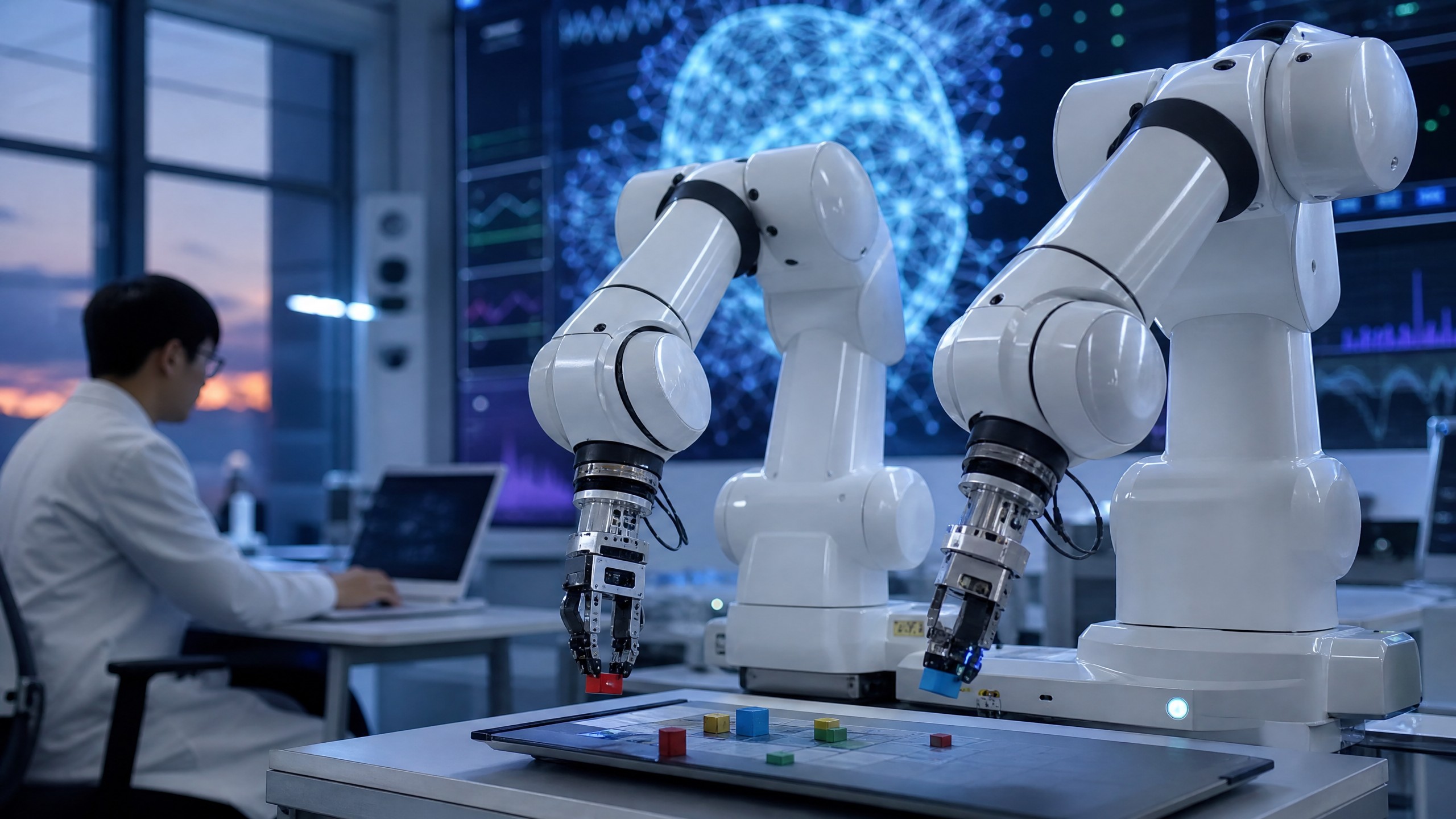
For years, the robotics industry has operated under a persistent constraint: hardware capabilities have consistently outpaced the cognitive software required to control robots in unstructured environments. Actuators have become more precise, materials more durable, batteries more efficient, and sensors more ubiquitous. Yet the ability of a robot to enter a novel space and navigate it without prior mapping, let alone manipulate objects within it, has remained a formidable challenge. This cognitive bottleneck has restricted most robotic deployments to controlled and predictable settings such as factory floors, structured warehouses, and carefully mapped logistics centers.
That landscape is changing rapidly as embodied artificial intelligence moves away from rigid programming and toward generalized learning. On July 9, 2026, Dexmal, the robotics venture founded by Megvii co-founder Tang Wenbin and recently merged with Atomix, introduced its DM0.5 embodied foundation model at its annual developer conference [1]. The release marks a significant inflection point in the trajectory of general-purpose robotics, characterized by a 31 percent improvement in zero-shot navigation and a comprehensive suite of tools designed to accelerate multi-embodiment deployment across diverse hardware platforms [2].
The importance of the announcement is not limited to one benchmark result. DM0.5 combines a larger model architecture, a specialized data pipeline, a 60-second native memory mechanism, embodied chain-of-thought reasoning, and support for multiple robot forms. Taken together, those elements suggest that Dexmal is not simply releasing another perception model or robotics control stack. It is attempting to establish a practical foundation layer for robots that must perceive, reason, move, and adapt in dynamic physical spaces.
The Genesis of Dexmal and the DM0.5 Architecture
To understand the significance of the DM0.5 release, it is essential to examine the lineage and strategic positioning of Dexmal. Founded by Tang Wenbin, a prominent figure in the computer vision space known for his foundational work at Megvii, Dexmal was built on the premise that the next frontier of artificial intelligence lies in physical embodiment [3]. The recent strategic merger with Atomix consolidated critical expertise in both high-level cognitive reasoning and low-level motor control, creating a unified entity capable of addressing the full stack of embodied intelligence [4]. This merger was not merely a pooling of resources. It represented a deliberate alignment of vision, learning, control, and deployment architectures, setting the stage for a more integrated approach to robotic intelligence.
The DM0.5 model represents the first major technical milestone following this consolidation. At its core, DM0.5 is a 4-billion-parameter foundation model, doubling the parameter count of its predecessor [5]. While 4 billion parameters may seem modest compared with large language models that often exceed hundreds of billions of parameters, embodied AI has different engineering constraints. In robotics, model size must be evaluated alongside inference latency, power consumption, robustness, sensor fusion capability, and the ability to convert perception into action quickly enough for safe physical interaction.
A robot operating in the physical world cannot wait several seconds for a response when a human steps into its path or when an object shifts unexpectedly during manipulation. Latency can determine whether a robot grasps a cup cleanly or knocks it off a table. It can determine whether a mobile platform stops safely or collides with an obstacle. For this reason, parameter efficiency is especially important. DM0.5 appears to be designed around the practical requirements of embodied deployment, not simply around scaling laws imported from text-based AI.
The foundation of DM0.5’s capabilities lies in its specialized training data pipeline. The model was trained on 150,000 hours of curated data [6]. This dataset is not merely a collection of internet videos. It is tailored for robotic learning and physical interaction. It includes 50,000 hours of real-robot high-precision manipulation data, capturing nuanced force, torque, and trajectory adjustments required for complex physical tasks [7]. This matters because manipulation is one of the hardest areas in robotics to generalize. A model must understand not only what an object is, but also how it behaves under contact, how much force it can tolerate, where it can be grasped, and how its state changes during interaction.
The corpus also incorporates 100,000 hours of egocentric video data, giving the model a human-like perspective on interacting with the world and understanding object continuity over time [8]. Egocentric data is particularly valuable for embodied models because it helps bridge the gap between observation and action. A robot does not merely classify a scene from a static camera angle. It moves through space, experiences partial occlusion, changes viewpoint, and must infer what remains true even when an object is temporarily out of sight.
Crucially, the training corpus also encompasses 1 million square meters of high-fidelity scene reconstruction, allowing the model to develop a stronger spatial understanding of diverse environments, from cluttered domestic spaces to complex industrial settings [9]. Scene reconstruction data contributes to navigation, obstacle avoidance, and semantic mapping. It helps the model understand not just the visible surface of a scene, but the spatial structure that governs movement through that scene.
Cognitive Advancements: Memory, Abstraction, and Chain-of-Thought
One of the most critical technical innovations within DM0.5 is its context abstraction layer, which introduces a 60-second native memory [10]. In traditional robotic control systems, actions are often reactive, based on immediate sensory input without a sustained understanding of temporal context. If a robot looks away from an object, it may lose track of the object’s position or state unless that information is maintained in a separate mapping or task-planning system. This creates fragility in tasks that require multi-step reasoning.
The 60-second native memory allows DM0.5 to maintain a coherent representation of its environment and ongoing task over a meaningful timeframe. This temporal awareness is essential for activities in which the outcome of one action dictates the parameters of the next. Examples include assembling a multi-part component, retrieving an item from a storage area, following a person through a crowded hallway, or navigating around a temporary obstacle that may soon move. In each case, the robot must preserve context, not simply react to the latest frame of sensor input.
This memory layer also has implications for safety. Robots operating around humans need to remember recent motion patterns, previously detected hazards, and incomplete tasks. A delivery robot in a hospital corridor, for instance, may need to remember that a patient was seated near a doorway a few moments earlier, even if a cart temporarily blocks the view. A manipulation robot may need to remember that it already loosened a fastener before moving to the next step. Without temporal continuity, robots can appear capable in isolated actions but unreliable in longer workflows.
Coupled with this memory architecture is the implementation of an embodied chain-of-thought reasoning mechanism [11]. Chain-of-thought reasoning has proven effective in large language models for solving complex logic and mathematical problems, but applying a similar concept to physical embodiment requires translation from abstract reasoning to spatial and kinematic planning. DM0.5 uses embodied chain-of-thought to break down high-level natural language commands into a sequence of executable subtasks, continuously evaluating progress and adjusting trajectory alignment in real time [12].
This trajectory alignment is central to the model’s practical value. In robotics, planning and execution often diverge. A plan may assume an object is in a particular location, but the object may move slightly. A gripper may approach at a poor angle. A mobile base may encounter unexpected friction or floor variation. DM0.5’s trajectory alignment mechanism is intended to reduce these gaps by comparing expected outcomes with real-time sensory feedback and adjusting physical execution accordingly.
The result is a more integrated cognitive loop. The model perceives the environment, maintains context, interprets goals, decomposes tasks, executes actions, and revises those actions as conditions change. This is the type of loop required for general-purpose robotics, where success depends less on perfect preprogramming and more on continuous adaptation.
Shattering the Zero-Shot Navigation Bottleneck
The most headline-grabbing metric from the DM0.5 launch is its performance in navigation, specifically in zero-shot and few-shot scenarios. Zero-shot navigation refers to the ability of a robot to successfully navigate a completely unseen environment without prior training, mapping, or human intervention in that specific space. It has long been one of the central objectives of mobile robotics because it directly affects deployment cost and scalability.
DM0.5 achieved a 31 percent increase in zero-shot navigation success rates compared with previous state-of-the-art models [13]. This is a meaningful jump because navigation failures are not merely technical inconveniences. They are deployment blockers. If a robot requires extensive site-specific mapping before it can operate, every new deployment becomes a custom engineering project. That slows adoption, raises costs, and limits robotics to customers with the budget and technical capacity to support complex installations.
The improvement is likely attributable to the model’s combination of scene reconstruction training, egocentric spatial awareness, semantic understanding, and memory. When placed in a novel environment, DM0.5 can rapidly construct a useful representation of its surroundings. It can identify obstacles, pathways, target destinations, and affordances with greater reliability. It understands not only the geometry of space, but also the meaning of objects within it. A door implies a potential pathway. A chair may imply a seating area and a likely human presence. A glass object may require greater clearance. A hallway sign may provide navigational context.
In few-shot scenarios, where the model receives a minimal amount of prior information or a brief demonstration, the performance jump is even more pronounced, registering a 45 percent improvement [14]. Few-shot performance is important for enterprise deployment because many commercial environments cannot be treated as completely unmapped. A facility may provide a short route demonstration, a partial floor plan, or a limited set of labeled waypoints. A model that can use minimal information efficiently can reduce commissioning time while still benefiting from available context.
These advancements have profound implications for robots in hospitals, retail spaces, offices, hotels, campuses, airports, eldercare facilities, and domestic settings. These spaces are dynamic. Furniture moves, people behave unpredictably, doors open and close, lighting changes, and obstacles appear without warning. A robot that depends on a fixed map may degrade quickly in such environments. A robot with stronger zero-shot navigation can adapt as conditions change.
The Autonomous Robot Penetration Index, or ARPI, is especially relevant here because navigation autonomy is one of the key factors affecting how deeply robots can penetrate real commercial environments. ARPI evaluates more than whether a robot can perform a task in a laboratory. It considers deployment friction, autonomy level, environmental flexibility, cost of integration, operational reliability, and scalability. A 31 percent jump in zero-shot navigation directly improves the environmental flexibility and deployment friction dimensions. If validated outside benchmark settings, the improvement could increase the practical penetration potential of mobile and mobile-manipulation robots in markets where mapping and customization have historically limited adoption.
Benchmarking Dominance and Inference Efficiency
Beyond navigation, DM0.5 has demonstrated strong performance across a range of standardized evaluations, supporting Dexmal’s claim that it is a general-purpose embodied model rather than a narrow navigation system. According to Dexmal’s technical report, the model beats the current state of the art on four distinct industry benchmarks [15]. Most notably, it secured the number one ranking on the RoboChallenge Table30 V2 benchmark, achieving a total score of 54.42 and a success rate of 43 percent [16].
The RoboChallenge Table30 V2 benchmark is significant because tabletop manipulation remains one of the most demanding categories of embodied AI. A model must identify objects, infer grasp points, handle variations in shape and texture, adapt to clutter, and execute precise movements. A 43 percent success rate may sound modest compared with software-only AI benchmarks, but in physical manipulation, even incremental improvements can be meaningful. Real-world object interaction involves uncertainty at nearly every layer, including perception, contact mechanics, actuation, and recovery from failed attempts.
DM0.5 also achieved a 99.1 percent success rate on the LIBERO benchmark, which evaluates lifelong learning and the ability to acquire new skills without forgetting previously learned ones [17]. This capability is crucial for robots deployed in environments where tasks evolve over time. A warehouse robot may begin with picking and sorting, then later learn inspection or replenishment. A domestic robot may learn household-specific preferences. An industrial robot may adapt to new product lines. If learning new tasks causes degradation in previous skills, long-term deployment becomes unstable. High performance on lifelong learning benchmarks suggests that DM0.5 may offer a more stable foundation for robots that must improve over time.
Despite its sophisticated cognitive architecture and benchmark performance, DM0.5 is engineered for efficient inference. The model achieves an inference latency of 50 milliseconds on an NVIDIA H100 Tensor Core GPU [18]. More importantly for broader commercial adoption, it maintains a viable 90-millisecond latency on a consumer-grade NVIDIA RTX 4090 GPU [19]. This matters because inference hardware economics are a major determinant of robotics adoption. A model that requires top-tier data center hardware for every robot may be impractical for many deployments. A model that can operate on accessible GPU hardware is easier to test, prototype, and deploy.
Dexmal also reported a 60 percent reduction in fine-tuning costs [20]. Fine-tuning cost is another important ARPI factor because it affects integration expense and scalability. Many robots fail commercially not because the hardware is incapable, but because adapting the system to each customer’s environment consumes too much engineering labor. If DM0.5 lowers the cost of adapting models to specialized tasks, it could make robotics viable for smaller enterprises that cannot afford bespoke deployments.
A Multi-Embodiment Ecosystem: DexDev and Ferrata
Dexmal’s vision extends beyond the foundation model itself. The company is building an ecosystem to support the development and deployment of embodied AI across the industry. Recognizing that the future of robotics will include a diverse array of hardware form factors tailored to specific tasks, DM0.5 is designed for multi-embodiment operation [21]. The model currently supports a wide range of robotic platforms, including the Aloha bimanual system, ARX, Universal Robots arms, the Unitree G1 humanoid, Tiangong, and Realman [22].
This hardware-agnostic approach is strategically important. The robotics industry is fragmented across manipulators, mobile bases, humanoids, quadrupeds, drones, and task-specific machines. A foundation model that can transfer capabilities across embodiments could reduce duplicated effort and accelerate learning across the sector. Developers could train a cognitive skill once and adapt it across different bodies, subject to physical constraints and task requirements.
For customers, multi-embodiment support reduces the risk of vendor lock-in. A retailer might use a mobile robot for aisle scanning, a fixed arm for backroom sorting, and a humanoid platform for future customer-facing tasks. If those systems can share a common intelligence layer, the organization gains consistency in developer tooling, fleet management, and task planning. It also becomes easier to compare hardware suppliers based on mechanical suitability rather than being forced into a single proprietary stack.
To facilitate this ecosystem, Dexmal simultaneously launched the DexDev platform [23]. DexDev provides developers with tools for training, simulation, and deployment of embodied models. A key component of DexDev is the DFOL2.0 reinforcement learning loop, the Dexmal Framework for Offline Learning, which streamlines fine-tuning using offline data [24]. Offline learning is valuable because real-world robot training can be expensive, slow, and risky. Simulated and offline workflows allow teams to improve policies before exposing robots to physical environments where failures can damage equipment or interrupt operations.
Dexmal also introduced Ferrata, a multi-agent operating system designed to orchestrate interactions between multiple robots and their environment [25]. Ferrata enables fleet-level coordination, allowing diverse robotic systems powered by DM0.5 to collaborate on tasks, share spatial intelligence, and optimize collective efficiency. This operating system is particularly relevant for logistics, manufacturing, healthcare operations, facility management, and large commercial campuses.
The multi-agent layer could become one of the most important pieces of Dexmal’s strategy. Individual robot intelligence is necessary, but large-scale adoption often requires coordinated autonomy. A fleet of robots must avoid congestion, divide tasks, update shared maps, respond to changing priorities, and integrate with enterprise systems such as warehouse management software, hospital scheduling platforms, security systems, or building management tools. Ferrata’s success will depend on whether it can provide this orchestration reliably and securely.
Competitive Landscape and Procurement Implications
The introduction of DM0.5 significantly alters the competitive landscape of the embodied AI sector. Dexmal is positioning itself as a challenger to established players and well-funded startups. Companies such as Google DeepMind have made significant strides with models like RT-X, while startups and major technology firms are pushing the boundaries of humanoid robotics through vertically integrated approaches. Dexmal’s strategy differs by emphasizing an efficient, hardware-agnostic foundation model coupled with a developer ecosystem.
This distinction matters. Vertically integrated robotics companies can optimize tightly around a specific hardware platform, which may produce strong near-term performance in controlled applications. However, hardware-agnostic platforms may scale more broadly if they can deliver reliable cross-embodiment transfer. The tradeoff is integration complexity. A general model must adapt to many different sensors, actuator configurations, kinematic limits, and safety systems. Dexmal’s ability to manage those differences will determine whether DM0.5 becomes a widely adopted foundation layer or remains strongest within a limited compatibility set.
For enterprise procurement teams and technology strategists, the DM0.5 release requires a reassessment of deployment strategy. The traditional model of purchasing vertically integrated robotic systems, where hardware and software are tightly coupled and proprietary, is being challenged by robust multi-embodiment foundation models. This shift resembles the evolution of computing from proprietary systems toward standardized software layers running across diverse hardware.
The ability to deploy a single cognitive architecture across diverse hardware platforms, including stationary robotic arms, mobile platforms, and humanoids, offers advantages in standardization, maintenance, and scalability. Procurement teams can negotiate hardware contracts independently of software capabilities, reducing vendor lock-in. The improvements in zero-shot navigation and the reported reduction in fine-tuning costs directly affect total cost of ownership. Organizations can anticipate faster deployment times, reduced reliance on site-specific engineering, and greater flexibility in adapting robots to new tasks as business needs evolve.
At the same time, procurement teams should evaluate the maturity of DexDev and the long-term viability of Ferrata. Strong benchmark performance is not the same as production reliability. Enterprise deployments require robust support, documentation, cybersecurity practices, compliance alignment, observability tools, rollback mechanisms, and integration with existing workflows. Performance on consumer-grade hardware such as the RTX 4090 is a strong indicator of accessibility, but enterprise-scale deployments still require careful edge computing design, network resilience, data governance, and safety validation.
The ARPI implications are significant but conditional. DM0.5 appears to improve several ARPI-relevant dimensions, including autonomy level, environmental adaptability, deployment speed, cost of customization, hardware flexibility, and fleet scalability. However, ARPI also weighs operational proof. The model’s true index impact will depend on whether benchmark gains translate into stable service hours, low intervention rates, acceptable maintenance requirements, and measurable productivity gains in live deployments.
The Path Forward for Embodied Intelligence
The launch of Dexmal’s DM0.5 foundation model represents a critical step forward in the pursuit of general-purpose embodied intelligence. By addressing bottlenecks in zero-shot navigation, real-time cognitive processing, memory, and multi-embodiment support, Dexmal has demonstrated that the gap between robotic hardware capability and software autonomy is narrowing. The combination of a 4-billion-parameter architecture, a specialized training data pipeline, efficient inference, and a developer ecosystem positions Dexmal as a central player in the next phase of robotics competition.
The next phase will be defined by real-world validation. Benchmarks provide useful comparisons, but embodied AI ultimately succeeds or fails in messy physical environments. Hospitals, warehouses, homes, stores, and factories contain edge cases that are difficult to capture in standardized tests. Robots must handle sensor noise, human unpredictability, object variability, floor conditions, occlusion, regulatory constraints, and unexpected interruptions. A model that performs well in these environments will have a meaningful advantage over systems that remain brittle outside controlled demonstrations.
For developers, DM0.5 offers a potentially practical path toward building applications that do not require starting from scratch. For hardware makers, it may provide a common intelligence layer that increases the value of their platforms. For enterprises, it may reduce the cost and risk of robotics adoption. For the broader embodied AI market, it raises the competitive bar by combining navigation, manipulation, memory, and deployment tooling into a single ecosystem.
The true test for Dexmal will be translating technical metrics into reliable, scalable commercial performance. If the 31 percent jump in zero-shot navigation holds up in real deployments, and if DexDev and Ferrata mature into robust production tools, DM0.5 could become an important foundation for adaptable robotics. For now, the release is a clear signal that embodied AI is advancing toward a more general, more deployable, and more economically practical phase.
Sources:
[1] Dexmal Developer Conference Keynote, July 9, 2026.
[2] Dexmal Official Press Release: “Introducing DM0.5: The Next Generation of Embodied AI,” July 2026.
[3] Tang Wenbin, Public Statements on the Founding Vision of Dexmal, 2024.
[4] Industry Analysis Report: “The Strategic Implications of the Dexmal-Atomix Merger,” Q1 2026.
[5] Dexmal DM0.5 Technical Whitepaper, Section 2: Model Architecture, July 2026.
[6] Dexmal DM0.5 Technical Whitepaper, Section 3: Data Pipeline and Curation, July 2026.
[7] Dexmal DM0.5 Technical Whitepaper, Subsection 3.1: Real-Robot Manipulation Data, July 2026.
[8] Dexmal DM0.5 Technical Whitepaper, Subsection 3.2: Egocentric Video Integration, July 2026.
[9] Dexmal DM0.5 Technical Whitepaper, Subsection 3.3: High-Fidelity Scene Reconstruction, July 2026.
[10] Dexmal DM0.5 Technical Whitepaper, Section 4: Context Abstraction and Memory, July 2026.
[11] Dexmal DM0.5 Technical Whitepaper, Section 5: Embodied Chain-of-Thought Reasoning, July 2026.
[12] Dexmal DM0.5 Technical Whitepaper, Subsection 5.1: Trajectory Alignment Mechanisms, July 2026.
[13] Dexmal DM0.5 Performance Benchmarks Report, Section 1: Navigation Metrics, July 2026.
[14] Dexmal DM0.5 Performance Benchmarks Report, Subsection 1.2: Few-Shot Adaptation, July 2026.
[15] Dexmal DM0.5 Performance Benchmarks Report, Executive Summary, July 2026.
[16] RoboChallenge Table30 V2 Official Leaderboard, Accessed July 2026.
[17] LIBERO Benchmark Official Results Database, Accessed July 2026.
[18] Dexmal DM0.5 Hardware Optimization Guide, Section 1: Enterprise GPU Performance, July 2026.
[19] Dexmal DM0.5 Hardware Optimization Guide, Section 2: Consumer GPU Performance, July 2026.
[20] Dexmal Developer Portal: “Cost Analysis of Fine-Tuning DM0.5,” July 2026.
[21] Dexmal Ecosystem Overview, Section 1: Multi-Embodiment Strategy, July 2026.
[22] Dexmal Supported Hardware Compatibility List, Version 1.0, July 2026.
[23] DexDev Platform Documentation, Introduction, July 2026.
[24] DexDev Platform Documentation, Section 4: DFOL2.0 Reinforcement Learning Loop, July 2026.
[25] Ferrata Multi-Agent OS Technical Overview, July 2026.
Disclaimer: This article is for informational purposes only and does not constitute financial, investment or technical advice.














