
Ant Group’s Lingbo open sources LingBot-Depth 2.0 and LingBot-Vision, a spatially native embodied vision foundation model
Ant Group’s Lingbo Technology unveiled LingBot-Depth 2.0 and open sourced LingBot-Vision, a foundation model that makes boundary structure a core pretraining signal.
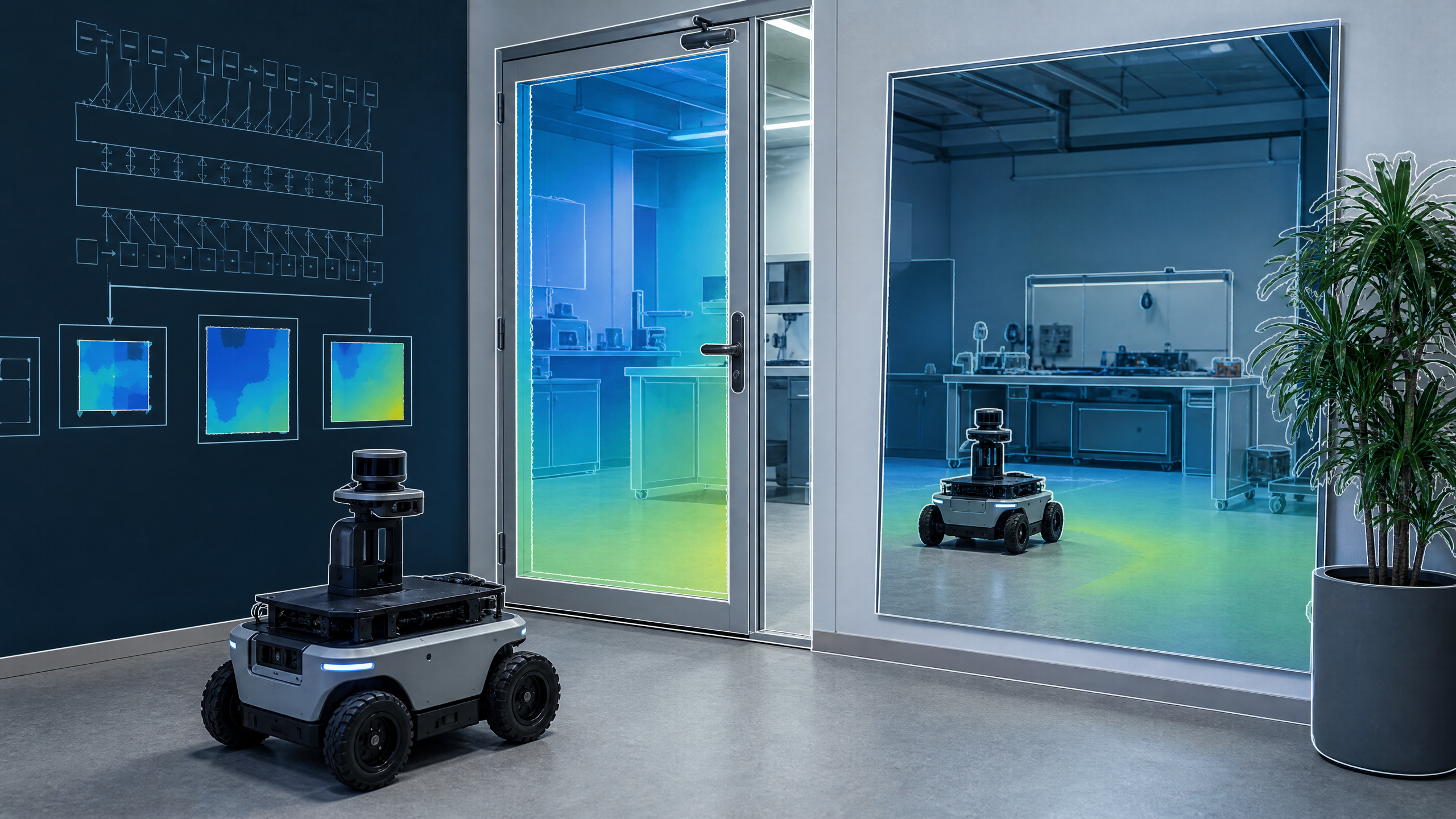
July 7, 2026, Ant Group’s embodied AI subsidiary Lingbo Technology released two major building blocks for robotics perception and then opened the door for developers. LingBot-Depth 2.0, a new spatial perception model trained on a 150 million scale depth dataset, now leads 12 of 16 industry depth completion benchmarks. In the hardest indoor test with large missing depth regions, its RMSE drops from 0.132 to 0.062. The company also open sourced LingBot-Vision, a foundation model that treats boundary structure as a first class pretraining objective. The team calls it spatially native, and on NYU-Depth v2 transfer it matches or beats models up to seven times larger, including a 7 billion parameter DINOv3 baseline. A 0.3 billion parameter distilled student keeps parity with the 7B reference while using about 23 times fewer parameters and a pretraining corpus of 160 million images, which is roughly one tenth the scale of DINOv3 style recipes.
What was announced
Lingbo’s July 7 bundle contains two discrete pieces that are designed to work together in embodied settings.
· LingBot-Depth 2.0 is a production oriented depth completion and estimation model. It is trained at 150 million sample scale and posts new results across indoor and challenging materials that confuse traditional sensors. Glass panels, mirrors, and other transparent or reflective surfaces are particular strengths.
· LingBot-Vision is a self supervised vision foundation model built on a ViT backbone with a pretraining task that forces the model to recover boundary structure. The company frames this as spatially native pretraining because it gives the transformer an explicit spatial objective, rather than leaving geometry to emerge implicitly.
Both projects are released for the community. LingBot-Vision weights are available in four sizes, roughly mapping to ViT-G, ViT-L, ViT-B, and ViT-S tiers, with code on GitHub and model cards on Hugging Face. The technical report is posted on arXiv as 2607.05247.
Why boundary structure as an objective matters
Most self supervised vision pretraining uses image reconstruction, invariance, or teacher student distillation to shape features. These approaches have produced strong general purpose descriptors, yet they do not guarantee that the learned features encode crisp spatial discontinuities that align with surfaces and object edges. Robotics perception stacks often need exactly that information to support navigation, grasp planning, and scene understanding, especially when depth sensors fail or when robots must plan under partial observations.
LingBot-Vision elevates boundaries to a training objective. The team describes masked boundary modeling, sometimes called boundary forcing, in which the model must predict intentionally hidden boundary cues from context. Through that task, the model becomes more sensitive to contour continuity, depth discontinuities, and occlusion geometry. That inductive signal simplifies downstream transfers to depth estimation and depth completion. It also improves zero or low shot performance on tasks that favor spatial reasoning, because the backbone has seen millions of cases where edges carry the most useful information about a scene’s 3D structure.
There is a pragmatic reason to prefer this route in robotics. Robots operate amid reflective and transparent surfaces that defeat active depth sensors. Glass windows, acrylic guards, and polished metal can cause time of flight and structured light cameras to report invalid or noisy readings. A vision model that is tuned to find boundaries and infer geometry from monocular cues can mitigate those failure modes, which is exactly where LingBot-Depth 2.0 is designed to capitalize on the foundation model’s features.
Evidence on benchmarks and data efficiency
Lingbo reports that LingBot-Vision is built around a roughly one billion parameter ViT configuration, with distilled students at smaller scales. On NYU-Depth v2 depth estimation transfer, the main model meets or exceeds the performance of much larger teacher style baselines, including a 7B DINOv3 reference in internal comparisons. The 0.3B distilled student is reported to match the 7B result at a fraction of the size, yielding around 23 times fewer parameters. The pretraining corpus is 160 million images, which is an order of magnitude smaller than the datasets often used in comparable self supervised pipelines. That efficiency is an important operational benefit, because many robotics teams do not have the budget or time to run hundred billion sample regimes.
On the depth side, LingBot-Depth 2.0 moves the headline numbers. The model leads 12 out of 16 publicly tracked depth completion benchmarks in the company’s test matrix. The most striking figure is the halved RMSE in the hardest indoor scenario with wide missing regions, improved from 0.132 to 0.062. Glass, mirrors, and transparent objects are also cited as improved cases, which map to real world operational pain points in warehouses, retail, and service environments. These claims were certified by Orbbec’s depth vision laboratory, adding a third party measurement layer on top of Lingbo’s internal validation.
While independent replication across the community will take time, the profile of results aligns with the idea that explicit boundary supervision can cut through classic edge cases. By biasing the features toward surface breaks, the model can infer shape and layout even when direct depth returns fail.
How LingBot-Vision compares to incumbent models
Embodied vision is not a single task, and no single pretraining objective fits every downstream requirement. That said, a few defaults have become common. DINO style self supervised ViTs remain a strong baseline for representation learning. Meta’s Segment Anything Model dominates segmentation workflows and provides promptable masks for downstream tasks but it was not designed for depth estimation. Traditional masked autoencoders supply reconstruction skills but often require significant adaptation to compete on geometric tasks.
Lingbo’s contribution is to add a simple, explicit bias toward spatial discontinuity, then to show that this one change yields strong depth transfer without a billion image pretraining run. The distilled 0.3B student hitting parity with a 7B DINOv3 reference on NYU-Depth v2 is the clearest expression of that idea. It suggests that much of the signal needed for geometry sits in boundaries, not just in global invariances or teacher matching scores.
Embodied vision and depth perception models, side by side
Below is a compact comparison of common choices for perception backbones in embodied work. It focuses on the pretraining objective, parameter scale, spatial bias, and suitability for depth tasks and edge deployment.

Productization with Orbbec and an edge SDK
Open source is only half the story. Lingbo also set a deployment track in motion with Orbbec. The company says Orbbec’s depth vision lab certified the headline results. The partners are working to optimize LingBot-Depth on the Gemini 330 series depth cameras. An EGO RGB D data collection device adaptation is planned to facilitate dataset expansion and evaluation in the field. Lingbo also previewed an SDK tailored for edge use, which matters for mobile robots that cannot maintain a reliable link to the cloud. The roadmap includes an integrated camera product that ships with a commercial build of LingBot-Depth before year end.
The shape of that partnership suggests two layers of product work. First, software tuning and model conversion to target Orbbec’s hardware constraints. Second, a vertically integrated option for customers who want a ready to mount perception module, which reduces integration time for small robotics teams.
Engineering choices that stand out
A few design decisions, as described by Lingbo, are worth highlighting for practitioners.
· Boundary first objective. Masked boundary modeling changes what the model learns by default. It avoids a purely reconstruction or invariance based representation and makes edges first class signals.
· Parameter efficient students. The 0.3B distilled model is not a toy. If it matches a 7B DINOv3 reference in depth transfer, it broadens the set of robots that can run strong perception without server class hardware.
· Mid scale pretraining corpus. A 160M image corpus is still large, but it is closer to a practical ceiling for well funded labs than a billion image run. This opens a path for replication and further research.
· Alignment with depth completion. The tight coupling between the foundation model and Depth 2.0 shows up in the results on glass and mirrors. This pairing is a reminder that foundation models pay off when aligned with specific tasks that inherit their inductive biases.
Where the limits may be
The release notes point to strengths on indoor scenes and on materials that sensor based depth often mishandles. Open questions remain.
· Outdoor generalization. Bright sunlight, weather, and long range scenes stress both monocular inference and active depth sensors. The report focuses on indoor and indoor like settings. Outdoor evidence would be useful.
· Multi camera fusion. Many robots use stereo, RGB D, and event cameras in combination. How LingBot-Vision features perform in fused pipelines deserves exploration.
· Motion and temporal continuity. The boundary objective is defined at the image level. It is plausible that explicitly modeling temporal edges and motion boundaries could add another jump in performance for tasks like SLAM and dynamic obstacle tracking.
· Label free integrity. Self supervised methods can inherit dataset biases. Boundary heavy pretraining might overemphasize edges in textures or artwork that do not imply geometry. Careful evaluation on varied domains is needed.
None of these caveats diminish the significance of the step forward reported on depth completion. They frame the next round of experiments the community will likely run.
What this means for embodied AI and robotics buyers
For teams building mobile robots in warehouses, retail, hospitals, and hospitality, fragile perception is a constant source of downtime. A robot that misreads a glass door or fails to resolve a mirror can stall at best and cause damage at worst. If a foundation model plus a tuned depth head reduces these incidents, it becomes a procurement level decision.
· Fewer sensor substitutions. Transparent and reflective materials often trigger expensive hardware workarounds. Software that narrows those gaps lets buyers keep standard camera and depth modules.
· Edge viability. A 0.3B model that stays competitive makes it realistic to run on an embedded GPU or a mid tier compute module. That eases thermal and battery constraints for mobile platforms.
· Data leverage. If the model reaches strong spatial representations on 160M images, scaling additional data collection becomes more about edge cases and domain coverage, not just raw volume.
· Vendor ecosystem. Orbbec integration and an SDK can reduce integration friction. If the integrated camera product arrives on time, it gives systems integrators an off the shelf upgrade path.
Open source details and how to start
Lingbo has published LingBot-Vision code and checkpoints for four sizes that correspond to ViT-G through ViT-S style capacities.
· Hugging Face: robbyant/lingbot-vision
· GitHub: robbyant/lingbot-vision
· Technical report: arXiv 2607.05247
Early adopters can begin with the B or S sizes to test throughput and memory on target hardware, then graduate to L or G if the application allows. For depth completion, LingBot-Depth 2.0 is positioned as the primary head for robotics tasks. The company has not yet posted training code for the 150M depth corpus, but it has described the evaluation matrix and will release an SDK to facilitate deployment on edge devices.
Historical context for LingBot releases
Lingbo has iterated rapidly in 2026. Depth 1.0 landed on January 27, followed by LingBot-World on January 29 and World-Fast on April 27, then LingBot-Map on April 16. Today’s package ties those strands together by hardening depth and tightening the link between the foundation model and geometric heads. The cadence also signals a strategic bet that embodied AI needs spatially biased pretraining, not just larger generic vision models.
How to evaluate the claims on your own stack
· Test on your hardest surfaces. If your robots struggle with mirrors or semi transparent guards, replicate the company’s scenarios with your data.
· Measure latency and thermal budget. The 0.3B distilled student is designed for edge, but workload mix can spike memory or heat. Profile end to end with your navigation stack.
· Check long tail generalization. Hold out locations and lighting patterns that differ from your training set.
· Plan for fusion. If you use stereo or LiDAR, evaluate whether the boundary features improve fusion stability.
A transparent process will let buyers judge whether the advantages carry through in their operations.
Outlook
If the boundary objective continues to show this level of leverage, it could become a standard component in embodied model pretraining. The most near term effect is likely to be better indoor navigation and manipulation under glass and mirror heavy conditions. By year end, the Orbbec integrated camera with a commercial build of LingBot-Depth would give the market a ready made proof point. If that product hits performance and price targets, expect copycat boundary objectives to appear across research labs and vendors.
For now, the open source release lowers the barrier to trying the approach. It gives startups and labs a concrete route to stronger depth transfer without committing to multi billion sample training runs. That is good news for an ecosystem that needs more practical wins, not just larger models.
Sources
· QbitAI
· GitHub: robbyant/lingbot-vision
· Hugging Face: robbyant/lingbot-vision














