Anhui humanoid output rises as Mojia expands deployment
Anhui reports complete humanoid-robot output above 2,600 units in the first half of 2026, after producing just over 700 units in all of 2025. Mojia Robot, incubated within Chery, reports more than 590 humanoid sales across over 60 markets during the first half. A Hefei public data-service platform is training robots in battery assembly, handling and service scenarios. The disclosed figures point to more activity, while leaving delivery, utilisation and customer outcomes unreported.
Anhui is linking a public data-collection program in Hefei with a push for humanoid deployments and a sharp rise in output. The province reports complete-machine humanoid production above two thousand six hundred units in the first half of 2026, up from just over seven hundred in all of 2025, while Mojia Robot logs expanding global sales.
Hefei builds a humanoid training loop
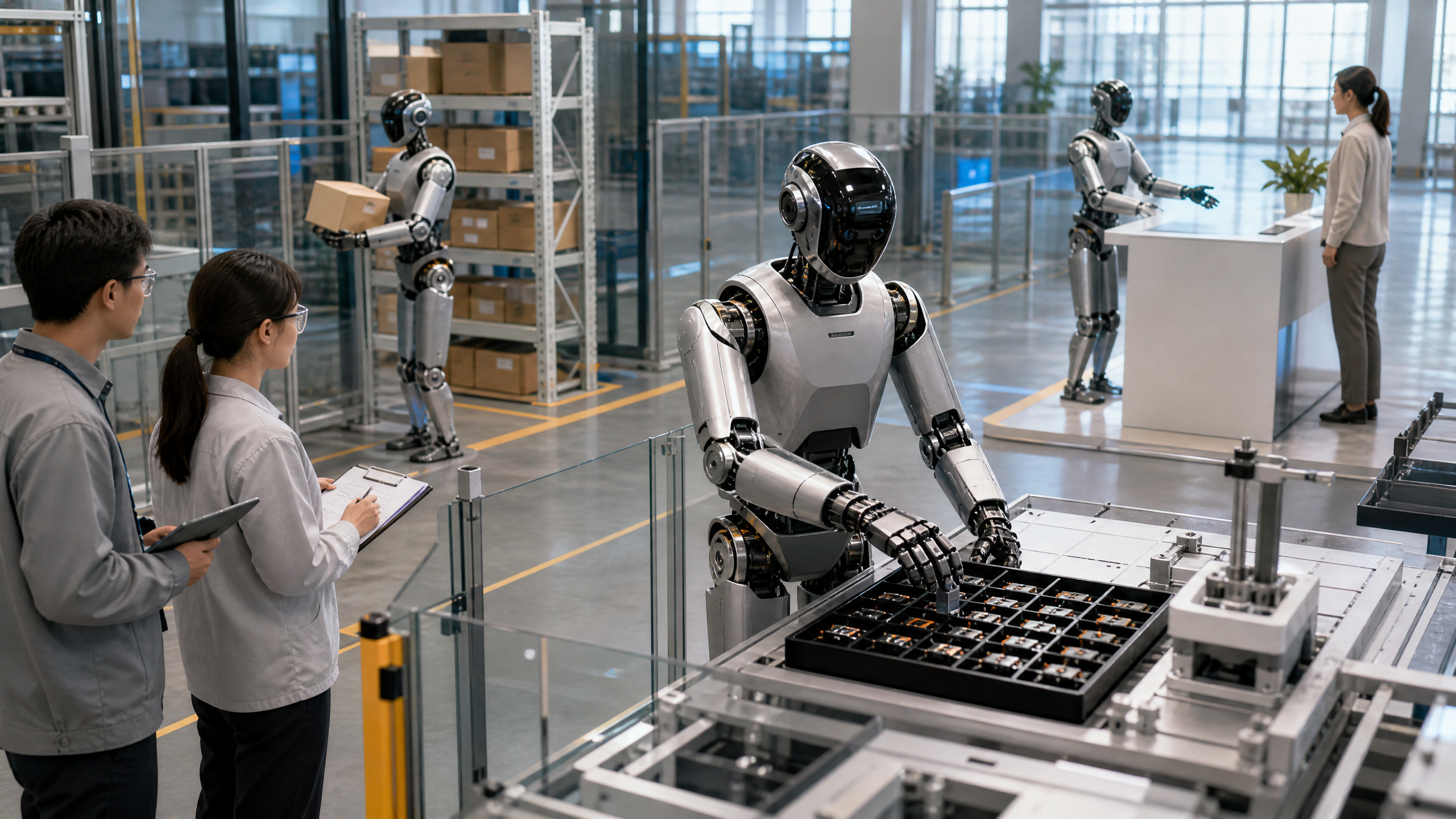
A public intelligent-robot service platform in Hefei covers one thousand six hundred square metres and staffs about forty data-collection workers. The team sets up realistic operating environments that include precision battery assembly, shelf-item identification and handling, and service interaction. The platform records robot motions and turns the observations into training data that improve perception and motion models across different humanoid designs.
This arrangement aligns with a stated loop of real-scene training, data accumulation, product iteration, and scaled deployment. Rather than test in abstract simulations alone, the platform mixes mechanical tasks like placement and pick with public-facing interactions, which are prone to ambiguity. The aim is to harden models with sensory variation that reflects how a robot will actually be asked to work, from a gloved operator in a battery line to an impatient shopper at a kiosk.
For operations leaders, the presence of a common facility changes the onboarding calculus. Vendors that use shared testbeds can arrive with a baseline of trained behaviors for common jobs, which shortens a factory or venue’s own data-collection ramp. That can reduce technician time at the edge and cut down on trial resets. The gains will only hold if a buyer’s site conditions match the platform’s staged scenarios closely enough, so a walk through of the test scenes should be on the pre-pilot checklist.
The method is easiest to grasp with a plain comparison. Training a humanoid with real-scene data is like teaching a new hire with work samples and shadow shifts rather than only a manual. The samples expose edge cases and the shadowing makes timing and handoffs clear. The better the samples, the smoother the handover.
Province ties data to sector targets
Anhui has described a coordinated push across industrial and service domains that relies on the Hefei loop to build repeatable behaviors. It is promoting industrial robots for automotive material handling, service robots for commercial guides and retail, and care robots for community health and eldercare organisations. In each category the claim is that data from realistic scenes feed product updates and ready units for scaled deployment.
That mix points to an organisational approach. A provincial platform hosts shared data and training activity while vendors and adopters target defined sectors. Automotive plants already run with tight takt times and standard fixtures, so material handling is a logical first target for robot arms and mobile bases. Retail and public guide roles vary more by site and language. Community health and eldercare add sensitivity around privacy and human interaction. Putting them under one loop suggests a belief that data breadth will help generalize models across tasks.
Procurement teams should read this as an invitation to specify. If a supplier references the Hefei platform, ask which exact tasks and scenes were used, which error modes were observed, how often models are updated, and how those updates are validated before arrival on site. Request a mapping between your job specification and the platform’s scenarios, then design a small pilot that mirrors that mapping. This locks in testable claims and reduces later debate over whether a miss came from the robot or from a mismatch of environments.
Output rises faster than job proof
Production numbers and sales headlines are moving up. Anhui reports complete-machine humanoid output above two thousand six hundred units in the first half of 2026. That compares to just over seven hundred in all of 2025. Mojia Robot, which was incubated inside Chery from 2023 and formally established in early 2025, reported global sales above three hundred humanoids in 2025 and more than five hundred ninety in the first half of 2026, across more than sixty countries and regions.
The gap is that counts do not reveal how many robots are meeting a named job specification, at what level of consistency, for how many hours per day, and with what support burden. The disclosures do not give shipment definition, revenue, return rates, fleet utilisation, safety metrics, customer names, or a separation between orders and deliveries. Without those signals, a buyer cannot infer the weight of proof behind a claimed task, and an operator cannot plan staffing around expected stability.
The platform-first story is sound engineering practice, but the commercial question is still open. If the Hefei loop is producing better general models, we should see pilots convert into multi-site rollouts where the same task is repeated with minimal retuning. The data would then shift from unit counts to job counts, from boxes moved to hours at spec, from demos to schedule adherence. Until those numbers are public or shared under an evaluation agreement, unit growth is best seen as capacity, not guarantee.
"Production without proof of job repeatability is a bet, not a contract."
That is a conservative reading, not a dismissal. The move from a few hundred to a few thousand units puts more machines in more varied conditions, which is a necessary step to improve models. The Hefei platform adds structure to that process by staging tasks that matter to target sectors. The procurement edge comes from turning this structure into verifiable milestones. For example, set a threshold for mispick rate in shelf handling or for handover timing during a reception flow, then hold pilots to those thresholds before authorizing expansion.
Mojia targets public facing use cases
Mojia Robot offers a clear example of how vendors are aligning with the broader push. The company was incubated inside Chery from 2023 and became a formal entity in early 2025. Its Mo Yin humanoid stands one point six seven metres tall, supports multiple languages, and is intended for traffic direction, customer reception, and exhibition inspection. These are tasks where presence and clear communication matter as much as manipulator skill.
The numbers suggest momentum in market reach. Mojia reported global sales above three hundred humanoids in 2025 and more than five hundred ninety in the first half of 2026, across more than sixty countries and regions. Pair those placements with a public data loop and you have a feedback channel that can improve multilingual prompts, visitor guidance routines, and movement safety envelopes in crowded spaces. Operations managers for venues and events should see an opportunity to standardize scripts, signage integration, and escalation paths that can carry across sites.
Even so, practical gaps remain. Public roles vary by language mix, acoustic noise, lighting, and crowd density. If deployments draw on shared training data from Hefei, buyers should verify that those scenarios include the specific conditions of their venues. Plan small, time-bounded trials that cover peak hours, include clear stop rules for off-nominal behavior, and gather interaction logs for post-mortem review. A short pilot that hits real stress points is worth more than a longer pilot that avoids them.
From units to use cases that repeat
The province’s message is that real-scene data drives iteration and deployment at scale. The production figures and Mojia’s reported sales give that story a sense of momentum. Yet the commercial test is repeatable jobs. A repeatable job has a clear definition of done, measurable tolerances, and an observed rate of task completion that stays within those tolerances across shifts and weeks. Every procurement decision should aim to turn vendor claims into that form.
Treat the data platform as a starting kit, not as proof by itself. Ask vendors who trained at Hefei to describe the battery assembly scenes, the shelf handling layouts, and the service interaction scripts they used. Map those to your workcells or venues, then co-author a test plan. Include trigger conditions, time windows for retries, fallbacks to human staff, and a rule for model changes during the pilot. Leave room for improvement, but guard against silent retuning that moves the goalposts.
The analogy is simple. You would not approve a new tool in a plant based only on how many were shipped. You would check that it hits torque, speed, and durability specs on your line. Humanoids deserve the same discipline. A data loop helps get there faster, yet it does not replace acceptance testing. Once a robot clears a job at one site with real numbers, stamp that use case and roll it to the next site with the same metrics.
If you are sourcing for automotive material handling, look for vendor evidence tied to the fixtures and bins you use, and to the motion profiles that minimize line interference. For retail or guides, look for evidence tied to your store layouts, product mix, and traffic patterns, with multilingual prompts that match your brand. For health and eldercare, push for proofs around consent, privacy handling, and incident response in community settings. The data loop can and should inform each of those, but the contract should stand on job proof.
A cautious path to scale
There is real activity in Anhui. The Hefei platform places about forty workers in the loop to gather data in realistic scenes across factory and service environments. The province highlights a chain that runs from training to data to iteration to scaled deployment. Mojia is specific about the height and roles of its Mo Yin humanoid and reports rising global sales counts. Provincial output has risen sharply in the first half of 2026.
A decisive point follows. When buyers shift attention from unit counts to documented, repeatable jobs, vendors will compete on sustained task quality rather than on the number of robots shipped. The Hefei platform and the reported output gains can help, but only if procurement teams convert them into verifiable commitments. That is where the next year of progress will be won or lost.
This analysis is provided for informational purposes only and does not constitute investment, legal, or procurement advice. RobotAIGeek does not endorse specific vendors or guarantee the performance of early-stage technologies.