
AI2 Robotics Raises $735M to Scale Wheeled Humanoid Robots in China
Shenzhen startup AI2 Robotics closed a $735 million round at a $2.8 billion valuation, backed by state funds and industrial giants, as it bets that wheeled humanoid robots can reach factory floors faster than bipedal alternatives.
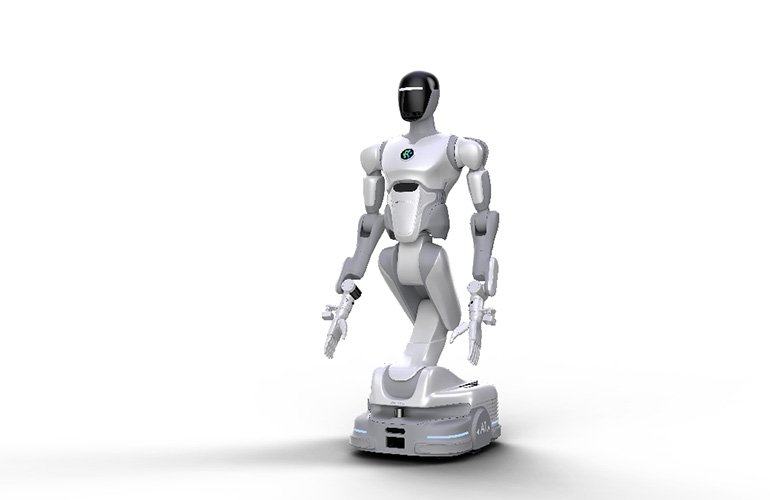
Shenzhen-based AI2 Robotics has raised approximately $735 million in a new financing round, pushing its valuation past 50 billion yuan, or roughly $2.8 billion. The round places the four-year-old company among the best-funded players in China's physical AI sector and signals that investors are increasingly comfortable backing a wheeled alternative to the legged humanoid robots dominating headlines elsewhere in the industry. For buyers evaluating embodied AI today, this funding indicates that a less glamorous but more dependable form factor may win real contracts faster than platforms focused on demo spectacle.
AI2 Robotics, formally known as Zhiping Fang Technology, was founded in April 2023 by Dr. Guo Yandong. The company builds wheeled mobile manipulator robots with a humanoid torso, paired with a proprietary vision-language-action model called Alpha Brain. Rather than chasing the bipedal, stair-climbing humanoid form factor that companies such as Unitree and UBTech have popularized, AI2 Robotics chose a wheeled base from the start, targeting structured environments in logistics, manufacturing, biotech, retail, and public service settings across China.
What Is AI2 Robotics and Why Did It Raise This Round Now?
AI2 Robotics builds wheeled mobile manipulator robots with a humanoid torso, paired with a proprietary vision-language-action model called Alpha Brain, and it raised $735 million in July 2026 to expand deployment in logistics, manufacturing, biotech, retail, and public service settings across China.
The Shift Toward Deployment Economics
The investor group spans three very different pools of capital: state-backed vehicles including the National Small and Medium Enterprises Development Fund, industrial corporations such as pharmaceutical group Sino Biopharmaceutical and liquor conglomerate Moutai Group, and financial investors including CICC Capital and GSR Ventures [1]. When a state development fund, a pharmaceutical company, a spirits maker, and two financial investors all write checks into the same robotics round, it demonstrates how broadly physical AI has been absorbed into China's industrial policy thinking.
The company's own materials describe its flagship platform, AlphaBot 2, as a production-ready robot rather than a research demonstration, and the funding is explicitly earmarked for scaling deployment rather than for further prototyping. The wheeled versus legged debate in humanoid robotics is not a cosmetic design choice. AlphaBot 2 cannot climb stairs or cross rugged terrain, a real limitation compared with bipedal competitors. In exchange, the company gets a robot that is mechanically simpler, cheaper to manufacture, more durable in continuous industrial use, and subject to fewer regulatory hurdles when it operates in public-facing spaces.
Trading Legs for Dependability
Think of AlphaBot 2 less like a mechanical person and more like a warehouse cart that grew arms and a brain. It rolls instead of walks, which is the same reason a hospital gurney has wheels rather than legs. Above that rolling base sits a humanoid torso with two five-fingered hands and more than 34 degrees of freedom, controlled by the Alpha Brain software, which reads a camera feed, figures out what is in front of it, and plans a multi-step task such as picking an item off a shelf and placing it in a bin. The wheels trade the ability to climb stairs for lower cost, sturdier hardware, and an easier path through safety reviews before a robot is allowed to work alongside people.
The Total Cost of Ownership Calculation
While much of the industry focuses on bipedal mobility, a logistics operator weighing a fleet purchase is not just comparing sticker price. Maintenance frequency, mean time between failures, and the cost of taking a unit offline for repair all feed into a deployment economics calculation that increasingly favors simpler drivetrains over legged systems that carry more moving parts. Against Unitree, UBTech, and legged rivals such as Boston Dynamics and Figure AI, AI2 Robotics is effectively conceding the mobility contest in exchange for a stronger claim on total cost of ownership in indoor, flat-floor environments.
Strategic Outlook for Buyers
For procurement teams evaluating embodied AI vendors this year, this funding round is a useful data point on where Chinese state and industrial capital is placing bets. A logistics or manufacturing buyer comparing wheeled and legged platforms must weigh total cost of ownership and maintenance burden as heavily as marketed mobility, since the gap between demo capability and deployment reality is exactly the kind of distinction that separates a pilot program from a scaled rollout.
There is also a regulatory dimension to the wheeled bet. Chinese cities and provinces have been rolling out real-world testing programs for humanoid and embodied robots throughout 2026, and platforms that cannot climb stairs or handle uneven terrain face fewer safety and liability questions when operating around members of the public. A wheeled robot confined to flat, indoor floors is, in practice, an easier machine to certify and insure than a bipedal one still refining its fall recovery behavior.
This analysis synthesizes company statements and public market activity; readers should conduct independent diligence before making procurement or deployment decisions.
This article is based on publicly available statements, filings, and press materials from the companies, institutions, and outlets named above. RobotAIGeek did not independently verify every commercial, technical, or financial claim made by the sources. Readers should conduct independent due diligence before making business, investment, deployment, or procurement decisions based on this reporting.














